
Stretch Mark
Treatment
Stretch marks are not a surface flaw — they are scars in the dermis where collagen and elastin fibres tore apart faster than the skin could repair them. Topical creams cannot reach this layer. Effective treatment requires controlled remodelling of the dermis itself — through fractional laser, RF microneedling, and regenerative pairings. At Couture Dermatology and Laser, every protocol is calibrated to the stage of your striae and your individual skin type.
Optimal results
Improvement target
Dermatologist

"Stretch marks live in the dermis — no cream from the outside has ever changed that. Real improvement requires reaching the layer where the damage is."

Treat the Stage.
Rebuild the Dermis.
Stretch marks are striae distensae — dermal scars formed when the skin is stretched faster than its connective tissue can adapt. The collagen and elastin fibres tear, and the skin repairs the damage as visible linear marks. They exist in two clinical stages: striae rubra (red, early) and striae alba (white, mature). Each responds differently to treatment.
Striae rubra are the inflammatory, actively remodelling stage — typically pink, red, or purple. They respond fastest and most fully to treatment because the dermis is still capable of regenerating. Striae alba are the mature, atrophic stage — silvery white, depressed, and structurally settled. They require more sessions and a combined approach to stimulate new collagen formation.
At Couture Dermatology and Laser, every stretch mark consultation begins with staging — identifying whether your striae are rubra or alba — followed by selecting the right combination of fractional laser, RF microneedling, PRP, exosomes, and prescription topicals. Treating mature striae with a single laser session is the most common reason patients are disappointed with stretch mark treatment elsewhere.
From Staging
to Remodelling
Stretch mark treatment is a structured series, not a single appointment. The right sequence depends on staging, skin type, and how the dermis responds across early sessions.
Striae Staging
Your dermatologist evaluates each affected area — identifying striae rubra (red, treatable faster) versus striae alba (white, requires more sessions) — and maps depth, distribution, and skin elasticity.
Photographed for recordTechnology Selection
Fractional laser for surface texture and pigment. RF microneedling for deeper collagen remodelling, particularly in skin of colour. PRP or exosome pairing where additional regenerative signal will accelerate results.
Custom combinationIn-Office Treatment
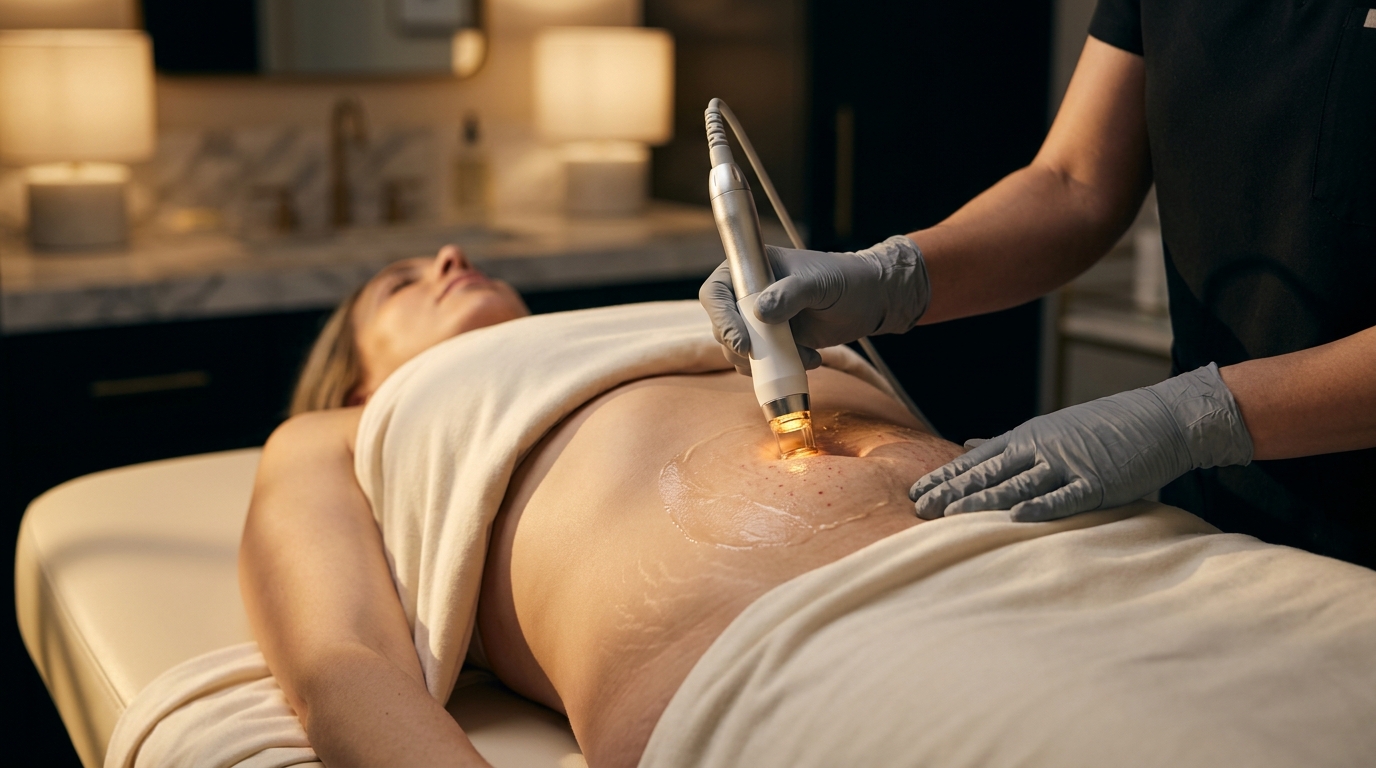
Topical numbing applied for 30 to 45 minutes. The selected device passes across the striae at depths calibrated to your skin. Session length: 30 to 75 minutes depending on area size.
30–75 minutesCollagen Remodelling
Body's wound-healing response builds new collagen across the striae over the following weeks. Sessions repeat 4 to 6 weeks apart. Final visible improvement is typically reached 3 to 6 months after the last treatment.
Final result @ 6 monthsStretch Mark
Modalities
No single technology fully addresses every stretch mark. These four modalities form the clinical toolkit — combined as your striae stage and skin type require.
Surface & Pigment
Fractional Laser
Non-ablative fractional laser creates micro-columns of controlled thermal injury that trigger new collagen across the striae. Highly effective for striae rubra (red marks) and for refining surface texture across mature striae alba.
Deeper Remodelling
RF Microneedling
Insulated needles deliver radiofrequency energy directly into the deep dermis, producing strong collagen and elastin remodelling. The safest stretch mark technology for Fitzpatrick IV-VI skin because it does not use light energy that targets melanin.
Regenerative Boost
PRP & Exosome Pairing
PRP (your own platelets) or lab-derived exosomes applied immediately after microneedling or fractional laser amplify the collagen response — particularly valuable for stubborn mature striae alba that plateau with technology alone.
Topical Foundation
Prescription Retinoid Protocol
Topical tretinoin (when not pregnant or breastfeeding) extends and protects the result of in-office treatment — stimulating ongoing collagen production and improving texture at the surface between sessions. The non-negotiable foundation.
Smoother Texture.
Quieter Marks.
Striae Visibly Soften
Treated stretch marks become measurably less visible — narrower, shallower, and closer in colour to the surrounding skin. The texture flattens as new collagen and elastin fill the structural defect from within.
Red Marks Cleared
Striae rubra (early red and purple stretch marks) clear most fully — frequently to the point where they read as soft skin lines rather than visible marks. Early intervention within the first 12 months produces the best results.
Mature White Stretch Marks Improved
Even striae alba (older, white, atrophic marks) respond to combined RF microneedling, fractional laser, and regenerative pairing — visibly softening over a structured series of 5 to 6 sessions.
Safe for All Skin Tones
RF microneedling and carefully calibrated non-ablative laser protocols make stretch mark treatment safe for Fitzpatrick IV-VI patients — historically excluded from aggressive resurfacing because of post-inflammatory pigment risk.
Confidence in Clothes & Skin
Patients consistently report a meaningful shift in confidence — shorts, swimsuits, fitted dresses, and bare skin no longer carry the daily mental weight of stretch mark visibility. The result is often emotional as much as cosmetic.
"The clinical goal of stretch mark treatment is honest improvement — visibly quieter, softer striae that no longer dominate the skin. Erasure is a myth; meaningful softening is achievable."— Couture Dermatology and Laser
visible result
Board-Certified
Every stretch mark protocol is designed and delivered personally by Dr. Chinonso Kagha Abisogun, MD, FAAD — a Fellow of the American Academy of Dermatology
Staged-First
Striae rubra and alba are treated differently — staging is the first step in any plan, never glossed over with a one-size-fits-all device
Skin-of-Colour Safe
RF microneedling and non-ablative protocols calibrated for Fitzpatrick IV-VI — one of the few practices truly safe for skin of colour stretch marks
Honest Outcomes
Realistic 50–70% improvement target — never promises of erasure, only achievable, meaningful, dermatologist-led result
Areas We
Treat
Stretch marks appear wherever skin has been stretched faster than the dermis could adapt. Non-surgical treatment works across every common striae location on the body.
Abdomen & Lower Belly
The most common stretch mark area — particularly after pregnancy or significant weight change. Responds well to fractional laser plus RF microneedling.
Thighs & Hips
Inner and outer thigh striae from adolescent growth or post-pregnancy — treatable with combined RF microneedling and regenerative pairing.
Breasts & Décolletage
Common after pregnancy, breastfeeding, or significant breast volume change. Careful technique preserves surrounding skin while remodelling the striae.
Buttocks & Lower Back
Stretch marks across the gluteal and sacral area — frequently from growth or weight change in adolescence — respond progressively to series treatment.
Arms & Shoulders
Post-bodybuilding or rapid weight-gain striae across upper arms and shoulders are a less common but well-treated indication for fractional laser.
Knees & Calves
Less common but treatable — typically from puberty growth or significant weight fluctuation. Conservative dosing preserves the thinner skin in these zones.
Is Stretch Mark Treatment
Right for You?
- Adults with red or purple stretch marks (striae rubra) — early-stage marks respond most fully and earliest intervention produces the best results.
- Post-pregnancy patients (no longer breastfeeding) with abdominal, thigh, or breast striae they want measurably softened.
- Patients with mature white stretch marks (striae alba) seeking dermatologist-led improvement that creams and oils have failed to deliver.
- Those with darker skin tones (Fitzpatrick IV-VI) who have been excluded from aggressive treatment elsewhere — RF microneedling is calibrated for safety in skin of colour.
- Patients comfortable wearing SPF 50+ daily across treated areas and committed to a structured series of 3 to 6 sessions over 4 to 6 months.
- Those wanting honest 50% to 70% improvement rather than impossible promises of complete erasure — realistic expectations are part of successful treatment.
Honest Expectations
Stretch marks are scars in the dermis — they cannot be erased completely with any non-surgical treatment, and any clinic claiming otherwise is misleading you. The realistic clinical goal is 50% to 70% visible improvement: striae that no longer dominate the skin, no longer prompt camouflage, and read as soft texture rather than scars.
Treatment is also less effective the longer the marks have been present. White, mature striae alba require more sessions than red, recent striae rubra. Pregnancy, breastfeeding, recent isotretinoin use, and active skin infections at treatment sites are contraindications. Your dermatologist will discuss candidacy honestly.
Pairs Beautifully
With…
Stretch mark treatment refines the striae themselves. These adjacent treatments improve surrounding skin quality, address pigment, and complete the body refinement story.
Exosomes
Lab-derived stem cell signalling vesicles applied immediately after RF microneedling or laser — concentrated growth factors that amplify collagen remodelling across stubborn mature striae.
Explore exosomes →Body Microneedling
For surrounding skin texture and laxity around the treated striae — body microneedling builds overall collagen for a refined, even surface across the abdomen, thighs, and arms.
Explore microneedling →Non-Surgical Fat Reduction
For patients with both stretch marks and stubborn fat pockets, CoolSculpting or EMSCULPT NEO refines the underlying contour beneath improved skin texture for complete body work.
Explore fat reduction →Medical-Grade Skincare
A dermatologist-prescribed retinoid plus SPF 50+ protocol stimulates ongoing collagen production and protects the investment in stretch mark treatment over time — non-negotiable for lasting results.
All treatments →Results That Speak for Themselves
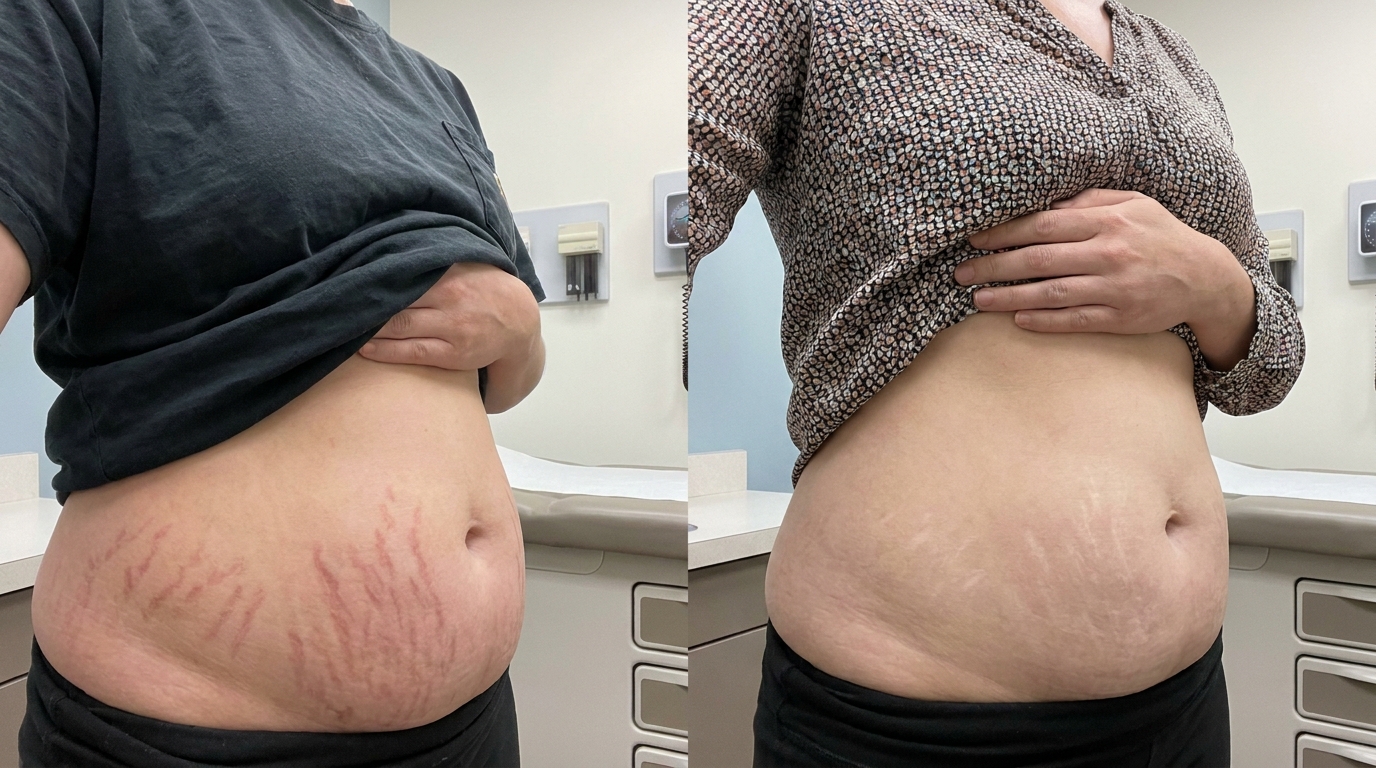
Individual results vary. Final visible improvement is typically apparent 3 to 6 months after a complete treatment series, as collagen remodelling within the striae reaches its peak. Daily SPF 50+ is essential to preserve results.
Quieter Marks.
Smoother Skin.
No stretch mark protocol is correct without first staging your striae and assessing your skin type. At Couture Dermatology and Laser, Dr. Chinonso evaluates every patient personally before recommending a combination of fractional laser, RF microneedling, or regenerative pairing. The goal is always real, measurable improvement — never the impossible promise of erasure.
Sat · By Appointment Only
"After my second pregnancy, the stretch marks on my belly and inner thighs were the one thing I could not make peace with. Dr. Chinonso staged my striae properly and built a six-session RF microneedling plus exosome protocol. Six months later, my skin reads as smooth — not flawless, but smooth. The most honest cosmetic conversation I have ever had."
Renata J.
Verified Patient · Beverly Hills
Frequently
Asked Questions
Direct answers to the questions patients most commonly ask before their stretch mark consultation — on sessions, staging, skin tones, and realistic expectations.
Most patients require 3 to 6 sessions spaced 4 to 6 weeks apart. Red stretch marks (striae rubra) often respond in 3 to 4 sessions; mature white stretch marks (striae alba) require 5 to 6 or more sessions to remodel the collagen sufficiently. Treatment is more effective the earlier it is started.
Complete erasure of stretch marks is not realistic — they are permanent structural changes in the dermis. The clinical goal is measurable improvement: 50% to 70% visible reduction in texture, depth, and colour, so striae read as softer, smoother, and less noticeable in normal lighting.
Red stretch marks (striae rubra) are the early, inflammatory stage — typically pink, red, or purple — and respond most fully to treatment because the dermis is still actively remodelling. White stretch marks (striae alba) are the mature, atrophic stage — silvery or white — and require more sessions and a combined approach to stimulate collagen induction.
Yes — when the correct technology is selected. RF microneedling is one of the safest options for Fitzpatrick IV-VI skin because it does not use light energy that targets melanin. Non-ablative fractional laser protocols and exosome pairing further reduce pigment risk in patients of colour.
RF microneedling typically involves 24 to 72 hours of mild redness. Fractional laser may produce redness, mild swelling, and rough texture for 3 to 7 days. Most patients return to normal activities the next day. Strict SPF 50+ is essential during the treatment series to protect the result.
Yes — pregnancy stretch marks (striae gravidarum) respond particularly well to a combined fractional laser, RF microneedling, and topical retinoid protocol once the patient is no longer pregnant or breastfeeding. Earlier intervention (within the first 12 months) produces the best results.