

Here’s something I hear almost every week in my practice: “Dr. Abisogun, I’ve read everything online about PRP for hair loss, and I still don’t know what to believe.” And honestly? That confusion makes complete sense. Between the glowing five-star reviews and the frustrated “it did nothing for me” comments, it’s nearly impossible to know what’s real. If you’ve been quietly watching your part get wider or your ponytail get thinner, and you’re wondering whether PRP for hair loss in Beverly Hills is a genuine solution or just an expensive trend, you’re not alone.
Thinning hair carries a weight that goes far beyond aesthetics. I see patients who’ve quietly rearranged their whole morning routine around hiding it. The anxiety is real. So is the fear of trying something that leaves you looking “done” or, worse, seeing no difference at all.
Here’s what I want you to know: PRP isn’t a one-size-fits-all injection. In the right hands, it’s a precision biological tool, custom-fitted to your specific pattern of loss, your biology, and your life. In this article, I’ll walk you through exactly how it works, who it genuinely helps, and what a bespoke, medically guided approach to hair restoration actually looks like.
Key Takeaways
- PRP is not a generic injection—it’s a biological tool drawn from your own blood, and when applied with precision, it can reawaken dormant hair follicles rather than simply masking the problem.
- Choosing the right approach for PRP for hair loss in Beverly Hills means understanding that your scalp, your pattern of loss, and your biology all require a customized treatment plan—not a one-size-fits-all protocol.
- PRP works differently than Minoxidil or Finasteride, and knowing how each option fits your specific type of hair loss can save you months of frustration and money spent on the wrong solution.
- The growth factors inside your platelets—think of them as a dedicated construction crew—do the heavy lifting of stimulating new density, but results unfold gradually and require realistic expectations from the start.
- Expertise matters more than the treatment itself: a Harvard-trained dermatologist who understands the nuances of all skin types and scalp conditions can be the difference between visible, lasting results and a disappointing outcome.
Why PRP for Hair Loss in Beverly Hills is the Custom Fit You Need
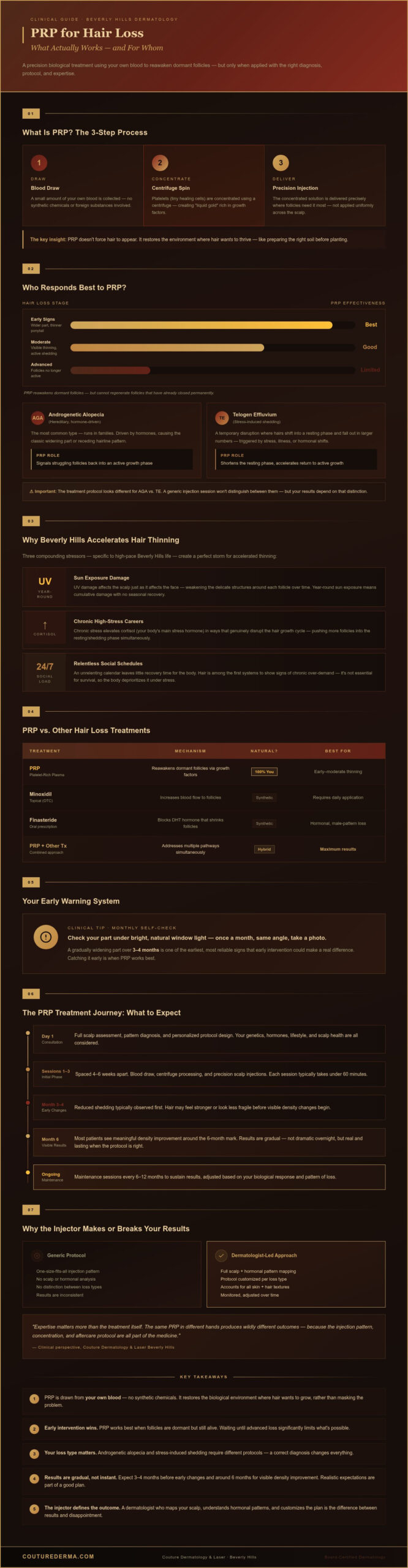
Think of PRP as liquid gold, and I mean that literally. We draw a small amount of your own blood, spin it in a centrifuge to concentrate the platelets (tiny cells your body uses to heal and repair tissue), and then deliver that concentrated solution precisely where your follicles need it most. No synthetic chemicals. No foreign substances. Your body’s own pharmacy, working on your behalf.
That’s the philosophy behind what we do at Couture Dermatology. The scalp isn’t a surface to be treated uniformly, it’s a garden. And just like a garden, it needs the right soil conditions before anything can grow. PRP doesn’t force hair to appear; it restores the environment where hair wants to thrive.
Here in Beverly Hills, that environment is under constant pressure. High-stress careers, relentless social schedules, and year-round sun exposure create a perfect storm for accelerated thinning. UV damage affects the scalp just as it affects the face, weakening the delicate structures around each follicle over time. And chronic stress? It elevates cortisol in ways that genuinely disrupt the hair growth cycle. So when patients ask me why their hair seems to be thinning faster than their peers elsewhere, the Beverly Hills lifestyle is often part of the honest answer.
Choosing the right approach to PRP for hair loss in Beverly Hills means accounting for all of that. Not just your genetics. Your whole picture.
Is PRP the right ‘fabric’ for your hair loss?
In my practice, the patients who respond best to PRP are the ones who catch thinning early. We’re talking about a slightly wider part, a ponytail that feels a little thinner, or a hairline that seems to be quietly retreating. At that stage, the follicles are still alive but struggling, and PRP gives them exactly the growth-factor signal they need to shift from dormant to active.
The two most common patterns I treat are androgenetic alopecia (hereditary thinning driven by hormones, the kind that runs in families) and stress-induced shedding, which dermatologists call telogen effluvium (a temporary disruption where more hairs than usual enter the resting phase and fall out). PRP can support both, but the treatment protocol looks different for each. That distinction matters enormously, and it’s one a generic med spa injection session simply won’t account for.
Actionable Tip: Once a month, check your part under bright, natural light, ideally near a window. Take a photo from the same angle each time. A gradually widening part over three to four months is one of the earliest, most reliable signs that early intervention could make a real difference.
The emotional landscape of hair restoration
Let’s be honest about something. Losing your hair doesn’t just change how you look; it changes how you move through the world. I’ve sat across from executives, artists, and new mothers who describe the same quiet grief: the way they avoid certain lighting, skip events, or spend twenty minutes arranging their hair before leaving the house. That’s not vanity. That’s identity.
A dermatologist-led approach to PRP for hair loss in Beverly Hills matters precisely because of this. When a Harvard-trained physician who understands the full complexity of scalp health, hormonal patterns, and diverse hair textures is guiding your plan, the outcome isn’t just more hair. It’s the calm confidence that comes from knowing your treatment was designed specifically for you, not pulled from a generic protocol sheet.
The goal, always, is restoration that looks and feels like you. Fuller. Quieter. Yours.
The Science of Liquid Gold: How Your Own Blood Restores Your Hair
Let’s get specific about what’s actually happening inside that vial of your blood, because this is where most explanations fall frustratingly short. Yes, we draw blood, spin it, and inject it. But the why behind each of those steps is what separates a treatment that genuinely changes your hair from one that simply goes through the motions.
Your blood contains platelets, tiny cell fragments your body deploys whenever there’s tissue that needs repairing. Normally, they rush to a wound site and release a cascade of signaling proteins called growth factors. Think of those growth factors as a dedicated construction crew: VEGF (vascular endothelial growth factor) is the one laying new pipes, building fresh blood vessels to restore oxygen supply to the scalp. PDGF (platelet-derived growth factor) is the project manager, telling surrounding cells to multiply and rebuild. And TGF-beta (transforming growth factor beta) is the quality controller, regulating the repair process so it doesn’t overshoot. When we concentrate your platelets and deliver them directly to a thinning zone, we’re essentially calling that entire construction crew to a site that’s been quietly neglected.
Here’s the concept that changes everything: a dormant follicle isn’t a dead follicle. In my practice, I see patients who assume that because a patch of scalp looks thin, those follicles are gone. Often, they’re not. They’ve simply stalled in a resting phase, starved of the biological signals they need to shift back into active growth. PRP delivers exactly those signals, right to the root.
The centrifuge process: Crafting the concentrate
The process is more precise than most people realize, and far less dramatic than they fear.
- Step 1: The blood draw. We collect a small amount of your blood, comparable in volume to a standard lab test. Nothing about this step should feel alarming.
- Step 2: The spin. The tube goes into a centrifuge, which separates your blood into layers by density. The red blood cells sink to the bottom. The platelet-rich plasma, that concentrated “liquid gold,” rises to the top. This is what we harvest.
- Step 3: The precision injection. Using a fine needle, we deliver the concentrate directly into the thinning zones of your scalp, mapped specifically to your pattern of loss. Not a uniform grid. Your scalp, your map.
What happens at the cellular level?
Once those growth factors are delivered, two things happen that most people don’t expect. First, VEGF triggers neovascularization, meaning new, tiny blood vessels begin forming around the follicle. This is critical. A follicle that’s been thinning has often lost some of its blood supply, which is part of why it’s struggling. Restored circulation brings oxygen and nutrients back to the root, creating the environment where growth becomes possible again.
Second, the growth factors work to prolong the anagen phase, which is the active growth phase of the hair cycle. Every hair on your head cycles through growth, transition, and rest. When that growth phase gets cut short, which is exactly what happens with androgenetic alopecia, hairs become progressively finer and shorter before they stop appearing altogether. PRP pushes that growth phase to last longer, which is how you get denser, stronger strands over time.
One thing I always make a point of telling patients: PRP doesn’t manufacture new follicles. It fortifies the ones you already have. That’s clinical realism, not pessimism. It means the earlier you start, the more you have to work with, and the more meaningful your results will be. For anyone exploring PRP for hair loss in Beverly Hills, timing genuinely matters.
And that mild redness and tenderness you feel after a session? That’s not a side effect to suppress. That’s the inflammatory response we’re intentionally triggering, a controlled biological signal that tells your body to send resources to the scalp. It’s the treatment working.
Actionable Tip: Avoid ibuprofen (and other NSAIDs like naproxen) for at least 48 hours before your PRP session. These medications blunt the inflammatory response that makes PRP effective in the first place. Acetaminophen is fine if you need pain relief beforehand.
If you’re ready to understand exactly what your scalp needs, schedule a consultation and we’ll map out a plan built around your biology, not a generic protocol.
PRP vs. The Alternatives: Curating the Right Path for Your Scalp
Let’s talk about the options on the table, because I know most of you have already tried at least one of them. Minoxidil (Rogaine) is usually the first stop. It’s accessible, it’s relatively affordable, and the dermatology community has decades of data behind it. But here’s what the bottle doesn’t tell you: it works only as long as you use it. Every single day. Forever. Stop applying it, and within a few months, whatever ground you gained starts quietly retreating.
I call it “the daily chore.” And in my practice, I see Minoxidil burnout constantly. Patients who started with genuine commitment, applied it faithfully for months, then slowly fell off the routine because life got busy, the scalp irritation became too much, or the results just didn’t feel worth the daily ritual. That’s not a character flaw. That’s a design flaw in the treatment itself.
Why ‘off-the-rack’ solutions often fall short
Finasteride is the other name that comes up often, particularly for men with androgenetic alopecia (hereditary thinning). It works by reducing the hormone signal that shrinks follicles over time. For the right patient, it can be genuinely effective. But it’s a systemic medication, meaning it circulates through your whole body, not just your scalp, and that comes with a conversation about hormonal side effects that every patient deserves to have honestly before starting. It’s not a decision to make based on a quick online search. It requires a clinical assessment of your full health picture.
PRP operates on a completely different principle. It’s not suppressing a hormone. It’s not a topical you apply twice daily until the end of time. After an initial series of sessions, most patients move to a maintenance rhythm of once or twice a year. That’s the “set it and forget it” quality that makes it so well-suited for the kind of life most people in Beverly Hills are actually living.
Actionable Tip: If you’ve used Rogaine consistently for six months and you’re seeing no meaningful change in density or shedding, that’s not a reason to try harder. That’s a signal to have a clinical conversation about what else might be driving your loss and whether a biological approach like PRP fits your picture better.
The hybrid approach: A tailored regimen
Here’s where it gets interesting, because for many of my patients, the answer isn’t PRP instead of their current routine. It’s PRP alongside it. I often describe PRP as the soil preparation. Medical-grade topicals, prescribed at the right concentration for your specific pattern of loss, become the ongoing maintenance that keeps the environment fertile between sessions. Together, they work in a way that neither does alone.
The same logic applies when a patient is considering a hair transplant. Transplanted follicles need a healthy, well-vascularized scalp to take root and thrive. Using PRP in the months before a procedure, and often in the recovery period after, significantly improves the conditions those grafts land in. It’s the difference between planting seeds in dry, compacted soil versus rich, prepared ground.
And for patients who come to me wanting a comprehensive refresh, not just their hairline, there’s a natural conversation to be had about the full picture. Thinning hair combined with under-eye hollowing or fatigue is one of the most common combinations I see in practice. Pairing hair restoration with a treatment like under-eye brightening addresses both the crown and the face in a way that feels cohesive and intentional, rather than piecemeal.
When patients ask me about the hair transplant question specifically, my honest answer is this: surgery is a powerful tool, but it’s a last resort, not a first step. If follicles are still alive and responding, restorative care through PRP for hair loss in Beverly Hills can deliver meaningful density without a surgical recovery. The time for transplant conversation is when conservative options have been genuinely optimized and the loss has progressed to a point where restoration requires redistribution rather than stimulation.
Actionable Tip: Before committing to any single treatment path, ask your provider to map your specific pattern of loss. Diffuse thinning across the crown responds differently than a receding hairline, and the right protocol depends entirely on understanding which follicles are dormant versus which are gone. That distinction changes everything about your treatment plan.
Your Treatment Journey: From Consultation to Visible Growth
Most patients arrive at their first appointment with a mix of quiet hope and guarded skepticism. They’ve read the before-and-afters, they’ve done the research, and now they want to know: what actually happens when they walk through our door? Here’s the honest, step-by-step picture.
The ‘Couture Consultation’: Your Scalp Gets Mapped, Not Guessed At
Before a single needle is uncapped, we do something most clinics skip entirely: we map your scalp. Under magnification, I can see the difference between follicles that are dormant and struggling versus zones where the follicle structure has genuinely thinned. That distinction changes everything about where we inject, at what depth, and how densely. We’re also checking for underlying contributors, seborrheic dermatitis (a scaly, inflamed scalp condition), nutritional deficiencies, thyroid irregularities, anything that could be quietly working against your results if left unaddressed.
This is the part of PRP for hair loss in Beverly Hills that a fifteen-minute med spa session simply can’t replicate. A bespoke map of your scalp means every injection lands with intention, not habit.
What the Injections Actually Feel Like
Let’s be honest: the scalp is sensitive. But “uncomfortable” and “painful” are two very different things. We use a fine-gauge needle and apply a topical numbing agent beforehand. A cooling technique during the injection itself keeps the sensation mild and manageable. Most patients describe it as a series of brief pressure points rather than sharp pain. By the time we’re done, the whole treatment typically takes under an hour, start to finish, including the blood draw and centrifuge spin.
The redness and mild tenderness that follow? That’s not a problem to manage. As I explained earlier, it’s the biological response we’re intentionally triggering. It fades within 24 to 48 hours for most people.
The ‘Couture Protocol’ for Best Results
Small preparation choices make a measurable difference in the quality of your PRP concentrate. The single most overlooked one is hydration. Drink at least two glasses of water in the hour before your appointment. Dehydrated blood yields a thinner, less concentrated plasma, and that directly affects the potency of what we inject. I call it the 20-minute rule: arrive hydrated, and give yourself 20 minutes of calm before your draw so your body isn’t in a stress response.
The good news for anyone with a full calendar: there’s no meaningful social downtime. You can return to work the same day. The scalp may look slightly flushed, but it’s nothing a hat or a relaxed hairstyle won’t cover. No bandages, no recovery room, no rearranging your week.
Actionable Tip: Switch to a sulfate-free shampoo for at least three days after your session. Sulfates are detergents that can irritate a freshly treated scalp and disrupt the delicate healing environment we’ve just created. Gentle cleansing in those first 72 hours protects the work we’ve done.
Managing the ‘Great Shed’: Why Falling Hair Can Mean Progress
Here’s the conversation I have with almost every patient around weeks three to six: “Dr. Abisogun, I think something’s wrong. My hair is shedding more than before.” And every time, my answer is the same: stay the course. The best is genuinely yet to come.
What’s happening is a biological reset. PRP accelerates the hair cycle, which means hairs that were already in the resting phase get pushed out to make room for new growth. It can feel alarming. It looks like loss. But it’s actually the system recalibrating, clearing the runway so stronger, healthier strands can emerge. This is the phase most online resources don’t warn you about, and it’s the single biggest reason patients abandon treatment too early.
This is also why I recommend a starter series of three sessions, typically spaced four to six weeks apart, rather than a single treatment. One session creates a signal. Three sessions create momentum. The follicles need repeated biological cues to shift from dormant to consistently active, and the cumulative effect of a full series is substantially greater than any single injection can deliver.
Actionable Tip: Take a scalp photo every four weeks from the same angle, in the same lighting. The month-to-month changes are subtle enough that you’ll miss them without documentation. Most patients who feel discouraged at month two are genuinely surprised by their own month-six photos.
Here’s the timeline I give every patient as a realistic framework:
- Month 1: The scalp environment is being primed. You may notice reduced shedding toward the end of this phase, but visible density changes are unlikely yet. This is foundation work.
- Month 3: New growth begins to emerge, often as fine, shorter strands in previously thin zones. The part may start to look slightly fuller. This is the moment most patients feel the first real flicker of confidence returning.
- Month 6: This is where the results become genuinely visible to others, not just to you under a magnifying mirror. Density, strand caliber, and overall coverage are measurably improved for most patients who’ve completed their starter series and maintained the protocol.
Actionable Tip: Avoid intense heat styling, including blow dryers on high heat, for 48 hours post-treatment. Heat increases scalp inflammation beyond the therapeutic range we’ve calibrated, and it can also dehydrate the treated tissue before it’s had a chance to respond optimally.
Patience, in this context, isn’t passive. It’s part of the treatment. And for anyone ready to begin that journey, book your consultation so we can map your scalp, set your baseline, and build a plan that’s calibrated to your biology from the very first appointment.
The Couture Difference: Why Expertise Matters for Your Hair
There’s a question I get asked more than almost any other: “Does it really matter who does my PRP?” And my honest answer is yes. Profoundly, yes. Not because I’m biased toward my own practice, but because I’ve seen what happens when the person holding the syringe doesn’t understand the biology behind the loss. The injection is the easy part. Understanding why a particular zone is thinning, what’s driving it beneath the surface, and how your specific scalp will respond to treatment? That’s where training separates a meaningful outcome from a disappointing one.
A Harvard medical education doesn’t just teach you what to do. It teaches you to ask why. Why is this patient losing density at the crown but not the temples? Why did their shedding accelerate after a period of stress, and what does that tell us about the phase their follicles are currently in? Those questions shape the entire treatment plan. And for anyone considering PRP for hair loss in Beverly Hills, the physician’s ability to ask and answer them is the difference between a protocol built for you and one built for everyone.
Expertise in diverse hair textures
Here’s a gap I see in nearly every competitor’s approach: they treat the scalp as if all hair is the same. It isn’t. Not even close.
Curly and coily hair textures have a fundamentally different follicle architecture. The follicle itself is curved rather than straight, which affects how sebum distributes along the strand, how the scalp breathes, and how inflammation presents. Fine, straight hair faces its own distinct challenges: the follicles are smaller, the sebaceous glands more active, and the early signs of miniaturization (the gradual shrinking of the follicle that precedes visible thinning) can be harder to detect without proper magnification. Each texture requires a different injection map, a different depth calibration, and a different post-treatment protocol.
In my practice, I celebrate that diversity rather than flatten it. I treat patients across the full spectrum of hair types and skin tones, and I’ve spent years developing the clinical eye to recognize how thinning presents differently across those textures. The same precision and sensitivity we bring to acne scar refinement on diverse skin types carries directly into how we approach scalp health. Texture isn’t a complication. It’s context. And it shapes everything about how we build your plan.
Actionable Tip: If you have naturally coily or tightly textured hair, photograph your scalp at the crown and along your part line specifically, not just the hairline. Thinning in coily textures often starts at the crown and is easier to miss in a standard mirror check.
We’re not just injecting. We’re translating your biology into a treatment that fits your life, your hair, and your specific pattern of loss. That’s the artisanal approach. It takes longer to design. It takes more clinical skill to execute. But it’s the reason our patients see results that hold.
Your next step toward confidence
Don’t wait until thinning becomes balding. That phrase might sound like a sales line. It isn’t. It’s the single most consistent piece of advice I give, because the follicles we can work with today may not be available to us in two years. Early intervention is not urgency for urgency’s sake. It’s biology.
Booking a signature consultation with Dr. Abisogun at Couture Dermatology means arriving to a conversation, not a sales pitch. We map your scalp, review your history, and build a plan that’s calibrated to where you are right now. Whether that means a starter series of PRP for hair loss in Beverly Hills, a hybrid approach alongside medical-grade topicals, or simply a clearer picture of what’s driving your loss, you leave with answers. Real ones.
Schedule your consultation here and take the first step toward a fuller, quieter version of yourself.
Actionable Tip: Bring a complete list of your current supplements to your first visit, especially Biotin. High-dose Biotin supplementation (common in many “hair growth” products) can interfere with certain lab tests we use to assess thyroid function and other underlying contributors to hair loss. Knowing your supplement routine before we run any panels keeps your results accurate and your plan on solid ground.
Your Fuller, Quieter Hair Story Starts Here
If there’s one thing I want you to take from everything we’ve covered, it’s this: thinning hair isn’t a verdict. It’s a signal. And the earlier you respond to it, the more you have to work with.
We’ve walked through the biology, the comparisons, the realistic timeline, and the clinical nuance that separates a treatment built for you from one built for everyone. The throughline in all of it? Precision matters. Timing matters. And the expertise guiding your plan matters most of all.
PRP for hair loss in Beverly Hills, done with Harvard-trained clinical judgment and a bespoke approach calibrated to your specific scalp, hair texture, and pattern of loss, isn’t a gamble. It’s a considered, biological investment in follicles that are still worth saving.
You don’t have to keep rearranging your morning or avoiding certain lighting. The path forward is clearer than you think.
Book your Couture Hair Consultation with Dr. Abisogun and let’s build a plan that’s genuinely, specifically yours.
Frequently Asked Questions About PRP for Hair Loss
How many PRP sessions will I need for hair loss?
Most patients start with a series of three sessions, spaced four to six weeks apart. That initial series is what builds real momentum at the follicular level. After that, a maintenance session once or twice a year is typically enough to hold and extend your results. That said, the honest answer is: it depends on how far along your loss is and how your scalp responds. Some patients with more advanced thinning benefit from a fourth session before moving to maintenance.
Is PRP for hair loss painful?
Uncomfortable, yes. Painful, not typically. We apply a topical numbing agent before we begin, and the injections themselves feel more like brief pressure points than sharp pain. The scalp is sensitive territory, and I won’t pretend otherwise. But in my practice, the patients who arrive most anxious are usually the ones who tell me afterward it was far more manageable than they expected. The entire session, including the blood draw and centrifuge spin, runs under an hour.
Can I wash my hair after a PRP injection?
Wait at least 24 hours before washing your hair after a session. The treated scalp needs time to absorb the growth factors we’ve just delivered, and water, especially warm water, can dilute that process before it’s had a chance to take hold. When you do wash, use a sulfate-free shampoo for the first 72 hours post-treatment. Sulfates are detergents that can irritate a freshly treated scalp and disrupt the healing environment we’ve carefully created.
Are the results of PRP for hair loss permanent?
PRP produces durable results, but not permanent ones in the absolute sense. Here’s the honest framing: PRP restores and strengthens the follicles you have, but it doesn’t stop the underlying biological process driving your loss. For someone with hereditary thinning, that process continues in the background. Maintenance sessions, typically once or twice a year, are what keep your results holding strong over time. Think of it less like a one-time fix and more like a high-performance investment that rewards consistent care.
Will PRP work for total baldness?
This is one of the most important questions I answer in consultations, and the honest answer is no. PRP works by reactivating follicles that are dormant but still structurally present. If a follicle has been gone long enough that the scalp has essentially closed over it, there’s nothing left to stimulate. This is exactly why early intervention matters so much. If you’re looking at completely smooth, shiny scalp in a given area, a hair transplant consultation is the more appropriate next conversation than PRP.
How much does PRP for hair loss cost in Beverly Hills?
I’m not going to quote you a number here, because pricing for PRP for hair loss in Beverly Hills varies meaningfully depending on the scope of your treatment plan, the number of sessions in your starter series, and whether we’re incorporating any complementary therapies into your protocol. What I will say is this: a consultation is the only honest starting point. It’s where we assess your specific pattern of loss, map your scalp, and build a plan calibrated to your biology. That conversation gives you a real number, not a generic estimate.
Are there any side effects to PRP injections?
Because PRP is drawn from your own blood, the risk of allergic reaction is essentially zero. The most common responses are mild redness, tenderness, and some temporary swelling at the injection sites, all of which typically resolve within 24 to 48 hours. Occasional pinpoint bruising can occur, particularly in patients who are prone to it. In my practice, I also prepare patients for the shedding phase that can appear around weeks three to six, which isn’t a side effect so much as a biological reset that signals the treatment is working.
Can I combine PRP with hair transplant surgery?
Yes, and in many cases it’s genuinely the smarter approach. PRP can be used in the months leading up to a transplant to optimize the scalp environment, improving vascularity and follicle health before grafts are placed. It’s also used in the recovery period after surgery to support graft survival and accelerate healing. Transplanted follicles take root more successfully in a well-prepared scalp. If you’re weighing both options, that’s a conversation worth having during your consultation so we can sequence them in a way that serves your outcome best.