
I often see patients who walk into my office after a “standard” laser treatment left them with more dark spots than they started with. It’s a frustrating reality when a generic approach fails your unique biology. If you are searching for the right hyperpigmentation treatment for black skin beverly hills, you likely already know that melanin-rich skin requires a delicate, expert touch. You’re right to be cautious. The fear of being burned or scarred is a valid concern I hear every day in my practice.
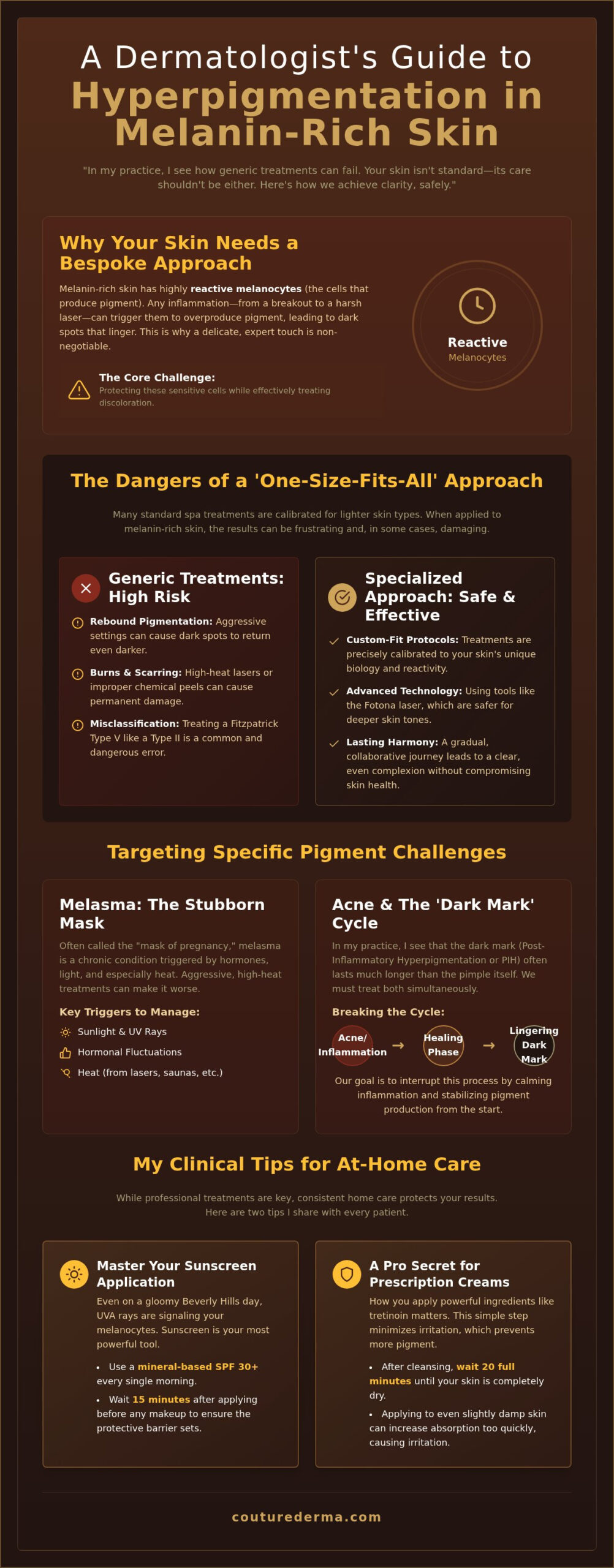
But here’s the thing. You don’t have to choose between safety and results. In this article, I’ll explain how our bespoke, Harvard-trained approach protects your melanocytes (cells that produce skin pigment) while perfecting your complexion. We will explore the specific protocols and advanced technologies like the Fotona laser that help us achieve a clear, even skin tone. One clinical tip I share with everyone is to start a mineral-based SPF 30 immediately; even ten minutes of Beverly Hills sun can darken existing spots. Let’s look at how we create a transformative journey tailored specifically for you.
Key Takeaways
- Understand why melanin-rich skin requires a specialized approach to protect reactive melanocytes from scarring and rebound pigment.
- Discover why “one-size-fits-all” treatments at standard spas often fail and how to avoid the risk of chemical burns or laser damage.
- Learn about safe, custom-fit hyperpigmentation treatment for black skin beverly hills using advanced technologies like the Fotona laser.
- Explore the philosophy of Clinical Realism and how a collaborative, gradual journey leads to lasting aesthetic harmony and clear skin.
Why ‘Skin of Color’ Requires a Specialized Dermatological Approach
Think of your skin as a piece of fine, delicate silk. You wouldn’t use a heavy industrial needle to mend a couture gown; you’d choose a thread and technique that respects the fabric’s unique weave. In my practice at Couture Dermatology & Laser Beverly Hills, I view melanin-rich skin through this same lens of artisanal care. When patients come to me for hyperpigmentation treatment for black skin beverly hills, they often expect a standard solution. But “skin of color” isn’t a single category. It’s a rich spectrum that includes Black, Brown, and Hispanic heritages, each requiring a bespoke clinical touch.
The Science of Melanin and Reactive Skin
The biology of your skin is designed for protection. At the heart of this system are melanocytes (cells that produce skin pigment). While melanin provides a natural defense against UV rays, these cells are incredibly reactive. Any form of inflammation, whether it’s from a breakout or a harsh scrub, can trigger these cells to overproduce pigment. This is often what is hyperpigmentation at its most basic level. In deeper skin tones, this reactivity often results in “ghosting,” which are those persistent dark marks that linger long after the initial injury has healed.
Actionable Tip: Apply a mineral-based SPF 30 or higher every single morning, even if it’s a typical “gloomy” morning in Los Angeles. The year-round Beverly Hills sun emits UVA rays that penetrate clouds and windows, silently signaling your melanocytes to stay in an overactive, pigment-producing state. Wait at least 15 minutes for the sunscreen to set before applying any makeup to ensure the protective barrier remains intact.
The Fitzpatrick Scale: More Than Just a Number
In the dermatology world, we use the Fitzpatrick Scale to categorize how skin responds to the sun. However, I’ve learned through 15 years of clinical experience that this scale is about reactivity, not just the shade of your complexion. During my Harvard training, I realized that many “standard” protocols were designed for lighter skin types. This is a problem. In my practice, I often see patients who were misclassified by less experienced providers. If you are a Fitzpatrick Type IV or V but are treated with settings meant for a Type II, the risk of a “rebound” effect or even a permanent burn is high.
We don’t just look at the color; we look at the biology. We ensure your hyperpigmentation treatment for black skin beverly hills is safe, intentional, and precisely calibrated for your specific skin architecture. It’s about finding that perfect balance between clinical efficacy and the preservation of your skin’s natural health.
In my practice, I’ve noticed that skin concerns rarely travel alone. Most patients coming in for hyperpigmentation treatment for black skin beverly hills are dealing with a combination of active issues and the marks they leave behind. Whether it’s the aftermath of a breakout or hormonal shifts, the goal is always the same: restoring a uniform, radiant canvas. I see patients who have spent years trying to cover up unevenness, not realizing that the underlying condition needs a specific, gentle approach to avoid making the pigment worse.
Melasma: The Stubborn Pigment Challenge
Melasma is often called the “mask of pregnancy,” but it’s much more complex than that. It’s a chronic condition driven by hormones, light, and even heat. Here’s the thing: many patients try aggressive peels or high-heat lasers elsewhere, only to find the pigment returns with a vengeance. This happens because heat is a major trigger for melanocytes. My protocol focuses on cooling the skin and using a specialized dermatological approach that stabilizes pigment before we even consider advanced interventions. We view this as a collaborative journey, often detailed in our guide on The Art of Skin Rejuvenation: A Couture Guide to Treatments.
Acne and the ‘Dark Mark’ Cycle
When I see patients with acne, I’m not just looking at the bumps. I’m looking at the Post-Inflammatory Hyperpigmentation (PIH) that follows. In melanin-rich skin, the “dark mark” often lasts significantly longer than the pimple itself. If we only treat the acne, we’re only doing half the job. We must treat the inflammation and the pigment simultaneously to break the cycle. Actionable Tip: If you use prescription creams, here is a professional secret. Wait 20 minutes after cleansing before applying tretinoin. Applying it to damp skin increases absorption too quickly, which can lead to irritation and, ironically, more pigment. For those with deeper textural issues, you can erase acne scars with professional refinement using our custom-fit protocols.
Beyond pigment, I see many patients who struggle with “ashy” patches that are actually eczema or psoriasis. In my practice, I’ve seen these conditions present as deep purple or even silvery-brown plaques. Because the traditional “redness” is missing, many people suffer for years without the right treatment. And let’s be honest, the most important part of any hyperpigmentation treatment for black skin beverly hills is ensuring the skin is healthy from the inside out. This includes checking for acral lentiginous melanoma, a type of skin cancer that often appears on the palms or soles of the feet in people of color. If you’re ready to move past the frustration of “one-size-fits-all” care, you can schedule a personal consultation to begin your transformation.
The Risks of Generic Care: Why ‘One Size Fits All’ Fails Melanin
Let’s be honest; your skin has a long memory when it comes to trauma. In my practice, I often see the aftermath of “budget” treatments where the provider treated melanin-rich skin like any other fabric. It doesn’t work that way. When you’re seeking hyperpigmentation treatment for black skin beverly hills, you must look beyond the glossy ads of high-volume Med Spas. These facilities often rely on standard protocols that prioritize speed over safety. For someone with deeper skin tones, a “standard” setting can be the difference between a successful glow and a permanent scar.
I avoid using absolutes like “always” or “never” because every patient’s biology is unique. However, I do insist on a conservative, progressive approach. We don’t try to win the race in one session. Instead, we treat your skin like a delicate couture piece, using a specific needle and thread for your unique “fabric.” This clinical realism ensures we achieve aesthetic harmony without triggering the very pigment we’re trying to erase.
The Hidden Dangers of Improper Laser Settings
Lasers are essentially light-seeking missiles. They are designed to “see” and target pigment. Here’s the thing; if the laser isn’t calibrated correctly, it can’t distinguish between the dark spot you want to remove and the natural melanin in your skin. This is what I call “target confusion.” When a laser misidentifies your skin tone as the target, it delivers too much energy to the surface. This leads to burns, blistering, and “rebound” darkening. If a provider tells you their laser is “safe for everyone” without explaining how they adjust the pulse duration and cooling for your specific Fitzpatrick type, that’s a major warning sign.
Peels and Potent Actives: Proceed with Caution
Chemical peels can be transformative, but they are also a fine line between rejuvenation and a chemical burn. Aggressive acids like high-percentage glycolic or TCA can cause intense inflammation. In darker skin, this inflammation triggers melanocytes (cells that produce skin pigment) to go into overdrive. This results in Post-Inflammatory Hyperpigmentation (PIH). I prefer to curate peels that are custom-fit for your skin’s current tolerance level, gradually increasing strength as your skin builds resilience.
Actionable Tip: Pay close attention to how your skin feels after using new products or receiving a treatment. If your skin feels “tight and shiny” for more than two days, you’re over-exfoliating. This is a sign that your skin barrier is compromised, which makes you much more vulnerable to new dark spots. Stop all actives and focus on a simple, hydrating routine for at least a week to let the outer layer of skin recover.
Signature Treatments for Melanin-Rich Skin: From Lasers to Injectables
In my practice, I find that the most successful transformations happen when we stop fighting your skin and start working with its natural rhythm. Choosing a hyperpigmentation treatment for black skin beverly hills isn’t just about picking a laser off a shelf. It’s about designing a protocol that respects the “long memory” of your melanocytes (cells that produce skin pigment) while achieving that coveted, even radiance. We treat your complexion like a piece of bespoke couture, ensuring every setting and product is custom-fit for your unique biology.
The “Couture Consultation” is the most vital part of this journey. This isn’t a rushed five-minute chat before a procedure. It’s a deep dive into your skin’s history, your lifestyle, and your specific goals. We map out a collaborative path that prioritizes safety and long-term health over quick, risky fixes. Let’s be honest; a hurried approach is how many patients of color end up with burns or rebound darkening elsewhere.
Laser Skin Resurfacing: The Couture Method
I see patients who are absolutely terrified of lasers. And I don’t blame them. Many traditional lasers use high heat that can easily trigger inflammation in darker skin. But in our practice, we use fractional technology with the Fotona laser. This advanced method treats only a small percentage of the skin at a time, leaving “bridges” of healthy tissue to speed up healing and keep the skin cool. It’s a controlled, precise renewal that avoids the “all-or-nothing” risks of older systems.
Actionable Tip: To get the best results, you should pre-treat your skin with a pigment inhibitor, like kojic acid or azelaic acid, for at least two weeks before any laser procedure. This “quiets” your pigment-producing cells and significantly reduces the risk of post-treatment darkening. Think of it as preparing the fabric before the first stitch is ever placed.
Injectables and Facial Contouring
Aesthetic harmony involves more than just clear skin; it’s about the way light hits your face. Often, what looks like a “tired” shadow under the eyes is actually deep-seated pigment. We address this specifically by targeting the color rather than just adding volume. You can learn how we refresh this delicate area with under-eye brightening. When it comes to fillers, I focus on addressing volume loss while strictly respecting your natural ethnic features. For example, jawline contouring for a defined profile can create a stunning silhouette without looking “done” or artificial.
Actionable Tip: If you’re considering dermal fillers, always opt for a gradual progression. I typically suggest waiting at least two to three weeks between sessions to allow the product to fully integrate with your tissue. This ensures a soft, natural-looking result that enhances your features rather than masking them. Ready to design your personal protocol? Book your Couture Consultation today to begin your transformation.
Designing Your Personal Transformation at Couture Dermatology
In my practice, I often tell patients that we aren’t just looking for a quick fix; we’re designing a legacy for your skin. When you seek hyperpigmentation treatment for black skin beverly hills, you deserve more than a transactional appointment. You deserve a relationship with a doctor who respects the complex biology of your melanin. This is the foundation of “Clinical Realism.” It’s a philosophy where we balance ambitious aesthetic goals with the absolute safety of your skin’s health. Beverly Hills provides a beautiful backdrop for this transformation, but it also presents the challenge of constant UV exposure that keeps your melanocytes (cells that produce skin pigment) on high alert.
Aesthetic improvement is a gradual progression, not a hurried task. We don’t believe in “one-size-fits-all” because your skin is a unique fabric that requires a specific needle and thread. My Harvard training and 15 years of experience have taught me that the best results come from a collaborative, transformative journey. We work together to ensure your results look natural, refined, and entirely yours. For those looking to support their skin’s health from within during this process, Yahreah Skin offers insights into premium supplements that complement a professional skincare regimen.
What to Expect During Your Couture Consultation
Actionable Tip: Bring your current skincare products to your visit. I need to see exactly what your skin is currently “wearing” to understand if your routine is supporting our goals or accidentally triggering more pigment. Seeing the actual bottles helps me identify hidden irritants, like high-percentage alcohols or harsh fragrances, that might be causing the low-level inflammation that keeps your skin in a reactive state.
Starting Your Journey Toward Timeless Skin
The best time to start your transformation is today. With the year-round sun in Los Angeles, your skin is constantly being signaled to produce more pigment. Waiting only allows those dark marks to settle deeper into the outer layer of skin. I see patients who wait years because they were afraid of being mistreated, but the right specialized care makes all the difference. We are here to ensure your path toward even, radiant skin is safe, intentional, and effective.
If you are still in the research phase, you might find my guide on how to choose the best dermatologist in Los Angeles helpful for your decision. We believe that every patient deserves to feel recognized and meticulously attended to. When you’re ready to move past the frustration of generic care, you can book your consultation with Dr. Abisogun to begin your personal transformation.
Your Path to a Luminous, Even Complexion
Achieving a clear skin tone isn’t about finding the strongest acid or the most aggressive laser setting. It’s about a deep, scientific understanding of how your skin responds to the world. We’ve discussed why a specialized approach is non-negotiable for melanin-rich skin and how generic treatments often lead to harm. In my practice, I combine my Harvard-trained expertise with a sincere passion for protecting the safety of your melanocytes. We focus on clinical realism, ensuring your journey is safe, intentional, and effective.
By choosing a dedicated hyperpigmentation treatment for black skin beverly hills, you’re investing in a relationship with a team that truly sees you. Our clinic, located in the heart of Beverly Hills, provides the artisanal care your unique biology requires. One final tip: keep your skincare simple for the first 48 hours after any professional treatment to let your skin barrier settle. Let’s work together to reveal your most radiant self. Experience the art of bespoke dermatology-schedule your Couture Consultation today.
Your transformation is a collaborative process, and I’m honored to guide you. Your best skin is within reach.
Frequently Asked Questions
Is laser skin resurfacing safe for Black or Brown skin?
Laser skin resurfacing is safe for Black and Brown skin if performed with specific technology and calibrated settings that prioritize cooling. In my practice, we utilize the Fotona laser and fractional methods to treat only a percentage of the skin at once. This approach prevents the melanocytes (cells that produce skin pigment) from overheating and triggering a burn. It’s about using a precise, gentle touch rather than high heat.
Can a dermatologist help with dark spots from old acne?
We absolutely help patients clear the persistent dark marks left behind by old acne breakouts. This process often involves a combination of medical-grade topicals and custom-fit chemical peels to speed up the renewal of the outer layer of skin. I see patients who have struggled with these marks for years. But with a tailored protocol, we can typically break the cycle of inflammation and fade the pigment effectively.
How do I know if my dermatologist is experienced with skin of color?
You should ask about their specific clinical training in ethnic dermatology and look for a portfolio that features diverse skin tones. An expert provider will explain how they adjust laser pulse durations and cooling for your unique Fitzpatrick type. In our practice, we prioritize your safety through a deep-dive consultation before any procedure. If a clinic uses “standard” settings for everyone, it’s a sign to seek specialized care.
What is the best treatment for melasma in Beverly Hills?
The best hyperpigmentation treatment for black skin beverly hills often involves a multi-modal strategy that combines pigment stabilizers with low-heat laser sessions. Melasma is a chronic, reactive condition, so we avoid aggressive treatments that might cause the pigment to return even darker. I typically recommend a daily mineral SPF and specific topicals like tranexamic acid to keep your pigment-producing cells in a quiet, stable state over the long term.
Do I really need sunscreen if I have a darker skin tone?
You definitely need daily sunscreen because UV rays are the primary trigger for dark spots and uneven tone. Even if you don’t burn easily, your melanocytes are highly sensitive to the intense Beverly Hills sun. I suggest using a tinted mineral SPF 30 every morning to provide a physical barrier. This protects your skin from silent sun damage that can darken existing pigment in just a few minutes of exposure.
What happens if a laser treatment causes hyperpigmentation?
If a laser treatment performed elsewhere has caused new darkening, we immediately pivot to calming the inflammation and stabilizing the pigment cells. This is a common issue I see in my practice after improper procedures at high-volume spas. We use gentle, medical-grade topicals and avoid all heat-based treatments until your skin barrier has fully recovered. It’s a careful process of mending the delicate fabric of your skin through clinical realism.
How long does it take to see results for skin rejuvenation?
You will typically start to see visible improvements in your skin tone within four to six weeks of beginning a new protocol. This timeline aligns with your skin’s natural renewal cycle as new cells move to the surface. However, a full transformation for deep-seated issues like melasma or old acne scars usually takes several months of consistent care. We emphasize that aesthetic improvement is a gradual progression rather than a hurried task.