

Imagine catching your reflection in a Rodeo Drive storefront and feeling that familiar sting of frustration. If you’re searching for an effective hyperpigmentation treatment in Beverly Hills (the process of fading excess pigment to even out skin tone), you’ve likely realized that expensive luxury serums haven’t touched those stubborn brown spots. In my practice at Couture Dermatology & Laser Beverly Hills, I see patients who have tried every high-end cream on the market, yet they still feel the need to layer on heavy foundation before heading out. It’s exhausting to deal with uneven patches that seem to darken every time you step into the bright California sun.
I understand the hesitation you might feel, especially if you have a deeper skin tone and fear that aggressive lasers might cause more harm than good. But here’s the thing; you deserve a clear, radiant complexion without the heavy makeup. This article will show you how a couture approach, rooted in board-certified expertise and advanced medical science, can finally erase those marks. We’ll look at why custom-fit protocols are essential for safety, how the right technology can restore your glow, and how we simplify your routine to keep your skin flawless for the long term.
Key Takeaways
- Understand why the constant Beverly Hills sun makes dark spots so persistent and why a standard skincare routine isn’t enough to stop the cycle.
- Learn how your melanocytes (cells that produce skin pigment) act as an internal umbrella and how to calm them to prevent new spots from forming.
- Discover how a professional hyperpigmentation treatment in Beverly Hills reaches the deeper layers of skin that over-the-counter serums simply can’t touch.
- Explore how I use advanced lasers like Fotona and Vbeam to precisely lift away pigment while keeping your unique skin tone safe and healthy.
- Find out what to expect during a “Couture Consultation” as we move away from quick fixes toward a long-term, custom-fit transformation for your skin.
Why Beverly Hills Sun Makes Hyperpigmentation a Unique Challenge
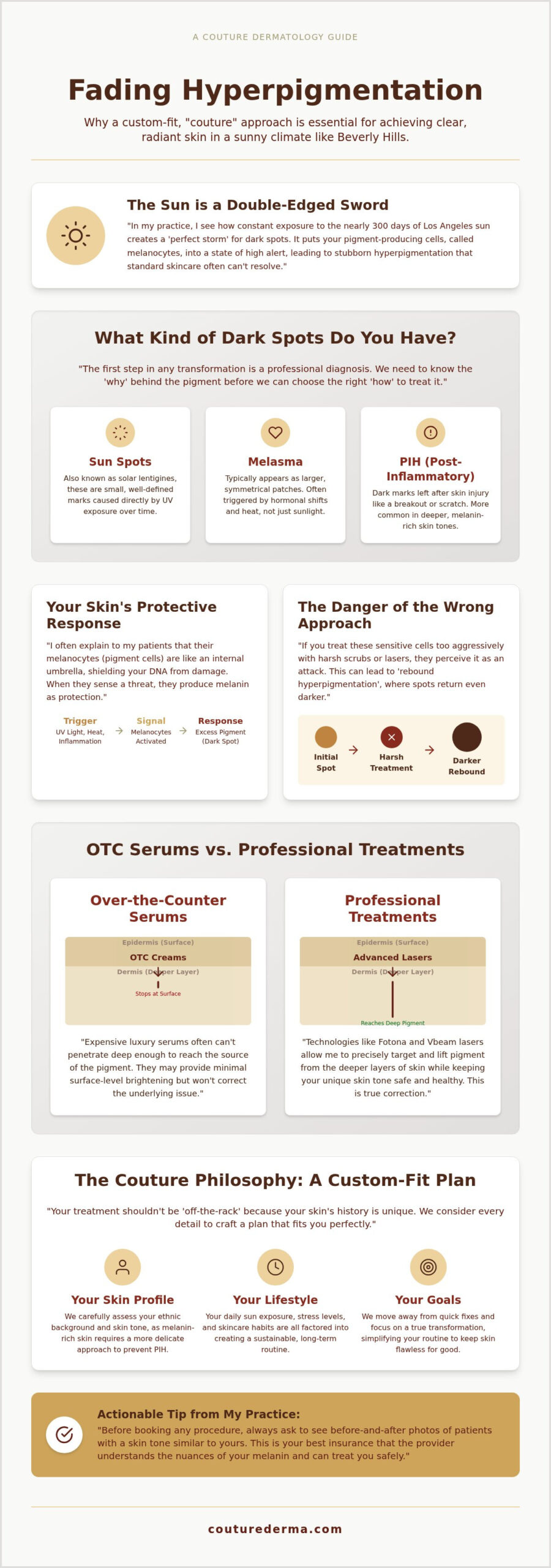
Living in Los Angeles means we enjoy nearly 300 days of sunshine a year. But for many of my patients, that light is a double-edged sword. If you are seeking hyperpigmentation treatment in Beverly Hills, you’re likely dealing with melanin (the pigment that gives skin its color) that has gone into overdrive. In my practice, I see how the constant exposure to UV rays and heat creates a “perfect storm” for dark spots. It’s not just a medical issue; it’s an emotional one. In a city where aesthetic harmony is highly valued, feeling like you have to hide your skin under layers of concealer can chip away at your confidence.
I approach skin like a master tailor approaches a bespoke garment. Your treatment shouldn’t be off-the-rack because your skin’s history and biology are unique. We call this our “Couture” philosophy. It means we don’t just look at the spots on the surface; we look at the person behind them. We consider your lifestyle, your ethnic background, and your long-term goals to craft a plan that fits you perfectly.
Is it Sun Damage or Melasma?
Patients often ask me why their spots won’t budge. We first have to distinguish between solar lentigines (sun spots), which are small, defined marks caused by UV exposure, and melasma. Melasma typically appears as larger, symmetrical patches on the cheeks or forehead. Here’s the thing; melasma is often triggered by hormonal shifts and even heat, not just light. This is why a professional diagnosis is the first step in your transformation journey. Without knowing the “why” behind the pigment, we can’t choose the right “how” to treat it effectively.
The “Skin of Color” Factor
I specialize in treating all skin types, and this is crucial because melanin-rich skin behaves differently. Deeper skin tones are much more prone to Post-Inflammatory Hyperpigmentation (PIH). These are the dark marks left behind after an injury, a scratch, or a breakout. Using a “one-size-fits-all” approach on melanin-rich skin can be dangerous. If a laser is too aggressive, it can actually trigger more pigment instead of removing it. It’s about finding that balance between clinical efficacy and gentle care.
The Science of Melanin: Understanding Your Skin’s Protective Response
To understand why hyperpigmentation treatment in Beverly Hills requires such a delicate touch, we have to look at what’s happening beneath the surface. I often tell my patients that their melanocytes (cells that produce skin pigment) are like a protective internal umbrella. They aren’t trying to ruin your complexion. Instead, they are trying to shield your cell’s DNA from damage. When your skin senses heat, UV light, or even friction, it triggers an inflammatory cascade. This signal tells the melanocytes to pop open their umbrellas and dump pigment to protect the area.
In my practice, I see many people who have tried to scrub or burn their spots away with harsh products. Here’s the thing; if you treat these cells too aggressively, they perceive it as an attack. This leads to rebound hyperpigmentation, where the dark spots return even darker than before. It’s why we prioritize calming the skin and suppressing the pigment factory before we ever attempt to brighten it. If you’re tired of the cycle of fading and rebounding, you can schedule a personalized skin assessment to start a more intentional journey.
What Happens Inside Your Pores?
Inside the pore, an enzyme called tyrosinase acts as the “on switch” for pigment production. When this enzyme is overactive, it leads to the uneven patches we call hyperpigmentation. I often see this in patients who have struggled with breakouts. Even after the blemish is gone, the inflammation leaves the tyrosinase switch stuck in the “on” position. This is why Acne Scar Refinement often involves more than just smoothing the skin; it requires precise medical intervention to shut down that pigment production.
Why Your Skin Remembers Every Burn
Your skin has a long memory. Melanocytes are incredibly sensitive cells, and they remember the damage from a bad sunburn you had years ago. In our sunny Beverly Hills climate, these cells stay in a state of high alert. Every bit of incidental sun exposure, like the light hitting your face while you drive, keeps the pigment cascade active. This is why consistency in your medical-grade routine is non-negotiable.
Professional Treatments vs. Over-the-Counter Creams
In my practice, I see patients who have spent thousands on department store serums that promise the world but deliver very little. It’s a common frustration. While a $200 bottle might feel luxurious, these cosmetic products are legally restricted in how deeply they can penetrate your skin. For a truly effective hyperpigmentation treatment in Beverly Hills, we need to move beyond surface-level brightening and into medical-grade depigmentation. And that requires ingredients that actually reach the root of the problem.
Here’s the thing; cosmetic brands focus on the outer layer of skin. But the root of your dark spots often lies much deeper. In my practice, I utilize prescription-strength ingredients like Hydroquinone and Cysteamine. These are powerful tools that require the supervision of a board-certified expert to ensure they don’t cause irritation. If you’ve been DIY-ing your routine for more than three months without seeing a change, it’s time to stop the guesswork and seek professional guidance. Clinical results require clinical-strength solutions.
While professional treatments are essential for deep pigment, a supportive home routine is just as important; you can learn more about Auriaskin to find gentle, effective products that work alongside medical-grade solutions.
The Limitations of At-Home Retinols
Many people assume that any retinol will do the trick. But OTC (over-the-counter) versions are often far less potent than prescription tretinoin. And while acids can be helpful, using them improperly at home can actually trigger your melanocytes (pigment-producing cells) to create even more dark spots. I’ve seen many cases where a “gentle” home peel led to significant inflammation and worsened the condition. It’s about the right concentration and the right delivery system for your specific skin type.
The Beverly Hills Standard: Clinical Chemical Peels
When we perform a VI Peel or a specialized Couture peel, we are targeting the dermal-epidermal junction (the area where the outer and middle layers of skin meet). This is where stubborn pigment lives. But we don’t just jump into a peel. I typically require patients to use a “pigment inhibitor” for two weeks beforehand to calm the skin. This prep work is essential for a safe transformation, especially when we are working on delicate areas like under-eye brightening where the skin is naturally thinner and more prone to irritation.
Advanced Laser Protocols for Pigment Refinement
In my practice, I see patients who are terrified of lasers because they’ve heard horror stories about burns or worsening pigment. It’s a valid fear, especially for those with melanin-rich skin. But here’s the thing; when we use the right technology with a tailored approach, lasers are the gold standard for hyperpigmentation treatment in Beverly Hills. We don’t just use one machine for everyone. Instead, we select the specific wavelength that matches your unique pigment profile to ensure a safe, transformative result.
I often use the Vbeam laser when I see redness mixed with brown spots. It targets the red components (blood vessels) that often feed the pigment cascade. For stubborn brown spots, we utilize fractional lasers. These work by creating microscopic “pixels” of treatment that lift away pigment while leaving the surrounding skin intact. In my practice, the Fotona laser is a workhorse for diverse skin tones. Its unique pulse structure allows us to treat pigment safely without overheating the skin, which is the key to avoiding Post-Inflammatory Hyperpigmentation (PIH) in deeper skin tones.
During a signature laser session at Couture, you can expect a meticulous process. We start by cooling the skin to ensure comfort. As the laser moves across the treatment area, you might feel a snapping sensation or mild warmth. We aren’t just “zapping” spots; we are carefully refining the canvas of your skin to restore its natural radiance. If you’re ready to see what advanced laser technology can do for your skin, you can book your couture consultation today.
Targeting Under-Eye Darkness
Dark circles are rarely just one thing. In my practice, I find they are often a mix of pigment and vascular issues. By using specialized lasers for under-eye brightening, we can address both the surface darkness and the underlying vessels that make you look tired. It’s a delicate area that requires the precision of a board-certified expert.
The Post-Treatment Protocol
The transformation doesn’t end when you leave our office. I guide my patients through a specific three-step protocol to protect their investment:
- Step 1: Immediate cooling and soothing with medical-grade antioxidants to calm the inflammatory response.
- Step 2: Strict sun avoidance for the first 48 hours to prevent any heat-induced pigment rebound.
- Step 3: Reintroducing “brighteners” only once the skin barrier has fully healed, typically after five to seven days.
For those looking to supplement their medical-grade routine with gentle, moisture-focused products, you can check out Seoul Routine for a curated selection of authentic Korean skincare that emphasizes barrier protection.
Designing Your Custom-Tailored Skin Transformation
In my practice, I see patients who are exhausted by the search for a permanent solution. They have hopped from one viral product to another, hoping for a miracle that never arrives. Here’s the thing; effective hyperpigmentation treatment in Beverly Hills isn’t just about the hour you spend in my laser chair. It’s about the weeks and months of intentional care that happen before and after. We move beyond the “quick fix” to design a long-term maintenance plan that evolves with your skin’s needs.
I view our work as a collaborative journey. Think of me as your skin’s architect and your partner in transformation. We combine the rigor of medical dermatology with the nuance of aesthetic artistry to ensure your results look natural, refined, and healthy. Your skin is a living organ, and its needs change with the seasons and your life stages. In most cases, the goal is a complexion that looks effortless, but we know that effortless beauty requires a very intentional foundation.
The Couture Philosophy: More Than Just a Procedure
When you come in for a Couture Consultation, we look at the whole picture. I’m not just looking at your dark spots; I’m looking at your lifestyle, your diet, and even your hormonal health. These factors all play a role in how your melanocytes (cells that produce skin pigment) behave. By understanding the root causes, we can stop the pigment cascade before it starts. This holistic view is what separates a medical-grade transformation from a standard spa visit.
Booking Your Beverly Hills Experience
Our practice is located on Henger Street, right in the heart of the city’s aesthetic hub. We’ve designed the experience to be seamless for busy Los Angeles professionals who value both their time and their results. You shouldn’t have to navigate a complicated process to get the expert care you deserve. Our online booking system is straightforward and allows you to choose a time that fits your schedule.
Your path to radiant skin starts with an expert eye. Don’t let another season of sun damage settle into your skin. Book your Couture Consultation online today and let’s start your tailored transformation journey together.
Your Journey to Luminous Skin Starts Here
You’ve learned that erasing dark spots isn’t about buying the most expensive cream on the shelf. It’s about understanding your skin’s biology and calming the inflammatory cascade that triggers your melanocytes (pigment-producing cells). In my practice, I combine Harvard-trained expertise with a deep specialization in Skin of Color to ensure every laser pulse and peel is perfectly suited to your unique profile. Choosing a hyperpigmentation treatment in Beverly Hills should feel like a bespoke experience, tailored to your lifestyle and your long-term goals.
Our bespoke clinical environment is designed to be a sanctuary where science meets artistry. We don’t believe in rushed, one-size-fits-all solutions. Instead, we offer a collaborative path to help you achieve the even, radiant tone you’ve been searching for. You can begin your skin transformation at Couture Dermatology today. Let’s work together to restore your confidence and let your natural glow shine through. It’s time to feel comfortable in your own skin again.
Frequently Asked Questions
How long does it take to see results from hyperpigmentation treatment?
You should expect to see visible improvement within 4 to 8 weeks for surface pigment, while deeper issues often take 3 to 6 months to resolve. When seeking hyperpigmentation treatment in Beverly Hills, remember that skin cell turnover takes time. In my practice, I see patients who get discouraged after two weeks, but your results depend on the depth of the pigment and your commitment to a medical-grade routine.
Are lasers safe for dark skin tones or will they cause more scarring?
Lasers are safe for dark skin tones only when performed by an expert using the right technology, such as the Fotona laser. In my practice, I utilize specific wavelengths and cooling techniques to protect the outer layer of skin. This prevents Post-Inflammatory Hyperpigmentation (PIH), which is the dark marking left after an injury. Never trust a one-size-fits-all laser approach if you have melanin-rich skin.
What is the best sunscreen for melasma in the Beverly Hills sun?
The most effective choice for melasma in our intense Southern California sun is a tinted mineral sunscreen containing iron oxides. These oxides are crucial because they block blue light, which we now know triggers pigment just as much as UV rays. I often tell my patients that a standard white sunscreen isn’t enough for stubborn melasma. Look for zinc oxide or titanium dioxide on the label for physical protection.
Can I get hyperpigmentation treatments while pregnant or breastfeeding?
I typically advise pausing aggressive hyperpigmentation treatment in Beverly Hills, like Hydroquinone or Retinoids, while you are pregnant or breastfeeding. Hormonal shifts often trigger melasma, but safety comes first. In my practice, I switch patients to pregnancy-safe alternatives like Azelaic Acid or Vitamin C. These ingredients help manage pigment without the risks associated with stronger medical-grade prescriptions. Always check with your obstetrician before starting any new protocol.
Why did my dark spots come back after my last chemical peel?
Dark spots often return if your melanocytes (cells that produce skin pigment) weren’t properly calmed before the procedure. This is called rebound hyperpigmentation. If a chemical peel is too aggressive or used without a pigment inhibitor prep-period, the skin perceives it as an attack and produces more melanin to protect itself. This is why a tailored, medical-grade plan is so much more effective than a quick, off-the-shelf solution.
Is hyperpigmentation treatment covered by medical insurance?
Most insurance providers consider these treatments elective aesthetic procedures, so they are typically not covered. While medical dermatology for conditions like suspicious moles is often covered, fading dark spots for cosmetic reasons is an out-of-pocket investment. In my practice, we focus on long-term results to ensure your investment provides lasting value. Many patients find that a structured professional plan is more cost-effective than buying endless ineffective luxury serums.
What is the difference between sun spots and age spots?
Sun spots and age spots are actually the same clinical condition, known as solar lentigines. They are the result of cumulative UV exposure over many years, not just your age. I see these marks on patients in their 20s as often as those in their 50s. While they are usually harmless, any spot with irregular borders or changing colors should be evaluated by a board-certified dermatologist to rule out skin cancer.
Can diet or supplements help clear my skin from the inside out?
Diet alone won’t erase dark spots, but certain supplements can help protect your skin from the inside out. In my practice, I often suggest Polypodium leucotomos, a fern extract that acts as an internal antioxidant against UV damage. Think of it as a booster for your sunscreen, not a replacement. A diet rich in antioxidants can support your skin’s healing process, but medical-grade treatments are still necessary to lift existing pigment.