

You wake up and notice that the painful bump on your chin has finally flattened, but your relief is short-lived. In its place sits a stubborn, dark purple mark that you know from experience might linger for the next six months. It is a frustrating cycle I see constantly in my Beverly Hills practice, where the breakout ends but the ghost of the blemish remains. Finding an effective acne treatment for black skin often feels like a gamble between products that do nothing and harsh chemicals that cause even more irritation.
Let’s be honest. Most off-the-shelf solutions aren’t designed with your melanocytes (cells that produce skin pigment) in mind. In my practice, I have found that success comes from a bespoke approach that treats active clogs while simultaneously calming the pigment-producing cells that overreact to inflammation. I am going to show you how to clear your complexion and erase those lingering shadows with a routine tailored to your biology. We will explore the specific protocols and professional treatments that deliver a clear, even tone without the fear of scarring.
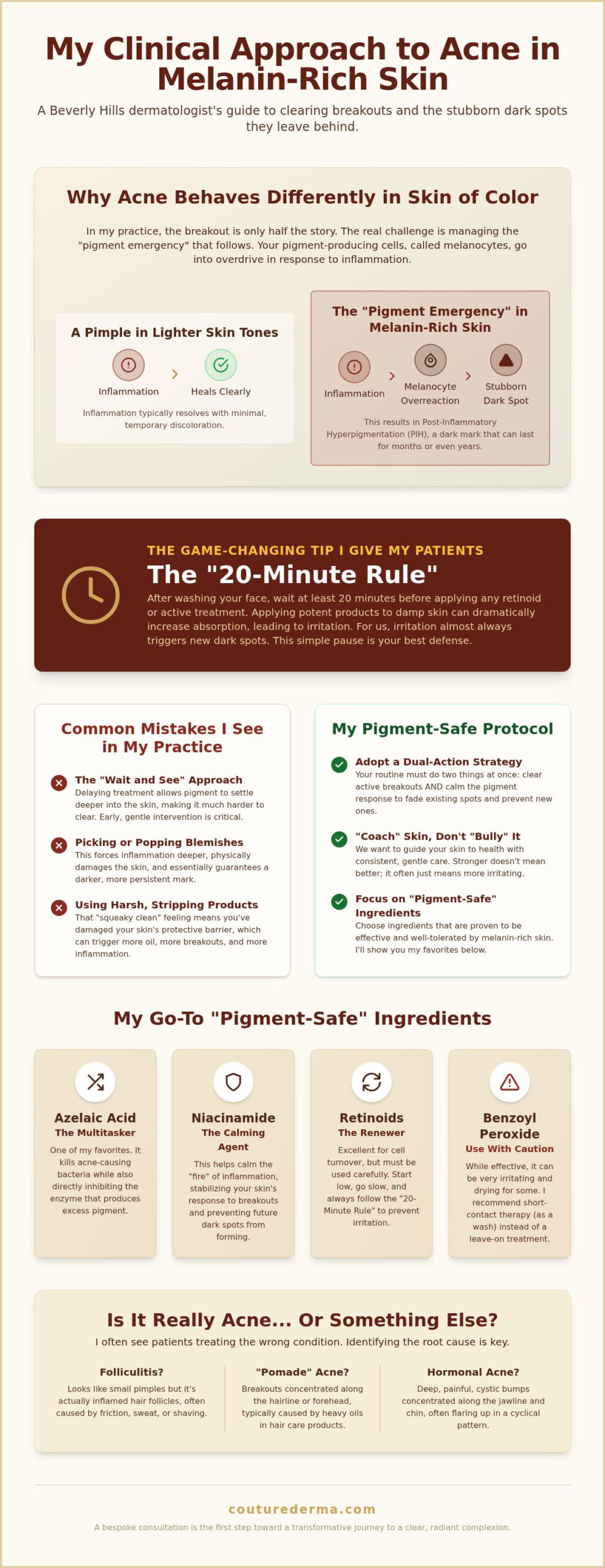
Here is a tip I give all my patients: wait at least 20 minutes after washing your face before you apply a retinoid. Applying it to damp skin can increase irritation, which is exactly what we want to avoid to prevent new dark spots from forming.
Key Takeaways
- Learn why melanocytes (cells that produce skin pigment) make breakouts behave differently and how to calm their reactive nature.
- Discover why the “20-minute rule” is a game-changer for acne treatment for black skin to stop irritation before it starts.
- Master the dual-action approach of clearing active clogs while you simultaneously erase the “shadows” of dark spots left behind.
- See how modern laser technology safely targets skin concerns without the traditional risks of burns or permanent scarring.
- Understand why a bespoke consultation is the first step in your transformative journey toward a truly even and radiant complexion.
Why is acne different for those of us with darker skin?
In my practice, I see how acne behaves differently in melanated skin every single day. It isn’t just about the temporary bump. For my patients, the real challenge of acne treatment for black skin is managing the “pigment emergency” that happens the moment a pore becomes inflamed. When a breakout occurs, your melanocytes (cells that produce skin pigment) become hyper-reactive. They flood the area with melanin, leading to Post-Inflammatory Hyperpigmentation (PIH). This is why the “shadow” left behind often feels like a bigger problem than the pimple itself.
Let’s be honest. The “wait and see” approach is often a mistake for skin of color. While someone with less pigment might heal without a trace, a delay in treatment for you typically leads to permanent scarring or dark patches that take months to fade. Early intervention is the most effective acne treatment for black skin because it stops this pigment cycle before it can settle deep into the tissue.
To better understand this concept, watch this helpful video:
The role of inflammation in melanated skin
Even a small pimple can trigger a massive release of pigment. This is why picking or popping is significantly more damaging for darker complexions; you’re essentially forcing the inflammation deeper and guaranteeing a darker mark. It is also important to recognize the difference between a dark spot and a true acne scar. A spot is just excess pigment on the surface, but a scar involves a change in the skin’s texture. If you notice indentations or raised bumps, you may eventually need professional acne scar refinement to smooth the skin’s surface.
Is it really acne or something else?
I often see patients who think they have stubborn breakouts, but it is actually folliculitis (inflamed hair follicles). We also frequently see “pomade acne” along the hairline, which is caused by heavy oils in hair care products migrating to the skin. If your breakouts are deep, painful, and concentrated along the jawline, it is usually a sign of hormonal triggers rather than simple surface clogs. Identifying the root cause is the only way to build a routine that actually works.
Actionable Tip: Take a photo of your skin in natural light every week. It is hard to see progress day-to-day, but these photos will help you track how quickly those spots are actually fading and whether your current routine is making an impact.
Designing your custom home-care ritual
Think of your skincare routine like a tailored suit; it must fit your specific needs or it simply won’t perform. In my practice, I often see patients who believe they need the strongest products available to see results. But for an effective acne treatment for black skin, “stronger” often just means “more irritating.” We want to coach your skin into health, not bully it into submission. If your skin feels tight or “squeaky clean” after washing, your cleanser is too harsh. That stripped feeling means you’ve damaged your skin’s natural barrier, which can actually trigger more oil production and inflammation.
I typically suggest starting with a lower concentration of Retinol to avoid “retinoid dermatitis” (redness, itching, and peeling). In skin of color, this type of irritation is a major setback because it often leads to new dark patches. To prevent this, I teach my patients the “20-minute rule.” After washing your face, wait at least 20 minutes before applying any active treatments. Applying products to damp skin increases absorption too quickly, which significantly raises the risk of irritation. It’s a simple step that makes a world of difference in your results.
The “Pigment-Safe” ingredient list
When selecting ingredients, I look for multitaskers that respect your skin’s biology. Azelaic acid is one of my favorites because it kills acne-causing bacteria while simultaneously fading existing dark spots. I also recommend Niacinamide for calming the “fire” of inflammation. It helps stabilize your skin’s response to breakouts, which prevents future PIH from forming. While Benzoyl Peroxide is a classic choice, it should be used with caution. It’s effective, but it can cause excessive dryness and irritation if you use a concentration that is too high or apply it too frequently.
The non-negotiable role of SPF in Beverly Hills
Living in Beverly Hills means we deal with year-round sun, and let’s be honest: you cannot fade dark spots if you aren’t protecting them. UV rays act like a spotlight on your hyperpigmentation, turning a temporary mark into a semi-permanent “tattoo” by deepening the pigment. You need a daily sunscreen that offers broad-spectrum protection without leaving a chalky, purple, or ashy residue. Finding a “no-white-cast” formula is essential so that you actually enjoy wearing it every day. If your current routine isn’t giving you the clarity you deserve, a bespoke consultation at our practice can help us refine your strategy.
Actionable Tip: Swap your foaming cleanser for a gentle, non-foaming cream or oil cleanser if your skin feels dry. A healthy barrier is your first line of defense against the inflammation that causes acne and dark marks.
Dealing with the “shadow” of hyperpigmentation
Here’s the thing: clearing the pimple is only half the battle. In my practice, I treat the “shadow” (post-inflammatory hyperpigmentation or PIH) as seriously as the active breakout because the emotional toll of dark marks often outweighs the frustration of the initial acne. I see patients who have spent months trying to hide these spots with heavy makeup, only to find the spots haven’t budged. Effective acne treatment for black skin must address this lingering pigment with the same precision we use to stop the clogs.
But let’s be honest. Reaching for a “lightening cream” from a random beauty supply store is a gamble you shouldn’t take. These unregulated products often contain hidden steroids or mercury that can cause permanent damage. In our clinic, we use medical-grade brighteners that are specifically formulated to even out your complexion safely. We want to silence the overactive pigment cells without irritating the healthy skin around them.
Natural brighteners that actually work
You don’t always need the harshest chemicals to see a difference. I often recommend a combination of Kojic acid and Vitamin C to boost radiance and slow down the process that makes pigment. For those with sensitive skin, licorice root extract is a fantastic, gentle alternative that calms redness while it brightens. Lately, Tranexamic acid (a powerful ingredient that blocks the pathways that lead to pigment) has become a favorite in my clinic for treating particularly stubborn patches that haven’t responded to other ingredients.
The risk of Ochronosis and “rebound” darkening
I monitor my patients very closely when we include high-strength hydroquinone in their routine. While it is effective, using it for too long can lead to ochronosis (a rare, permanent blue-black skin discoloration). To avoid this, I utilize a “cycling” method. We use active brighteners for three months to lift the pigment and then give the skin a rest for at least one month. This prevents “rebound” darkening and keeps your skin’s biology in balance. Learn more about our under-eye brightening treatments which often use similar pigment-calming logic to treat delicate areas.
Actionable Tip: Apply your brightening spot treatment only to the dark mark itself, not the surrounding healthy skin. Using a cotton swab can help you stay precise and prevent creating a “halo” effect of lighter skin around the spot.
When is it time for professional laser or medical intervention?
Many of my patients walk into our practice terrified of the word “laser.” I see patients who have heard horror stories about burns, permanent white spots, or worsening pigment. Let’s be honest: in the past, many lasers weren’t designed with your skin in mind. But technology has shifted. Today, professional acne treatment for black skin involves sophisticated devices that are both safe and incredibly effective when handled by an expert who understands the nuances of melanated skin.
In my practice, we utilize what I call the “Couture” approach. This means we select specific wavelengths that bypass the melanocytes (cells that produce skin pigment) on the surface to target the root of the problem deeper down. In most cases, the best results come from a thoughtful combination of medical-grade topicals and targeted in-office light therapy. It’s a collaborative, transformative journey toward clarity rather than a series of quick fixes.
Safe lasers for skin of color
Not all lasers are created equal. For example, the Vbeam laser is excellent for targeting the redness and vascularity (blood vessel activity) that often fuels painful, cystic inflammation. Another favorite is the Aerolase Neo. This is a “no-touch” laser that delivers energy so quickly it doesn’t have time to overheat the surface pigment. We use these tools to shut down active acne while simultaneously stimulating collagen to help your skin heal itself from the inside out.
Chemical peels and microneedling
If your main concern is surface-level congestion or uneven texture, chemical peels are often a better starting point than lasers. The VI Peel is a specialized blend I frequently use because it treats active acne and stubborn pigment at the same time without excessive downtime. When it comes to texture, microneedling is my go-to for refining acne scars. It creates tiny, controlled channels that trigger your skin’s natural repair process. Just remember: “deeper” isn’t always “better.” In skin of color, being too aggressive can actually trigger the very pigment issues we are trying to solve.
If you are ready to move beyond over-the-counter products that aren’t delivering the results you deserve, you can schedule a bespoke consultation to see which technology fits your skin’s unique story.
Actionable Tip: Always ask your provider if they have a “long-pulse” laser or a 1064 nm Nd:YAG laser. These specific technologies are the gold standard for darker skin because they safely bypass the surface melanin to treat the deeper layers of the skin.
Your transformative journey at Couture Dermatology
At our practice, we don’t believe in “one-size-fits-all” skincare. Acne treatment for black skin requires a level of detail that generic protocols simply cannot provide. I see patients who have tried every viral trend on social media only to end up with more inflammation and deeper dark spots. Our process is intentionally different. We treat your skin like a bespoke garment, ensuring every active ingredient and every laser setting is measured specifically for your unique biology.
It all begins with a deep-dive consultation. I want to understand your skin’s history, from the products that failed you in the past to the specific lifestyle factors that trigger your flares today. We focus on long-term health and “timeless skin” rather than aggressive, quick fixes that often backfire in skin of color. My goal is to build a relationship of trust; and we are here to support you through every stage of the healing process, from the first breakout to the final fading of a dark mark.
The Beverly Hills experience
Our Beverly Hills location isn’t just about the prestige of the address. It allows us to treat specific environmental factors like city pollution and year-round sun damage that are unique to our Southern California lifestyle. Healing requires a calm, sophisticated environment where you feel recognized and meticulously attended to. We want your treatment to feel like a retreat rather than a clinical chore. For those looking for a complete facial refinement once their skin is clear and healthy, you can also explore our jawline contouring services to enhance your natural bone structure and profile.
Booking your couture consultation
Taking the first step toward a clearer, more confident you starts with a simple conversation. During your first visit with me, we will map out a structured path that aligns with your specific aesthetic goals and clinical needs. You can also review what a dermatologist wants you to know about acne to better understand my philosophy before you arrive. We are ready to help you transition from frustration to a state of calm confidence in your complexion.
Actionable Tip: Bring your current products to your consultation so we can “edit” your routine. I often find that patients are using too many competing actives, and simply removing the wrong products can be as transformative as adding new ones.
Embrace your path to radiant, even skin
We’ve covered a lot today. Here’s the thing: your skin’s biology is unique, and your treatment should be too. We’ve discussed why managing the “pigment emergency” is the most critical part of an effective acne treatment for black skin; we also looked at how the right home-care ritual can stop inflammation before it starts. Whether we are using the Aerolase Neo to shut down breakouts or crafting a medical-grade brightening routine, every step is designed to respect your melanocytes (cells that produce skin pigment).
In my practice, I combine my Harvard-trained expertise with specialized protocols developed specifically for skin of color. You don’t have to settle for ineffective products or live in fear of stubborn dark marks. By choosing a clinical authority in Beverly Hills, you are choosing a transformative journey that prioritizes your long-term health and self-assurance. It is time to stop guessing and start glowing.
Begin your journey to clear skin: Book a Couture Consultation with Dr. Abisogun
I can’t wait to see the transformation you’ll achieve. Your radiant results are waiting.
Frequently Asked Questions
Is it safe to use salicylic acid on Black skin?
Yes, salicylic acid is generally safe and effective for exfoliating oily pores in skin of color. I see patients who benefit from it because it’s oil-soluble, meaning it gets deep into the follicle. However, you should stick to a 2% concentration or lower to avoid chemical burns. If you use it too aggressively, you risk triggering the very inflammation that leads to dark patches. Start by using it only twice a week.
How long does it take for dark spots from acne to fade on darker skin?
Dark spots, or post-inflammatory hyperpigmentation, typically take 16 to 20 weeks of consistent treatment to show significant improvement. In my practice, I find that the timeline for fading marks in darker skin is often 40% longer than in lighter tones. It is a slow, gradual progression that requires patience. Using a daily brightener with ingredients like azelaic acid can help speed up this transformative journey toward an even complexion.
Can Black skin get laser treatment for acne without scarring?
Yes, Black skin can safely receive laser treatment for acne if the provider uses the correct technology and settings. In our practice, we use “long-pulse” lasers like the 1064 nm Nd:YAG, which bypasses surface pigment to target the root of the issue. This prevents the heat damage that causes scarring. Always ensure your specialist has specific expertise in treating diverse skin tones to ensure your safety and aesthetic harmony.
Does African Black soap really help with acne and dark spots?
While it is a popular traditional remedy, African Black soap is often too harsh for acne-prone skin. It typically has a very high pH, which strips your skin’s natural barrier and causes extreme dryness. This irritation can actually make your acne treatment for black skin less effective by causing more inflammation. If you love the results, limit its use to once or twice a week and always follow with a rich moisturizer.
What is the best sunscreen for Black skin that won’t cause breakouts?
The best sunscreen for you is a non-comedogenic (won’t clog pores) formula that leaves no ashy residue. I recommend looking for “ultra-sheer” mineral or chemical sunscreens that feel elegant on the skin. In Beverly Hills, where the sun is constant, you need broad-spectrum protection to stop UV rays from turning your temporary acne marks into permanent spots. Finding a formula you enjoy wearing every day is the key to long-term success.
Why does my acne always leave a dark mark even if I don’t pick it?
Dark marks occur because your melanocytes (cells that produce skin pigment) are naturally more reactive to any form of inflammation. Even if you don’t pick your skin, the internal “fire” of a pimple signals these cells to flood the area with melanin. This is a biological defense mechanism that results in a shadow once the bump heals. Silencing this overactive pigment response is why early acne treatment for black skin is so vital.
Can hormonal acne be treated differently in women of color?
Hormonal acne in women of color requires a dual-action approach that targets the internal triggers while protecting the surface from pigment. I often prescribe medications like spironolactone to block the hormones causing deep, cystic bumps along the jawline. Because these breakouts are more likely to leave long-lasting marks, we also prioritize calming agents like niacinamide. This ensures we are treating the root cause while maintaining a clear, even skin tone.
What should I do if my acne treatment is making my skin peel and turn gray?
If your skin is peeling or turning a “gray” ashy color, your products are likely causing too much irritation. This is often a sign of retinoid dermatitis, which happens when your skin’s barrier is compromised. You should stop all active treatments for three to five days and focus on heavy hydration with hyaluronic acid. Once the peeling stops, reintroduce your actives slowly using the “20-minute rule” we discussed earlier to prevent future sensitivity.