

You catch a glimpse of your profile in a mirror and notice a certain softness along your jawline that wasn’t there a few years ago. It’s a common moment of realization for many of my patients who feel they look older than they feel. If you’re looking for how to tighten sagging jowls without surgery, you’ve likely realized that luxury creams don’t provide the structural lift you’re after.
In my practice, I see people who want a sharper profile but fear looking “plastic” or “over-done” from a traditional facelift. I believe in a tailoring approach where we customize treatments to your unique bone structure and skin type. This guide explains how we use advanced tools like Ultherapy (a device that uses ultrasound to lift skin) and dermal fillers (injectable gels used for volume) to restore a crisp, youthful jawline. You’ll learn exactly how we achieve subtle, natural results with minimal downtime.
Key Takeaways
- Learn why the “inverted triangle” of youth shifts into a square shape and why “face yoga” or topical creams often fail to provide a real lift.
- Discover how to tighten sagging jowls without surgery by using dermal fillers to strategically restore anchor points and camouflage tissue descent.
- Understand the difference between radiofrequency tightening and ultrasound lifting, including how Ultherapy targets the same deep tissue layer (the SMAS) as a surgical facelift.
- Explore the “Couture” approach to jawline refinement that prioritizes natural, balanced results over an artificial or “over-filled” appearance.
- Find out why a professional consultation is the essential first step in tailoring a non-invasive treatment plan that matches your specific anatomy.
Why does the jawline lose its edge? Understanding the anatomy of jowls
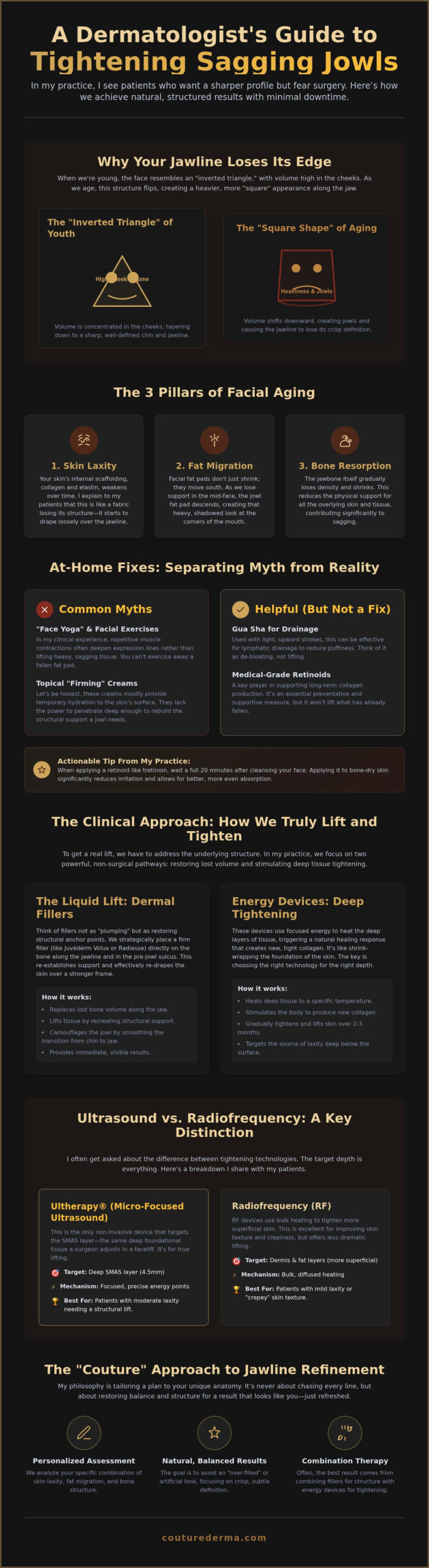
Jowls are the pockets of skin and tissue that begin to droop below your jawline as you age. When we’re young, the face typically resembles an “inverted triangle” where the volume is concentrated in the cheeks and tapers down to a sharp chin. Over time, that triangle flips. Volume shifts downward, and the face takes on a more “square” appearance. In my Beverly Hills practice, I often tell patients that treating jowls is like re-tailoring a suit that has lost its structure. It’s not just about the fabric; it’s about what’s happening underneath.
I see patients who are frustrated because they feel their face no longer matches their energy. Understanding how to tighten sagging jowls without surgery requires looking at the three pillars of facial aging: skin laxity (looseness), fat migration, and bone resorption (the shrinking of the jawbone). Each person’s jowling is a unique combination of these factors, which is why a personalized plan is essential.
To better understand how these structural changes impact your appearance and how we address them, watch this helpful video:
The role of collagen and elastin breakdown
Your skin relies on collagen and elastin to act as internal scaffolding. These proteins keep everything firm and elastic. In Los Angeles, our year-round sun exposure leads to solar elastosis (the accumulation of abnormal elastic tissue), which accelerates this breakdown. When the scaffolding weakens, the skin begins to drape over the jawline like loose fabric. Let’s be honest, those expensive creams aren’t reaching deep enough to fix this structural issue.
Actionable Tip: Start using a medical-grade retinoid (a vitamin A derivative) every other night to support collagen production before sagging becomes severe. Wait 20 minutes after washing your face before applying it to minimize irritation and ensure the product absorbs properly.
Fat pads and the downward shift
Have you noticed your jawline looks heavier even if your weight hasn’t changed? This happens because facial fat pads don’t just disappear; they move south. As we lose volume in the mid-face, the “jowl fat pad” becomes more prominent because there’s nothing left to hold it up. This downward migration creates that heavy, shadowed look at the corners of the mouth.
The final piece of the puzzle is bone resorption. As the jawbone loses density, it provides less support for the overlying tissue. This complex anatomy of facial aging is why a one-size-fits-all approach never works. In our practice, we often use jawline contouring with fillers to replace this lost structural support and restore a more defined profile without the need for an operating room.
Can you really fix jowls at home? Separating myths from clinical reality
Let’s be honest, we all want a quick fix from our bathroom counter. But when you’re looking for how to tighten sagging jowls without surgery, it’s vital to separate viral trends from clinical reality. The physics of jowling involves gravity pulling down migrated fat and weakened skin. Surface-level rubbing simply isn’t enough to reverse that structural shift. I see patients who have spent months on “face yoga” only to find they’ve actually etched deeper expression lines into their skin. Repetitive muscle contractions without structural support often deepen wrinkles rather than lifting heavy tissue.
Actionable Tip: If you use a gua sha tool, use it for lymphatic drainage (reducing puffiness) rather than trying to “iron out” sagging skin. Light, upward strokes help move fluid. But no amount of scraping will re-anchor a fallen fat pad.
The limits of over-the-counter (OTC) solutions
Most “firming” creams work by providing temporary hydration. They plump the outer layer of skin (epidermis), which might make fine lines look better for a few hours. They don’t have the power to lift the heavy tissue of a jowl. In our practice, I recommend focusing on ingredients that actually matter:
- Retinol to support collagen production
- Peptides for skin signaling and repair
- Vitamin C for antioxidant protection
If you’ve been using these for six months and still see no change in your jawline’s crispness, it’s likely time to move beyond the jar.
Actionable Tip: To test if your sagging is due to skin laxity or volume loss, gently press your finger upward on your cheekbone. If the jowl disappears, your primary issue is likely mid-face volume loss that requires structural support rather than just surface tightening.
Where professional technology takes over
I see many patients who have spent thousands on high-end jars, only to find the real solution was a targeted 30-minute procedure. This is where professional technology takes the lead. We use energy-based devices to bypass the surface and reach the foundation of the skin. By delivering heat to the deeper layers, we trick the body into a healing response that builds new, tight collagen.
While energy is great for tightening the fabric of the skin, sometimes the issue is lost volume. Facial fillers are often the missing piece. They provide the structural poles to hold up the tent. This is a core part of jawline contouring in our practice. If you’re ready to stop guessing and start seeing a defined profile, you can schedule a personalized assessment to see which approach fits your anatomy.
The Art of the Liquid Lift: Injectables for Jawline Contouring
In my practice, I find that many people think the only way to fix a sagging jaw is to pull it back manually. But when you’re exploring how to tighten sagging jowls without surgery, injectables offer a precision that surface treatments simply can’t match. I see patients who worry that fillers will make their face look heavy or “puffy.” Here’s the thing: the goal isn’t just to fill the skin; it’s to recreate the structural anchor points that have shifted over time. By placing dermal fillers (gel-like substances used for volume) in the mid-face and temples, we can actually lift the lower face upward.
This approach is supported by a 2024 study on the JOLT technique, which demonstrates how strategic hyaluronic acid placement can significantly refine the jawline. In my Beverly Hills clinic, we use a tailoring approach to camouflage the descent of tissue. Instead of just chasing the jowl itself, we build out the jawline’s edge to make it look sharp and continuous again. It’s about creating an optical illusion of a youthful, straight bone structure.
Actionable Tip: If you’re considering fillers, ask your provider for a “high-G-prime” product. These are firmer gels that provide the structural support needed for a crisp jawline, rather than the softer, more flexible gels typically used for lips.
For those with a heavier lower face, Kybella (deoxycholic acid, a substance that breaks down fat) is often a vital part of the plan. It’s an injectable that permanently destroys fat cells in a targeted area, allowing us to melt away the “jowl fat” specifically. You can learn more about our bespoke approach to jawline contouring to see how we blend these techniques for a custom fit.
Restoring volume vs. melting fat
I often combine these methods for what I call the “Couture” standard. Fillers add the support, while Kybella removes the weight. It’s a careful balance of adding and subtracting to achieve aesthetic harmony. In most cases, patients need a mix of both to see a truly defined profile that lasts. We aren’t just fixing a problem; we’re refining your silhouette.
Actionable Tip: Ensure your provider looks at your profile from a 45-degree angle, not just straight on. A sharp jawline must look natural from every perspective, especially when you’re in motion or speaking at a dinner party.
Neuromodulators: The “Nefertiti Lift”
Sometimes the culprit isn’t just gravity; it’s your own muscles. I see patients whose platysma (the thin muscle in the neck) is constantly pulling their jawline downward. By using Botox (botulinum toxin), we can relax these muscles. This is often called the “Nefertiti Lift.” In my practice, I find that relaxing these muscles creates a subtle, elegant lift that looks entirely natural. It’s a key step in how to tighten sagging jowls without surgery because it removes the constant downward tension that causes early jowling.
Energy-Based Refinement: Lasers and Skin Tightening
While injectables restore the structural poles of the face, energy-based devices address the tension and quality of the skin itself. If you’re researching how to tighten sagging jowls without surgery, you’ll find that these technologies are the closest we get to a surgical result without an incision. In my practice, I use Radiofrequency (RF) tightening to deliver controlled heat into the skin. Here’s the thing: this heat “tricks” your body into thinking there’s a minor injury, which triggers a massive production of new collagen and elastin.
Ultrasound technology, specifically Ultherapy, takes this a step further by targeting the SMAS layer (the same structural layer surgeons lift during a facelift). This allows for a deeper lift that was previously impossible without a scalpel. I also frequently use Laser Skin Resurfacing to create a “shrink-wrap” effect. This process removes damaged outer layers while tightening the underlying dermis (the middle layer of skin), effectively pulling the jawline back into place.
Actionable Tip: Plan for a series of 3 sessions for most energy-based treatments. Collagen doesn’t grow overnight; it takes about 3 to 6 months for the new fibers to “knit” back together and show the full lifting effect.
RF Microneedling: The dual-action approach
I often recommend RF microneedling for patients who want both tightening and a refined skin texture. The tiny needles create channels that allow heat to bypass the surface and reach the foundation directly. This is a significant advantage for my patients with darker skin tones. Since the heat is delivered deep, we don’t have to worry as much about triggering melanocytes (cells that produce skin pigment), making it a safe, inclusive option for everyone.
The Fotona and Tixel alternatives
Every face is different, so our technology must be too. We utilize the Fotona laser for a unique multi-layered tightening approach that treats the skin from both the inside of the mouth and the outside. For those with sensitive skin or who want a needle-free experience, Tixel is an excellent choice. It uses thermal energy to stimulate the skin without the downtime of traditional lasers.
Actionable Tip: To maintain your results, always apply a broad-spectrum SPF 30 or higher every single morning. UV damage is the primary cause of collagen breakdown, and skipping even one day can undo the progress we make with professional treatments.
If you’re ready to see which of these advanced technologies is right for your profile, you can book your couture consultation to begin your transformation.
Your Transformation Journey: What to expect at Couture Dermatology
Let’s be honest, you didn’t get jowls overnight. The best results in aesthetic medicine are a gradual progression toward your best self, rather than a rushed transformation. In my practice, we start every journey with the “Couture Consultation.” This is a deep dive where we discuss your medical history, your specific aesthetic goals, and the unique anatomy of your face. When looking for how to tighten sagging jowls without surgery, the most important factor is a plan that respects your natural features.
I see patients who are terrified of looking “plastic” or “over-filled.” In Beverly Hills, the standard of beauty has shifted toward a more refined, undetectable look. As a board-certified dermatologist, my eye is trained to see the face as a whole. We don’t just treat the jowl; we treat the support structures around it. This ensures that your results are balanced and elegant, avoiding the heavy look that comes from inexperienced hands.
Actionable Tip: Before your consultation, take photos of yourself from your 20s or 30s. This helps us understand your original bone structure and fat distribution, allowing us to “re-tailor” your profile based on your younger self rather than a generic template.
The “Couture” Difference in Beverly Hills
Our philosophy centers on “quiet luxury” in dermatology. This means we prioritize safety and clinical rigor alongside artistic results. We use the latest technology, but we use it with a conservative touch. I believe that aesthetic improvement should be a collaborative, transformative journey. You are an active participant in this process. Discover the Art of Skin Rejuvenation with Dr. Abisogun to see how we blend science with a bespoke sensibility.
Taking the next step toward a defined profile
Preparing for your first treatment is just as important as the procedure itself. To minimize the risk of bruising, I ask my patients to avoid blood thinners like aspirin, ibuprofen, or fish oil for 7 to 10 days before any injectable treatment. This small step makes a significant difference in your recovery time. We want you to pass the “dinner party test”—where your friends notice you look refreshed and vibrant, but they can’t quite put their finger on why.
Actionable Tip: If you are prone to swelling, sleep with your head slightly elevated on two pillows for the first 48 hours after a tightening procedure. This helps lymphatic drainage and speeds up the “settling” process of your new jawline.
But here is the most important thing: your skin is an investment. If you are ready to stop feeling “tired” and start feeling confident in your profile, we are here to guide you. Ready to refine your jawline? Let’s talk about a plan that fits you perfectly. You can schedule your assessment today to learn more about how to tighten sagging jowls without surgery in a way that looks entirely natural.
Rediscover Your Profile with Precision and Artistry
Restoring a sharp jawline is about more than just surface treatments. It’s a careful process of re-tailoring the face by addressing lost volume and skin laxity (looseness) at the source. We’ve seen how to tighten sagging jowls without surgery by combining energy-based lifting with structural injectables. This multi-layered approach ensures that your results look elegant and entirely your own. In my practice, I focus on the subtle details that create a harmonious, youthful profile without the need for an operating room.
My Harvard-trained expertise and experience treating diverse skin types allow me to provide a level of bespoke Beverly Hills clinical care that prioritizes your safety and artistic goals. We don’t believe in a one-size-fits-all machine. Instead, we curate a plan that evolves with you. You deserve to feel confident every time you catch your reflection. If you’re ready to define your jawline and restore your self-assurance, I invite you to take the next step. Book your bespoke jawline consultation with Dr. Abisogun to begin your transformation journey today. You’re in expert hands.
Frequently Asked Questions
How long do non-surgical jowl treatments last?
Results typically last between 12 and 24 months, depending on the specific modality we use. In my practice, I find that hyaluronic acid fillers in the jawline often maintain their structure for up to two years. Energy-based treatments like Ultherapy or RF microneedling stimulate your own collagen, so while the lift is long-lasting, your natural aging process continues. Most of my Beverly Hills patients opt for a small maintenance tweak every 12 to 18 months.
Is it possible to tighten jowls naturally without any procedures?
Let’s be honest, topical creams and facial exercises cannot reverse the structural descent of fat pads or bone loss. While medical-grade retinol (a vitamin A derivative) improves skin texture, it won’t provide the mechanical lift needed for sagging tissue. I see patients who have tried “face yoga” for months only to find it deepens their expression lines. For real refinement, you need deeper intervention that reaches the foundation of the skin.
Does filler in the jawline make your face look bigger?
When done correctly, jawline filler actually makes the face look slimmer and more contoured, not bigger. We use a tailoring approach to create a sharp edge that separates the face from the neck. This creates a shadow that defines your profile. In my practice, I focus on restoring the “anchor points” in the mid-face and jaw. This draws the eye upward and creates an elegant, refined silhouette rather than adding bulk.
What is the best age to start treating sagging jowls?
Most patients begin noticing early jowling in their late 30s or early 40s. This is the ideal time for “prejuvenation” treatments like Ultherapy or subtle fillers to maintain your structural foundation. Starting early means we can use less product and fewer sessions to achieve a natural look. However, I see patients in their 50s and 60s who achieve beautiful results by combining different energy-based technologies and injectables to restore their profile.
How many sessions of RF microneedling are needed for jowls?
In most cases, I recommend a series of three sessions spaced about four to six weeks apart. This timeline allows your skin to complete its natural healing cycle and “knit” new collagen fibers together. While some patients see a subtle glow after one visit, the real lifting effect takes about three to six months to fully manifest. Consistency is key when you’re learning how to tighten sagging jowls without surgery through collagen induction.
Is there any downtime with non-surgical jawline tightening?
Downtime is typically minimal, though it varies by treatment. For injectables, you might experience slight swelling or a small bruise for three to five days. Energy-based treatments like Tixel or RF microneedling often cause a “sunburn” sensation and mild redness for about 48 hours. Most of my patients return to their normal social schedules within a few days. I always suggest avoiding major events for one week after your procedure just to be safe.
Can weight loss help reduce sagging jowls?
Weight loss can be a double-edged sword for the jawline. While reducing overall body fat may shrink the jowl fat pad, rapid weight loss often leads to “Ozempic face,” where the skin loses its underlying support and sags further. I often see patients who have reached their goal weight but are frustrated by the resulting loose skin. In these cases, we focus on restoring volume and tightening the skin’s “shrink-wrap” effect.
Are these treatments safe for all skin tones and ethnicities?
Yes, our practice specializes in treating all skin types and tones with extreme care. Technologies like RF microneedling and the Fotona laser are particularly safe for darker skin because they bypass the surface to protect melanocytes (cells that produce skin pigment). This prevents issues like post-inflammatory hyperpigmentation (dark spots caused by irritation). We always customize the energy settings to ensure clinical rigor and safety for every patient when discussing how to tighten sagging jowls without surgery.