You’re standing under the bright lights of your vanity mirror, applying foundation only to realize it’s actually highlighting every indentation. In my practice, I see patients who feel trapped by these textures and are overwhelmed by the search for a laser for acne scars in Beverly Hills. It’s frustrating to want clear skin but fear the risk of dark spots or a recovery time that doesn’t fit your life. You want a solution that works, but the crowded market makes it hard to know which path is safe for your specific skin type.
I understand that hesitation because I’ve spent 15 years treating diverse skin tones where the risk of PIH (post-inflammatory hyperpigmentation or dark spots after treatment) is a real concern. But here’s the thing: your skin is like a piece of fine silk, and you can’t use a one-size-fits-all approach to repair it. I’m going to show you how personalized laser protocols can reconstruct your skin architecture and erase the memory of past breakouts for good. We’ll look at how we tailor treatments to give you smooth, light-reflective skin that looks just as good in person as it does under the Southern California sun.
Key Takeaways
- Learn why acne scars are a deep structural change in the dermis (the middle layer of skin) and why surface creams typically fail to reach the root of the issue.
- Discover how we use a tailoring approach to select the right laser for your skin’s unique architecture, balancing ablation (removing the outer layer of skin) with internal heating.
- Understand why selecting the right laser for acne scars beverly hills requires a specialist who knows how to adjust settings for your specific Fitzpatrick scale (a system to classify skin types by their reaction to UV light).
- Get a clear roadmap for the first 14 days of recovery, focusing on how to support your skin while your cells do the heavy lifting of rebuilding collagen.
Why Acne Scars Don’t Just Fade (And How Beverly Hills Sun Changes the Game)
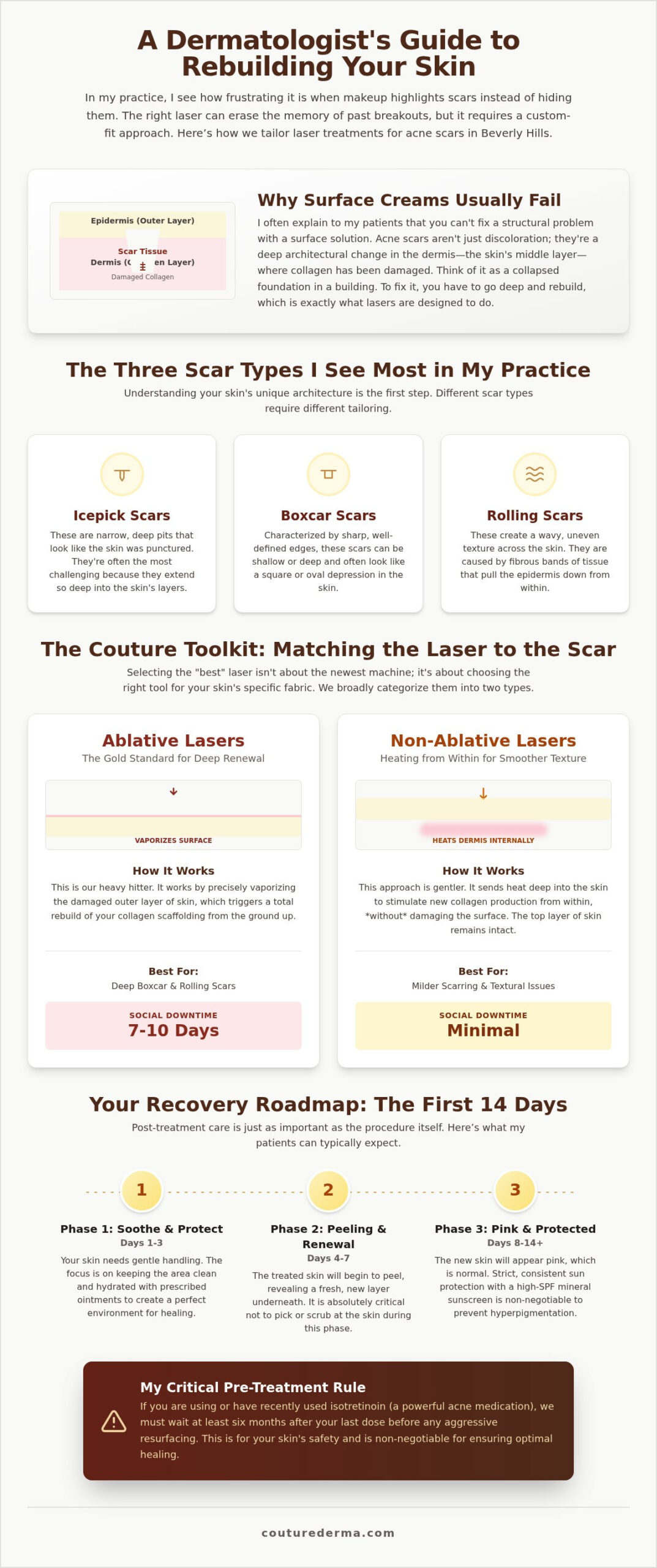
In my practice, I see patients who have spent years trying every luxury serum on the shelf, hoping for a miracle. But here’s the reality: topical creams usually fail because they can’t reach the dermis (the middle layer of skin) where the real damage lives. When you have a breakout, your skin goes through a complex wound healing response. If the body produces too much or too little collagen, which acts as the scaffolding that keeps your skin firm, the architecture of your skin is permanently altered.
Living in Southern California adds another layer of complexity to this journey. The year-round Beverly Hills sun can be a major obstacle because UV exposure often causes scars to darken. This makes finding an effective laser for acne scars beverly hills clinic a priority for many of my clients who are tired of hiding under heavy makeup.
The Three Scars I See Most: Icepick, Boxcar, and Rolling
I often tell my patients that treating scars is like tailoring a custom gown. You have to understand the biological fabric before you start. Icepick scars are narrow, deep pits that look like skin was punctured by a tiny tool. They are typically the most challenging to tailor because they reach so deep into the skin’s layers. Boxcar scars have sharp, defined edges, while rolling scars create a wavy, uneven texture across the cheeks.
Actionable tip: To see your skin’s true architecture, turn off the overhead lights in a dark room and hold a flashlight to the side of your face. This side-lighting will cast shadows that reveal which scar type dominates your skin.
The “Ghost” of Acne: PIH vs. True Scarring
It’s vital to distinguish between a “ghost” and a “pit.” Many people come to our practice frustrated by dark spots, which we call PIH (post-inflammatory hyperpigmentation). These are just pigment changes, not actual changes in skin texture. Resurfacing a deep pit requires different skin rejuvenation techniques than simply fading a temporary spot.
Actionable tip: If you are currently using isotretinoin (a potent acne medication), wait at least six months after your last dose before scheduling an aggressive resurfacing treatment to allow your skin’s healing capacity to return to normal.
Understanding this distinction is the first step in your transformation. You can read more about what a dermatologist wants you to know about acne to see how these issues begin.
The Couture Toolkit: Selecting the Right Laser for Your Skin’s Architecture
Selecting the right laser for acne scars in Beverly Hills isn’t just about finding the newest machine. It’s about choosing the right needle for the silk. In our practice, we view your skin as a unique biological fabric that requires a custom-fit approach. We generally categorize our tools into two groups: ablative and non-ablative. Ablative lasers work by removing the outer layer of skin to force a fresh start; meanwhile, non-ablative lasers heat the tissue from within to stimulate collagen without damaging the surface.
I see patients who are confused by the endless options available in the 90210 area. But here’s the thing: the “best” laser is simply the one that reaches the specific depth of your scarring. Different wavelengths target different layers. We might use a deeper reach for a thick rolling scar and a more superficial touch for fine texture issues. Laser resurfacing for acne scarring is a highly technical process that requires matching energy to your skin’s specific architecture. You can learn more about our specific approach to acne scar refinement during your consultation.
CO2 Laser: The Gold Standard for Deep Renewal
The CO2 laser is essentially the heavy hitter of dermatology. It works by vaporizing damaged tissue, which sounds intense, but it’s what triggers a total rebuild of your collagen scaffolding. I typically recommend this for patients with deep boxcar or rolling scars who want a permanent, high-impact change. It essentially “resets” the skin’s memory of past trauma.
Actionable tip: If you choose a CO2 treatment, plan for about 7 to 10 days of social downtime. You’ll likely want to avoid being on camera or attending major events while your skin goes through its initial peeling phase.
Fractional Lasers: Precision Refinement with Minimal Downtime
Fractional lasers take a pixelated approach to healing. Instead of treating the entire surface, the laser creates thousands of microscopic treatment columns. Because the surrounding tissue stays intact, the skin heals much faster. This is often the ideal choice for a busy Beverly Hills lifestyle. It minimizes the risk of crusting and allows you to get back to your routine sooner. I often suggest a series of 3 to 5 sessions to achieve the most refined, light-reflective result.
Actionable tip: To maintain your results after any laser session, apply a broad-spectrum SPF 30 or higher every single morning, even if you’re just driving. The Southern California sun through a car window can still trigger pigment changes in healing skin.
If you’re ready to see which tool fits your skin’s needs, you can schedule a personalized assessment with our team.
The Fitzpatrick Factor: Why Inclusive Laser Care is Non-Negotiable
I see patients who have been told for years that they simply aren’t candidates for laser treatments. It’s a common misconception that lasers are only for fair skin, but that’s just not true. In my practice, we use the Fitzpatrick Scale (a system to classify skin types by how they react to UV light) to ensure we’re using the right settings for every individual. When you’re looking for a laser for acne scars in Beverly Hills, you need an expert who understands that high-melanin skin (Types IV-VI) requires a different strategy. We often use lower heat and longer pulses to protect your skin while still getting those smooth, refined results.
Everyone deserves skin that makes them feel confident, regardless of their background. The Couture philosophy is built on the idea that technology should be adapted to the person, not the other way around. Let’s be honest: the settings on a machine matter far more than the brand name on the box. It’s about the settings, not just the technology itself.
The Risk of Post-Inflammatory Hyperpigmentation (PIH)
One of the biggest fears for my patients with darker skin is PIH (dark spots that appear after an injury or treatment). This happens because melanocytes (cells that produce skin pigment) can overreact to the heat of the laser. To prevent this, I often pre-treat the skin with medical-grade brightening agents to quiet these cells before we ever start the procedure. Think of it like preparing a canvas before you begin to paint.
Actionable tip: Use a broad-spectrum SPF 50+ every day for at least two weeks before your appointment. This helps stabilize your pigment and reduces the chance of unwanted dark spots appearing after your session.
Erbium vs. CO2 for Diverse Tones
While CO2 is excellent for deep texture, Erbium lasers are often a gentler touch for my patients with deeper skin tones. Erbium is more easily absorbed by water in the skin, which means it typically generates less heat than a CO2 laser. We also rely on chilled tips and advanced cooling technology to keep the surface of your skin safe while the laser works its magic underneath. In my practice, I often spend more time on the prep than the procedure itself.
Actionable tip: If you have a history of keloids (raised, thick scars that grow beyond the original injury), make sure to mention this during your consultation. We may need to adjust the intensity of the treatment or use specific post-care protocols to keep your skin healing smoothly.
The Recovery Roadmap: How to Protect Your Post-Laser Glow
Think of your laser treatment as the master tailoring of a gown. The procedure itself is the cutting and stitching, but the recovery is the delicate hand-finishing that ensures the garment sits perfectly. In my practice, I tell patients that while the laser for acne scars in Beverly Hills starts the transformation, your cells do the heavy lifting during the first 14 days. One of the biggest mistakes I see is people letting their skin get too dry. We want a moist environment, not scabbing. Scabs are biological roadblocks that slow down the reconstruction of your skin architecture.
Actionable tip: Keep your post-care balms in the refrigerator. The cooling relief helps significantly with swelling and feels incredible on skin that’s still feeling the heat from the procedure.
What do I do for the first three days?
During the first 72 hours, we focus on the Vinegar and Vanicream phase. I often recommend gentle vinegar soaks to keep your skin’s pH balanced and keep bacteria away. Use a ratio of one tablespoon of white vinegar to one cup of cool water. It’s normal to see redness and mild swelling. Your skin will likely feel like sandpaper. But here’s the thing: you must follow the hands-off rule. Picking at even a tiny flake can create a new scar, undoing all the work we just did.
Actionable tip: When doing your vinegar soaks, use a clean, soft washcloth and gently press it to your face rather than rubbing. Rubbing can disrupt the healing outer layer of skin and lead to irritation.
When can I use my regular products again?
By week two, we can usually start reintroducing your actives. But you have to be careful. I have a strict 20-minute tretinoin rule: wait at least 20 minutes after cleansing before applying your retinoids (vitamin A derivatives) to prevent unnecessary irritation. This is also the time to lean into Vitamin C. It is your best friend for collagen synthesis (the process of building new skin protein) post-laser. Most of my patients pass the Dinner Party Test around day 10. This is when they feel confident enough to show off their new glow without heavy camouflage.
Actionable tip: If you’re reintroducing Vitamin C, start with a lower concentration, around 10 percent, to ensure your newly resurfaced skin can handle it without stinging.
Actionable tip: Switch to a silk or satin pillowcase during the first 14 days of recovery. This reduces friction on your face while you sleep, which helps prevent premature peeling of the healing skin.
If you’re ready to start your own skin transformation, you can book your consultation online today.
Your Transformation Journey: The Couture Dermatology Experience
In my practice, I often tell patients that we aren’t just treating a skin condition; we’re reconstructing a narrative. The Couture Consultation is where this journey begins. We don’t just look at the scar. We look at the person. We analyze how your skin moves, how it reflects light, and how it has healed in the past. When you seek a laser for acne scars in Beverly Hills, you’re looking for more than just a machine. You’re looking for a specialist who understands textural harmony.
I see patients who have tethered scars. These are indentations held down by deep fibrous bands. In these cases, a laser might not be enough on its own. We often combine our technology with subcision (breaking up scar bands) or dermal & lip fillers to lift the skin back to its original plane. This creates a 3D result that looks natural and smooth. You can explore our full approach to Acne Scar Refinement at Couture Dermatology to see how we blend these techniques.
Why a Harvard-Trained Eye Matters for Your Face
The difference between a refined result and a disappointing one often comes down to the person behind the device. Clinical experience is essential for distinguishing between different types of tissue and knowing exactly how much energy to apply. One-size-fits-all med spas can sometimes lead to grid-like scarring or poor results because they use generic settings. If you wouldn’t buy a bespoke suit off a generic rack, why treat your face any differently? My Harvard-trained background allows me to approach your skin with scientific rigor and an artistic eye.
Taking the First Step Toward Refinement
Your transformation is a collaborative journey. It isn’t a series of transactional appointments but a path toward reclaiming your self-assurance. When you’re ready to start, booking your visit is simple. But I do have one request: bring your current skincare list. Knowing what you use daily is a must for me to design a safe and effective protocol. And don’t worry about being perfect. We’re your partners in this.
Actionable tip: Stop using all physical exfoliants, such as scrubs or cleansing brushes, at least one week before your consultation. This ensures I can see your skin’s natural baseline without temporary irritation.
Let’s be honest. You aren’t just fixing a problem. You’re erasing the memory of past breakouts and stepping into a version of yourself that feels vibrant. It’s time to reclaim your confidence and discover how we tailor our treatments for your unique skin.
Reclaim Your Skin’s Natural Harmony
Acne scars don’t have to be the final word on your complexion. These textures are simply a record of how your skin once healed, but they aren’t permanent. By choosing a laser for acne scars in Beverly Hills that matches your unique biological fabric, we can reconstruct that architecture from the inside out. Whether we use a deep CO2 reset or a gentle Erbium touch for diverse skin tones, the goal is always a smooth, light-reflective finish that feels like you.
In my practice, I combine Harvard-trained expertise with a deep commitment to inclusive care. We don’t believe in one-size-fits-all settings because your skin deserves a bespoke clinical protocol tailored to your specific needs. It’s about more than just a procedure; it’s a collaborative journey toward self-assurance. If you’re ready to erase the memory of past breakouts and see a more refined version of yourself in the mirror, the next step is simple. You can begin your skin transformation at Couture Dermatology today. Let’s work together to give your skin the meticulous care it deserves.
Common Questions About Acne Scar Treatment
Is laser for acne scars painful, or just uncomfortable?
Most patients tell me it feels like a series of quick, hot rubber band snaps against the skin. In our practice, we prioritize your comfort by applying a high-potency numbing cream for at least 45 minutes before we begin. We also use integrated cooling systems to soothe the area during the procedure. While you’ll definitely feel some heat, it’s typically described as manageable rather than painful.
How many sessions will I need to see a real difference?
This depends entirely on your scar type and the specific laser we choose for your skin architecture. If we use an aggressive CO2 laser, you might see significant improvement in just one session. But for fractional treatments, I typically recommend a series of three to five sessions spaced about four to six weeks apart. This gradual approach allows your collagen (the protein that keeps skin firm) to rebuild steadily.
Can I get laser treatment if I still have active breakouts?
I generally advise clearing active acne before we start the resurfacing process. If you have active cysts or pustules (pimples filled with fluid), the laser heat can sometimes trigger more inflammation. We want to stop the fire before we try to repair the charred wood. In most cases, I’ll put you on a medical dermatology protocol first to stabilize your skin so your results are permanent.
What is the average cost of laser for acne scars in Beverly Hills?
Prices for a laser for acne scars in Beverly Hills vary widely based on the technology used and the size of the treatment area. A single session with a specialized dermatologist reflects the high-end equipment and the level of expert care required for safe results. During your consultation, we provide a clear breakdown of the investment needed for your specific tailoring plan, ensuring there are no surprises during your journey.
Will insurance cover my acne scar laser treatment?
In most cases, insurance companies view laser resurfacing for acne scars as a cosmetic procedure rather than a medical necessity. This means they typically don’t cover the cost. However, if your scarring is the result of a traumatic injury or a specific medical condition, it’s worth checking with your provider. Our office can provide the necessary documentation if you choose to submit a claim for an out-of-network review.
How long do the results of laser skin resurfacing last?
The results for indented textural scars are typically permanent because the laser actually stimulates the production of new, healthy tissue. Once those pits are filled with your own natural collagen, they don’t just disappear. But you have to remember that your skin will continue to age naturally. To protect your investment, I tell patients to use a medical-grade SPF 30 every day to prevent new sun damage.
Can I go back to work the next day after a fractional laser?
You can often return to work the next day if you don’t mind looking like you have a moderate sunburn. Your skin will likely be red and slightly swollen, and it might feel a bit rough. But unlike older lasers, fractional technology leaves tiny bridges of healthy skin that speed up healing. If your job involves being on camera, you might want a two-day buffer for the initial redness to fade.
What happens if I have a history of cold sores and want laser?
If you have a history of cold sores, it’s vital to let me know before your session. Laser heat can sometimes trigger a breakout of the herpes simplex virus (the virus that causes cold sores). In my practice, I routinely prescribe a short course of antiviral medication to start a day or two before your laser for acne scars in Beverly Hills appointment. This simple step prevents the virus from interfering with healing.