

You’ve tried a brightening product, watched the patches fade, then noticed them return after a stretch of sunny days. If you’re considering melasma laser treatment Los Angeles clinics offer, you may be wondering whether a laser could help or make the discoloration more noticeable. That’s a reasonable question. When products haven’t given you a clear direction, a dermatologist can help you understand what may be causing the patches and which options are worth discussing.
Melasma can recur, and laser isn’t the best first step for everyone. This guide explains how a dermatologist may assess whether laser belongs in your care, what risks and limitations to discuss, and how skin tone, treatment history, and daily sun exposure can shape the decision. You’ll also find questions to bring to a consultation, so you can compare options and understand what a personalized plan may involve.
Key Takeaways
- Melasma laser treatment Los Angeles options should be considered as part of a clinician-guided plan, not chosen by device claims alone.
- Ask how your diagnosis, skin tone, and treatment history affect the potential benefits and risks of laser.
- Compare device-based options with sun protection and clinician-guided treatments before deciding on a sequence.
- Before committing, ask who will assess you, who will perform the procedure, and how progress and follow-up will be handled.
- A dermatologist can help tailor a plan and determine whether laser belongs in your care at all.
What should you know before considering melasma laser treatment in Los Angeles?
You’ve tried a brightening product, watched the patches soften, then noticed them darken again after time outdoors. Before choosing melasma laser treatment Los Angeles providers offer, it helps to understand what may be causing the discoloration. Melasma causes recurring patches of darker skin linked to excess pigment production by melanocytes, the cells that produce skin pigment.
Melasma is a recurring skin condition that causes darker patches when pigment builds up in areas of the skin, often on the face. You can read more about what melasma is, but an online description can’t confirm what’s causing your particular spots. Laser may be one option, but it isn’t an automatic first choice. A dermatologist needs to consider your skin and history before recommending a treatment.
This video shows a laser treatment for pigment spots. It isn’t a guide to whether laser is appropriate for melasma.
How is melasma different from other dark spots?
Melasma often appears as flat, brown or gray-brown patches across the cheeks, forehead, bridge of the nose, or upper lip. The pattern can offer clues, but appearance alone doesn’t confirm the cause. Sun spots, marks left after skin irritation, and other forms of hyperpigmentation, meaning areas with extra skin pigment, can look similar.
If a mark is new, changing, or uncertain, have a dermatologist assess it rather than assuming it’s melasma or treating it with a laser. The right approach depends on the diagnosis, your skin tone, and what may have triggered the change.
Why can melasma be emotionally frustrating?
Melasma can fade and return, so it’s understandable to feel discouraged after trying products without clear guidance. It can be difficult to tell whether a new product is helping or irritating your skin. A careful assessment can replace some of that trial and error with a plan based on your skin and treatment history.
Before your consultation, take a photo of the affected areas in consistent lighting and make a short list of products you’ve used, when you started them, and any changes you noticed. Bring it with you. These details can help the dermatologist assess the pattern and discuss whether laser belongs in your care plan.
Could laser help melasma, or make pigmentation more noticeable?
It’s natural to hope a laser can fade stubborn patches. But some laser approaches can irritate the skin and may make pigmentation more noticeable in certain patients. During a melasma laser treatment Los Angeles consultation, the decision shouldn’t be based on the spot alone. The first steps are to clarify the diagnosis and consider how your skin has responded to past care.
Laser suitability for melasma depends on the diagnosis, your skin tone, your treatment history, and a clinician’s assessment, because the same approach may affect people differently. There isn’t one device or plan that can be recommended for every patient. The American Academy of Dermatology’s overview of melasma treatment options also describes laser as one possible part of care, rather than a universal solution.
Who might be considered for a laser-based approach?
Before discussing a device-based option, a dermatologist may review the pattern of pigmentation, your skin tone, any history of irritation or dark marks after inflammation, and what you’ve already tried. If melasma has returned or your skin became more sensitive during earlier care, those details are relevant. They can help guide a discussion about possible benefits, risks, and alternatives, but they don’t by themselves determine whether you’re a candidate.
Treatment choices should be tailored to the person, not just the device. Couture Dermatology & Laser Beverly Hills offers laser treatments, including laser skin resurfacing, but a consultation is needed to discuss whether a laser approach has a role in your care for melasma. Don’t assume a particular treatment is appropriate without an individual assessment.
What risks and limitations should you discuss?
Ask what irritation may look or feel like, whether pigment could darken or change, and what the clinician would do if your skin reacts. Melasma can recur even after it improves, so laser shouldn’t be presented as a permanent fix. No particular number of sessions or result can be promised without knowing your case.
Before deciding, ask how your response will be monitored and when the plan might be adjusted. If the chance of irritation or pigment changes concerns you, or the diagnosis isn’t certain, ask whether another approach is more appropriate. A careful consultation should leave room for that conversation, not rush you toward a procedure.
How does laser compare with other melasma treatment options?
It’s tempting to compare treatments by how quickly a device promises to change the skin. Instead, consider the role each option may play. The American Academy of Dermatology outlines several approaches, and a dermatologist can help you weigh them in light of your diagnosis and past care.
| Option | Possible role | What to keep in mind |
|---|---|---|
| Clinician-guided care applied to skin | A dermatologist may recommend prescription treatments based on your skin and history. | Suitability and instructions vary. Prescription care needs medical guidance. |
| Sun protection | A regular part of managing melasma alongside other approaches. | Daily habits matter; protection doesn’t replace assessment or other care. |
| Device-based options | A dermatologist may discuss a laser or another device for selected cases. | Possible benefits and risks depend on the diagnosis, device, and individual skin response. |
There isn’t one best sequence for everyone. A dermatologist may consider what you’ve tried, whether your skin became irritated, and how the discoloration changed before discussing whether melasma laser treatment Los Angeles patients are considering belongs in a broader plan. A device is a medical choice, not a cosmetic promise, and marketing claims aren’t a substitute for an individualized assessment.
When might a dermatologist discuss treatments applied to skin?
Prescription treatments applied to skin may be discussed after a clinician reviews your diagnosis, skin history, and possible risks. Tretinoin is a prescription retinoid, a medicine related to vitamin A, and it isn’t suitable for every patient. Use it only as advised by your clinician. If it’s prescribed, follow this guidance: Wait 20 minutes after cleansing before applying tretinoin.
What role does sun protection play alongside treatment?
Sun exposure can make melasma harder to manage, so daily sun protection may support a clinician-directed plan. It doesn’t replace treatment or guarantee that patches won’t return. If you’re unsure how to make protection work with your commute, outdoor time, or daily routine in Los Angeles, ask your dermatologist for practical guidance.
Apply sunscreen 15 minutes before sun exposure. Follow the product directions, and ask your clinician how to fit sun protection around any prescribed care. The aim is a routine you can follow consistently, not a device chosen on the promise of a quick fix.
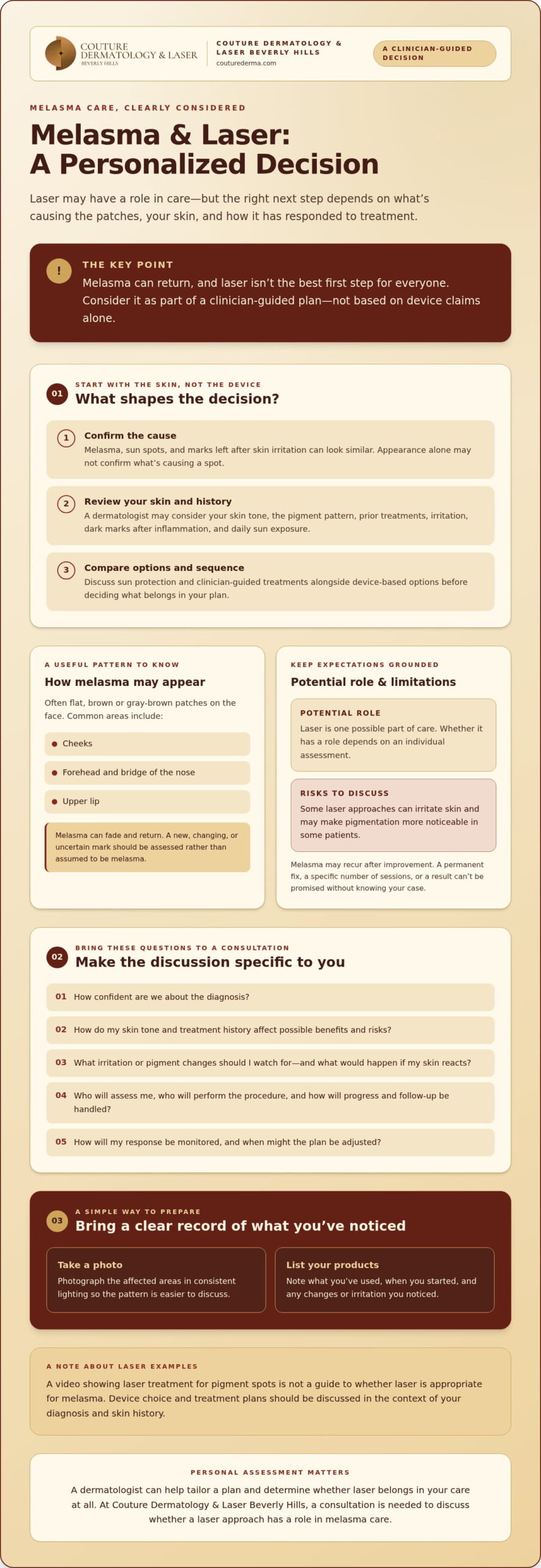
What should you ask before choosing melasma laser treatment in Los Angeles?
A thoughtful consultation should leave you understanding the diagnosis, the reason for the proposed approach, and what happens if your skin responds differently than expected. If you’re considering melasma laser treatment in Los Angeles, ask questions before making a decision. A sound plan should be tailored to your skin, not built around a device’s marketing claims.
What should happen during a careful consultation?
A dermatologist may review your skin history, current and past products, possible triggers, prior treatments, and what you hope to change. Bring a list of products you use and note any irritation or pigment changes you experienced. It’s also reasonable to ask how your skin tone and history of dark marks will shape the recommendation.
Use this checklist to guide the conversation:
- 1. Diagnosis: What supports the diagnosis of melasma, and could another cause explain these patches?
- 2. Options: What approaches could I consider besides laser, and why would you recommend this sequence for me?
- 3. Risks: What irritation or pigment changes should I watch for, and how would you respond if they occur?
- 4. Care team: Who will evaluate me, and who will perform the procedure?
- 5. Follow-up: How will you monitor my response, when should I check in, and what should I do if the pigmentation changes?
You can also ask for a plain-language explanation of why the suggested device and plan fit your case. If you’re comparing clinicians, look for a dermatologist who explains options and risks clearly; a guide to how to choose a dermatologist in Los Angeles can help you think through what matters to you.
How can you prepare and care for skin around treatment?
There isn’t one preparation or recovery routine that fits every laser. Follow your clinician’s specific instructions, and ask which products or activities to pause or continue rather than guessing. Before proceeding, make sure you know how follow-up works and who to contact if you notice unexpected irritation or darker patches.
At Couture Dermatology in Beverly Hills, these questions can guide a measured discussion of your choices. If you’d like to talk through your concerns and possible options, you can request an appointment.
How can a Beverly Hills dermatologist tailor your melasma plan?
You may come in hoping to discuss a specific laser. The first step is to understand what you want to change, what you’ve tried, and how your skin has responded. A medical assessment helps determine whether laser belongs in a broader melasma plan or whether another approach deserves attention first.
Couture Dermatology is a cosmetic and medical dermatology clinic in Beverly Hills, serving patients in Los Angeles. Led by Harvard-trained dermatologist Dr. Chinonso Kagha Abisogun, the practice provides personalized skincare treatments, including medical dermatology and laser treatments. The goal of a consultation is to help you understand the options and their limits, then consider a plan based on your skin rather than a device claim.
What does a tailored consultation help clarify?
A dermatologist may consider your goals, skin tone, history of irritation or pigment changes, and response to previous care. Those details can influence whether a device-based option is worth discussing and how it might fit with other clinician-guided care. You can ask directly whether a non-laser approach may be more appropriate, and why a particular sequence is being suggested.
General laser skin resurfacing guidance can explain what a procedure may involve, but it can’t determine whether laser is suitable for melasma in your case. Ask about a specific device only after confirming its current availability and role in the practice, and discussing whether it makes sense for you. You deserve a clear explanation, including what remains uncertain.
What is a simple next step if you are considering care?
Before a visit, jot down what you hope to improve, which products and treatments you’ve used, and any changes or irritation you noticed. This gives the consultation a more useful starting point. You can also bring questions about alternatives, possible risks, and how your response would be monitored.
A consultation at the Beverly Hills clinic is for assessment and planning, not a promise that you’ll have a procedure. If you’d like to talk through your concerns and possible options, you’re welcome to contact Couture Dermatology to arrange a consultation. The conversation can start with your skin and what, if anything, may belong in your plan.
Take the Next Step Toward a Thoughtful Melasma Plan
Laser may have a place in melasma care, but it isn’t the right choice for every person. The decision should start with a clear diagnosis and a careful review of your skin tone, treatment history, and possible risks. Because melasma can return, any discussion of melasma laser treatment Los Angeles should also include how you’ll manage your skin beyond a procedure.
Couture Dermatology is a Beverly Hills medical and cosmetic dermatology practice serving patients in Los Angeles. The clinic treats medical skin conditions, including melasma, and offers laser treatments. Led by Harvard-trained dermatologist Dr. Chinonso Kagha Abisogun, the practice provides personalized skincare treatments and can discuss whether laser, another option, or a broader plan may fit your needs.
If you’re ready to talk through your concerns, you can schedule a consultation to discuss your melasma care. The first step is a personal assessment, not a promise of a particular procedure. With clear information and a plan shaped around your skin, you can make your next decision with greater confidence.
Frequently Asked Questions
Is laser treatment a good option for melasma?
Laser can be an option for some people with melasma, but it isn’t the right starting point for everyone. A dermatologist should first confirm the diagnosis and review your skin tone, past treatments, and history of irritation or pigment changes. In some cases, a plan focused on sun protection and clinician-guided treatments applied to skin may be discussed before a device-based approach.
Can laser make melasma darker?
Yes, some laser approaches may irritate the skin and make pigmentation more noticeable in certain patients. The risk can depend on your skin and the treatment selected, so ask your dermatologist how they’ll assess your individual risk and monitor your response. If you notice unexpected irritation or darkening after treatment, contact the clinician who treated you for guidance rather than trying new products on your own.
How many laser treatments are needed for melasma?
There isn’t a fixed number of treatments that applies to everyone. The recommended plan depends on the diagnosis, the device being considered, your skin’s response, and your history with other care. Ask what the clinician will look for before suggesting another session, how progress will be reviewed, and what alternatives might make sense if your skin becomes irritated or the pigmentation changes.
What is the best treatment for melasma?
There’s no single best treatment for every person. A dermatologist may discuss sun protection, prescription treatments applied to skin, or a device-based option based on your diagnosis, skin tone, and previous care. Melasma can recur, so ask how the plan will support ongoing management, not just short-term fading. Be cautious of claims that a particular device can permanently clear melasma.
Does melasma come back after laser treatment?
It can. Melasma is a recurring condition, and fading after a procedure doesn’t mean the pigment can’t return. Sun exposure and other triggers may affect how it behaves over time. Ask your dermatologist what ongoing care may be appropriate for you, how to protect your skin day to day, and what signs should prompt a follow-up. A laser shouldn’t be presented as a permanent cure.
How do I choose a melasma laser dermatologist in Los Angeles?
Look for a dermatologist who can assess the diagnosis, discuss options beyond laser, and explain possible risks in terms you understand. Ask who evaluates you, who performs any procedure, and how your skin tone and prior pigment changes shape the plan. For melasma laser treatment in Los Angeles, Couture Dermatology in Beverly Hills is led by Harvard-trained dermatologist Dr. Chinonso Kagha Abisogun.
Should I try prescription treatment before considering a laser?
It’s worth asking your dermatologist whether prescription treatment should be considered before laser. The sequence depends on your diagnosis, previous treatments, skin sensitivity, and goals. Prescription medicines aren’t suitable for everyone and should be used under medical guidance. Bring a list of products and treatments you’ve tried, including any irritation or changes in pigmentation, so your clinician can help weigh the options.