

You notice a rough patch on your cheek that still feels like sandpaper after moisturizing. It may be actinic keratosis, a sun-related change in skin cells, but other skin concerns can look similar. I know it can be unsettling to wonder whether a spot could become skin cancer. If a patch persists or changes, have it assessed instead of guessing from its appearance.
I’m Dr. Chinonso Abisogun, a board-certified dermatologist with 15 years of experience. I’ll explain what a suspicious spot may look and feel like, how I assess it, and why a diagnosis can’t be made reliably at home. You’ll also learn how dermatologists approach treatment and follow-up, along with practical ways to protect your skin and know when to seek an assessment.
Key Takeaways
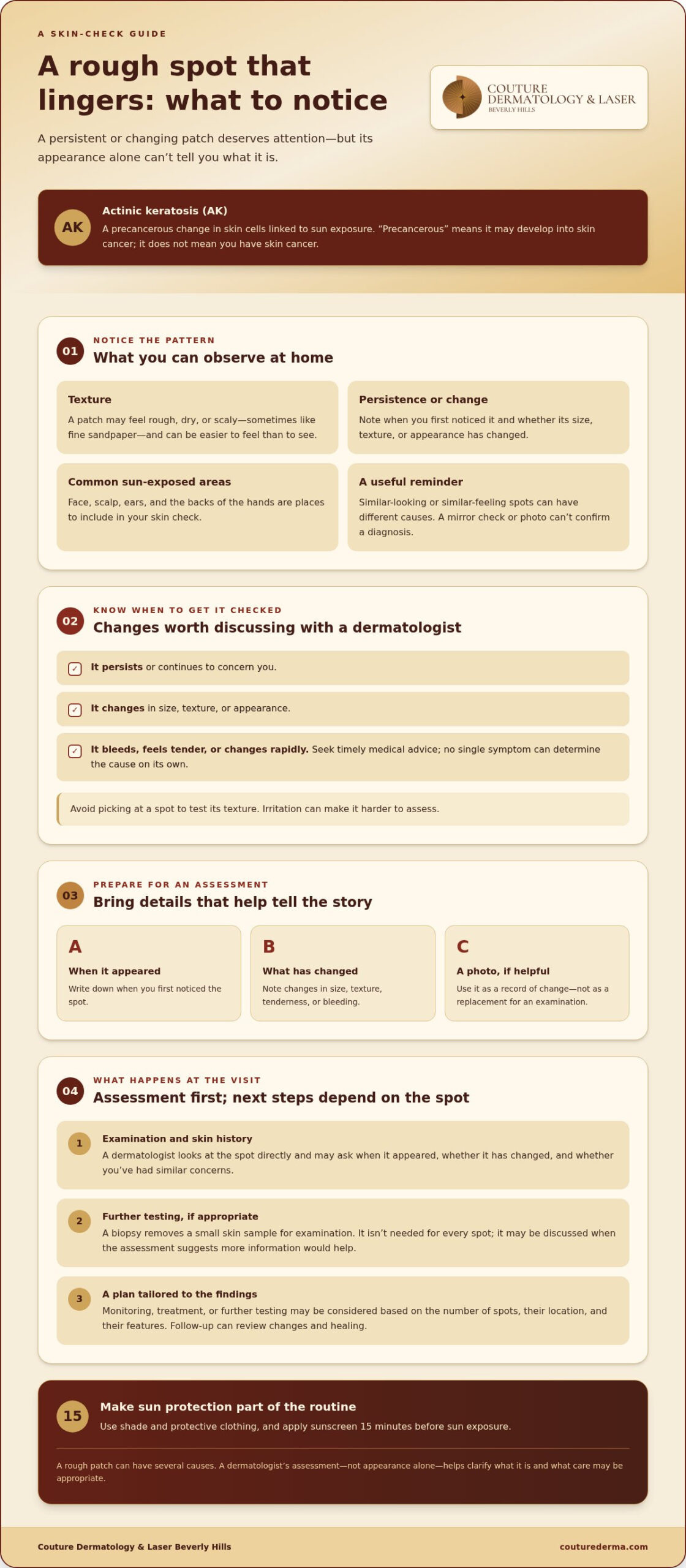
- A rough, persistent patch can have several causes, so notice changes rather than relying on appearance alone.
- Learn what actinic keratosis may look and feel like, and why a dermatologist’s assessment matters.
- Actinic keratosis is a precancerous skin change, but that does not mean you have skin cancer.
- A dermatologist can tailor treatment and follow-up to the spot’s number, location, and features.
- Make sun protection practical with shade, protective clothing, and sunscreen applied 15 minutes before sun exposure.
What Is Actinic Keratosis, and Why Does It Matter?
You find a rough patch while washing your face, and it’s still there weeks later despite your usual moisturizer. That can be frustrating, but appearance alone can’t tell you what the spot is. In my practice, I encourage patients to have persistent or changing patches assessed rather than trying to diagnose them at home. Note when you first noticed the spot and whether its texture, size, or appearance has changed.
Actinic keratosis is a precancerous change in skin cells linked to sun exposure; it is not, by itself, a diagnosis of skin cancer. “Precancerous” means the change may develop into cancer, so it deserves medical attention without being a reason to assume the worst. A dermatologist considers the spot’s appearance and feel, along with your skin history.
What causes actinic keratosis?
Repeated exposure to ultraviolet (UV) rays, part of sunlight that can damage skin, can affect skin cells over time. The effects may build gradually, so a spot can appear long after the exposure that contributed to it. This general link doesn’t establish what caused any one person’s patch. When you notice an area, record when it appeared and any changes you’ve seen to share at your assessment.
Who may develop actinic keratosis?
Sun exposure and your personal skin history help shape an assessment, but neither confirms a diagnosis. People of different ages and skin tones can develop sun-related changes, and the spots may look different across skin tones. During a skin exam, I consider the area itself and the broader pattern of changes. If you’re concerned about a spot, include it in your notes so you remember to point it out.
What Does Actinic Keratosis Look and Feel Like?
A spot can feel more noticeable than it looks. Some people describe a rough, dry, or scaly patch that catches a fingertip like fine sandpaper. It may be easier to feel than to see, especially if the change is subtle or blends with your skin tone. These are possible clues, not a way to confirm what the spot is.
In my practice, I remind patients that several skin concerns can look or feel similar. A dry patch, for example, may have a different cause, and a photo or mirror check can’t reliably tell you which one it is. The Skin Cancer Foundation describes actinic keratosis as the most common precancer, but a dermatologist still needs to assess an individual spot in context.
Try this: Note when you first noticed the spot and whether it has persisted or changed. Avoid picking at it to test its texture, since that can irritate the area and make it harder to assess. If you take a photo to help you remember how it looked, treat it as a record of changes, not a substitute for an examination.
Where can actinic keratosis appear?
These spots are often found on areas that receive regular sun exposure, such as the face, scalp, ears, and backs of the hands. Location can help guide a skin exam, but it doesn’t establish a diagnosis. As you observe your skin, include less-obvious areas that get sun, such as the edges of your ears or a thinning scalp.
When should a persistent spot be assessed?
Arrange a skin assessment if a spot persists, changes, or concerns you. Bleeding, tenderness, or rapid change are reasons to seek timely medical advice, though no single symptom can determine the cause or urgency on its own. I look at the spot directly and consider your skin history rather than relying on a photograph alone.
If you’d like a dermatologist to assess a spot, you can schedule a skin assessment with our clinic.
Can Actinic Keratosis Become Skin Cancer?
It can, but that doesn’t mean a spot will become cancer. Actinic keratosis is considered precancerous, which means it may develop into squamous cell carcinoma, a type of skin cancer that begins in cells near the skin’s surface. A precancerous spot carries a potential risk, not a certain outcome. An examination helps clarify what you’re dealing with and what care may be appropriate.
I understand why the word “precancerous” can sound alarming. It describes a reason to assess and manage a spot, not a cancer diagnosis. The Mayo Clinic’s overview of actinic keratosis symptoms and causes also explains the connection with squamous cell carcinoma. Your next steps depend on the spot’s clinical features and your skin history, not on a prediction based on appearance alone.
How does a dermatologist evaluate a suspected spot?
I assess the spot directly and may ask when you noticed it, whether it has changed, and whether you’ve had similar concerns before. A visual examination and your skin history help guide the assessment. You can’t reliably confirm the cause at home, even with a clear photo.
If the spot’s features call for more information, I may recommend a biopsy, which means removing a small skin sample so it can be examined. A biopsy isn’t needed for every spot. It’s one way to investigate a finding when an in-person assessment suggests further testing would be helpful.
Why might follow-up or biopsy be discussed?
Assessment findings help determine whether monitoring, treatment, or further testing makes sense. The plan is tailored to what I see; one approach doesn’t fit every spot. Follow-up also gives you a chance to discuss changes and review whether the area is healing or needs another look.
Before your appointment, jot down when you first noticed the spot and any changes in its size, texture, tenderness, or bleeding. Bring up anything that worries you, even if it seems small. Those details help me understand your concern and decide on a thoughtful next step with you.
How Is Actinic Keratosis Treated and Monitored?
If a dermatologist identifies actinic keratosis, the next step is to choose an approach based on the number of spots, where they are, and what they look like on examination. There isn’t one plan for every patient. I consider whether care should focus on a few individual spots or a broader area of sun-damaged skin, then explain the options and what recovery may involve.
What treatment approaches may a dermatologist consider?
For an individual spot, a dermatologist may use cryotherapy, which freezes the affected area to destroy the changed cells. If there are several spots or a wider affected area, a clinician may consider a prescription cream applied to the skin or a light-based approach. These options work differently, and the right choice depends on your clinical findings and care needs.
Ask me to explain the aim of the recommended treatment, how to use or prepare for it, and what changes to expect. That conversation can help you understand why one approach is being considered over another without assuming that every visible spot needs the same care.
What should you expect after treatment?
Some treatments can cause temporary redness, crusting, or irritation as the skin heals. The type and length of recovery depend on the approach used and the area treated, so I wouldn’t rely on a general timeline to judge your own healing. Follow the aftercare instructions your clinician gives you instead of adapting another person’s routine.
A practical step: Keep your treatment instructions somewhere easy to find, and make a note of any change that seems unexpected. Contact your clinician for guidance if you’re unsure whether what you’re noticing is part of the expected healing process.
Follow-up timing is also individualized. Before you leave, discuss when your clinician would like to review the treated area and what signs should prompt you to get in touch sooner. At Couture Dermatology & Laser Beverly Hills, medical dermatology includes skin exams, which can help put a spot and your broader skin health into context. If you have a persistent or changing concern, you can book a medical skin assessment.
How Can You Protect Your Skin and Get Expert Care in Beverly Hills?
Sun protection is a practical habit, not a way to erase past exposure or diagnose a spot you’ve already noticed. If a rough area persists or changes, arrange an assessment rather than waiting to see whether sunscreen makes it disappear. Prevention and evaluation have different roles: one helps limit ongoing exposure, while the other helps clarify what a spot may be.
What can you do to reduce ongoing sun exposure?
Build a simple routine around the times you’ll be outdoors. Seek shade when you can, and use protective clothing such as a long-sleeved shirt, a wide-brimmed hat, or sunglasses. Apply broad-spectrum sunscreen, which protects against both UVA and UVB rays, to exposed skin. Apply sunscreen 15 minutes before sun exposure, and follow its label for reapplication.
Make the routine easy to repeat: keep sunscreen near the items you take outside, and put on a hat before heading out. Consistency can support skin health, but it doesn’t replace having a persistent or concerning spot examined.
What happens when you book a skin assessment?
At our Beverly Hills clinic in Los Angeles, I focus the visit on the concern that brought you in, your skin history, and a clinical examination. I’m Dr. Chinonso Abisogun, a Harvard-trained, board-certified dermatologist with 15 years of experience. Tell me when you first noticed a spot, what changes you’ve seen, and what questions are on your mind. The assessment helps guide a considered next step.
If you’re unsure about a persistent or changing area, you don’t have to work out what it is on your own. A medical dermatology appointment gives you space to have it assessed and discuss a plan suited to your findings. Book a dermatology appointment.
Take the Next Step Toward Confident Skin Care
A rough or persistent spot can be unsettling, but you don’t have to identify it by appearance alone. Actinic keratosis is a precancerous change, not a confirmed skin cancer diagnosis, and a dermatologist can assess the spot and explain whether monitoring, treatment, or further testing is appropriate.
Keep up practical sun protection, note changes you observe, and arrange an assessment for a spot that persists or concerns you. At Couture Dermatology & Laser Beverly Hills, medical dermatology includes full skin exams. I’m Dr. Chinonso Kagha Abisogun, a Harvard-trained, board-certified dermatologist, and I can help you understand your skin findings and consider a thoughtful next step.
If you’re ready to have a spot assessed, book a personalized dermatology appointment. A clear assessment can replace uncertainty with a plan tailored to you.
Frequently Asked Questions
Is actinic keratosis skin cancer?
No. Actinic keratosis is generally described as a precancerous skin change, not a diagnosis of skin cancer. Some spots may develop into squamous cell carcinoma, a common type of skin cancer that begins in cells near the skin’s surface, but an individual spot’s risk can’t be judged from a description alone. A dermatologist can examine it and discuss whether monitoring, treatment, or further testing is appropriate.
Can actinic keratosis go away on its own?
A spot’s appearance may change, but that doesn’t confirm that it has resolved or is harmless. Several skin changes can look alike and have different causes, so don’t rely on a spot fading or seeming less noticeable as proof. If the area persists, returns, or changes, note what you’ve seen and discuss it with a dermatologist who can assess it directly.
How is actinic keratosis diagnosed?
A dermatologist may examine the spot and ask when it appeared and how it has changed. If more information is needed, the clinician may recommend a biopsy, which means taking a small skin sample for examination. The right assessment depends on the finding; a photo or online description can’t reliably establish a diagnosis. At Couture Dermatology & Laser Beverly Hills in Los Angeles, medical dermatology includes full skin exams, led by Harvard-trained, board-certified dermatologist Dr. Chinonso Kagha Abisogun.
What treatments are used for actinic keratosis?
Treatment is guided by a clinician’s assessment, including the spots’ number, location, and appearance. Options may include a procedure aimed at individual spots or a prescribed treatment for affected areas. The approach and recovery can vary, so ask what to expect and follow the care instructions for your specific treatment. Don’t start prescription medicine or try to remove a spot yourself without medical guidance.
Can sunscreen prevent actinic keratosis?
Sun protection can help reduce ongoing ultraviolet exposure, but it can’t diagnose or treat a spot that’s already present. Seek shade, wear protective clothing, and use broad-spectrum sunscreen as directed. Apply sunscreen 15 minutes before sun exposure. If you notice a persistent or changing area, arrange an assessment rather than relying on sunscreen alone. These habits support skin health, while an exam addresses an existing concern.
Is actinic keratosis contagious?
No. Actinic keratosis is a sun-related change in skin cells, not something passed from one person to another through ordinary contact. The word “precancerous” can sound frightening, but it doesn’t mean a spot is confirmed skin cancer. If you notice a rough or persistent area, focus on getting it assessed rather than avoiding contact or trying to identify it on your own.