

You like the shape of your face, but wish your skin looked a little fresher. You’re not looking for a fuller face or a change in your features. I hear that distinction in conversations about skinvive treatment beverly hills: the goal may be skin quality, not added volume.
I’m Dr. Chinonso Abisogun. I’ll explain what Skinvive is intended to address, how its role differs from other aesthetic treatments, and what a dermatologist may consider before recommending an approach. The right next step starts with your goals and a clear discussion of what each option can and can’t do.
Key Takeaways
- Clarify whether your priority is skin smoothness or a different concern before considering an injectable.
- Bring your skin history and previous treatments into the candidacy discussion. Suitability depends on an individualized clinical assessment.
- Compare treatments by the goal they’re meant to address, such as texture, volume, pigment, or scarring.
- Use a skinvive treatment beverly hills consultation to discuss the treatment rationale, alternatives, and expectations tailored to you.
- A personalized discussion at Couture Dermatology can help you understand the skin treatments our Beverly Hills clinic offers and shape a medically informed next step.
What is Skinvive and what skin goals does it address?
In my practice, I meet people who want their skin to look a little fresher but aren’t looking to change their facial shape. Others come in with a different goal entirely. The useful first step is naming what you want to improve, because “smoother skin” and “more facial volume” are not the same treatment objective.
Skinvive by Juvéderm is a hyaluronic acid injectable designed to improve skin smoothness in the cheeks and, under its current U.S. labeling, reduce horizontal neck lines and improve neck appearance in adults over 21. Hyaluronic acid, or HA, is a substance found naturally in the body that helps hold water. You can read more about Hyaluronic Acid. Skinvive is often described as a skin booster, a term used for injectables intended to support skin quality rather than restore facial volume.
What does Skinvive aim to improve?
The treatment’s labeled cheek goal is improved skin smoothness. Its current neck indication addresses horizontal neck lines and overall neck appearance. Skinvive may also be described as supporting hydration, but that language isn’t a promise that every person will see the same change. Your skin, medical history, and treatment plan all matter.
Here’s a practical way to prepare for a discussion: describe what you notice in your own words. Is your concern rough-looking texture, visible lines, or a sense that your face has lost fullness? If you can, look at the area in natural light and explain what “fresher” would mean to you. That gives a dermatologist a clearer starting point than choosing a product based on a trend.
How is Skinvive different from a traditional dermal filler?
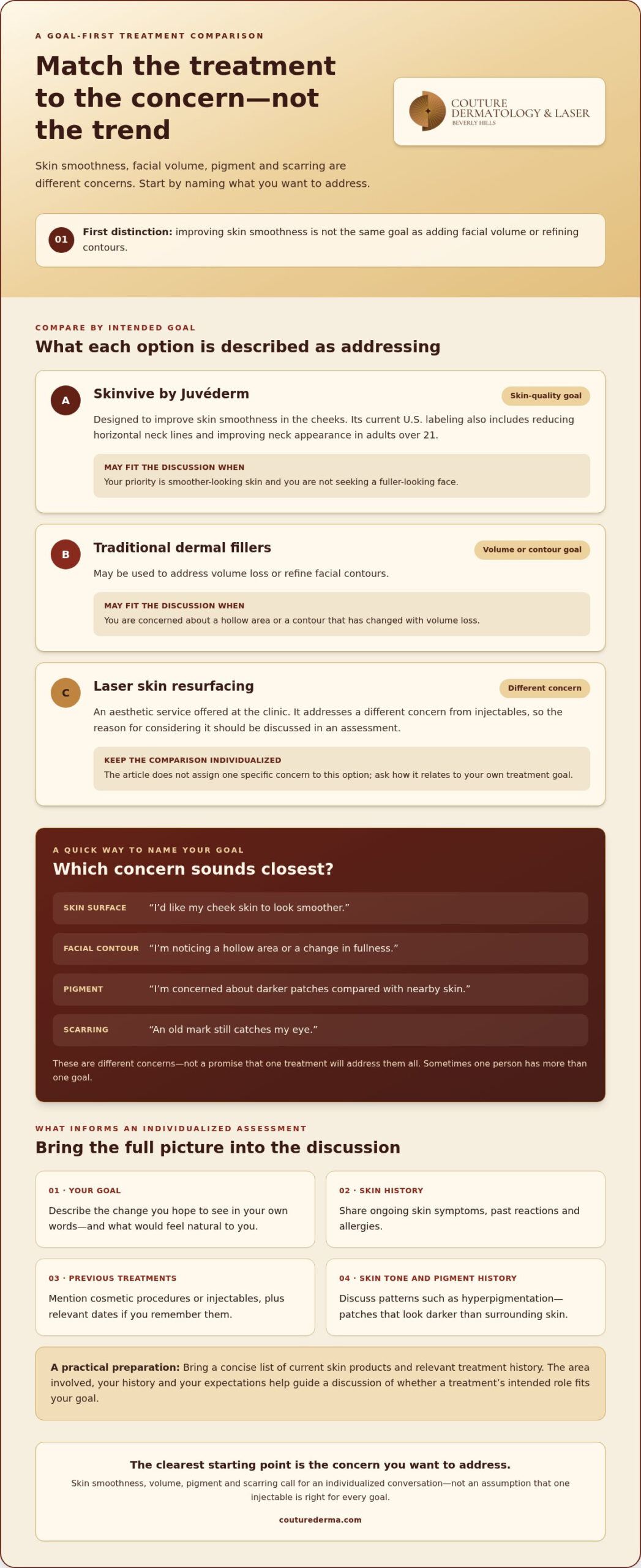
Skinvive and traditional dermal fillers are both injectable treatments, but their intended goals differ. Skinvive is designed to improve skin smoothness in its labeled areas. Dermal fillers may be used to address volume loss or refine contours. Neither description means one approach is right for every person. The best fit depends on the concern being assessed and your overall treatment goals.
For example, if you’re bothered by a less smooth cheek surface but don’t want a fuller-looking cheek, it’s worth discussing a skin-quality approach. If your concern is a hollow area or a contour that has changed with volume loss, a filler discussion may be more relevant. Sometimes a person has more than one concern, and one injectable may not address all of them.
That distinction matters when you search for skinvive treatment beverly hills. I focus on the goal you describe, the area involved, and whether the expected role of a treatment aligns with what you hope to see. At Couture Dermatology in Beverly Hills, our aesthetic services include dermal and lip fillers and laser skin resurfacing. Those treatments address different concerns, so a recommendation should follow an assessment rather than a product trend.
How does a dermatologist assess Skinvive candidacy in Beverly Hills?
You might come in saying, “I want my skin to look more refreshed,” without being sure what change would make the biggest difference. In my practice, I start by exploring what that means to you rather than matching you to a treatment based on a quick checklist. A useful assessment considers your goals, skin history, prior cosmetic treatments, and expectations together.
Skinvive’s FDA-cleared uses describe specific treatment goals, but that information can’t determine whether it’s right for you. You can review the Skinvive by Juvéderm FDA Approval and Information for product background. Personal suitability requires a clinical discussion. I consider whether your concern aligns with the treatment’s intended role and whether another approach may better fit what you’re hoping to address.
What should I share during a Skinvive consultation?
Start with the change you hope to see, in your own words. “I want my cheeks to look less dull” gives us a different starting point than “I want more definition.” I’ll ask what you’ve noticed, how long it’s been on your mind, and what result would feel natural to you. Clear expectations help us discuss realistic options without assuming an injectable is the answer.
Your skin history matters, too. Tell me about ongoing skin symptoms, past reactions, allergies, and previous cosmetic procedures or injectables. Bring a concise list of your current products and relevant treatment history, including approximate dates if you remember them. This practical step can help me understand what your skin has experienced and which questions deserve attention.
Why does skin tone matter in an individualized assessment?
Patients have a wide range of skin tones, and careful care means considering your skin as it is, not relying on a one-size-fits-all assumption. I look at the area you’d like to treat and ask about patterns such as hyperpigmentation, meaning patches of skin that appear darker than the surrounding skin. That history helps me understand your baseline and discuss relevant considerations.
Skin tone alone doesn’t establish whether Skinvive is suitable, and I don’t use it to make blanket promises about safety or results. I base the conversation on your individual history and the treatment’s verified labeling. If your expectations don’t match the intended goal, I’ll explain that and discuss other options that may be more appropriate. At Couture Dermatology, our Beverly Hills practice treats a diverse range of skin types, including deeply melanated skin.
If you’d like to discuss your skin concerns and the treatments available at our Beverly Hills clinic, you can request an appointment online.
Skinvive or another aesthetic treatment: which goal are you trying to address?
Sometimes a patient points to one area and describes several things at once: the skin looks uneven, a cheek seems flatter, and an old mark still catches their eye. Those concerns may sit close together, but they don’t automatically call for the same approach. I find it helpful to separate what you notice into skin surface, facial contour, pigment, or scarring before discussing options.
The comparison below is a starting point, not a diagnosis. Skinvive, dermal fillers, and laser resurfacing have different intended roles, so they aren’t interchangeable choices. In my practice, I assess the concern first, then explain which available options may fit your goals.
If your main goal is…
Skin texture or hydration: Skinvive is intended for specific skin-quality goals in its labeled areas. A discussion can clarify whether that purpose matches what you hope to address.
Volume or contour: Dermal fillers may be considered for concerns involving facial fullness or shape. The aim differs from a treatment focused on skin smoothness.
Surface texture or certain marks: Laser resurfacing is a distinct approach that may be discussed for selected surface concerns. At Couture Dermatology, laser skin resurfacing improves tone, texture, and clarity, including concerns such as scarring, sun damage, and uneven pigmentation. The right plan depends on the skin finding being assessed.
Pigment changes: Dark spots or uneven tone call for an assessment of the cause and pattern. Couture Dermatology offers hyperpigmentation correction, but a skin booster shouldn’t be assumed to address pigment concerns.
Acne scarring: Scars may need their own evaluation because their appearance and depth can vary. Skinvive shouldn’t be presented as a scar treatment without supporting evidence.
When is the concern about skin quality rather than facial volume?
Try describing what you see without naming a treatment. “My skin looks rough in this light” points toward a surface concern; “my cheek looks less full” describes a contour or volume concern. These phrases don’t diagnose the issue, but they give your dermatologist a clearer way to understand your priority and discuss whether Skinvive or another category is relevant.
If you’re considering a skinvive treatment beverly hills, bring up every goal that matters to you, even if one seems minor. I can then help distinguish the main concern from secondary ones and explain why a particular option may or may not address them. For broader surface concerns, laser resurfacing is a separate treatment category. At our Beverly Hills clinic, the approach is tailored to the skin finding being assessed.
What if acne scarring or under-eye concerns are the priority?
If an old acne mark is what bothers you most, a separate scar-focused conversation may be more useful than assuming a skin-quality injectable will address it. Our acne scar refinement approach addresses scarring as its own concern, with the assessment guiding the discussion.
Under-eye changes also deserve a focused evaluation. Shadowing, color, and contour can have different causes, so don’t assume Skinvive is intended for that area. Naming the concern clearly helps keep the conversation grounded in what each treatment is designed to do.
What should you ask before choosing Skinvive treatment?
A good consultation should leave you clearer about the goal, the reasoning behind a recommendation, and what to expect from your individual plan. You don’t need to arrive with medical language or decide in advance that Skinvive is right for you. Bring your questions, describe what you’d like to change, and give yourself room to consider the answer.
It can help to move through the discussion in a simple order:
- What concern are we addressing? Ask what specific skin change the dermatologist believes Skinvive is intended to address in your case. Make sure the proposed goal matches what you’ve described, rather than assuming the treatment covers every concern in the area.
- Why might this approach fit? Ask how the recommendation relates to your goals and which parts are based on verified product information. Product labeling describes general uses; it doesn’t establish your personal suitability or predict your result.
- What alternatives should I consider? Ask whether another treatment category may better match your priority, especially if you’re seeking a change in facial volume, pigment, or scarring rather than skin smoothness.
- What applies to my plan? Ask which product-specific details, potential risks, and aftercare instructions are relevant to you. Your clinician should explain the guidance for the plan being discussed instead of relying on assumptions about every injectable.
Which questions help clarify the treatment plan?
Listen for a clear connection between your concern and the proposed approach. If you say you want a subtle change in how your skin looks, ask what the treatment is expected to address and what it isn’t intended to change. In my practice, that distinction keeps the conversation practical and supports a decision based on your goals, not a promise.
You can also ask how your medical and cosmetic treatment history affects the discussion. Share any prior injectables, procedures, or reactions that may be relevant, then ask whether they change the options being considered. The purpose isn’t to steer you toward treatment; it’s to make sure the reasoning is tailored to you.
How can you set realistic expectations?
Before the appointment, write down what “natural” or “refreshed” would mean to you. A specific description, such as wanting skin to look smoother without changing facial fullness, gives your dermatologist something concrete to discuss. Note questions as they come up, too. It’s easy to forget them once you’re in the room.
Ask what kind of change is reasonable to discuss for your particular concern, and which details remain uncertain for an individual patient. I won’t promise a fixed result or timeline. The conversation should separate known product information from clinical judgment about your suitability. That’s especially useful if you’re weighing a skinvive treatment beverly hills consultation against other options.
If you’d like to talk through your skin goals and the treatments offered at our clinic, you can request an appointment online.
How does a Skinvive consultation at Couture Dermatology in Beverly Hills begin?
You don’t need to arrive with a decision already made. A consultation at Couture Dermatology & Laser Beverly Hills begins with a conversation about what you’ve noticed, what you’d like to change, and what matters to you in an aesthetic result. I’ll also ask about your skin history, current concerns, and previous treatments so we can consider your goals in context.
I’m Dr. Chinonso Abisogun, a Harvard-trained, board-certified dermatologist, MD, FAAD. I completed a cosmetic and laser fellowship at Harvard Medical School and Massachusetts General Hospital’s Wellman Center. In our Beverly Hills clinic, I draw on my medical and cosmetic dermatology background to help you understand the options we offer and their intended roles, without treating a product description as a promise about your individual outcome.
What does couture-level personalization mean in practice?
It means your plan is customized specifically to you. I consider how your skin has responded to past treatments, your lifestyle, and the change you hope to see before discussing suitable options. Your priorities might include a subtle skin-quality improvement, while another patient may be weighing an entirely different concern. The discussion should reflect those differences.
We’ll also talk through what a treatment is intended to address and what it may not address. If your main goal points toward another approach, I’ll explain the distinction and discuss suitable options with you. Personalization isn’t about adding more treatments; it’s about matching the plan to your needs and setting expectations grounded in a clinical assessment.
You can make the conversation easier by bringing a brief list of your goals, skin history, current products, and prior cosmetic treatments. You might write, “I’d like my skin to look smoother, but I don’t want to change my facial fullness.” That gives us a concrete starting point and helps keep the consultation focused on what matters to you.
How can you take the next step in Beverly Hills?
If you’re considering a skinvive treatment beverly hills, the next step is a personalized discussion about your skin goals, not a commitment to proceed with a particular treatment. We can talk through relevant product information and consider whether its intended role aligns with what you hope to address. At Couture Dermatology & Laser Beverly Hills, I can also explain the laser and aesthetic treatments our Beverly Hills clinic offers for concerns such as texture, scarring, and facial volume.
When you’re ready to discuss your goals, you can book an appointment online with Couture Dermatology & Laser Beverly Hills. I’ll help you explore a thoughtful next step based on your skin and priorities, without promising a particular result.
Take the next step at your own pace
You don’t have to arrive with a decision about Skinvive already made. Start with the change you hope to see, then use a consultation to understand whether that goal fits the treatment or calls for another approach. That keeps the focus on your priorities, not on choosing a procedure before you’ve had a chance to discuss your skin.
If you’re considering a skinvive treatment beverly hills, bring the questions that matter most to you and allow space for an honest conversation about what may be appropriate. A personalized assessment can help you move forward with more clarity, whether Skinvive is relevant to your goals or another treatment better fits the concern.
Arrange an appointment with Couture Dermatology in Beverly Hills when you’re ready to discuss your skin goals and available treatment options. A thoughtful next step can begin with a conversation, and you deserve to feel informed and comfortable as you decide what comes next.
Frequently Asked Questions
What is Skinvive treatment designed to address?
Its labeled uses are specific, so check that the area and goal being discussed match current product information. In a consultation, you can ask, “Is this use within the product’s FDA labeling, and what change are we aiming for?” That question helps separate approved product information from broader descriptions or personal predictions. The label can inform your decision, but it can’t tell you exactly how your skin will respond.
Is Skinvive the same as a traditional dermal filler?
No. The useful distinction is the result being sought, not simply the fact that both are injectables. Before deciding, describe the feature you want to change and ask the dermatologist to explain how the proposed option is meant to address it. If the explanation focuses on a different goal than yours, pause and clarify the mismatch before making a decision.
Who may be a candidate for Skinvive treatment?
Adults who are considering a goal within Skinvive’s labeled uses may discuss it with a dermatologist, but age and treatment goals alone don’t settle whether it’s appropriate. A clinician can review your health background and the details of your plans before advising you. If you take medication or have a health concern you’re unsure is relevant, include it in that discussion rather than leaving it out.
Can Skinvive be considered for different skin tones?
Skin tone doesn’t by itself answer whether Skinvive is appropriate. To make the discussion more specific, note whether you’ve had lasting marks or unusual skin changes after past procedures, and mention them to your dermatologist. You can also bring a photo that shows the concern clearly in ordinary lighting. These details add context without treating skin tone as a stand-in for your individual skin history.
How should I prepare for a Skinvive consultation in Beverly Hills?
Set aside your questions before the appointment and decide which one you most want answered. You might ask how the recommendation relates to current product labeling or what options could fit if your goal calls for a different approach. If you’re researching skinvive treatment beverly hills, this short list can keep the conversation focused and help you leave with a clear understanding of the options discussed.
Can Skinvive be discussed alongside other aesthetic treatments?
Yes, you can bring up more than one aesthetic concern in the same consultation. That doesn’t mean each concern needs treatment or that different treatments should happen together. Ask the dermatologist to explain whether the options are being considered as separate choices or as parts of a broader plan. Understanding that distinction can help you weigh each recommendation on its own merits.