
You look at a recent photo and notice your jawline doesn’t match the shape you’d pictured. You’re considering jawline contouring as an African American man in California, but want an approach tailored to you, not borrowed from someone else’s face.
That hesitation makes sense. Aesthetic changes are personal, especially when you want to refine your appearance without losing the features that feel like you.
I’ll explain how jawline contouring may affect facial proportions, what can shape candidacy, and how treatment planning and recovery can differ. You’ll have a clearer starting point for deciding what questions to bring to a consultation.
Key Takeaways
- Look at how your chin, jaw angle, and overall facial width work together before deciding what kind of definition you want.
- Understand how filler and masseter Botox address different features, so you can discuss an approach that fits your goals.
- Consider candidacy in light of your facial structure, treatment goals, and whether the concern is muscle prominence, chin projection, or fullness beneath the chin.
- Plan around the treatment you choose: swelling, bruising, and downtime can differ between non-surgical and surgical approaches.
- A tailored plan can refine the jawline while preserving the proportions and features that make your face your own.
How Does a Defined Jawline Affect Masculine Facial Proportions?
A defined jawline can change how your chin, lower face, and neck appear in relation to one another. Natural-looking contouring starts with your facial structure and the specific change you want, not a preset ideal.
Masculine Anatomy and Natural-Looking Results
Masculine jawlines are often wider and higher, with a heavier middle section, a sharper chin-to-jaw angle, and a flatter base. These features are a reference, not a template: your chin projection, jaw width, and facial proportions determine what looks balanced on you. Natural-looking results respect those details instead of simply making the jaw larger or sharper.
For surgical contouring, look for a surgeon board-certified in a relevant specialty, such as plastic surgery, with specific facial surgery training and experience. Ask how the plan accounts for your bone structure, your goals, and the changes you want to avoid.
In California, relevant specialists may include board-certified plastic surgeons and facial plastic surgeons experienced in jaw procedures. Look for experience treating a range of African American facial features and skin tones; no single facial type represents everyone.
Facial Profile and Jaw-Neck Definition
Jawline contouring can refine the lower face’s width and angles, making the profile appear more defined. But the jaw and neck meet visually: fullness beneath the chin or loose skin can affect the jaw-neck transition, even when the jawbone is prominent. Consider your side profile as well as your straight-on view when describing your goals.
Men with different skin tones and facial structures can see different changes because starting proportions and treatment areas matter. A tailored plan may refine an angle or add definition without giving every face the same outline.
Jaw contouring also appears in facial feminization surgery, where surgical approaches may include shaving the lower jaw edge or reducing the chewing muscles to narrow the jaw. That goal differs from masculine contouring, which may emphasize definition rather than narrowing.
Facial Balance and Filler Planning
Filler planning considers how the jaw relates to your chin and the rest of your face. Adding volume only along the jaw may draw attention to width; carefully placed filler at the chin or selected jaw areas may create a more coherent profile. Placement should follow your anatomy and desired shape.
Full-face filler means assessing several facial areas together, not automatically treating them all. For example, a recessed-looking chin may affect how strong the jawline appears, so the plan may consider chin projection before adding definition elsewhere. You can explore jawline contouring with filler as a non-surgical option.
Insurance coverage depends on your plan and whether treatment is considered medically necessary; cosmetic contouring is generally a self-pay expense. Financing is separate from insurance, and terms depend on the arrangement.
How Can Jawline Contouring Help Me?
Jawline contouring can address different concerns with different injectable treatments. The key is matching the approach to the feature you want to change.
Jawline and Chin Filler Options
Dermal fillers can add structure to selected parts of the jaw or chin. For example, adding volume at the chin may improve projection, while placement along the jaw may create a more defined edge. These adjustments are planned around your facial proportions rather than adding volume everywhere.
At a consultation, describe the change you want in practical terms: more chin projection, clearer jaw angles, or a stronger-looking profile. This gives the treatment plan a specific direction. Jaw and chin filler injections take only a few minutes, but careful assessment and placement are central to a considered result.
Dermal Fillers for Jawline Definition
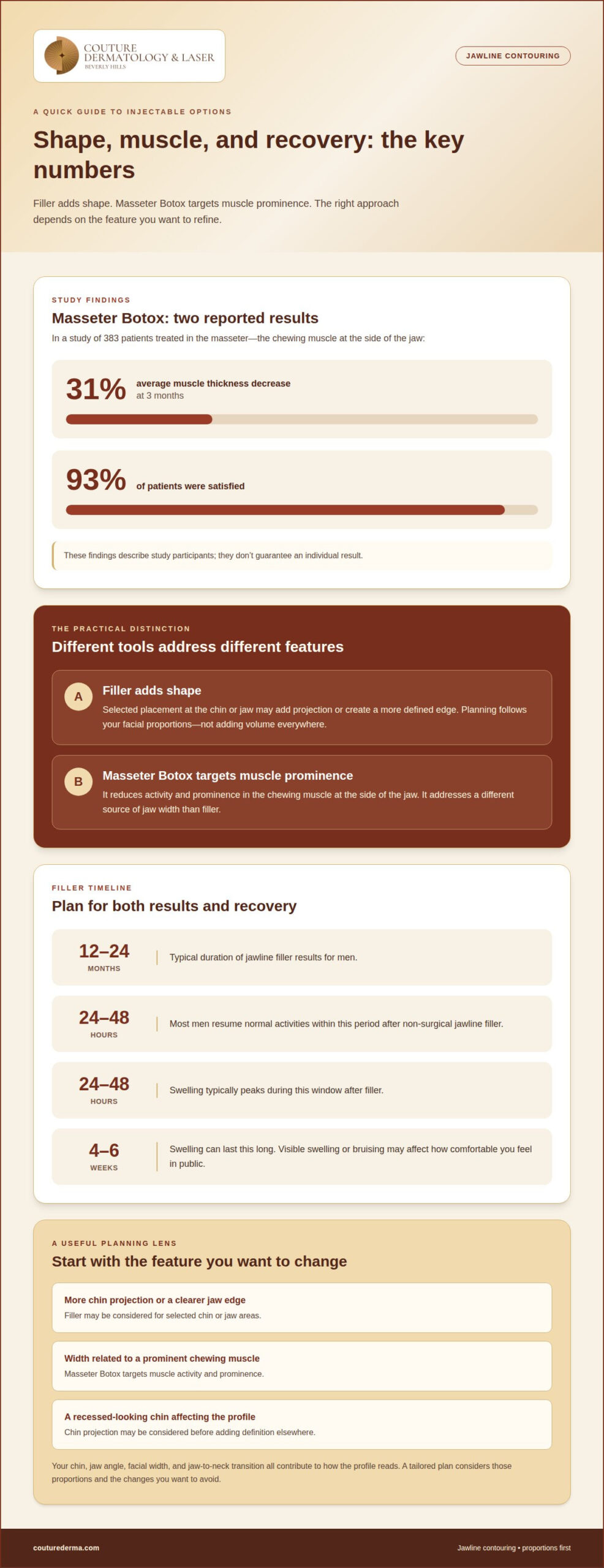
Filler can refine contours without surgery, and results for men typically last 12 to 24 months. It provides temporary definition, so it may suit you if you want to explore a chiseled look before considering a longer-lasting change. The amount and placement depend on whether your goal is a sharper angle, added chin support, or a more continuous jawline.
Some patients use filler to preview added chin projection before discussing an implant with a plastic surgeon. But filler and an implant are different treatments: a temporary injectable result can help clarify your preferences, not predict the exact surgical outcome. Bring reference photos showing a profile you like, then discuss which features suit your face.
Masseter Botox addresses a different source of jaw width. The masseter is a chewing muscle at the side of the jaw; Botox injections can reduce its activity and prominence. In a study of 383 patients treated in this muscle, average thickness decreased by 31% at 3 months, and 93% of patients were satisfied. These findings describe study participants, not a guaranteed individual result.
The practical distinction is this: filler adds shape, while masseter Botox targets muscle prominence. If your jaw appears wide, an injectable plan may focus on the muscle; if your chin looks recessed, filler may be considered instead. Some plans address more than one feature, but each choice should connect to your stated goal.
During consultation, discuss your desired degree of definition and whether you prefer a temporary, non-surgical approach. I can use that conversation to shape a plan around your features. If you’re ready to discuss your goals, you can schedule a consultation.
Recovery time and return to work
Recovery depends on the procedure: injectable filler and surgical jaw enhancement have different timelines. After non-surgical jawline filler, most men resume normal activities within 24 to 48 hours, though visible swelling or bruising may affect how comfortable you feel in public. Plan around the treatment area and your schedule, not just the appointment itself.
With jawline filler, swelling typically peaks 24 to 48 hours after treatment and can last 4 to 6 weeks. Bruising may remain for a few days, while swelling, bruising, or tenderness after chin filler or Botox typically subside within 2 to 5 days. These changes can overlap, so allow time for your face to settle before judging the contour.
Some patients can return to work immediately after jawline filler, while others prefer a short pause because of visible bruising or tenderness. If your work involves frequent video calls or in-person meetings, consider scheduling the procedure before a quieter day. Keep the first 24 to 48 hours flexible, especially if swelling would make you self-conscious.
Kybella treatment for fullness beneath the chin can cause swelling lasting 5 to 7 days per session. That recovery differs from filler, so don’t assume both options have the same downtime. Ask which treated area may swell and how that could affect your routine, such as wearing a shirt collar or attending an event.
Surgical jawline procedures involve a longer recovery. Men typically need 7 to 14 days before feeling comfortable in public, and many return to desk work after 7 to 10 days. Swelling and bruising often peak around days two through four. Strenuous exercise is typically delayed for 4 to 6 weeks, while social downtime may last 1 to 3 weeks.
Preparation begins with choosing a procedure and setting realistic time aside for its recovery. Before an injectable appointment, review your calendar for work events, travel, or photographs in the days that follow. For surgery, arrange support during the early recovery period and plan work around the 7 to 10-day desk-work timeframe.
In the first days after treatment, follow the personalized aftercare instructions you receive and keep track of swelling or bruising. A skilled clinician can explain what changes fit the expected course for your procedure. If your goal is a more masculine contour, remember that the final appearance may take longer to assess than your return to everyday activities.
Jawline contouring candidacy
Candidacy starts with a clear goal and a realistic understanding of the change you’re considering. I encourage you to name what you hope will look different and what you want to preserve. This keeps the conversation centered on your preferences, rather than an image or trend that may not suit you.
Before choosing an approach, consider how lasting you want the change to be and what level of recovery fits your life. A temporary option and a surgical procedure involve different commitments. Your decision should account for the result you want, your comfort with maintenance, and the time you can set aside for recovery.
For surgical jawline enhancement, men should have reached full skeletal maturity, typically at age 18 or older. Age is one consideration, not a complete candidacy assessment. The amount of change you want, the procedure being considered, and your readiness for its recovery also help shape the decision.
At a California consultation, ask: “What change can this approach reasonably create, and what will it not change?” Also ask how the plan fits your priorities, what recovery involves, and whether ongoing maintenance is needed. These questions help you understand the commitment before deciding.
It can help to describe your goal without relying on a celebrity image or a broad label like “stronger.” For example, you might want a subtle change that remains consistent with your current appearance. Jawline contouring for African American men in California should reflect your individual preferences, not assume a single aesthetic standard.
Think about how you’ll assess whether a change feels right. Choose a goal you can describe in your own words, such as wanting your profile to feel more balanced in photographs. This gives the consultation a practical reference point and makes it easier to discuss the degree of change you’re comfortable pursuing.
Skin tone and identity don’t define one ideal jawline. Your personal vision matters, including the features you want to retain and how visible you want the change to be. Jawline contouring for African American men in California should be discussed in the context of your goals, facial characteristics, and treatment preferences.
Before committing, make sure you understand the proposed approach and feel comfortable with its trade-offs. Take time to consider the options and return to your priorities before deciding. A thoughtful choice begins with a clear vision and a plan that reflects it.
Customized jawline contouring
A customized plan starts with your specific aesthetic goal, not a preset jaw shape. I consider how your chin, jaw angles, muscle prominence, and profile work together. A man seeking more definition at the back corners needs a different plan from someone hoping to refine chin projection. That distinction guides treatment choice and placement.
We can shape the discussion around three views: straight on, from the side, and at a slight angle. Each may reveal a different feature, such as uneven jaw width or a chin that appears less prominent in profile. Describe what you’d like to change and point to the area that draws your attention first.
Dermal fillers can add structure in selected areas without changing the underlying bone. Depending on how your features relate, the plan may focus on the chin, the jawline, or both. Adding volume everywhere can make the lower face look heavier, so the goal is to refine the outline while preserving your natural proportions.
The back corner of the jaw can also be reshaped for a rounder, smoother contour. This may suit you if a sharp corner feels too angular. An assessment considers whether you want a more defined edge, a softer transition, or a subtle change that remains harmonious with your facial structure.
Muscle prominence calls for a different strategy than adding filler. If the chewing muscle contributes to a broad appearance, the plan should distinguish that from a naturally wide jaw. This helps avoid using volume to address a concern with another cause. Your preferred masculine appearance should guide the balance between definition and softness.
For African American men, customization means responding to each person’s features rather than assuming skin tone determines one ideal shape. Chin projection, facial width, and the natural jaw angle vary from person to person. Tell me what you want to preserve, too. That helps shape a plan around your identity as well as your aesthetic goals.
Think of the process as tailoring: agree on the priority, select the area to address, then refine the plan around your proportions. If you want to discuss a personalized approach, book a jawline contouring consultation.
Couture Dermatology & Laser Beverly Hills
Couture Dermatology & Laser in Beverly Hills offers Dermal & Lip Fillers and Botox for non-surgical jawline refinement. During a consultation, I can consider whether your goal involves added definition or prominent chewing muscles, then discuss an approach suited to your facial proportions. The aim is a considered change that works with your features, not a one-shape-fits-all result.
If you’re weighing injectable treatment against other options, a personalized discussion can clarify what these approaches can address and what recovery may involve. Contact Couture Dermatology & Laser in Beverly Hills to discuss your jawline goals and possible next steps.
Choose a Direction That Feels Like You
Before taking the next step, put your vision into words. What would you like to notice in your reflection, and which features do you want to preserve? For African American men considering jawline contouring in California, personal priorities can guide a conversation toward a result that feels intentional, not borrowed from someone else’s face.
You don’t need to arrive with a perfect description or a fixed treatment decision. Start with the change that matters most to you, then discuss how it fits your appearance and comfort. A thoughtful decision is one you understand and feel ready to make, at your own pace.
If you’re ready to talk through your goals, request an appointment with Couture Dermatology & Laser Beverly Hills. Your next step can be a conversation, and your vision can lead it.
Frequently Asked Questions
Does jawline enhancement look natural on men?
Yes, jawline enhancement can look natural when the plan suits your facial structure and the change is measured. A defined contour doesn’t have to mean a sharply carved or enlarged jaw. Someone seeking slightly stronger chin projection may need a different approach from someone wanting a softer transition near the jaw’s back corner. Share what you want to preserve, too, so your goals guide the aesthetic choices.
What Are the Main Options for Masculine Jawline Enhancement?
Main options include dermal fillers, Botox injections for prominent chewing muscles, and surgical procedures that change jaw or chin structure. Treatment for fullness beneath the chin addresses a different concern from jaw definition. The useful first step is identifying what contributes most to your appearance: chin projection, muscle prominence, jaw shape, or under-chin fullness. Each points toward a different option and recovery experience.
What Are the Risks and Potential Complications of Jawline Enhancement?
Possible effects depend on the treatment and can include swelling, bruising, and tenderness after injectables. Masseter muscle reduction may involve increased postsurgical pain and swelling. Surgical procedures have their own recovery considerations, which should be discussed for the specific operation. Before deciding, ask what effects are expected, what symptoms need prompt attention, and how follow-up is handled. Clear answers help you understand the trade-offs without assuming every method has the same risks.
What Causes a Masculine, Feminine, or Weak Jawline?
Jawline appearance reflects several features, including bone shape, chin projection, chewing-muscle size, and fullness beneath the chin. A wider jaw or sharper jaw-to-chin angle may contribute to a traditionally masculine appearance, while a softer outline can reflect different combinations of facial structure and tissue. “Weak” is subjective, not a diagnosis. Describe the specific feature you notice, such as a recessed-looking chin or an indistinct jaw-neck line.
What jawline contouring options are available for African American men in California?
Options in California can include injectable fillers for added contour, Botox injections when chewing-muscle prominence contributes to width, and surgical approaches for structural changes. Treatments for fullness beneath the chin address that area rather than the jawbone itself. For African American men, planning should consider your individual facial features and goals, not assume a single ideal shape based on race. In Los Angeles, a consultation can help clarify which concern you want addressed first.
How do jaw implants, fillers, liposuction, and genioplasty compare for male jawline contouring?
Fillers add temporary volume to selected areas, while jaw implants provide structural support. Liposuction removes excess fat beneath the chin, addressing under-chin fullness rather than adding definition to the bone. Genioplasty changes chin projection and may influence the profile, but serves a different purpose from jaw implants. These procedures differ in scope, permanence, and recovery. Compare them by the specific feature you want changed.
What are the risks of jawline surgery and injectable jawline contouring, including risks for darker skin?
Risks vary by procedure: injectable treatments can involve swelling, bruising, or tenderness, while surgical approaches involve a more involved recovery. Skin tone alone doesn’t determine individual risk. Your skin history, treatment area, and chosen method all matter in planning. Ask how the approach accounts for your skin and facial features, what changes to expect afterward, and what follow-up is available if you have concerns during recovery.
How long is recovery from jaw implants, jawline liposuction, or fillers?
Recovery is generally shorter after fillers than after surgical procedures, but visible swelling or bruising can still affect your plans. Jaw implants and liposuction involve surgical healing, and the treated area influences when you feel ready for work, social plans, or exercise. Before scheduling, discuss your specific procedure and upcoming commitments. Build flexibility into your calendar rather than assuming you’ll feel comfortable in public as soon as routine activities resume.