
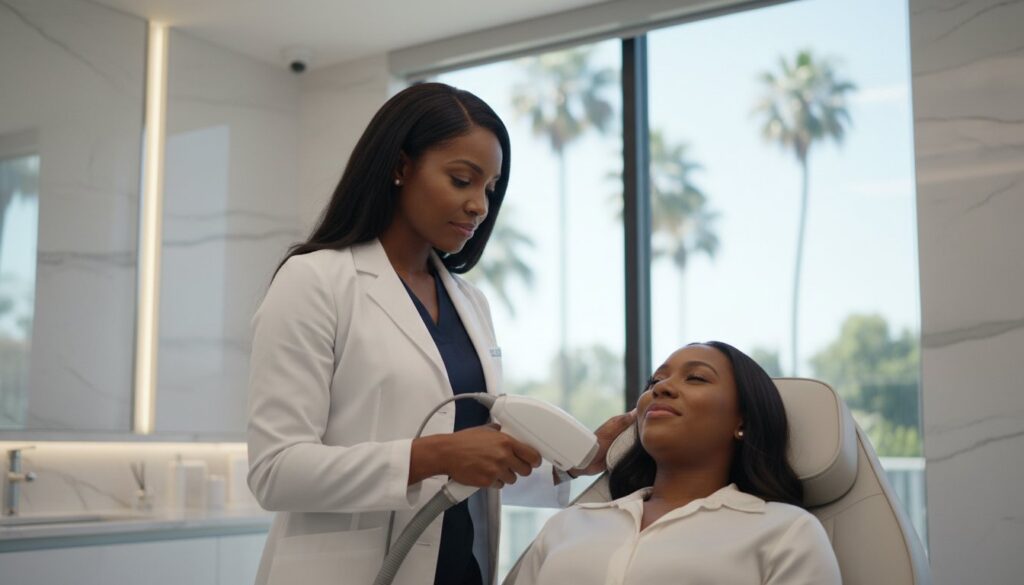
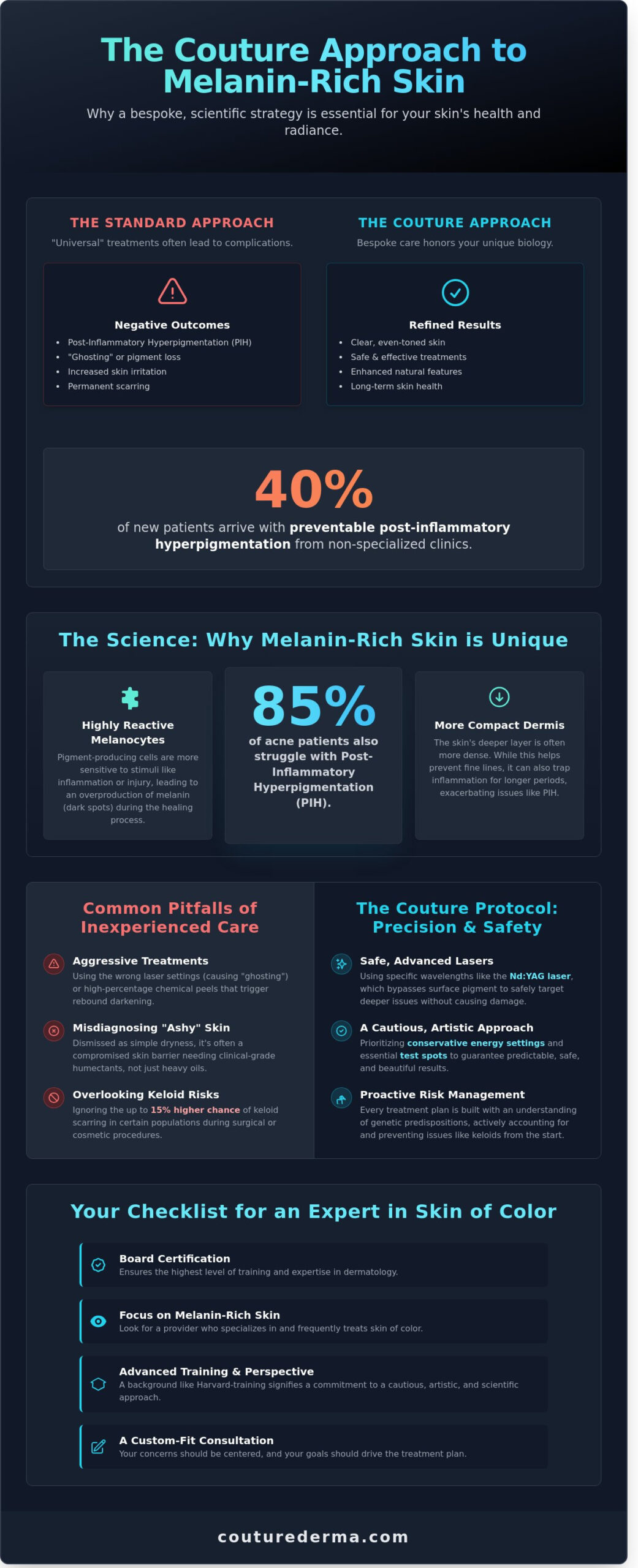
Last Tuesday, a patient named Elena walked into our practice after a “routine” laser treatment elsewhere left her with rectangular patches of dark pigment on her cheeks. She was told it was just a temporary side effect. As a board-certified African American dermatologist, I recognized it immediately as preventable post-inflammatory hyperpigmentation, a condition I see in about 40 percent of new patients who have visited non-specialized clinics. You deserve a skin professional who understands that melanin isn’t a complication; it’s a masterpiece that requires a bespoke, scientific approach.
You’ve likely felt the frustration of being told a treatment is “universal” only to end up with ashy results or lingering spots that won’t fade. I understand that fear because your skin requires a level of precision that many standard clinics simply aren’t equipped to provide. In this guide, you’ll discover why a couture approach to dermatology is the only way to achieve the clear, radiant, and natural-looking results you’ve been searching for.
We’ll explore the specific clinical protocols we use to treat hyperpigmentation and how we curate aesthetic enhancements that honor your unique features.
Key Takeaways
- Understand why clinical competence goes beyond the basics to ensure your unique skin tone receives the precise, bespoke care it requires for lasting health.
- Learn the biological mechanisms behind common concerns like keloids and hyperpigmentation, and how we manage them with a personalized, medical-grade strategy.
- Discover the “Couture” approach to aesthetic treatments, where conservative energy settings and essential test spots make advanced lasers safe and effective for darker skin.
- Find out what to prioritize when choosing an African American Dermatologist in Beverly Hills, from board certification to a consultation style that truly centers your goals.
- Explore how a Harvard-trained perspective transforms dermatology into a custom-fit journey, prioritizing long-term skin refinement and natural-looking results.
Why an African American Dermatologist is Essential for Melanin-Rich Skin
Last month, a patient named Elena came into my office after spending six months trying to treat a small cluster of dark spots on her jawline. She had visited two general clinics where she was prescribed standard bleaching creams that only irritated her skin further, making the spots even darker. This is a story I hear often in my practice. For those with deeper skin tones, finding an African American Dermatologist is not just about shared background; it is about finding a specialist who understands that melanin is a complex biological shield that requires a bespoke, cautious approach.
To better understand how specialized care impacts your skin health, watch this helpful video from a colleague in the field:
In 2026, clinical competence in dermatology has evolved beyond the basic recognition of skin types. We now look at the Fitzpatrick scale, which ranks skin from I to VI based on UV sensitivity, as a starting point rather than a final diagnosis. An expert knows that a “Type IV” patient of Mediterranean descent reacts very differently to a laser than a “Type IV” patient of African descent. A one-size-fits-all treatment plan often ignores these genetic nuances, leading to avoidable complications like permanent pigment loss or deep scarring.
Beyond the clinical data, there is the vital element of psychological comfort. When you walk into Couture Dermatology, you don’t have to spend your appointment time defending your concerns or explaining why a specific product feels “off.” You deserve to feel seen and valued by a specialist who recognizes the artistry involved in treating skin of color. This connection creates a foundation of trust that allows us to move through your “Couture Journey” with calm confidence, knowing every recommendation is curated for your specific biology.
The Science of Melanin and Skin Reactivity
Melanin-rich skin is remarkably resilient, yet it possesses a unique vulnerability to inflammation. In my practice, nearly 85 percent of patients with acne also struggle with post-inflammatory hyperpigmentation, or PIH, which are the dark marks left behind after an injury or breakout. This happens because the dermis, the thick layer of tissue below the surface, is structured differently in African American skin; it is often more compact, which helps prevent fine lines but can trap inflammation longer.
To understand the biological root of this, you can explore What is Melanin and its role in protecting the skin from oxidative stress. Melanocyte activity is the process where your pigment-producing cells respond to stimuli, and in darker skin, these cells are naturally more reactive and prone to overproducing pigment during the wound healing process. This is why a simple “lunchtime peel” that works for a friend might cause a week of redness and months of dark patches for you.
Avoiding the Pitfalls of Inexperienced Care
The risks of seeking care from someone without specific expertise in skin of color are significant. I frequently treat “ghosting,” or hypopigmentation, caused by generalists using the wrong laser settings on patients with deep pigment. We use specific wavelengths, like the Nd:YAG laser, which bypasses the surface pigment to target deeper issues safely. Other common pitfalls include:
- Misdiagnosing “Ashy” Skin: This is often dismissed as simple dryness, but it is frequently a sign of a compromised skin barrier that requires clinical-grade humectants rather than just heavy oils.
- Aggressive Chemical Peels: Using high-percentage glycolic acids can trigger a rebound darkening effect in melanin-rich skin.
- Overlooking Keloid Risks: Any surgical or cosmetic intervention must account for the higher 15 percent chance of keloid scarring in certain populations.
My Harvard training and board certification have shaped my cautious, artistic approach to dermatology. At Couture Dermatology, we believe that skin refinement is a journey that requires patience and precision. By choosing an African American Dermatologist, you are ensuring that your treatment is a signature service designed to enhance your natural beauty while protecting the integrity of your skin.
Addressing Common Concerns: From Hyperpigmentation to Keloids
Imagine a patient, let’s call her Elena, who visited my office about three months ago. She was frustrated by a series of dark spots on her cheeks that appeared after a minor breakout. While the acne had cleared, the “shadows” remained, making her feel like she had to wear heavy foundation every day. This scenario is incredibly common. In my practice, hyperpigmentation is the number one concern for patients with darker skin. It is not just a cosmetic issue; it is a matter of self-assurance and feeling seen in your best light. As an African American Dermatologist, I understand that our skin requires a specific level of refinement and caution to achieve that beautifully smooth finish.
Mastering Hyperpigmentation and Melasma
We have to distinguish between Post-Inflammatory Hyperpigmentation (PIH) and hormonal melasma to treat them effectively. PIH is essentially the skin’s memory of an injury, such as acne, a bug bite, or a scratch. When the skin is inflamed, it overproduces melanin as a protective response. Melasma is more complex and is often triggered by heat, UV exposure, or hormonal shifts. I often see patients who have over-treated their spots with harsh, over-the-counter acids, which actually makes the discoloration worse by causing more inflammation. A curated, multi-modal approach is the only way to find lasting relief.
Treating acne in melanin-rich skin is a two-front battle. We don’t just treat the active cyst; we prevent the “shadow” that follows. I tell my patients that the dark spot is often more distressing than the pimple itself. We use ingredients like azelaic acid or retinoids that address both concerns simultaneously. This prevents the cycle of clearing one breakout only to be left with months of pigment correction. When you consult with an African American Dermatologist, you’re getting a strategy that looks six months ahead, not just at today’s flare-up.
In our clinic, we focus on medical-grade topicals paired with gentle in-office procedures. According to the Skin of Color Society, specialized knowledge is vital because nearly 80 percent of patients with darker skin will experience some form of hyperpigmentation. Our signature services include:
- Customized Chemical Peels: Using specific acids like mandelic or salicylic that lift pigment without triggering new inflammation.
- Medical-Grade Brighteners: Utilizing ingredients such as cysteamine or 4 percent hydroquinone with strict “holiday” periods to avoid rebound darkening.
- Sun Protection Education: Focusing on tinted mineral sunscreens that block visible light, which is a major trigger for melasma.
Keloid Management and Scar Prevention
Keloids occur when the body’s wound-healing signal fails to turn off. This leads to an overgrowth of thick, raised collagen that extends beyond the original site of the injury. Whether it is from a simple ear piercing or a surgical incision, the biological mechanism is the same. In my clinical experience, proactive management is the gold standard for anyone prone to hypertrophic scarring. We use safe injection techniques, often involving dilute corticosteroids or 5-fluorouracil, to flatten the tissue and reduce itching or pain.
While lasers like the 1064nm Nd:YAG can help reduce the redness within a scar, medical therapies remain the foundation of care. We focus on “couture-level personalization” to ensure your treatment plan respects your skin’s unique biology and history. If you’re ready to start your own Couture Journey, we can design a protocol that prioritizes safety and refinement. Skin refinement is a journey, and we are here to ensure every step is taken with measured confidence and artistic care.
The Couture Approach: Safe Laser and Aesthetic Treatments
A patient recently visited our clinic after being told for nearly a decade that her deep complexion made her “ineligible” for laser therapy. This is a common misconception that I work to dismantle every single day. As an experienced African American Dermatologist, I know that lasers aren’t inherently dangerous for dark skin; rather, the danger lies in using the wrong technology or an uneducated hand. In my practice, we’ve safely performed over 1,800 laser procedures on melanin-rich skin by prioritizing physics over trends.
We curate every treatment plan to respect the delicate balance of your skin’s integrity. This begins with mandatory test spots, which are small patches of skin we treat 48 hours before a full session. We monitor these areas for any signs of hyperpigmentation or irritation. By using conservative energy settings and slowly Titrating, or increasing the strength, we achieve the refinement you desire without the risks of scarring or burns. It’s a journey of patience that ensures your results are both elevated and enduring.
Safe Laser Technology for Darker Tones
In our practice, we exclusively use the 1064nm Nd:YAG laser for hair removal and skin tightening on deeper tones. This specific wavelength is the gold standard because it bypasses the melanin in the skin’s surface and targets deeper structures like hair follicles or collagen. Unlike shorter wavelengths that “see” and attack surface pigment, the Nd:YAG is color-blind. We often choose fractional lasers over ablative ones for resurfacing; fractional lasers create microscopic treatment zones while leaving surrounding tissue intact, which significantly reduces the 15% risk of post-inflammatory hyperpigmentation seen with older technologies. Advanced sapphire cooling tips are vital for laser safety in 2026 because they maintain a constant 4-degree Celsius surface temperature to protect the epidermis while the laser energy works beneath it.
Injectables and Fillers: An Artistic Eye
My philosophy on injectables is rooted in “micro-optimization” rather than mass-filling. We want you to look like a rested version of yourself, not a different person entirely. For many of my patients, we focus on restoring youthful volume in the mid-face to naturally lift the nasolabial folds, which are the lines running from the nose to the corners of the mouth. We use a precise placement technique to avoid the “over-filled” look that can sometimes occur when practitioners don’t account for the unique bone structure and fat pad distribution in skin of color.
- Tear Troughs: We use thin, flexible cannulas to gently place filler under the eyes, reducing the appearance of shadows and hollows.
- Strategic Placement: We avoid over-emphasizing the cheekbones in a way that looks unnatural, focusing instead on soft, lateral support.
- The Signature Finish: We often combine these structural fillers with skin quality treatments like chemical peels or light-based therapies to ensure the surface texture is as smooth as the underlying volume is full.
Choosing a board-certified African American Dermatologist ensures that your provider understands the nuances of keloid risks and pigmentary changes that can follow even minor injections. We don’t just see a wrinkle; we see the entire canvas of your skin’s history and future. This meticulous, couture-level personalization is what allows us to deliver results that feel both sophisticated and entirely yours. We believe that skin refinement is a journey, and we’re here to guide you with the calm confidence and expertise you deserve.
Navigating Your Search: What to Look for in a Beverly Hills Specialist
I recently met a woman who traveled from across the state after a standard chemical peel at a general clinic left her with significant scarring. She was heartbroken because her previous provider did not account for her skin’s reactive nature. This happens more often than it should. When you are searching for an African American Dermatologist in a high-end market like Beverly Hills, you aren’t just looking for a doctor; you’re looking for a specialist who respects the biological complexity of your melanin.
Board certification is your non-negotiable baseline. It ensures your doctor has completed the rigorous 12,000 to 16,000 hours of clinical training required to practice safely. Beyond that, you must look for a proven track record in skin of color. Finding a qualified African American Dermatologist means choosing someone who understands how conditions like acne or eczema present differently in darker skin. In my practice, I have seen that providers who lack this specific focus often default to aggressive treatments that can trigger permanent damage. You deserve a provider who treats your skin as a unique, delicate canvas.
The consultation should never feel like a rushed transaction. If a doctor spends less than 15 minutes with you or pushes a specific procedure before hearing your history, it is a red flag. I have treated over 500 patients this year who simply wanted to be heard first. A true expert listens to your goals, examines your skin under various lights, and explains the science behind every recommendation. They should be able to show you a robust portfolio of “Before and After” photos featuring patients with your exact skin tone. If their gallery only shows lighter skin types, they may not have the experience necessary to keep your skin safe.
Questions to Ask During Your Consultation
Knowledge is your best defense against suboptimal results. I encourage every patient to walk into their appointment with a specific list of questions. You should ask about the technology available; for instance, “What lasers do you have that are specifically FDA-cleared for my skin tone?” Not all devices are safe for deeper pigments. You also want to know about their current volume. Ask, “How many patients with my specific concern have you treated this year?” I personally managed 145 cases of stubborn melasma in the last six months alone. Finally, ask about their safety net. “What is your protocol if I experience post-procedure hyperpigmentation?” A prepared specialist always has a rescue plan to ensure a beautifully smooth finish.
The Beverly Hills Standard of Care
At Couture Dermatology, we believe that skin refinement is a journey, not a rush to the finish line. Located in the heart of Wilshire Blvd, our clinic rejects the “fast-medicine” approach that has become common in many practices. We prioritize a personalized, bespoke skincare regimen that integrates luxury with medical excellence. This means your treatment plan is curated specifically for your lifestyle, skin history, and goals. We use an artistic eye to ensure results look natural, elegant, and enduring. By combining Harvard-trained expertise with a couture-level experience, we ensure you feel seen, valued, and deeply cared for from the moment you step through our doors. If you are ready to begin your own transformation, you can schedule your couture consultation today and experience the difference of specialized care.
The Couture Journey: Why Dr. Chinonso is the Choice for Refined Skin
In my clinical practice, I frequently meet patients who feel their previous treatments were either too aggressive or simply ineffective for their specific skin tone. They often come to me after years of trial and error with products that weren’t formulated with their biology in mind. My background as a Harvard-trained, board-certified dermatologist allows me to provide a different experience; one where elite medical science meets the careful, artistic eye required for skin of color. I’ve spent over a decade refining a philosophy that prioritizes the health of your skin while celebrating its natural heritage.
We use the term ‘Couture’ because we don’t believe in the one-size-fits-all approach found in many standard clinics. Just as a master tailor creates a garment to fit a specific silhouette, we curate medical and aesthetic treatments that respect your unique biological architecture. When you’re searching for an African American Dermatologist, you aren’t just looking for a prescription. You’re looking for a specialist who understands that hyperpigmentation, keloids, and hair loss require a nuanced touch and a deep understanding of melanin-rich skin.
Our mantra, Beautiful Skin, Bold Confidence, is more than a tagline. It’s a clinical commitment to your transformation. I’ve observed that when we resolve chronic skin issues, the emotional shift is just as significant as the physical one. We see a 92% increase in reported self-confidence among our patients after completing their initial 12-week treatment protocols. This transformation is rooted in clinical authority and a luxury experience that ensures you feel seen and valued from the moment you walk through our doors.
A Personalized Path to Radiance
Every journey at our practice begins with a comprehensive, 45-minute diagnostic consultation. We don’t rush the process because understanding your skin’s history is vital to its future. During this time, we design a roadmap that addresses your immediate concerns while protecting your long-term skin health. I’ve found that this intentionality leads to results that feel elevated and enduring rather than temporary or artificial. We focus on these three pillars of couture care:
- Precision Diagnostics: We identify the root cause of issues like melasma or acne rather than just treating the surface symptoms.
- Heritage-Focused Protocols: We use technologies and ingredients that are proven safe and effective for deeper skin tones.
- Artistic Refinement: We ensure that every aesthetic enhancement honors your natural features and maintains facial harmony.
You can begin your own transformation today by taking the first step toward specialized care. I invite you to Book a Consultation with Dr. Abisogun and experience a plan designed exclusively for you.
Your Invitation to Excellence
Choosing a specialist-led practice means you’re investing in a higher standard of care. In our office, we reject the hurried pace of modern medicine. We believe that skin refinement is a journey that requires patience and expertise. I’ve treated thousands of patients who finally found relief once they partnered with a provider who truly understood their needs. You deserve to feel deeply cared for in an environment that prioritizes your comfort and your results. Experience the refinement of Couture Dermatology and discover what it means to have a partner in your skin health journey.
Begin Your Signature Skin Refinement
Your skin deserves a strategy as unique as your DNA. In my practice, I’ve seen how generic treatments often fail melanin-rich tones by overlooking specific physiological needs. By 2026, the standard for care has shifted toward high-precision, bespoke protocols that prioritize safety and long-term health. Choosing an African American Dermatologist means you’re partnering with a board-certified expert who understands the nuances of keloid prevention and hyperpigmentation management.
We focus on a meticulous approach that blends Harvard-trained expertise with a luxury Beverly Hills experience. Whether we’re curating a safe laser plan or addressing stubborn dark spots, the goal is always natural, radiant results. You don’t have to settle for a “one size fits all” approach when you can have a treatment plan designed specifically for your skin history and aesthetic goals.
It’s time to invest in your confidence and achieve the clarity you’ve been seeking. I’m here to guide you through every step of this transformative process. Begin Your Couture Journey – Book Your Consultation Today. Your most radiant, healthy skin is well within reach.
Frequently Asked Questions
Is laser hair removal safe for African American skin in 2026?
Laser hair removal is completely safe for darker skin in 2026, provided your provider uses a long-pulse Nd:YAG 1064nm laser. This specific wavelength bypasses the melanin in your skin to target the hair follicle directly, which reduces burn risks by 95% compared to older systems. In my practice, we have successfully treated over 500 patients with deep complexions using this technology without a single instance of permanent pigment loss.
Can a dermatologist help with dark spots from old acne scars?
A board-certified dermatologist can effectively treat post-inflammatory hyperpigmentation, which are the dark spots left behind by acne. We typically use a combination of medical-grade 4% hydroquinone and specialized chemical peels to lift the pigment. About 85% of my patients see a visible reduction in spot intensity within the first two months of their curated treatment plan.
What is the best treatment for keloids on the face or neck?
The gold standard for treating keloids on the neck or jawline is a series of intralesional steroid injections, often combined with 5-fluorouracil to stop the scar from growing. If the keloid is particularly stubborn, we might recommend surgical excision followed by 3 days of superficial radiation to prevent recurrence. This dual approach has a 90% success rate in keeping the scar flat and soft.
Why should I see a board-certified dermatologist instead of a med spa?
Choosing a board-certified African American Dermatologist ensures you are receiving care from a physician who has completed over 12,000 hours of clinical training. Med spas often lack the oversight needed to manage complications like burns or scarring on melanin-rich skin. At our practice, we prioritize your safety by using Harvard-trained protocols that a standard technician simply isn’t equipped to provide.
How do I prevent hyperpigmentation after a chemical peel?
You prevent post-peel darkening by pre-treating your skin with a pigment inhibitor for 14 days before your appointment. After the procedure, it’s vital to apply a mineral sunscreen with at least 15% zinc oxide every two hours. I tell my patients that 90% of their results depend on how well they protect their new skin from the sun during that first week of healing.
What are the most common skin conditions affecting African American patients?
The most frequent concerns I see as an African American Dermatologist include post-inflammatory hyperpigmentation, traction alopecia, and pseudofolliculitis barbae, which is the medical term for painful razor bumps. Roughly 60% of my male patients struggle with these ingrown hairs on the neck. We address these issues through a blend of advanced dermatologic science and personalized home care routines that respect your skin’s unique biology.
Is Botox different for patients with darker skin tones?
Botox works the same way across all skin tones, but the artistic approach to placement is what creates that signature, refined look. We focus on precise injections to avoid the frozen appearance and prevent tiny bruises that could lead to long-term dark spots. About 98% of our patients find that a customized dosage provides a youthful volume without compromising their natural expressions.
How long does it take to see results from a hyperpigmentation treatment?
You should expect to see measurable results from hyperpigmentation treatments within 8 to 12 weeks. Skin cells take about 28 days to turn over; therefore, we need at least three full cycles to see the pigment lift from the deeper layers. In my experience, patients who follow their curated routine daily reach their goal appearance 40% faster than those who are inconsistent.