Skin Rashes.
Diagnosed First.
A rash is not a diagnosis — it is a symptom. Contact dermatitis, drug reactions, urticaria, and inflammatory dermatoses can all produce redness and inflammation that look superficially similar but require entirely different treatment approaches. At Couture Dermatology, every rash is assessed, classified, and diagnosed before any prescription is written.
managed differently
for contact allergens
Dermatologist
"A rash is a symptom, not a diagnosis. The right treatment depends entirely on which condition is producing it."
Not All Rashes
Are the Same Condition.
The word "rash" describes an appearance, not a disease. Red, itchy, inflamed skin can be produced by a T-cell mediated immune reaction to a metal in a watchband, by a drug started three weeks ago, by a viral infection, by a mite infestation, or by an inflammatory dermatosis that will recur without ongoing management.
Treating an allergic contact dermatitis with topical steroids without eliminating the allergen suppresses the rash temporarily, only for it to return. Treating urticaria as eczema delays the appropriate antihistamine therapy by months. The investment in correct diagnosis is an investment in treatment that actually works.
At Couture Dermatology, the assessment includes a full history — recent medications, occupational exposures, travel, new products — alongside clinical examination of the rash morphology.
From Appointment
to Confirmed Diagnosis
We believe that treating without a clear diagnosis is a disservice to the patient. Here is how we ensure you receive the right care for your skin.
History & Assessment
Your dermatologist takes a detailed history of onset, duration, associated symptoms, recent medications, and exposures, while examining lesion morphology and distribution.
Thorough First VisitDifferential Diagnosis
A ranked list of likely conditions is established. For many rashes, clinical assessment is sufficient to confirm the diagnosis without further testing.
Before any prescriptionPatch Testing
If allergic contact dermatitis is suspected, patch testing is scheduled. Allergen chambers are applied to the upper back and read at 48 and 96 hours.
48h & 96h AppointmentsTargeted Treatment
Treatment is prescribed based on the confirmed diagnosis — whether that involves allergen avoidance, antihistamines, or specific topical and systemic therapies.
Matched to DiagnosisDiagnostic &
Treatment Tools
Effective rash management utilizes both precise diagnostic investigations and targeted therapeutic interventions.
Identification · Contact Allergens
Patch Testing
The gold-standard diagnostic tool for allergic contact dermatitis. Comprehensive panels of common allergens (metals, fragrances, preservatives) are applied to the back in small chambers and read at 48 and 96 hours to identify specific sensitizers.
Histological Evaluation
Diagnostic Skin Biopsy
When a clinical presentation is ambiguous or unresponsive to standard therapy, a minor surgical sampling of rash tissue is taken for histological evaluation by a dermatopathologist to establish a definitive cellular diagnosis.
Anti-Inflammatory · Localized Relief
Prescription Topical Therapy
Topical corticosteroids and steroid-sparing calcineurin inhibitors are the first-line treatment for managing active inflammation in dermatitis, eczema, and psoriasis. Potency is carefully matched to the body site and severity of the rash.
Systemic Care · Advanced Options
Oral & Biologic Therapies
For acute allergic reactions, urticaria, or severe inflammatory dermatoses, oral therapies (antihistamines, corticosteroids) or advanced biologic injectables provide the necessary systemic intervention when topicals are insufficient.
Rashes That
Cannot Wait.
Breathing Difficulty or Throat Swelling
Urticaria with throat involvement indicates anaphylaxis — a life-threatening emergency requiring immediate epinephrine and EMS. This is not a situation for an antihistamine alone.
Non-Blanching Purpuric Rash
Red-purple spots that do not turn white when pressed, accompanied by fever, may indicate meningococcal disease or vasculitis. Go directly to an emergency department.
Blistering with Skin Pain
A painful, rapidly spreading rash with blistering and mucous membrane involvement (mouth, eyes) may indicate SJS or TEN — severe drug reactions requiring hospitalisation.
Fever & Internal Organ Involvement
An extensive rash with fever, facial swelling, and enlarged lymph nodes weeks after starting a drug can indicate DRESS syndrome, requiring prompt hospital evaluation.
Rapidly Spreading Infection
Expanding redness, warmth, and severe tenderness indicating rapidly progressing cellulitis or secondary infection necessitates urgent medical attention.
"A rash is a symptom, not a diagnosis. The right treatment depends entirely on which condition is producing it."— Couture Dermatology
test read time
Board-Certified FAAD
Every rash evaluated by a board-certified Fellow of the American Academy of Dermatology
Patch Testing In-Practice
Allergen patch testing performed in-practice — no external referral required
Diagnosis Before Prescription
No prescription is written before the diagnosis is definitively established
Wilshire Blvd, Beverly Hills
9735 Wilshire Blvd, Suite 216, Beverly Hills, CA 90212 · (310) 444-0946
Six Common Rash Categories.
Each Handled Differently.
These are the most common rash types seen in dermatology practice. They can look similar at a glance, but their treatments are distinct.
Allergic Contact Dermatitis
Delayed hypersensitivity to a specific allergen like nickel or fragrance. Requires patch testing to identify the exact trigger for avoidance.
Irritant Contact Dermatitis
Direct damage to the skin barrier from repeated exposure to soaps, solvents, or water. Managed with barrier repair and irritant reduction.
Drug Rash (Exanthem)
Widespread symmetrical red spots appearing 7-14 days after starting a new medication. Requires discontinuation of the offending drug.
Urticaria (Hives)
Transient, intensely itchy wheals that resolve within 24 hours at any site. Managed with daily second-generation antihistamines or biologics.
Pityriasis Rosea
A self-limiting viral exanthem presenting with a "herald patch" and spreading in a tree-like pattern. Managed symptomatically.
Lichen Planus
An immune-mediated dermatosis producing pruritic, purple, polygonal papules on wrists and ankles. Managed with potent topicals or systemics.
Signs Your Rash Needs
a Dermatologist
- A rash persisting for more than 2 weeks that has not improved with over-the-counter antihistamines or mild hydrocortisone.
- A recurrent rash at a specific body site that clears and returns, suggesting repeated allergen contact.
- A rash that appeared shortly after starting a new medication, requiring professional evaluation.
- Occupational hand dermatitis from frequent exposure to water, chemicals, or wearing gloves.
- Any rash causing significant itch, sleep disruption, or distress affecting daily functioning.
- Widespread inflammation involving the face, genitals, or extensive body surface area.
What to bring to your appointment
The more information your dermatologist has, the more efficiently the diagnosis can be reached. Note exactly when the rash first appeared, all current medications and supplements, and any new products introduced in the weeks prior.
If you have tried any treatments — topical or oral — note what you used and what effect it had. A rash that partially responds to steroids but returns is a different clinical picture to one that does not respond at all.
Managing Chronic
Skin Conditions
Our clinic provides expert, evidence-based management for severe and chronic inflammatory dermatoses.
Eczema (Atopic Dermatitis)
Comprehensive management with prescription topicals, trigger avoidance, and advanced biologic therapy (dupilumab) for severe cases.
Explore eczema care →Psoriasis Management
Addressing chronic scaly plaques with topical therapy, phototherapy, and targeted biologic medications like IL-17 and IL-23 inhibitors.
Explore psoriasis care →Rosacea Calming
Managing chronic facial redness and papulopustular disease with vascular laser, IPL, and prescription systemic anti-inflammatory therapy.
Explore rosacea care →Acne Treatment
Inflammatory acne managed medically with oral therapy, prescription topicals, and in-office treatments for cystic and treatment-resistant cases.
Explore acne care →The Right Diagnosis.
The Right Treatment.
Most rashes that have not improved with over-the-counter treatments are either the wrong diagnosis, or a condition requiring prescription-grade therapy. A consultation at Couture Dermatology covers the full history, clinical assessment, and investigation plan.
Beverly Hills, CA 90212
Results That Speak for Themselves
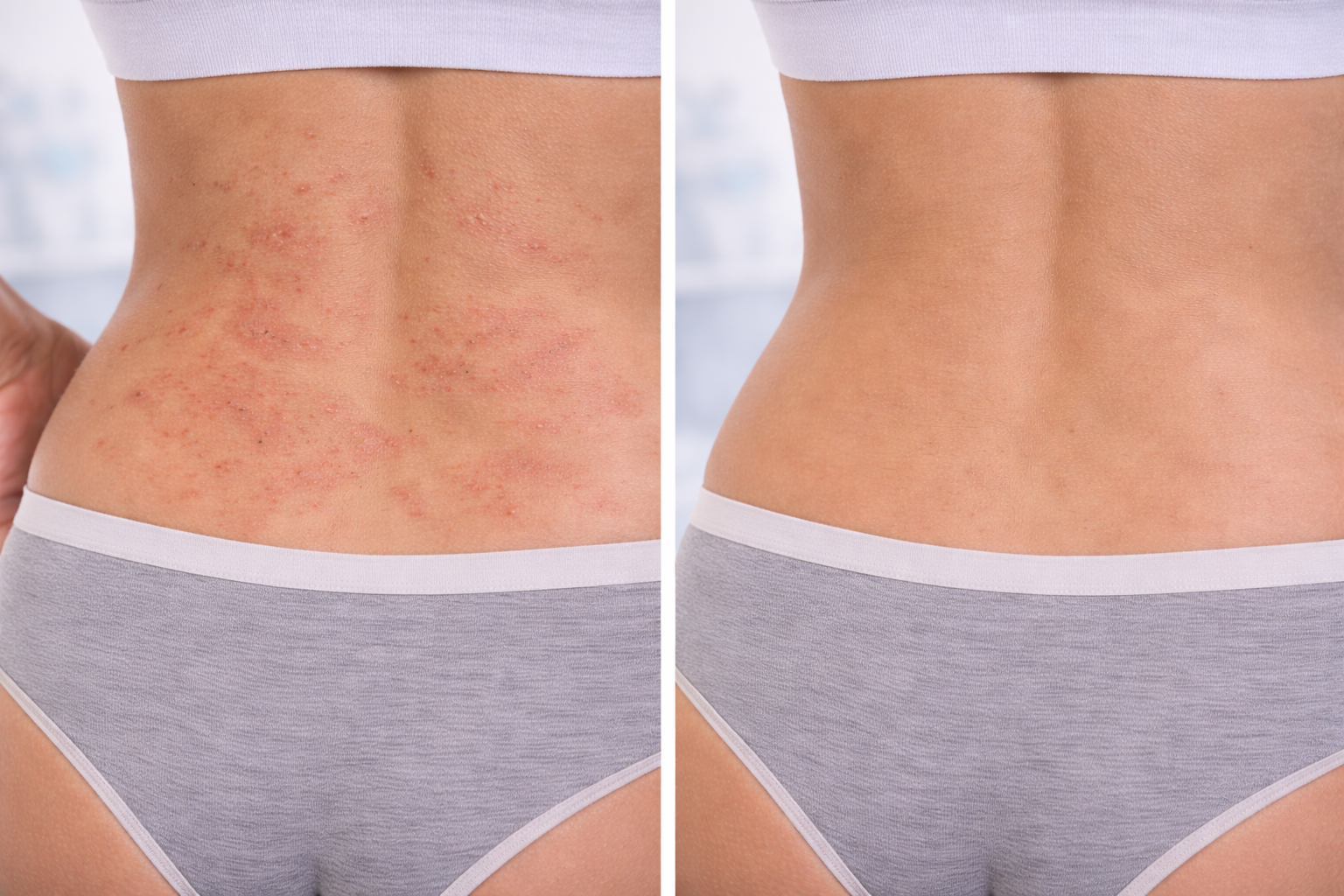
Individual results vary. Images represent outcomes achievable through a personalised treatment programme at Couture Dermatology.
Frequently
Asked Questions
Direct answers to the most common questions patients bring to consultation about skin rashes — on what causes them, when to worry, and how they are diagnosed and treated.
You should see a dermatologist if your rash has persisted for more than 2 weeks without improvement; if it is spreading, worsening, or involving the face or genitals; if it is associated with fever, joint pain, or systemic symptoms; if over-the-counter treatments have not helped; if you suspect a drug reaction; or if the rash is causing significant distress or interfering with daily life.
Irritant contact dermatitis (ICD) occurs when a substance directly damages the skin barrier — detergents, solvents, repeated water exposure, and acids produce ICD without any immunological involvement. Allergic contact dermatitis (ACD) is an immune-mediated delayed hypersensitivity reaction to a specific allergen (nickel, fragrance, rubber chemicals) and requires patch testing to identify.
Patch testing is the gold-standard diagnostic investigation for allergic contact dermatitis. A standard panel of common allergens is applied to the upper back in small chambers and left in place for 48 hours. The patches are then removed and the back is read at 48 hours and again at 96 hours, looking for localised eczematous reactions at individual allergen sites.
Yes — drug reactions are a common cause of skin rashes, presenting as widespread red, slightly raised spots appearing 1–2 weeks after starting the offending drug. Common culprits include antibiotics, anti-seizure medications, NSAIDs, and allopurinol. Rarely, drug reactions can progress to severe syndromes like SJS or DRESS, which require urgent medical attention.
Urticaria (hives) is characterised by transient, intensely itchy wheals that typically resolve within 24 hours at any individual site. Acute urticaria is usually triggered by infection, a food allergen, or a drug. Chronic urticaria is idiopathic in 80–90% of cases. Treatment is with regular second-generation antihistamines, or omalizumab for refractory chronic cases.
Seek urgent medical attention if your rash is accompanied by fever, difficulty breathing, throat tightening, or facial swelling (anaphylaxis). A petechial or purpuric rash (small red-purple spots that do not blanch when pressed) with fever is a medical emergency. Rapidly spreading rash with blistering, skin pain, and mucous membrane involvement requires immediate hospitalisation.
Related Treatments