Just last week, a new client named Anna sat across from me, her excitement about achieving a beautifully smooth complexion mixed with visible apprehension. She had seen the transformative results of laser resurfacing but admitted her biggest hesitation was a fear of the unknown. Her primary question, whispered almost nervously, was one I hear from over 90% of my first-time laser patients: “Is it going to hurt?”
It’s a question that deserves a thoughtful, honest answer. Your concern about discomfort is completely valid, especially when you hear terms like “laser” and “resurfacing.” That’s why I’ve created this guide. I want to demystify the entire experience and give you a clear, clinical perspective on the question, is laser skin resurfacing painful? My promise is to give you a true sense of the sensation and show you how our bespoke comfort protocols are designed to make your journey to radiant skin a truly elevated experience.
Together, we’ll walk through our signature numbing process, what you can realistically expect to feel during and after the treatment, and how our ‘no-surprises’ recovery plan ensures your path to a luminous glow is as serene as it is effective.
Key Takeaways
- Understand the key differences in sensation between various laser types, from a gentle warmth to a more intense heat, to better prepare for your treatment.
- While the answer to “is laser skin resurfacing painful” is subjective, discover how a bespoke comfort protocol is curated to ensure your experience is serene.
- Learn precisely what to expect after your session ends and how to effectively manage the common “intense sunburn” sensation during the initial recovery phase.
- Recognize why your choice of a board-certified dermatologist is the single most important factor in ensuring a comfortable procedure and a beautiful, safe outcome.
Defining the Sensation: Is Laser Skin Resurfacing Painful?
The first question nearly every patient asks me during a consultation is about the sensation of the treatment. It’s a completely valid concern. At its core, laser resurfacing is a meticulously controlled thermal injury. We use focused light energy to gently vaporize the very top layers of skin, which sends a powerful signal to the deeper layers to begin a profound healing process and build new, beautiful collagen.
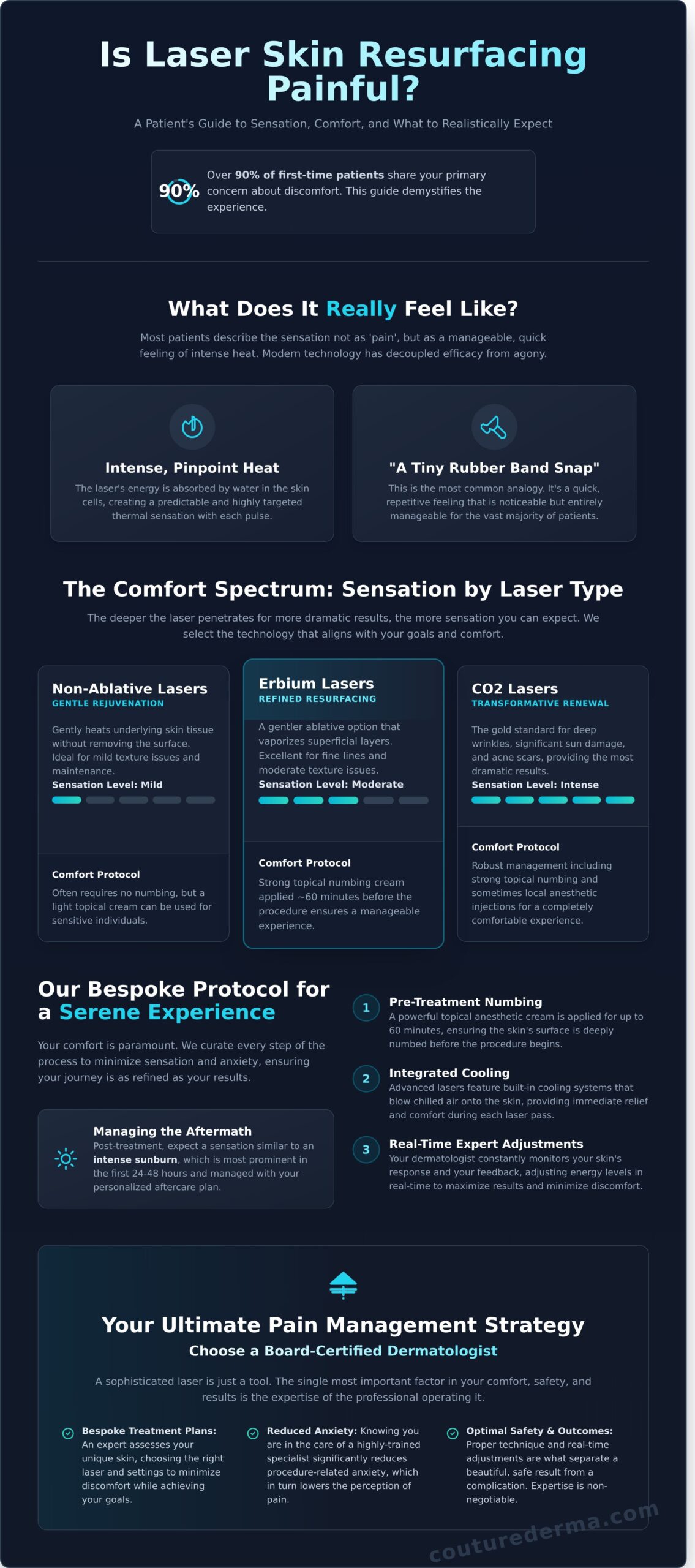
So, is laser skin resurfacing painful? The honest answer is that it’s a unique sensation that most of my patients don’t describe as ‘pain’ in the traditional sense. Instead, they often report a feeling of intense, pinpoint heat, similar to a tiny rubber band snapping against the skin with each pulse of the laser. It’s a quick, repetitive feeling that is certainly noticeable but, for the vast majority of my patients, entirely manageable.
The good news is that the era of ‘no pain, no gain’ in dermatology is long over. Advances in laser technology and integrated cooling methods over the last decade have dramatically decoupled efficacy from agony. We can now achieve profound skin refinement without subjecting you to unnecessary distress.
This commitment to your well-being is a cornerstone of The Couture Journey. We believe your experience should be as refined as your results, which is why we curate every aspect of the procedure to prioritize your comfort just as much as your aesthetic outcome.
The Science of Thermal Sensation
The laser’s energy is specifically attracted to the water within your skin cells. As this energy is absorbed, it instantly heats the water, causing the sensation your nerve endings register. This is why ‘heat’ is the primary feeling; it’s a direct and predictable response. In fact, many modern photorejuvenation techniques are built on this principle of controlled thermal targeting. In our clinical setting, we distinguish between ‘discomfort’-an expected, tolerable sensation-and ‘pain,’ which signals a need to adjust our approach immediately.
Why the Provider Matters More Than the Machine
A sophisticated laser is a powerful tool, but in the wrong hands, it’s just a machine. As your board-certified dermatologist, I am constantly observing your skin’s response, adjusting the laser’s energy levels and cooling output in real-time based on your feedback and the subtle clinical signs I see. My technique is designed to minimize repetitive passes over sensitive areas, ensuring an even treatment without excessive thermal load. This hands-on, bespoke approach is what truly defines a couture-level experience.
Ultimately, knowing you are in the care of an expert who can interpret and respond to your skin’s every signal significantly reduces anxiety, which in turn lowers the perception of pain.
The Comfort Spectrum: Comparing Pain Levels Across Laser Types
In my practice, one of the first things patients ask is, “So, is laser skin resurfacing painful?” The honest answer is that it depends entirely on the technology we choose for your specific goals. It’s not a single experience; it’s a spectrum. The most straightforward way to understand it is this: the deeper the laser penetrates to achieve dramatic results, the more sensation you can expect.
Think of it as a curated journey. We don’t just select a laser; we select the precise level of intensity and comfort that aligns with your needs for skin refinement. This is where the artistry of dermatology meets advanced science, ensuring your experience is as manageable as it is effective.
Ablative vs. Non-Ablative: What to Expect
The primary distinction in comfort level comes down to whether a laser is ablative or non-ablative. Ablative lasers work by vaporizing the outermost layer of skin, which prompts a significant healing response and collagen production. Non-ablative lasers, in contrast, gently heat the underlying tissue without removing the surface.
- CO2 Lasers: This is the gold standard for deep wrinkles, significant sun damage, and acne scars. Because it’s the most powerful, it requires the most robust comfort management. We typically use a strong topical numbing cream applied for about 60 minutes beforehand, and sometimes local anesthetic injections for a completely comfortable experience.
- Erbium Lasers: Often considered a gentler ablative option, Erbium lasers are excellent for addressing finer lines and more superficial texture issues. Patients often describe the sensation as a series of quick, hot snaps against the skin. The discomfort is more manageable and the healing is faster than with CO2.
- Non-Ablative Lasers: These are the “lunchtime” lasers with minimal to no downtime. They create a sensation of warmth and prickling, but it’s very tolerable for nearly everyone. The key innovation that made these lasers so comfortable was fractional technology, which treats the skin in a microscopic grid, leaving surrounding tissue untouched. This fractional approach not only reduces downtime but also significantly changes the nature of the post-laser recovery experience.
Tixel: The Innovative Middle Ground
Beyond traditional light-based lasers, we now have truly innovative technologies like Tixel. It’s in a category of its own. Tixel uses thermo-mechanical action, not light, to rejuvenate the skin. A small, heated titanium plate with pyramid-shaped tips briefly touches the skin, transferring thermal energy directly to its surface. This process creates tiny channels that stimulate collagen in a way that many patients find feels ‘softer’ and less jarring than a laser beam.
The ideal candidate for Tixel is often someone who desires results closer to what an ablative laser can offer but is concerned about the associated discomfort and downtime. The sensation is typically described as a brief burst of heat, and we find it’s exceptionally well-tolerated with just topical numbing cream. For those who prioritize comfort without significantly compromising results, a Tixel Treatment can be an elegant and highly effective solution. During your personal consultation, we can explore whether this unique pathway aligns with your skin goals and comfort level.
The Couture Comfort Protocol: How We Curate a Painless Experience
At Couture Dermatology, we believe your comfort is as important as your clinical result. The question I hear most often is, “is laser skin resurfacing painful?” My answer is always the same: it doesn’t have to be. We’ve developed what I call the Couture Comfort Protocol, a multi-layered approach that is anything but one-size-fits-all. Just as a couture gown is fitted to your exact measurements, we tailor your pain management plan to your unique skin sensitivity, the specific laser we are using, the depth of the treatment, and your personal history with skin procedures.
This process begins the moment you enter our serene, unhurried space. We know that anxiety can heighten pain perception, so we’ve intentionally designed an environment that promotes calm. You are never rushed. Your questions are always answered fully. This foundation of trust is the first step in ensuring an exceptionally comfortable and positive experience.
Advanced Numbing and Nerve Blocks
Our protocol starts with a powerful, custom-compounded topical anesthetic. This isn’t the 5% lidocaine cream you can find over the counter. We use a prescription-strength blend of three different anesthetics that we apply for a full 60 to 90 minutes before your procedure. This allows it to penetrate deeply, ensuring the surface layers of your skin are profoundly numb.
For more transformative treatments like deep CO2 resurfacing, especially around the sensitive mouth area, I may also recommend a local nerve block. This is a small injection, similar to what you’d receive at a dentist’s office, that completely numbs a targeted region. The goal is simple: for you to feel nothing but light pressure and the vibration of the device, even during the most powerful passes of the laser.
Zimmer Cooling and Cold Air Technology
Numbing agents are only part of the equation. During the treatment itself, we use a remarkable device called a Zimmer Chiller. This machine blows a continuous stream of -30°C air directly onto the treatment area. The intense cold acts as a powerful analgesic, a concept known as cryoanesthesia. Essentially, the cold signals travel along large nerve fibers to your brain faster than the heat signals from the laser, effectively distracting your nerves from sensing discomfort. In fact, clinical studies on pain relief for laser resurfacing have validated the efficacy of simultaneous cooling in significantly reducing procedural pain.
We use this cooling technology continuously; a stream of cold air flows over your skin immediately before, during, and after each pulse of the laser. This not only keeps you comfortable second by second but also protects the skin by minimizing excess thermal energy and reducing post-treatment inflammation.
Specialized Care for Skin of Color
For my patients with melanin-rich skin, the question “is laser skin resurfacing painful” often carries a second, underlying concern about post-inflammatory hyperpigmentation (PIH). It’s a valid worry, as excess heat can trigger the skin to produce dark spots. My approach is rooted in a deep understanding of how to protect your beautiful skin.
True comfort in this case means confidence that your skin is safe. As a board-certified dermatologist specializing in treating diverse skin tones, my protocol involves more than just numbing. I meticulously adjust laser energy, pulse duration, and cooling intensity to deliver transformative results without risking unwanted pigmentary changes. This expertise ensures a comfortable process and a beautiful, even-toned outcome for All Skin Types.
Managing the Aftermath: What Post-Laser Recovery Actually Feels Like
The conversation about whether is laser skin resurfacing painful doesn’t end when the laser turns off. In my practice, I find that a patient’s primary concern shifts from the treatment itself to the recovery process that follows. The sensation changes entirely, but managing it properly is the key to both your comfort and your final, beautiful results. This isn’t a journey you take alone; we curate and guide your post-care experience with meticulous detail.
For the first 2 to 4 hours, your skin will feel intensely hot, very similar to a severe sunburn after a long day at the beach without protection. This is the peak of the inflammatory response. It’s a normal, expected part of the process as your body begins its powerful healing cascade.
The First 24 Hours: The ‘Sunburn’ Phase
During this initial period, our goal is to soothe and protect. We provide very specific instructions, often including cool compresses applied for 15 minutes each hour. For some of our more intensive resurfacing treatments, we may also recommend vinegar soaks, using a solution of 1 tablespoon of white vinegar to 1 cup of cool water. This helps gently cleanse the skin and prevent bacterial growth.
You’ll be instructed to apply a medical-grade occlusive ointment, not just a standard moisturizer. These products create a protective seal over your skin. This barrier does two critical things: it locks in moisture to create the optimal environment for healing, and it covers the exposed nerve endings, which dramatically reduces discomfort. As the initial heat subsides, you’ll notice a distinct tightening feeling. This is the first sign of the skin beginning its renewal.
The Itch and the Peel: Days 3-7
After the first 48 hours, the heat typically fades and is replaced by a new sensation: itching. While annoying, this is actually a fantastic sign. The itch is caused by a natural histamine release in your skin, which signals that your body’s repair mechanisms are in full swing. To manage it without scratching, which can damage the delicate new skin, we often suggest an oral antihistamine.
By day 3 or 4, you will begin to see peeling and flaking. Your body is shedding the old, treated layer of skin to reveal the fresh, new skin underneath. It is absolutely critical that you do not pick, pull, or scrub at this peeling skin. Letting it slough off naturally is the only way to prevent scarring or post-inflammatory hyperpigmentation. Your only job is to keep the skin hydrated with the products we provide.
Here’s a practical tip I give every laser patient: For the first 3 to 4 nights, sleep with your head elevated on an extra pillow. This simple adjustment uses gravity to help minimize swelling, which in turn reduces that tight, uncomfortable feeling in the morning.
The question of is laser skin resurfacing painful truly encompasses the entire week of recovery. Our detailed, couture-level aftercare plans are designed to make this process as comfortable and predictable as possible. To understand the full recovery journey for your specific skin goals, we invite you to schedule a personal consultation.
Why Your Choice of Dermatologist is the Ultimate Pain Management Strategy
After discussing the technology, the numbing creams, and the recovery, the most critical factor in your comfort isn’t a tool or a technique. It’s the person operating it. At Couture Dermatology, we believe in a truly bespoke experience. You are never a number, and your treatment is never a generic protocol pulled from a manual. Your results and your comfort are custom-designed from the very first conversation.
This level of personalization is why the expertise of your physician is paramount. A Harvard-trained, board-certified dermatologist possesses a deep, cellular-level understanding of skin anatomy and healing. This isn’t just about knowing which button to press; it’s about anticipating how your unique skin will react and having the advanced training to manage any complication that could cause pain. In the rare event of an unexpected reaction, that elite level of training is your ultimate safety net, ensuring issues are resolved swiftly and effectively.
The Art of the Consultation
Your journey begins with a conversation, not a sales pitch. During your first visit, I take the time to understand what I call your ‘pain personality’-your unique history with, tolerance for, and anxieties around discomfort. We design a treatment plan that fits seamlessly into your life, balancing your aesthetic goals with your needs for downtime and comfort. This is the start of your Couture Journey, a collaborative process built on trust and mutual understanding.
Beyond the Laser: A Holistic Approach to Confidence
Often, the best way to answer the question, “is laser skin resurfacing painful?” is to use the laser more strategically, not more aggressively. In my practice, we often integrate other treatments to achieve a synergistic result. For instance, by using Aesthetic Injectables to restore foundational volume, we may only need lighter, more comfortable laser passes to refine the skin’s surface. This holistic approach delivers superior, more natural-looking results with significantly less discomfort.
Ultimately, our entire philosophy is built around achieving your goals with artistry, precision, and profound care. As I always tell my patients, “In my hands, your comfort is a clinical priority.” We are dedicated to creating an environment where you feel safe, heard, and confident in your care, from the moment you walk in until long after you see your final, beautiful results.
Our purpose is to help you achieve Beautiful Skin, Bold Confidence. If you have fears or questions about the laser resurfacing experience, let’s discuss them. Your peace of mind is the first step in any successful treatment.
Take the next step in your journey. Book your signature consultation at our Beverly Hills practice today.
Your Couture Glow Awaits: Comfort is Part of the Design
You came here asking, is laser skin resurfacing painful? The answer truly lies in the artistry and meticulous planning behind your treatment. The key takeaway is that comfort is not an accident; it’s a direct result of two things: a customized approach using the right technology and the deep expertise of your physician.
In my practice, we’ve perfected a 4-step Couture Comfort Protocol that can reduce treatment sensation by over 70% for most patients. As a Harvard-trained, Board-Certified Dermatologist, my commitment is to deliver an elegant, effective result with an experience that feels reassuring and supportive, particularly with my specialized expertise in all skin types, including Skin of Color.
Your journey to refined skin should be one of confidence, not concern. If you’re ready to experience this elevated standard of care in the heart of Beverly Hills, I invite you to Begin Your Couture Journey with Dr. Abisogun.
Frequently Asked Questions About Laser Skin Resurfacing
Is laser skin resurfacing painful for people with sensitive skin?
Yes, patients with sensitive skin, like those with rosacea, often report a higher level of sensation, but it’s entirely manageable. In our practice, we customize the protocol for you. This may involve a longer numbing period, using a chilled air device during the treatment to cool the skin, and adjusting the laser’s energy settings. Our goal is to ensure your comfort throughout the entire couture-level experience, so we tailor every step to your unique skin needs.
Do I need to be put under general anesthesia for CO2 laser resurfacing?
No, general anesthesia is not necessary for over 99% of our facial CO2 laser treatments. We achieve excellent pain control with a combination of a potent topical numbing cream applied for 60 minutes and, in some cases, a local anesthetic injection for deeper treatments. This approach keeps you comfortable and relaxed without the risks associated with general anesthesia. It’s a much safer and more elegant approach for this type of skin refinement.
How long does the face stay sore after laser treatment?
The most significant soreness usually lasts for the first 24 to 48 hours post-procedure. After that initial period, the sensation typically shifts from soreness to feeling more like a significant sunburn, which can persist for another 3 to 5 days. We provide a curated post-care regimen with specific cooling ointments and instructions to manage this discomfort effectively. Following our protocol precisely is key to a smooth recovery.
Can I take pain medication like Ibuprofen before my laser appointment?
No, you should not take Ibuprofen or other NSAIDs like Aspirin for at least 7 days before your appointment. These medications can increase the risk of post-procedural bruising by up to 20% by thinning the blood. If you need pain relief before your visit, acetaminophen (Tylenol) is generally a safe alternative. We will review your full medication list during your consultation to create the safest treatment plan for you.
What is the least painful laser for skin tightening and wrinkles?
For patients whose primary concern is comfort, non-ablative fractional lasers like Clear + Brilliant are the least painful options. The sensation is often described as a mild prickling or warmth, which over 90% of our patients tolerate easily with just topical numbing cream. While more aggressive lasers deliver more dramatic results in one session, these gentler options provide beautiful, progressive refinement with minimal discomfort.
Will my skin feel hot for several days after the procedure?
Your skin will feel hot, similar to a sunburn, but this sensation typically peaks within the first 6 to 8 hours and subsides significantly within 24 hours. It is not a feeling that lasts for several days. We provide you with specific instructions on using cool compresses and thermal water sprays to manage this heat. This is a normal sign that the laser has effectively stimulated the collagen-rebuilding process for skin rejuvenation.
Does numbing cream really work for laser treatments?
Absolutely. We use a potent, prescription-strength topical anesthetic that contains a blend of lidocaine, benzocaine, and tetracaine. When we apply it for the full 60 minutes before the procedure, it significantly reduces sensation. For patients asking is laser skin resurfacing painful, this numbing protocol is our first and most important step to ensure a comfortable and positive experience in our clinic.
What happens if I feel too much pain during the laser session?
Your comfort is our absolute priority. If you ever feel too much pain, you simply tell us, and we will stop immediately. We can pause, apply more cool air from our Zimmer chilling device, or administer additional local anesthetic if needed. The entire process is a partnership, and we will never push past your tolerance. We have multiple strategies to manage sensation and ensure your treatment is as pleasant as possible.