
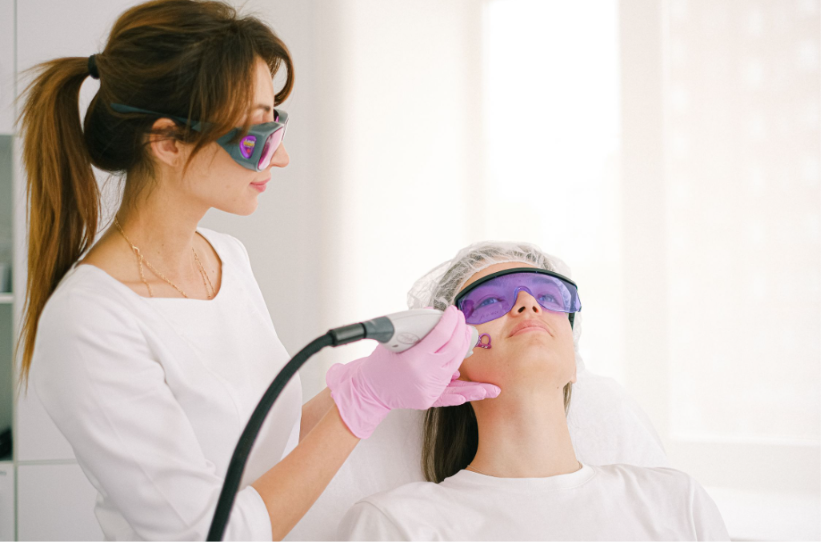
You have read the horror stories. A laser session that left dark patches worse than before. A burn that turned into a scar. A friend of a friend who walked into a medspa for one thing and walked out with hyperpigmentation that took a year to fade. So now, every time you consider a laser, you hesitate. You wonder if your skin is simply too risky to treat. I want to give you the calm, clinical truth, because the fear you have absorbed online is mostly a story about the wrong devices in the wrong hands, not about your skin.
Why Laser Safety for Skin of Color Matters More Than You Think
For years, laser technology was designed and tested primarily on lighter skin. That history left a real gap, and the people who paid for it were patients with melanin-rich skin who were burned, scarred, or left with pigment that was darker than what they came in to treat. The result is a community that has learned, understandably, to be afraid. But avoiding lasers altogether is not the answer, because the right device in experienced hands can do beautiful, safe work on deeper skin tones. Knowing the difference is what protects you.
When you understand laser safety for your skin, you gain:
- The confidence to pursue treatments you have been told to avoid, safely
- Protection from the single most common complication, post-inflammatory hyperpigmentation
- The ability to vet any provider in one short conversation
- Freedom from the guesswork that keeps so many people stuck with concerns they could address
- A realistic sense of what lasers can and cannot do for tone, texture, and scarring
What Makes a Laser Safe or Risky for Melanin-Rich Skin
The science here is simpler than the marketing makes it sound. Melanin absorbs light. The more melanin in your skin, the more energy your skin surface will soak up from a laser, and that absorbed energy is what causes burns and the pigment flares that follow. The goal with deeper skin tones is to deliver energy that mostly bypasses the melanin at the surface and reaches the target underneath, whether that target is a hair follicle, a pocket of pigment, or the deeper layers where collagen lives.
This is why wavelength matters so much. Longer wavelengths, like the 1064nm Nd:YAG, penetrate past the surface melanin and are widely considered the safest family for Fitzpatrick skin types four through six. Picosecond lasers, which deliver energy in ultra-short pulses, are favored for pigment because they shatter it with far less heat, which means less risk of triggering more pigment in response. On the other end, older technologies like the Alexandrite 755nm and broad intense pulsed light, often marketed simply as IPL, carry a much higher risk on deeper skin because they target surface melanin directly. None of this means a laser is good or bad in isolation. It means the match between the device, the settings, and your specific skin is everything.
Here’s How to Choose a Laser and a Provider You Can Trust
- Learn the Device Families That Belong Near Your Skin
You do not need to become an engineer, but a few names will protect you. For deeper skin tones, the long-pulsed 1064nm Nd:YAG and picosecond platforms are the families most often used safely for hair, pigment, and rejuvenation. Non-ablative fractional treatments can also be appropriate with conservative settings. The technologies that warrant the most caution on melanin-rich skin are the Alexandrite 755nm and traditional IPL, especially in less experienced hands. If a clinic only owns one device and insists it works for everyone, that is your signal to ask more questions.
- Ask These Three Questions Before You Book
First, which laser will you use on my skin specifically, and why that one for my Fitzpatrick type? A confident provider will answer without hesitation. Second, can I see before-and-after photos of patients with my skin tone, not just lighter skin? Real experience leaves a portfolio. Third, do you perform a patch test before the full treatment? For deeper skin tones, a test spot is not optional caution, it is standard care. If any of these three questions is met with vagueness or impatience, keep looking.
- Insist on a Real Consultation, Not a Sales Pitch
The safest laser outcome starts long before the laser turns on. A proper consultation includes a full skin analysis, an honest conversation about your history of pigmentation and scarring, and a plan that may include preparing your skin for weeks beforehand. At my practice, the first visit always begins with that conversation and analysis, because the right answer for your skin is sometimes a different treatment entirely, or a season of topical work first. A provider who rushes you toward the table on day one is optimizing for their schedule, not your skin.
Bringing It All Together
Picture walking into a consult and feeling, for once, completely safe. You ask your three questions and get clear answers. You see photos of skin that looks like yours. You leave with a plan that respects your history and your goals, not a high-pressure booking. That experience is not a fantasy reserved for other people, and it is not too much to ask. It is simply what good, culturally aware dermatology looks like, and it is what you deserve every time.
If you are in or near Beverly Hills and ready for that kind of care, I would be honored to meet you. Book a consultation at Couture Derma, where every first visit includes a full skin analysis and an honest plan built for your skin. And if you want to build the strongest possible foundation before any in-clinic treatment, the free 30-Day Flawless Skin Challenge is the place to start, and the Flawless Skin for Life course teaches the complete method I use with patients. Your skin, your heritage, your glow.