

Last Tuesday, I sat with a new patient who spent months hiding behind heavy makeup because a standard laser treatment elsewhere left her with dark, stubborn patches of post-inflammatory hyperpigmentation (dark spots caused by inflammation). If you’re searching for a dermatologist for skin of color los angeles, you’ve likely heard similar stories. It’s a tragedy I see far too often in my Beverly Hills practice where patients come to me with burns because a provider didn’t understand that melanocytes (cells that produce skin pigment) require a specialized touch.
I know it’s exhausting to feel like an afterthought in traditional luxury medical spaces. You deserve a relationship with a doctor who values your unique biology and prioritizes your safety above all else. And I’m going to show you how our bespoke couture approach uses elite science to create a clear, even-toned complexion. We’ll walk through the specific safety protocols that turn a standard appointment into a personalized journey toward beautiful skin and bold confidence. Here’s a tip I often share: wait 20 minutes after cleansing before applying any active treatment like tretinoin to help prevent the irritation that often leads to dark spots.
Key Takeaways
- Learn why partnering with a board-certified dermatologist for skin of color los angeles is the best way to avoid the heartbreak of permanent scarring or dark spots.
- Understand how your pigment cells react to trauma so you can choose treatments that work with your biology rather than against it.
- See why the “lasers aren’t for dark skin” myth is outdated and how the right technology can safely deliver the clear skin you’re after.
- Find out which specific questions will help you vet a provider’s experience with deeper skin tones before you ever sit in the treatment chair.
- Explore our “Couture Journey” philosophy that prioritizes long-term refinement and your safety over fast, risky results.
Why is finding a specialized dermatologist for skin of color in Los Angeles so critical?
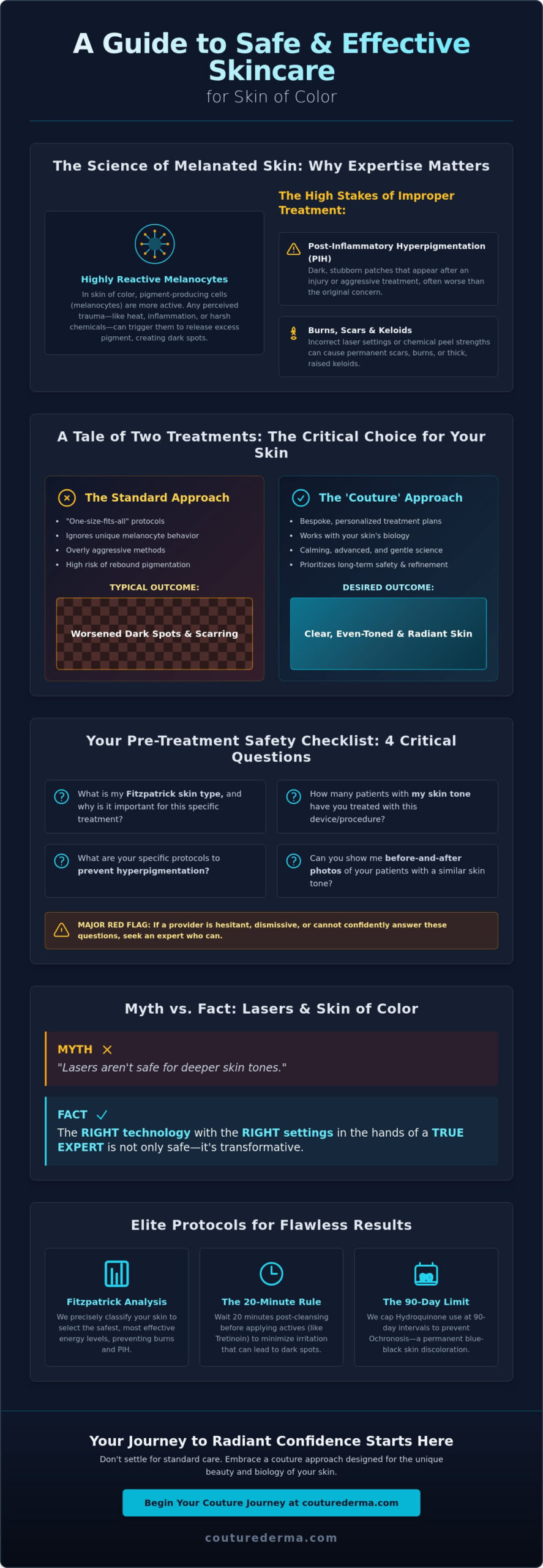
Last October, I treated a woman who came to me in tears after a “standard” chemical peel at a local medspa left her with map-like dark patches across her cheeks. This is post-inflammatory hyperpigmentation (PIH). It happens when treatments are far too aggressive for melanated skin. In my practice, I see these “rebound” cases far too often. Finding a specialized dermatologist for skin of color los angeles isn’t just about luxury; it’s about clinical safety. Our skin doesn’t just need more care. It needs different science. A true specialist understands the behavior of melanocytes (the cells that produce skin pigment) and how they react to heat, light, and chemical trauma.
To better understand this concept, watch this helpful video:
Standard dermatology protocols are frequently based on studies involving lighter skin tones. When these same methods are applied to deeper tones, the stakes are incredibly high. It’s the difference between a healthy glow and a permanent scar. You need a clinician who recognizes that what works for one person might cause a significant reaction in another.
What happens when a dermatologist doesn’t understand your skin’s unique biology?
When a provider uses a laser or peel that is too intense, your skin views it as an injury. Instead of healing normally, your melanocytes go into overdrive. This creates a “rebound effect” where the very spots you were trying to fix become darker and larger. I also see patients who develop keloids (thick, raised scars) from minor procedures because their doctor didn’t account for their genetic predisposition. In my practice, we rely on the Fitzpatrick scale for skin typing to determine exactly how much energy your skin can safely handle.
Here is a clinical tip: always ask your provider what your Fitzpatrick type is before they touch your skin with a laser. If they can’t answer, that’s a major red flag. Another protocol I insist on: if you’re using a hydroquinone cream for dark spots, don’t use it for more than 90 days at a time to avoid ochronosis (a permanent blue-black skin discoloration).
How does the Beverly Hills environment affect your skincare needs?
Living in Los Angeles means we deal with a UV index that hits 10 or higher during the summer months. For patients with melasma, this constant sun exposure is a persistent trigger. The “luxury gap” in Beverly Hills often means you get beautiful offices, but you might not get cultural competence. True luxury care must include an understanding of how your specific background influences your skin health. If you’re dealing with the aftermath of improper treatments, we often use acne scar refinement to help restore a smooth finish. Let’s be honest; your skin is an investment. You need a dermatologist for skin of color los angeles who treats it with the couture precision it deserves.
What makes skin of color unique from a clinical dermatological perspective?
In my practice, I often tell patients that their skin is like a delicate, high-end fabric. It requires a specific touch because the biology of melanated skin is distinct. The primary difference lies in the melanocytes (cells that produce skin pigment). While everyone has roughly the same number of these cells, in deeper skin tones, they are far more active. They act like security guards on high alert. Any trauma, whether it is a pimple, a scratch, or excessive heat from a laser, can trigger these cells to dump pigment into the skin. This is why a dermatologist for skin of color los angeles must prioritize a “couture” approach that focuses on calming the skin rather than just attacking a condition.
The outer layer of skin (epidermis) in patients with more pigment also tends to be more compact. This can be a double-edged sword. It provides some natural protection against sun damage, but it also means that certain conditions present very differently. For example, I see many patients with Hori’s Nevus, which looks like blue-grey patches on the cheeks. It is often misidentified as simple sun damage, but it is actually a deeper dermal pigment issue. Similarly, Dermatosis Papulosa Nigra (DPN) appears as small, fleshy brown bumps. Treating these requires a board-certified eye to ensure we don’t cause more pigment issues while trying to remove them. You can learn more about how we handle these nuances in this overview of Dermatology for Skin of Color.
Why do dark spots (hyperpigmentation) seem so stubborn?
Here’s the thing: not all dark spots are created equal. Post-inflammatory hyperpigmentation (PIH) is the result of skin “trauma,” like an acne breakout. Melasma, on the other hand, is often driven by hormones and heat. In my practice, I often see patients who have over-exfoliated with harsh scrubs or high-percentage acids, making their spots darker because the irritation keeps the melanocytes in a state of panic. We want to move from “clearing” the skin to “refining” it for the long term. If you are struggling with breakouts that leave marks, it helps to understand what a dermatologist wants you to know about acne.
Clinical Tip: Wait 20 minutes after cleansing before applying active ingredients like tretinoin. Applying it to damp skin increases absorption too quickly, which leads to the irritation and peeling that often causes new dark spots in skin of color.
How do we manage the unique challenges of hair and scalp health?
Clinical dermatology for diverse patients also includes the scalp. I frequently diagnose Traction Alopecia, which is hair loss caused by repetitive tension from tight styles. I also see Central Centrifugal Cicatricial Alopecia (CCCA), a form of permanent scarring hair loss that starts at the crown. These conditions require early medical intervention to prevent permanent loss. Let’s be honest; your hair and skin deserve an expert who understands these specific risks. If you are noticing changes in your skin or scalp, you can schedule a clinical consultation to start your own couture journey.
Which laser and aesthetic treatments are actually safe for deeper skin tones?
Let’s clear up one of the biggest misconceptions in my field: the idea that lasers are dangerous for melanated skin. While it’s true that the wrong device can cause a disaster, the right technology in the hands of a board-certified dermatologist for skin of color los angeles is transformative. In my practice, I focus on wavelength and pulse duration; these are the technical settings that determine whether a laser safely bypasses the pigment in your skin to reach its target or if it gets “stuck” on the surface and causes a burn. I often use the Fotona laser because its 1064nm wavelength is the gold standard for safety in deeper skin tones. It allows us to perform skin tightening and rejuvenation without triggering a pigment response. For redness or visible vessels, I rely on the Vbeam, but I adjust the settings to deliver energy over a longer period to prevent the sharp “snap” of heat that leads to scarring.
Chemical peels are another powerful tool, but they must be formulated correctly for your specific biology. I frequently use the Vi Peel Precision Plus because it combines brightening agents with suppressors that keep pigment cells quiet during the peeling process. This prevents the “rebound” darkening that often happens with generic peels. It’s about refinement, not just aggression. We want your skin to feel seen and valued, not attacked.
Is laser skin resurfacing a risk for my skin tone?
Ablative lasers, which essentially vaporize the outer layer of skin, are typically too risky for Fitzpatrick types IV through VI. Instead, I prefer non-ablative treatments. These heat the deeper layers to stimulate collagen while keeping the surface intact. Our practice also uses advanced cooling technology to keep the skin’s temperature stable throughout the procedure. If you’re looking to address texture or old marks, acne scar refinement using these safe laser methods is a game-changer. It delivers results that feel elevated and enduring without the downtime of traditional resurfacing.
Clinical Tip: Never skip the test patch. In my practice, I perform a small test spot behind the ear or along the jawline and wait at least 48 to 72 hours to see how the skin reacts before treating the entire face. If a med spa suggests a high-intensity CO2 laser for your dark skin without a test patch, please seek a second opinion.
Can injectables like Botox and fillers be customized for SOC?
Fillers aren’t just about volume; they’re about light. If a filler is placed too superficially in a patient with deeper skin, it can create a “shadow” that looks exactly like a dark spot or a bruise. This is why an artistic eye is essential. We use fillers to refine your natural structure, ensuring the transition between areas is seamless. For many of my patients, under-eye brightening with carefully placed filler can eliminate the look of fatigue without the risk of hyperpigmentation. We aim for a beautifully smooth finish that enhances your unique features rather than changing them.
How do I vet a dermatologist for skin of color in Los Angeles?
I see patients who have spent thousands on treatments that weren’t designed for their specific biology. Vetting a dermatologist for skin of color los angeles is a process that begins long before you sit in the exam chair. Start with the “About” page. You are looking for a board-certified dermatologist who has dedicated a significant portion of their 15 years of experience to diverse skin tones. Fellowship training or specific clinical focus in medical dermatology for skin of color is a major indicator of expertise. You want someone who views skin through a scientific and artistic lens.
During your consultation, ask about their specific protocol for Fitzpatrick type IV through VI. A true expert won’t be offended; they’ll be impressed. You should hear them talk about cooling techniques, lower energy settings with more passes, and meticulous skin preparation. Here is a red flag: “guaranteed” results. In medicine, there are no guarantees, only high probabilities based on elite science. Another warning sign is a lack of skin preparation. In my practice, I often require patients to use a medical-grade pigment inhibitor for at least 30 days before certain laser treatments to “quiet” the melanocytes (pigment-producing cells).
Does their ‘before and after’ gallery reflect your skin?
Diversity in visual evidence is non-negotiable for building trust. If you only see results on fair skin, that provider might not have the experience your biology requires. You want to see results that show refinement and a beautifully smooth finish rather than an over-processed, unnatural look. Let’s be honest; you are looking for evidence that the clinician understands how your skin heals.
Clinical Tip: Bring photos of your skin from 5 or 10 years ago to your consultation. This helps me understand your specific aging pattern and where your volume has naturally shifted over time. It allows us to curate a more accurate, bespoke plan for your rejuvenation journey.
What should your initial ‘Couture Journey’ consultation feel like?
A 5-minute skin check is not enough. A “Couture-level” consultation is a collaborative process where you feel seen, valued, and deeply cared for. We discuss your lifestyle, your history with dark spots, and your long-term goals. You can learn more about how to choose the best dermatologist in Los Angeles to ensure you’re getting the level of care you deserve. We prioritize a customized home-care regimen as a prerequisite for any in-office procedure. This ensures your skin is healthy and resilient enough to handle advanced treatments. If you’re ready to start your own bespoke skincare journey, you can book your clinical consultation today.
What is the ‘Couture Journey’ for diverse skin at our practice?
In my practice, I often remind patients that skin refinement is a journey; it’s never a rush to the finish line. We reject the “quick fix” mentality because, quite frankly, it’s often what causes the pigment damage I spend months correcting. My Harvard training isn’t just a line on a resume. It’s the foundation of every single protocol we use to keep your skin safe. As a specialized dermatologist for skin of color los angeles, I’ve spent 15 years perfecting the balance between clinical efficacy and the preservation of your unique pigment. Finding the right dermatologist for skin of color los angeles means choosing someone who understands that your biology is the priority.
Our 360-degree approach means we don’t ignore the medical health of your skin while pursuing aesthetic goals. We treat the active acne before we treat the scars. We quiet the inflammation before we introduce the laser. This meticulous, intentional care provides the luxury of peace of mind. You aren’t just a patient; you’re a partner in a transformative process. We aim for a beautifully smooth finish that feels both elevated and enduring. It’s about long-term health and the calm confidence that comes with it.
Bespoke treatment plans curated for your lifestyle
Every treatment plan is custom-fit for your specific lifestyle. If your schedule doesn’t allow for five days of peeling, we don’t suggest a deep chemical treatment. We find the “couture” fit that works for your timeline and your long-term skin goals. I see patients who want to look refreshed but never “done.” We prioritize natural-looking results that stand the test of time. Here is a daily essential: you must wear a mineral sunscreen containing zinc oxide or titanium dioxide every single day. Even when it’s “gloomy” in Los Angeles, the UV index can still trigger melasma and dark spots.
Ready to start your signature transformation?
Taking the first step toward your signature transformation is an act of self-care. We want you to walk out of our Beverly Hills clinic with “Bold Confidence” and skin that feels as vibrant as you are. Our practice is designed to be an accessible sanctuary where elite science meets personal care. Let’s be honest; your skin is your most visible investment. It deserves the highest level of expertise. You can book your clinical consultation to begin your own Couture Journey today.
Your Path to Radiant, Even-Toned Skin
Choosing a dermatologist for skin of color los angeles means opting for clinical safety over speed. We’ve explored why your biology requires a specialized touch and how the right laser technology can safely refine your complexion without the risk of “rebound” pigment. It’s about moving away from the fear of burns and toward the certainty of a plan designed specifically for your Fitzpatrick type. You don’t have to settle for “standard” care when your skin deserves a bespoke, couture approach.
In my practice, I combine my 15 years of board-certified experience with the precision of Harvard-trained protocols to ensure your results are both elevated and enduring. This is the luxury of knowing your skin is in the safest possible hands right here in Beverly Hills. You deserve to feel seen, valued, and deeply cared for throughout every step of your transformation. Let’s be honest; it’s time to trade frustration for the bold confidence that comes with healthy, glowing skin.
Begin Your Couture Journey — Schedule Your Consultation with Dr. Chinonso. Your transformation is waiting, and I’m ready to help you reveal your most radiant self.
Frequently Asked Questions
Is it safe for someone with dark skin to get laser hair removal?
Yes, it is safe as long as the provider uses a long-pulsed 1064nm Nd:YAG laser. This wavelength is specifically designed to bypass the pigment in your skin and target only the hair follicle. In our practice, we prioritize your safety by using specialized cooling systems that protect the surface layer. It’s frustrating when patients are told they aren’t candidates for hair removal simply because their provider lacks the right technology.
How do I get rid of dark spots (hyperpigmentation) permanently?
Getting rid of hyperpigmentation permanently is less about a single procedure and more about a long-term maintenance strategy. You need a dermatologist for skin of color los angeles who uses pigment inhibitors to keep your melanocytes quiet. If you don’t address the daily triggers like UV exposure or friction, the spots typically return. We focus on a “couture” plan that combines medical-grade topicals with safe clinical treatments to ensure your results endure.
What is the Fitzpatrick scale and why does my dermatologist use it?
The Fitzpatrick scale is a tool I use to categorize how your skin responds to ultraviolet light and heat. It ranges from Type I to VI, with deeper tones usually falling into the IV through VI categories. As a dermatologist for skin of color los angeles, this scale helps me calibrate laser settings with extreme precision. It’s the difference between an effective treatment and one that causes a significant burn or long-term scarring.
Can chemical peels actually make my skin darker if I have a deeper tone?
Yes, aggressive peels can cause your skin to darken through a process called post-inflammatory hyperpigmentation (PIH). When the skin is “attacked” by harsh acids, your pigment cells go into survival mode and dump excess melanin. We avoid this by using designer peels that contain anti-inflammatory ingredients. It’s much safer to achieve refinement through a series of gentle, intentional treatments rather than one risky, deep peel that panics your biology.
What are the most common skin conditions that affect African-American skin?
Conditions like pseudofolliculitis barbae (razor bumps), keloids, and specific pigmentary disorders present very differently in melanated skin. These issues are far more common in patients with deeper tones and require a specialized clinical approach to avoid secondary scarring. This level of specialized expertise is just as vital for lower extremity health; for instance, Local Foot Doc provides dedicated podiatric care for patients who value focused, expert treatment. Because these conditions can mimic other skin issues, getting an accurate diagnosis from a board-certified expert is critical to prevent permanent changes to your skin’s texture or tone.
How do I know if a dermatologist is truly an expert in skin of color?
A true expert will prioritize skin preparation and safety over “guaranteed” results. Look for a clinician who requires you to use a pigment-stabilizing cream for at least 30 days before any laser procedure. They should also have a gallery that features patients with your exact skin tone. If they can’t explain their specific cooling protocols or their experience with Fitzpatrick types IV through VI, they may not have the specialized knowledge your skin requires.
Why is sun protection still important for people with high melanin levels?
While melanin provides a natural defense, it only offers an SPF equivalent of about 13, which isn’t enough to prevent DNA damage. Sun exposure is also the number one trigger for melasma and stubborn dark spots. I see patients who struggle with uneven tone simply because they skip sunscreen on “gloomy” days. A tinted mineral sunscreen is your best defense because the iron oxides also block visible light, which contributes to pigmentation.
What is the difference between a medical dermatologist and a cosmetic dermatologist for SOC?
A medical dermatologist focuses on the health and pathology of the skin; a cosmetic dermatologist focuses on aesthetic refinement. At Couture Dermatology & Laser Beverly Hills, we bridge that gap. We believe you can’t achieve a beautifully smooth finish without first ensuring your skin is medically healthy and resilient. Every aesthetic treatment we offer is rooted in advanced dermatologic science to ensure your journey is both luxurious and clinically safe.