

Last Tuesday, a patient named Sarah sat in my chair at our Beverly Hills practice, worried she was late in preparing for laser hair removal appointment steps because she’d used her Retinol the night before. She was caught in that frustrating cycle of wanting permanent results but fearing the “what ifs” of hyperpigmentation (dark spots) or irritation. It’s a scenario I see often in my practice; let’s be honest, the excitement of never picking up a razor again is often overshadowed by confusion over shaving timelines and skincare ingredients.
You shouldn’t have to guess when it comes to your skin. My goal is to replace that uncertainty with a couture level of clinical precision, tailoring your skin’s preparation just as we would a bespoke garment. I’m going to share the exact protocol you need to prime your follicles for safe, effective, and permanent hair reduction. In our office, we treat every session as a serious medical procedure, ensuring our registered nurses provide the highest level of care under direct physician supervision.
We’ll walk through a clear, actionable checklist that covers everything from managing your active skincare to the “golden window” for shaving. By the time you’re done, you’ll have a professional guide designed to ensure your skin stays protected while your results remain flawless.
Key Takeaways
- Learn why preparing for laser hair removal appointment protocols are just as vital as the laser itself to ensure your skin is primed for selective photothermolysis.
- Understand why managing UV exposure is a non-negotiable step to prevent complications like hypopigmentation, or skin lightening, during your aesthetic journey.
- Discover why you must trade your tweezers for a razor; keeping the hair root intact is essential for the laser to successfully target the follicle.
- Identify the specific skincare ingredients, like Retinol, that must be paused seven days prior to avoid sensitivity or skin lifting.
- Master the Clean Skin rule to ensure your treatment area is free of barriers like lotions or oils that can hinder laser precision.
Why your prep determines your laser hair removal results
In my practice, I often tell patients that the laser is only half the battle. The other half? That’s your skin prep. I like to view our relationship as a partnership. I bring the 15 years of clinical expertise and the high-end technology, but you provide the canvas. If that canvas isn’t ready, we can’t create the masterpiece of smooth skin you’re looking for. Preparing for laser hair removal appointment sessions isn’t just about following a checklist; it’s about safety and maximizing your investment. Let’s be honest, you’re here for results that last, and those results start at home long before you step into our Beverly Hills office.
To better understand how this preparation fits into your journey, watch this helpful video overview:
When we get down to the science, we’re looking at a process called selective photothermolysis. It sounds like a mouthful, but it’s actually quite simple. We use specific light wavelengths to target and destroy the hair follicle without harming the surrounding skin. For a comprehensive laser hair removal overview, you’ll see that the goal is always the same: thermal damage to the hair bulb. My job is to ensure the laser “sees” only what it’s supposed to see. If your skin isn’t primed, that energy gets distracted, which is exactly what we want to avoid.
The science of the “Clean Canvas”
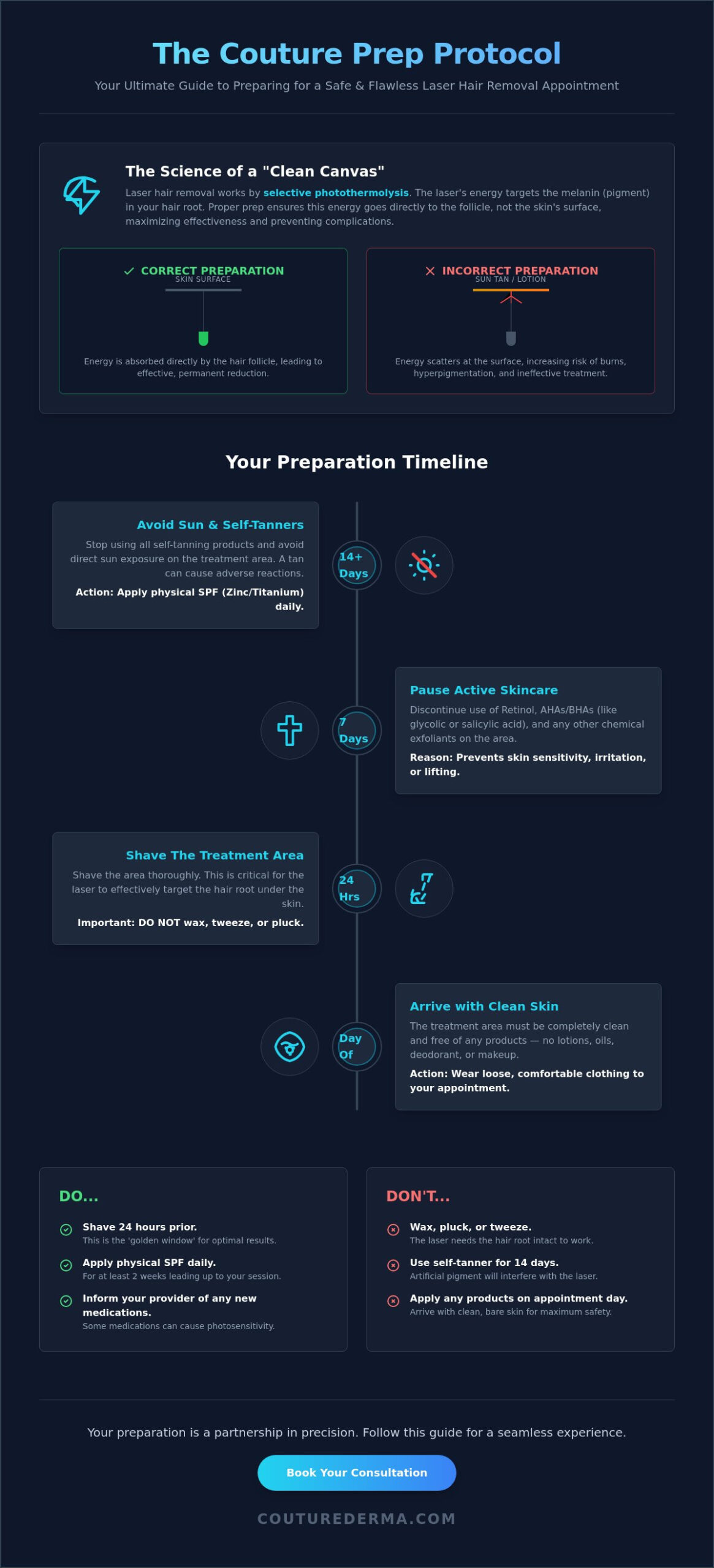
The laser identifies melanin (pigment) in the hair root to do its work. In most cases, if you have surface interference like a recent tan, leftover self-tanner, or even a thick layer of body lotion, the laser energy gets absorbed by the skin surface instead of traveling down to the follicle. This is how “hot spots” or even burns can happen. Think of your prep as clearing the path for a direct hit on the follicle. We want that energy to go deep, not stay on the surface. When the skin is a clean canvas, the laser can focus entirely on the root, leading to much more effective hair reduction.
Actionable Tip: Stop using all self-tanning products, including “gradual glow” lotions, at least 14 days before your session. If there’s any artificial pigment on the skin’s surface, the laser will target it instead of your hair.
A bespoke approach for every skin tone
I see many patients who believe laser isn’t for them because they have deeper skin tones. In my practice, that’s a common misconception. We use advanced settings and specific lasers designed to bypass the surface pigment. We adjust the energy specifically for your melanocytes (cells that produce skin pigment) to keep the outer layer safe. But here’s the thing; because we live with the Beverly Hills sun year-round, your prep requires extra vigilance. If you’ve had recent sun exposure, those melanocytes are “excited” and much more likely to react to the laser energy. This can lead to hyperpigmentation (dark spots) or hypopigmentation (light spots).
Actionable Tip: Apply a physical blocker SPF (look for zinc or titanium on the label) to the treatment area every single day for two weeks leading up to your visit. Even “incidental” sun through a car window can sensitize your skin.
By treating your skin with this level of detail, you aren’t just following a protocol. You’re ensuring that every pulse of the laser is as effective as possible. It’s about creating a safe environment where we can use the necessary power to get you to that hair-free goal without complications. We provide the technology, but your prepared skin is what allows that technology to shine.
The Sun Trap: Managing UV exposure before your session
Here’s the thing: a fresh tan is the number one reason I have to reschedule appointments at our practice. It’s a hard conversation to have, but I’d much rather push your session back than risk your safety. When you’re preparing for laser hair removal appointment visits, your skin’s baseline color must be stable. UV exposure, whether from a weekend in Malibu or just a long lunch on a patio, increases the risk of blisters and hypopigmentation (lightening of the skin). This happens because the laser can’t distinguish between the pigment in your hair and the active pigment in your sun-kissed skin.
I typically insist on a 4-week rule for sun protection. That means a full month of avoiding intentional tanning before we even think about starting the laser. In my practice, I see many patients who don’t realize that incidental exposure while driving in LA is just as significant as a day at the beach. That left arm often gets more sun through the car window than you’d expect. Following a strict guide on how to prepare for laser hair removal is essential to avoid these complications.
The danger of the “Hidden Tan”
Let’s be honest, we all love a bottled glow, but self-tanners and bronzers are a major no-go. These products must be scrubbed off at least 10 days before your appointment. The ingredients in fake tans can react with the laser energy, often leading to surface burns or uneven results. I’ve seen cases where even a tiny bit of residual bronzer caused unnecessary irritation during a session.
Actionable Tip: Use a physical exfoliant, like a gentle scrub or mitt, one week before your visit to ensure every bit of “bottled” glow is gone from the treatment area.
Sun protection as a clinical requirement
For my patients, SPF 30+ isn’t just a suggestion; it’s a clinical requirement. I recommend physical blockers containing zinc or titanium over chemical versions for your prep. These minerals sit on top of the skin and reflect UV rays immediately, whereas chemical filters need time to absorb. If we’re treating your face or neck, pay extra attention during your daily commute to avoid cumulative damage.
Actionable Tip: Keep a high-quality zinc-based sunscreen in your car’s center console. Reapply to your hands, arms, or neck 15 minutes before you start your drive home to block that late afternoon sun.
This level of vigilance is especially critical for my patients with melanin-rich skin. We want to keep those melanocytes (pigment-producing cells) calm and quiet to ensure the laser only targets the hair. If you’re ready to start your journey with a team that prioritizes your skin’s unique needs, you can schedule your consultation here to get started.
The Follicle Factor: Shaving vs. Plucking
Let’s be honest, the urge to pluck that one stray hair is strong. But you must resist. In my practice, I’ve seen many patients come in with perfectly smooth skin from waxing, only for me to tell them we have to wait another month to start. Why? Because the laser is looking for a specific target. It needs the hair root to be physically present beneath the skin to work its magic. If you pluck it out, the laser has nothing to “see” beneath the surface, effectively rendering that session useless. When you’re preparing for laser hair removal appointment details, remember that we are targeting the follicle, not the hair on the surface.
I often see patients who think shaving an hour before their visit is the best approach. But here’s the thing; shaving right before can leave your skin sensitized and your pores slightly inflamed. Conversely, waiting two days is too long, as hair on the surface can singe and cause a surface burn. The 24-hour window is the “sweet spot” for safety and efficacy. According to FDA laser safety facts, these medical devices are designed for precision, and a clean shave ensures the energy travels directly to the root without interference.
When is the best time to shave?
Following a specific shaving protocol ensures your skin is ready for a comfortable session. In our practice, I recommend these three steps the evening before your visit:
- Cleanse the area with a gentle, fragrance-free wash to remove oils.
- Use a fresh, sharp razor to avoid micro-cuts or razor burn.
- Shave the area completely smooth so the energy goes down, not across the skin.
Actionable Tip: If you realize you missed a small patch of hair once you arrive, don’t try to dry-shave it in the clinic. It significantly increases skin sensitivity and the risk of irritation. Just let your provider know so we can handle it safely with the proper glide.
Why does plucking ruin my results?
Every hair on your body goes through three stages: anagen (active growth), catagen (transition), and telogen (resting). The laser only works on hairs in the anagen phase. When you wax, thread, or epilate, you pull the root out and often force the follicle into a dormant phase. This means the laser can’t reach it during your session. You’re essentially paying for a treatment that has no target to hit.
Actionable Tip: If you have recently waxed or threaded, you should wait at least 4 to 6 weeks before starting your Couture journey. This allows enough follicles to return to the active growth phase for an effective first treatment.
By trading your tweezers for a razor, you’re ensuring that every pulse of the laser counts. It’s a small adjustment that makes a massive difference in how quickly you’ll see that smooth, hair-free transformation you’re after.
The No-Go List: Skincare and medications to pause
In my practice, I review every patient’s “skincare cocktail” during their initial consultation. It’s a vital part of preparing for laser hair removal appointment visits because many high-performance ingredients are light-sensitive. If you’re using potent actives, they can make your skin react unpredictably to the laser’s heat. Let’s be honest, nobody wants to deal with “hot spots” or skin lifting just because they forgot to pause their evening serum. My goal is to ensure your skin is resilient and ready for the transformative power of our lasers.
Managing Retinoids and Actives
Retinol and Tretinoin are the gold standards for skin health, but they work by accelerating cell turnover. This makes your epidermis (outer layer of skin) much thinner and more vulnerable to heat. In my clinic, I insist on a 7-day buffer for these products. This gives your skin barrier enough time to thicken and protect itself before we apply the laser energy. During this week, I suggest switching to simple, bland moisturizers containing Hyaluronic Acid, a molecule that helps skin hold onto moisture, to keep the area hydrated without irritation.
You also need to watch out for your chemical exfoliants. AHAs (Alpha-hydroxy acids) like Glycolic acid and BHAs (Beta-hydroxy acids) like Salicylic acid should be paused for at least 3 days before your session. These ingredients are designed to dissolve the “glue” between skin cells. While that’s great for a glow, it’s risky when paired with medical-grade lasers. I see many patients who think a “gentle” exfoliant is fine, but even those can increase sensitivity.
Actionable Tip: Wait 20 minutes after cleansing before applying any active treatments in the two weeks leading up to your pause date. This ensures your skin barrier remains intact and less prone to cumulative irritation.
Medications and Light Sensitivity
Beyond what you put on your skin, what you put in your body matters just as much. Certain medications are known photosensitizers, meaning they make your skin react more intensely to light. Common culprits I see include Doxycycline, which is often used for acne, specific types of birth control, and even herbal supplements like St. John’s Wort. If we laser photosensitive skin, you risk a reaction that feels like a severe sunburn. This can lead to unwanted pigment changes that take months to resolve.
Actionable Tip: If you start a new prescription or even a new over-the-counter supplement, call our office before your session. We may need to adjust your settings or wait a few days to ensure your safety.
We treat every session as a collaborative journey toward your best skin. If you’re ready to start your protocol with a team that prioritizes clinical precision, you can book your professional consultation to discuss your specific skincare routine.
Arriving at Couture: The final appointment checklist
Your visit to our Beverly Hills practice is a tailored experience, much like a final fitting for a bespoke suit. Every detail matters when you are preparing for laser hair removal appointment sessions, including the state of your skin the moment you walk through our doors. I often see patients who arrive straight from the gym or a long day at the office, but your “arrival state” can actually dictate how comfortable and effective your treatment will be. We want your skin to be a blank canvas, ready to receive the precise energy of our medical-grade lasers.
The “Clean Skin” mandate
The “Clean Skin” rule is perhaps the most critical part of your final checklist. In my practice, I’ve seen how leftover products can interfere with the laser’s path. Deodorant, for instance, often contains minerals like aluminum that can act as a shield, reflecting the laser energy away from the follicle or, worse, absorbing it and causing a surface burn. Lotions and body oils are equally problematic because they can trap heat on the skin surface, which increases discomfort and the risk of irritation.
If we are treating your underarms or bikini area, please ensure these zones are completely free of any topical products. If you are coming from a long day, don’t worry; we provide medical-grade wipes in our treatment rooms to ensure your skin is clinically clean before we begin. While we specialize in laser technology, we also offer a full range of high-end treatments for overall facial harmony. You can learn more about our aesthetic services to see how we combine clinical science with an artistic eye.
Actionable Tip: Skip your morning body oil or perfume on the day of your visit. Even if you aren’t treating your neck or chest, these products can migrate or leave a residue that complicates the “Clean Skin” mandate.
Comfort and Attire
Dress for the occasion by choosing loose-fitting, breathable cotton clothing. After your session, your skin will be slightly sensitized and will need to “breathe” as it sheds the residual heat from the laser. I typically advise against wearing tight leggings, skinny jeans, or synthetic fabrics like polyester immediately after a session. These materials can trap heat and cause friction, leading to unnecessary redness or even a heat rash (folliculitis).
During your first visit, we will also perform a thorough assessment using the Fitzpatrick scale (a system used to classify skin type based on how it responds to UV light). This ensures that our settings are perfectly calibrated for your specific melanin levels. It’s this level of meticulous detail that allows us to provide safe results for all skin types.
Actionable Tip: Bring a change of loose cotton clothes if you’re coming from a professional meeting or a workout. Switching into something airy immediately after your treatment will significantly improve your post-laser comfort.
Finally, remember to skip the gym, the sauna, and the hot tub for at least 24 hours after your visit. We want to keep your skin cool and calm as it begins its transformation. By following this Couture protocol, you aren’t just a patient; you’re an active participant in achieving the smooth, hair-free skin you deserve.
Step into Your Smooth Transformation
Achieving flawless results is a collaborative journey where your diligent preparation meets our clinical precision. By now, you understand that preparing for laser hair removal appointment sessions is a partnership that requires respecting the 4-week sun rule and the 7-day retinol pause to ensure your skin is as resilient as possible. These steps don’t just prevent irritation; they create the perfect canvas for our technology to work its magic safely. In my practice, I’ve used this exact protocol for 15 years to ensure that every patient, regardless of their skin tone, walks away with the smooth results they deserve.
I bring my Harvard-trained expertise and a deep commitment to personalized Beverly Hills clinical care to every treatment we perform. Whether we’re navigating the nuances of melanin-rich skin or simply ensuring your comfort, our team is here to guide you through every stage of this transformation. You don’t have to settle for the frustration of temporary fixes like waxing or threading any longer. It’s time to embrace a future where your skin is always ready and your confidence is absolute.
Begin your transformative journey—Book a Couture Consultation with Dr. Abisogun
You’re now equipped with the professional knowledge to make your first session a complete success. I can’t wait to see you in the clinic and help you start this new chapter of effortless, hair-free living.
Common Questions About Your Couture Journey
Can I use numbing cream before my laser hair removal appointment?
You can use a topical anesthetic, but I prefer to manage this in our practice to ensure it doesn’t interfere with the laser. Some over-the-counter creams are too thick or contain oils that can actually block the laser’s path. If you do apply your own, it must be washed off completely before we begin so your skin is a clean canvas. We often find that our integrated cooling technology provides enough comfort for most patients without needing extra topicals.
What happens if I forget to shave before my session?
If you forget to shave, the laser will target the hair above the skin instead of the root. This singes the hair on the surface and can cause a painful surface burn or unnecessary skin irritation. It’s one of the most common reasons we might have to reschedule a visit. Shaving 24 hours prior is a vital part of preparing for laser hair removal appointment protocols to ensure the energy reaches the follicle safely.
Is it okay to get laser hair removal while on my period?
Yes, it is perfectly safe, but you may find your skin is more tender than usual. I see patients who are much more sensitive to the laser’s heat during their cycle due to hormonal changes. It isn’t a medical risk, just a matter of your personal comfort. If you decide to go ahead with your session, we can easily adjust the cooling settings to keep you feeling relaxed.
How long should I wait after tanning to get laser hair removal?
In most cases, you should wait a full 4 weeks after significant sun exposure or a tanning bed session. A fresh tan means your melanocytes (cells that produce skin pigment) are active and “excited.” If we laser tanned skin, those cells can overreact, which leads to a risk of hypopigmentation (light spots) or blisters. Because we live in the Beverly Hills sun, we have to be especially careful about this year-round.
Can I exercise right before my laser appointment?
I recommend skipping the gym or any heavy exercise right before your visit. Working out raises your internal body temperature and increases blood flow to the skin’s surface. This extra heat can make the laser pulses feel much more “snappy” and intense. It’s better to arrive for your treatment with your skin in a calm, cool, and rested state.
What should I do if I have a breakout in the treatment area?
If you have an active, inflamed breakout or a cold sore, it’s best to wait until the skin has fully healed. Lasering over broken or infected skin can spread bacteria or worsen the inflammation. If it’s just a minor blemish that isn’t painful or open, we can typically shield that small spot and treat the skin around it without any issues.
Do I need to stop taking my vitamins before the session?
Most daily multivitamins are perfectly fine to continue. However, some herbal supplements like St. John’s Wort can make your skin photosensitive (extra sensitive to light). In my clinic, I review your full supplement and medication list during the consultation. We want to make sure your “skincare cocktail” won’t cause any unexpected reactions when the laser hits the skin.
How much hair should be visible for the laser to work?
Ideally, no hair should be visible on the surface at all. You want a clean, smooth shave so the laser energy travels directly to the pigment in the root beneath the skin. Any hair left on top just absorbs energy that should be going to the follicle, which wastes the pulse and increases the risk of a surface burn. This is why a thorough shave is the most important step when preparing for laser hair removal appointment visits.