
Best Acne Scar Treatment Options in Beverly Hills: Expert Dermatologist Solutions for Clearer Skin

By Tunde Abisogun, Cosmetic & Medical Dermatology in Beverly Hills | Couture Dermatology
Acne scarring may adversely affect self-image and cutaneous appearance; effective intervention is therefore often clinically indicated. In Beverly Hills, clinicians provide multiple advanced dermatologic modalities to refine skin texture and diminish scar visibility. This document reviews principal interventions—laser therapy, microneedling, and chemical peels—and explains how individualized treatment regimens can optimise clinical outcomes. A clear understanding of these options facilitates informed decisions regarding care and realistic expectations for skin improvement.
What Are the Most Effective Acne Scar Treatments Available in Beverly Hills?
Beverly Hills clinics provide a spectrum of evidence-based acne scar treatments customised to patient-specific factors. The principal modalities are listed below.
- Laser Therapy : This treatment utilizes focused light to target and reduce the appearance of scars, promoting collagen production and skin renewal.
- Microneedling : By creating micro-injuries in the skin, microneedling stimulates the body’s natural healing process, resulting in improved skin texture and reduced scarring.
- Chemical Peels : These treatments involve applying a chemical solution to exfoliate the skin, revealing fresher layers underneath and improving overall skin texture.
Couture Dermatology offers these modalities and delivers care plans tailored to individual clinical objectives.
The evidence base supports a multi-modal approach, employing lasers and needling among other adjunctive therapies for varied acne scar presentations.
Multimodality Acne Scar Treatment: Lasers, Needling & Tailored Approaches
The efficacy of lasers and radiofrequency in atrophic acne scarring is confirmed by many comparative and observational studies. Other modalities can be used as an adjunct, the choice of which depends on the type, severity, and number of atrophic scars. Minimally invasive procedures, such as fractional radiofrequency and needling, provide good outcomes with negligible risks in patients with dark or sensitive skin types.
Acne scarring management: systematic review and evaluation of the evidence, 2018
How Does Laser Acne Scar Removal Work and What Are Its Benefits?
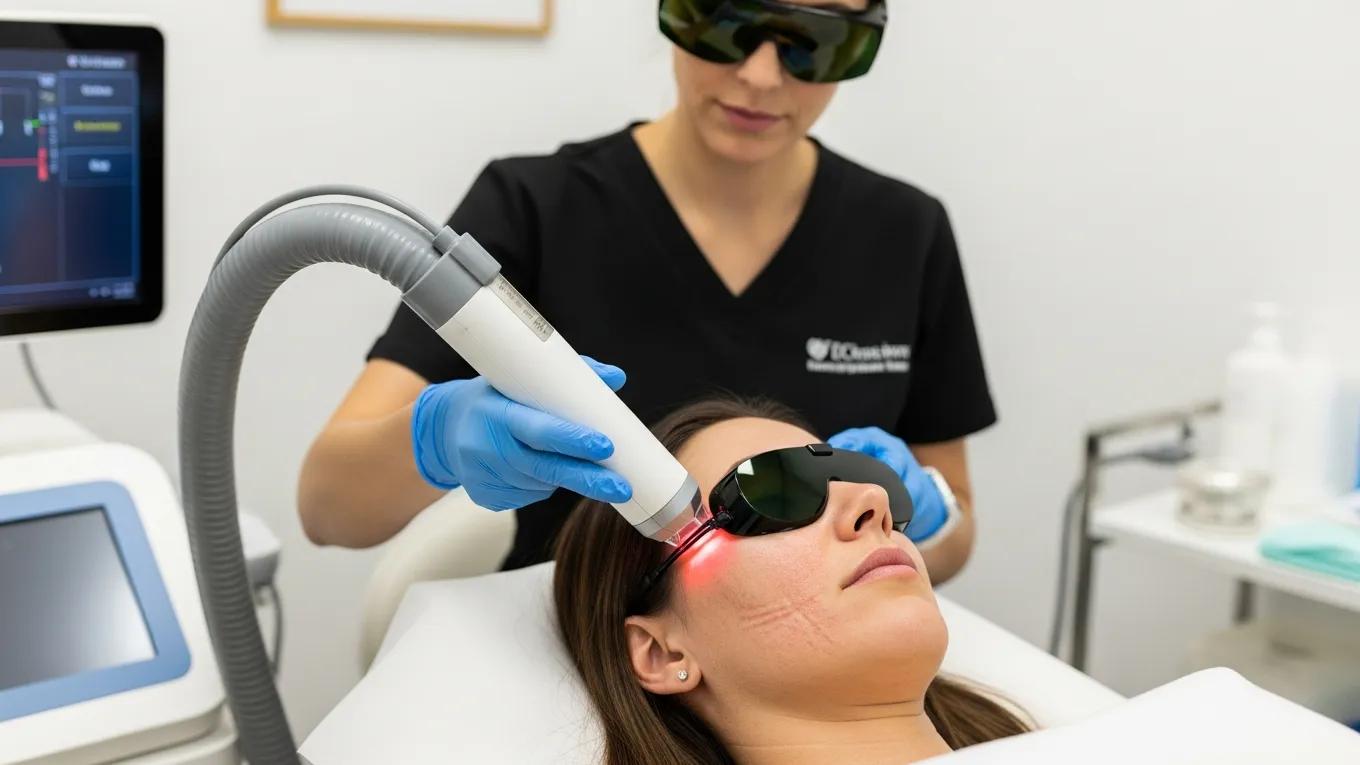
Laser resurfacing employs concentrated light energy to ablate or thermally remodel scar tissue. Energy delivery disrupts fibrotic scar bands and induces dermal remodelling via collagen synthesis. The combined effect is a reduction in scar depth with concurrent improvement in epidermal texture and pigment heterogeneity.
The principal benefits associated with laser therapy are as follows:
- Precision : Targeted treatment minimizes damage to surrounding skin.
- Minimal Downtime : Many patients experience quick recovery times, allowing them to return to daily activities sooner.
- Long-lasting Results : With proper care, the results can be long-lasting, providing a significant improvement in skin appearance.
EAV Table: Laser Treatment Options
Distinct laser platforms provide specific mechanisms of action and clinical benefits that may be matched to scar morphology and patient priorities.
| Treatment Type | Mechanism | Benefit |
|---|---|---|
| Ablative Laser | Removes outer layers of skin | Reduces deep scars effectively |
| Non-Ablative Laser | Stimulates collagen without damaging skin | Minimal downtime with gradual improvement |
| Fractional Laser | Treats only a fraction of the skin | Combines benefits of both ablative and non-ablative |
This comparison demonstrates how laser selection can be aligned with scar type and patient-specific factors to optimise outcomes.
Randomised trials have reported significant improvement in moderate to severe atrophic acne scars following ablative fractional CO2 resurfacing.
Fractional CO2 Laser Resurfacing for Atrophic Acne Scars
In this single-blinded randomized controlled trial we demonstrated that moderate to severe atrophic acne scars can be safely improved by ablative fractional CO 2 laser resurfacing.
Fractional CO2 laser resurfacing for atrophic acne scars: A randomized controlled trial with blinded response evaluation, 2012
What Results Can You Expect from Microneedling for Acne Scars?

Microneedling induces controlled microtrauma to the dermis to stimulate the wound-healing cascade and neocollagenesis. The procedure is employed to improve atrophic scar architecture and epidermal surface irregularities.
Patients may expect the following clinical effects from microneedling:
- Improved Skin Texture : The treatment helps to smooth out uneven skin and reduce the appearance of scars.
- Increased Collagen Production : As the skin heals, collagen levels rise, leading to firmer and more youthful-looking skin.
- Minimal Discomfort : Most patients report only mild discomfort during the procedure, making it a well-tolerated option.
What to Expect During Your Initial Dermatology Consultation?
At the initial consultation in our clinic, the dermatologist will perform a focused clinical assessment to determine the most appropriate treatment pathway. This evaluation includes medical history review, skin-type classification, and objective appraisal of scar severity.
Patients are invited to raise questions and disclose any concerns to ensure informed consent and a shared understanding of proposed interventions.
How Do Chemical Peels Improve Acne Scars and Skin Texture?
Chemical peeling employs application of controlled chemical agents to exfoliate the epidermis and, in deeper formulations, the superficial dermis. This process facilitates removal of photodamaged or scarred epidermis and promotes re-epithelialisation.
The primary therapeutic effects of chemical peels include:
- Exfoliation : Removes dead skin cells, revealing smoother skin underneath.
- Collagen Stimulation : Encourages the production of collagen, which is essential for skin elasticity and firmness.
- Customization : Different types of peels can be tailored to address specific skin concerns, including varying severities of acne scars.
Enhanced superficial peels are documented to improve epidermal texture and mitigate superficial pigmentary irregularities, with ancillary benefits for acne control in selected patients.
Chemical Peels for Skin Texture and Acne Control
Enhanced superficial chemical peels can improve overall skin texture and smooth superficial pigmentary abnormalities. Acne control may also be enhanced for many patients.
Latest chemical peel innovations, 2012
What Types of Chemical Peels Are Best for Different Acne Scar Severities?
Selection of peel depth should reflect scar severity and skin type. Superficial peels address mild scarring, medium peels achieve deeper epidermal and superficial dermal effects, and deep peels are reserved for severe scarring with longer convalescence.
- Superficial Peels : Best for mild scars, these peels exfoliate the outer layer of skin and require minimal downtime.
- Medium Peels : Suitable for moderate scars, these penetrate deeper and provide more significant results.
- Deep Peels : Ideal for severe scarring, these require longer recovery times but offer the most dramatic improvements.
How Is a Personalized Acne Scar Treatment Plan Developed by Beverly Hills Dermatologists?
Development of an individualised treatment plan requires a comprehensive dermatologic evaluation. Clinicians integrate scar classification, Fitzpatrick skin type assessment, and the patient’s therapeutic goals when formulating recommendations.
Dermatologists at Couture Dermatology utilize validated assessment protocols and multimodal strategies to align therapy with each patient’s specific clinical profile.
What Factors Do Dermatologists Consider When Customizing Treatments?
Key determinants in treatment selection include scar morphology, the patient’s cutaneous sensitivity and phototype, and the presence of active acne which must be controlled prior to definitive scar management.
- Type of Scarring : Different scars may respond better to specific treatments.
- Patient’s Skin Type : Skin sensitivity and type can affect treatment choices.
- Active Acne Management : Addressing ongoing acne is crucial before focusing on scar treatment.
How Does Combining Laser Therapy, Microneedling, and Chemical Peels Enhance Results?
A combined therapeutic strategy can address multiple pathogenic factors of scarring. Sequential or concurrent use of modalities often yields more comprehensive dermal remodelling than monotherapy.
For instance, ablative or fractional lasers can reduce scar depth, microneedling stimulates collagen deposition, and chemical peels improve epidermal smoothness. When properly scheduled, this synergistic approach frequently accelerates and amplifies clinical improvement.
What Are the Typical Costs and Consultation Process for Acne Scar Treatments in Beverly Hills?
Treatment costs vary according to modality, device, and extent of the treatment area. Fees reflect the complexity of the procedure and the practitioner’s expertise. The following ranges represent typical per-session estimates.
- Laser Treatments : Typically range from $500 to $3,000 per session, depending on the type and extent of treatment.
- Microneedling : Usually costs between $300 and $700 per session.
- Chemical Peels : Prices can range from $150 for superficial peels to $1,500 for deep peels.
How Much Should You Expect to Invest in Laser and Microneedling Procedures?
Financial investment should be considered alongside expected clinical benefit. Many patients judge the long-term improvements in skin quality and psychosocial impact to justify the cost.
It is prudent to discuss financing and payment options during the consultation to facilitate access to recommended treatments. For additional information on acne scar refinement , consult a specialist.
What Do Patients Say About Their Acne Scar Treatment Experiences at Couture Dermatology?
Patient reports commonly document measurable improvements in cutaneous texture and patient-reported confidence following appropriately selected therapies at Couture Dermatology.
Can Before-and-After Photos Demonstrate Treatment Effectiveness?
Standardised before-and-after photography provides objective visual documentation of treatment response and assists in establishing realistic outcome expectations for prospective patients.
How Do Patient Testimonials Reflect Satisfaction and Trust?
Testimonials contribute to practice transparency and may corroborate clinical efficacy and patient satisfaction when considered alongside clinical data and photographic evidence.
What Are the Most Common Questions About Acne Scar Treatments in Beverly Hills?
Patients frequently inquire about procedural efficacy, anticipated recovery intervals, and the incidence of adverse effects.
- How effective are these treatments?
- What is the expected recovery time?
- Are there any side effects?
Providing clear responses to these questions during consultation supports informed decision-making and realistic expectations.
Are Acne Scar Treatments Painful and How Long Is Recovery?
Procedural discomfort varies by modality and individual pain threshold. Most interventions cause only mild to moderate pain, which is commonly managed with topical or local anaesthesia as appropriate.
Recovery duration depends on the specific procedure: superficial approaches often require only days, whereas ablative treatments may necessitate extended convalescence for full resolution.
How Long Does Each Acne Scar Treatment Take to Show Results?
Temporal response varies with modality and individual healing. Typical timelines for observable improvement are summarised below.
- Laser Treatments : Results may be visible after 1-2 sessions, with optimal results appearing after several months.
- Microneedling : Improvements typically become noticeable within 4-6 weeks.
- Chemical Peels : Results can be seen within a week, with continued improvement over time.
Understanding these timelines enables appropriate scheduling of treatments and follow-up. If you are considering acne scar treatments , consult a qualified dermatologist to determine the optimal plan.
Frequently Asked Questions
What should I expect during my first acne scar treatment consultation?
The initial consultation will include a structured clinical evaluation: medical history, scar assessment, discussion of realistic outcomes, and review of suitable treatment options. The clinician will also document contraindications and discuss risks to support informed consent.
How can I prepare for my acne scar treatment?
Pre-procedure preparation typically includes minimising ultraviolet exposure and ceasing tanning products for an advised interval. Disclose all medications and supplements, as some may require temporary suspension. Follow any clinician-provided preparatory instructions precisely.
Are there any side effects associated with acne scar treatments?
Adverse effects are generally transient and may include erythema, oedema, and mild discomfort. Less common complications include persistent dyspigmentation or, rarely, secondary scarring. Discuss procedural risks with your dermatologist prior to treatment.
How many treatment sessions will I need for optimal results?
Session number is determined by scar severity and chosen modality. Laser therapy often requires 2–5 sessions; microneedling commonly requires 3–6 sessions; chemical peel frequency depends on peel depth. Your dermatologist will propose a personalised regimen.
Can I combine different acne scar treatments?
Combination therapy is frequently appropriate and may enhance efficacy by addressing multiple scar pathologies. Your clinician will evaluate timing and sequencing to ensure safety and maximise therapeutic effect.
What aftercare is necessary following acne scar treatments?
Post-procedural care is essential. Patients should avoid sun exposure, apply a physician-recommended broad-spectrum sunscreen, and adhere to specific wound-care instructions. Use gentle skin-care products and avoid abrasive procedures until cleared by the treating clinician.
Conclusion
Laser therapy, microneedling, and chemical peels are evidence-based options that can materially improve acne scar appearance and skin texture when selected and applied appropriately. Informed consultation with a qualified dermatologist is the first step to an individualised treatment plan and optimal clinical outcomes. Contact Couture Dermatology to discuss treatment options tailored to your clinical needs.