

Last Tuesday, a patient in my Beverly Hills office asked the question I hear most: how often should you get microneedling to see real change? Sarah was frustrated by slow results and worried that needling too frequently was actually hurting her skin. I see patients who feel this same exhaustion every day; they are tired of conflicting online advice and anxious about causing long-term damage.
It’s easy to feel overwhelmed, but I want to reassure you that the “wait” is just as productive as the needles themselves. In my practice, I treat skin like a fine silk that requires a custom fit, not a one-size-fits-all solution. You’ll discover the precise frequency your skin needs for optimal collagen renewal, tailored by my fifteen years of clinical experience.
We are going to move past generic fillers and look at specific schedules for acne scars, wrinkles, and general rejuvenation. I’ll explain why your skin’s natural remodeling cycle (the time it takes to build new tissue) dictates your results and how to find a professional rhythm that builds lasting confidence.
Key Takeaways
- Understand why the 4 to 6 week window is the biological sweet spot when deciding how often should you get microneedling to avoid chronic inflammation.
- Learn how your specific skin goals, like treating deep acne scars or fine lines, dictate a tailored schedule rather than a generic approach.
- Discover why the 28 day skin cell turnover cycle makes the rest period between your appointments just as vital as the treatment itself.
- See why professional vertical precision at our practice outperforms at-home rollers that often cause micro-tearing and unnecessary trauma.
- Shift your perspective from seeing treatments as simple appointments to viewing them as a collaborative, transformative journey for your skin health.
The Science of Controlled Injury: How Microneedling Triggers Skin Renewal
When I meet a new patient at Couture Dermatology & Laser, I often start by dispelling the myth that microneedling is just about the needles. It isn’t. It’s about how your body responds to them. We call it Collagen induction therapy, a process where we use tiny, sterile needles to create micro-channels (microscopic pathways) in the skin. But in our practice, we don’t just poke holes. We are architecting new skin. We are intentionally triggering a biological cascade that forces your skin to rebuild itself from the inside out.
To better understand this concept, watch this helpful video:
This transformation happens in three distinct phases. First is inflammation, where your skin sends out a “help” signal. Then comes proliferation, where new tissue forms. Finally, we reach remodeling. This is where the real magic happens. It’s a slow, beautiful process that can actually continue for up to 300 days after a single session. This long-term activity is exactly why the answer to how often should you get microneedling isn’t “as often as possible.”
Actionable Tip: Think of microneedling as a high-intensity workout for your skin’s fibroblasts (collagen-producing cells). Just like you wouldn’t hit the same muscle group at the gym seven days a week, your skin needs downtime to actually build the “muscle” of new collagen.
The Role of Fibroblasts and Growth Factors
In my Beverly Hills practice, I explain this as resetting your skin’s internal clock. When we use professional-grade devices, we can reach depths of up to 2.5mm. This allows us to hit the dermis (the deeper layer of skin) where those fibroblasts live. By releasing growth factors (natural proteins that signal repair), we wake up cells that may have become sluggish due to age or year-round sun damage. If you are looking for acne scar refinement, this deep-level remodeling is the key to smoothing out those stubborn textures.
Why Your Skin Needs a “Rest Day”
The reason we wait between sessions is simple: repair takes time. If we needle too soon, we interrupt the proliferation phase and cause chronic inflammation. This doesn’t lead to better skin; it leads to scar tissue and sensitivity. Your skin needs that “rest day” to finish the architectural work we started in the office. This is why a 4 to 6 week interval is typically the baseline for most of my patients.
The Standard Protocol: Why Most Patients Need a 4 to 6 Week Interval
I see patients who walk into my office with a “more is better” mindset. They’ve spent years dealing with texture issues and they’re ready for a change yesterday. But here’s the thing: your skin doesn’t work on a Hollywood production schedule. In my practice, I’ve found that the 4 to 6 week interval is the absolute biological sweet spot for most healthy skin.
I often hear the question: exactly how often should you get microneedling to make those scars vanish? While I understand the urgency, going more frequently than every four weeks is often less effective. As noted in this guide on Microneedling Benefits and Results, the procedure relies on the body’s natural healing process, which simply cannot be rushed. If you needle too often, you trigger chronic inflammation. Instead of building healthy new tissue, you’re just keeping the skin in a state of constant stress.
Actionable Tip: When you book your first session, mark your calendar for exactly five weeks out. This gives your skin the full 28-day cycle to recover plus a buffer week for minor life delays without losing your momentum.
The Danger of Over-Needling
Let’s be honest about what happens when you rush the process. If we don’t allow the micro-channels to fully close and the underlying tissue to stabilize, we risk micro-scarring. This is the opposite of what we want. Over-treating can actually break down your existing collagen instead of building a new foundation. Think of it through a tailoring metaphor: you can’t finish a custom suit if you keep unpicking the seams before the thread is even tied off. You have to let the work set.
The “Couture” Timeline for Initial Results
In Beverly Hills, we deal with intense sun exposure almost year-round. This means our skin is already working hard to manage UV damage. Because of this, I might stretch your interval to six weeks during the summer months to ensure your skin isn’t overwhelmed. While you’ll see a “glow” almost immediately, real structural change usually takes at least three sessions. If you are struggling with acne scar refinement, patience is your best ally.
Actionable Tip: Take high-resolution “before” photos in the same lighting every 4 weeks. You might not notice the gradual smoothing in the mirror every day, but the side-by-side comparison will prove the protocol is working. If you’re ready to start your own transformation, you can schedule your consultation to discuss a personalized plan.
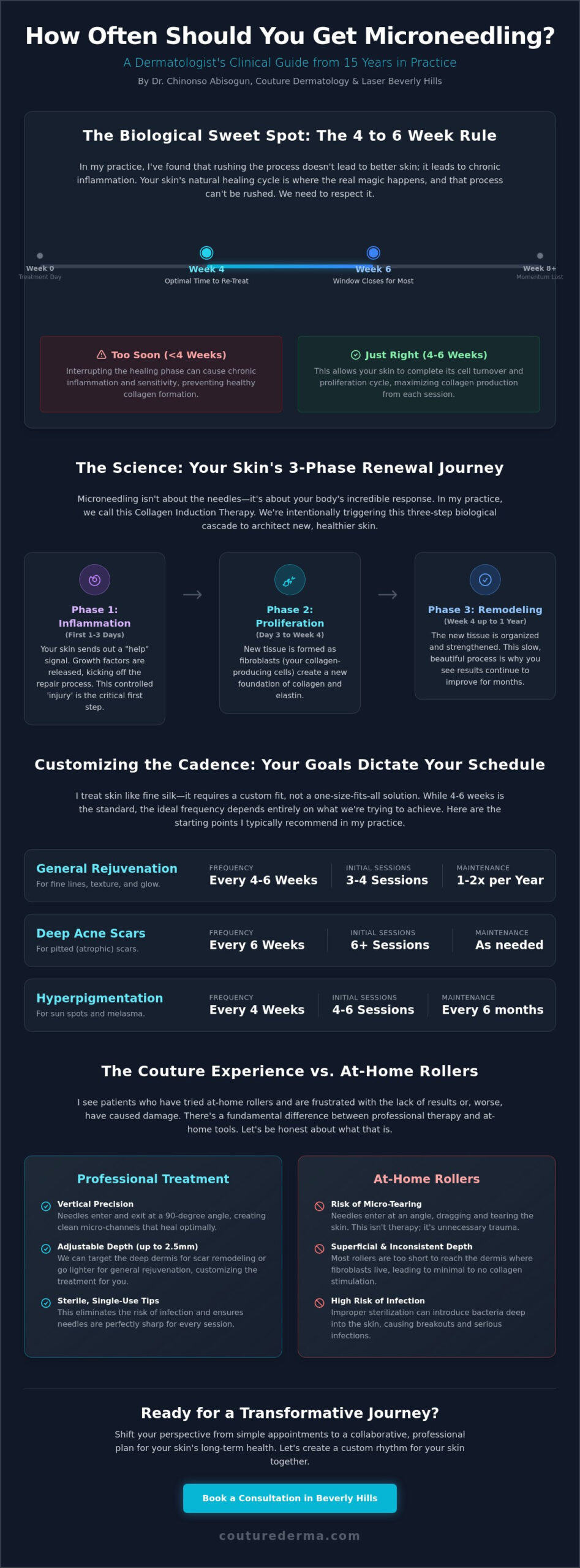
Customizing the Cadence: How Your Specific Skin Goals Dictate Your Schedule
I see patients who expect a one-size-fits-all answer, but here’s the truth: your calendar is as unique as your complexion. While we previously discussed the 4 to 6 week baseline, your biological age plays a major role in how we structure your journey. Older skin typically heals slower because the cellular engine isn’t as efficient as it once was. In these cases, I often suggest a 6 to 8 week gap to ensure we aren’t over-taxing your resources while trying to figure out how often should you get microneedling for your specific needs.
Actionable Tip: If you have a gala, wedding, or a major professional event, schedule your final session at least 3 weeks prior. This allows any lingering pinkness to fade and gives the fresh collagen enough time to settle into that signature Beverly Hills glow.
Acne Scar Refinement: A More Aggressive Path?
For those battling deep “pitted” textures like ice pick or boxcar scars, we sometimes take a more rigorous path. These structural issues often require a tighter 4-week interval to keep the remodeling process at its peak. In our practice, we often use a “Couture” approach by combining this with other modalities to break up fibrous tissue. You can explore our specific protocols for Acne Scar Refinement to see how we architect these transformative results.
Melanocytes and Hyperpigmentation: The Cautious Approach
Expertise really matters when we talk about diverse skin tones. I see many patients with deeper complexions (Fitzpatrick IV-VI) who worry about pigment issues. Your melanocytes (cells that produce skin pigment) are incredibly sensitive to injury. To avoid post-inflammatory hyperpigmentation, we often extend the “safety window” to 6 or 8 weeks. As noted in this guide from Yale Medicine on Microneedling, professional supervision is essential for these skin types to prevent unwanted darkening and ensure the condition improves rather than worsens.
Actionable Tip: Start using a tyrosinase inhibitor (a pigment blocker) for at least 2 weeks before your session. This “quiets” the pigment-producing cells and significantly reduces the risk of dark spots after your treatment.
Maintenance vs. Transformation
Transformation is a series; maintenance is a lifestyle. Once we’ve achieved your goals through an active series of 3 to 6 sessions, we shift gears. You might only need a refresh twice a year to keep your results polished and refined. This is especially true for delicate concerns like Under Eye Brightening where we want to maintain thickness without constant intervention. And remember our rhythmic mantra: consistent care leads to effortless confidence.
The Healing Phase: What Happens to Your Skin Between Appointments
I see patients who think the heavy lifting is done the moment they leave our practice. It isn’t. In fact, the “needling day” is really only 10% of the work. The other 90% is your home routine. Your skin operates on a roughly 28-day cell turnover cycle. This is the biological clock we are working with. When you ask how often should you get microneedling, you’re really asking how long it takes for this cycle to complete its architectural repairs. In my practice, I tell patients the home routine is their homework. If you don’t do the homework, you won’t see the grade.
Actionable Tip: Use a silk pillowcase for the first 3 nights after your treatment. It minimizes friction on your healing skin and helps prevent the “dragging” sensation that can occur with traditional cotton linens.
The First 72 Hours: Protection and Hydration
The first three days are about keeping the peace. You must avoid “sweating it out” at the gym. It’s a common mistake, but heat and sweat can introduce bacteria into those microscopic channels, leading to unnecessary irritation or even infection. Stick to a minimal list: a gentle cleanser, hyaluronic acid (HA), and a physical SPF. Or, if you want a little extra comfort, try this trick. Keep your HA serum in the fridge for a soothing “Couture” cooling effect that calms the skin instantly.
Reintroducing Actives: The 20-Minute Tretinoin Rule
Let’s be honest about your “power” products. You need to wait at least five to seven days before using Retinoids or Vitamin C. When you do reintroduce them, follow my specific protocol: wait 20 minutes after cleansing before applying tretinoin. This ensures the skin is completely dry and prevents the product from absorbing too deeply, which can cause that shiny, “plastic” look of over-exfoliation. If your skin starts to feel tight or looks like saran wrap, pull back immediately. You’re moving faster than your cells can keep up.
Year-Round Sun Protection in Beverly Hills
The LA sun is relentless. Freshly needled skin is especially vulnerable to post-inflammatory hyperpigmentation (dark spots caused by skin trauma). And here’s the thing: the SPF in your makeup isn’t enough. You need a dedicated, medical-grade physical sunblock every single morning. If you’re still looking for a provider who understands these local environmental challenges, you can read my guide on how to choose the best dermatologist in Los Angeles. Protecting your skin now ensures the collagen we’ve built actually stays healthy. Ready to see what a customized schedule can do for you? Book your consultation to get started.
The Couture Experience: Why Professional Microneedling Outperforms At-Home Kits
I see patients who have tried every gadget on the market before they find their way to our practice. Let’s be honest about at-home devices; they simply cannot replicate the clinical environment. While these tools are marketed as convenient, the mechanical reality of a roller is actually quite traumatic for your skin. Professional pens use a vertical motion, entering and exiting the skin at a precise 90 degree angle. At-home rollers enter at an angle and exit at an angle, which creates a dragging effect that tears the tissue rather than healing it. This leads to unnecessary inflammation and, in some cases, permanent scarring.
Actionable Tip: If an at-home roller hurts or draws blood, it’s likely causing more tearing than healing. Professional treatments at Couture Dermatology & Laser Beverly Hills use topical numbing and precise depth control to ensure the experience is comfortable and safe while avoiding unnecessary trauma.
Sterility is another major factor I discuss in my office. Your bathroom simply isn’t a medical suite. Bathroom bacteria can easily hitch a ride on those needles, leading to breakouts or persistent irritation. In our clinical setting, we use single-use, medical-grade needle cartridges and maintain a sterile environment to ensure your transformation is as safe as it is effective. We prioritize your health as much as your aesthetic outcome.
The Power of “Needling Plus”
In our practice, we often elevate the results by adding PRP (Platelet-Rich Plasma) or “Exosomes” to a professional session. These growth factors are pushed deep into the micro-channels we’ve created, speeding up the repair process and enhancing the final result. Professional devices also allow us to vary the needle depth for different zones. We use a shallower setting for the thin skin under your eyes and a deeper setting for the thicker tissue on your cheeks. This level of customization is something a fixed-depth home roller just can’t offer. If you’re looking for even more dramatic structural change, we often discuss how this fits into a broader plan for acne scar refinement.
Collaborative Transformation: Your Consultation with Dr. Abisogun
Here’s the thing: your skin isn’t off-the-rack. It shouldn’t be treated with a generic tool in your bathroom. During a Couture consultation, we map your unique frequency and determine how often should you get microneedling based on your specific health history and aesthetic goals. We treat this as a collaborative, transformative journey rather than a series of isolated appointments. It’s about precision, safety, and a commitment to long-term excellence. Our final rhythmic mantra is simple: professional precision for a lifetime of radiance.
Your Journey Toward Refined Skin Architecture
I see patients who walk into my Beverly Hills practice looking for a significant change, and I always tell them that transformation is a collaborative process. We’ve explored the biological necessity of the 4 to 6 week interval and why rushing your skin’s natural repair cycle only leads to frustration. Understanding how often should you get microneedling is about more than just dates on a calendar; it’s about respecting the intricate remodeling phase where your cells do their best work. Whether you’re refining acne scars or seeking a subtle glow, the key is a schedule tailored specifically to your unique skin tone and history.
In our practice, we combine 15 years of board-certified expertise with the latest medical-grade technology to ensure your results are both visible and safe. We don’t believe in off-the-rack solutions for your skin. Instead, we offer specialized protocols designed for all skin types and tones in an elite facility. You deserve a professional partner who views your aesthetic goals as an artistic journey rather than a simple appointment.
Are you ready to stop guessing and start seeing real structural improvement? Begin your transformative journey with a bespoke consultation at Couture Dermatology. I look forward to helping you achieve a lifetime of radiance and confidence.
Frequently Asked Questions
Can I get microneedling every 2 weeks if my skin heals fast?
No, you shouldn’t needle every 2 weeks. Even if your skin’s surface looks calm, the internal construction site is still busy. I see patients who try to rush the process and end up with sensitized, reactive skin. You need at least 4 weeks for the proliferation phase to finish. Going too soon interrupts the healing and can actually lead to less collagen production over time.
How many microneedling sessions are needed for deep acne scars?
Most patients with deep acne scars require a series of 3 to 6 sessions to see a significant change in our Beverly Hills practice. Scars are essentially tethered tissue that needs multiple rounds of un-sticking and rebuilding. I typically space these about 4 weeks apart. While you’ll see a texture shift after the first treatment, the real structural transformation happens as the collagen layers build up over several months.
Is it okay to use a dermaroller between professional appointments?
I strongly advise against using a dermaroller between our professional sessions. These at-home tools often cause micro-tearing due to their wheel-like motion. In my practice, I’ve seen this lead to scarring and infection from bathroom bacteria. Let the professional devices do the heavy lifting. Your skin needs the time between appointments to focus on the precise channels we created in the office, not new trauma from a roller.
How long does the “vampire facial” glow actually last?
The immediate glow from a professional session usually lasts about two to three weeks. This is the result of increased blood flow and surface-level hydration. But here’s the thing: the real goal isn’t just a temporary glow. We are looking for the long-term structural benefits that appear 3 to 6 months later. That’s when the new collagen has fully matured, giving you that lasting, effortless radiance we aim for at Couture.
Can I get Botox and microneedling in the same week?
You can certainly get both, but I typically recommend waiting 48 hours after Botox injections before having a microneedling session. We want the Botox to settle into the muscle without being disturbed by the pressure or inflammation of the needling process. Or, we can do them in the same week if we plan the timing carefully. It’s all about ensuring each treatment has the space to perform at its peak without interference.
What happens if I wait too long (3+ months) between sessions?
If you wait longer than three months, you won’t lose the collagen you’ve already built, but you will lose the momentum of the active phase. Think of it like a fitness routine. When deciding how often should you get microneedling, consistency is what creates the compounding effect. A long gap just means it might take an extra session to reach your original goal, but your previous progress remains part of your skin’s foundation.
Will microneedling make my skin thinner over time?
It actually does the opposite. Microneedling is designed to thicken the dermis (the deeper layer of skin) by stimulating new collagen and elastin. I see patients who worry about wearing out their skin, but professional needling is a regenerative process. Over time, this leads to skin that is more resilient, firmer, and physically thicker. It’s the ultimate way to build a stronger foundation for your complexion without using artificial fillers.
How do I know if my skin is “over-needled” or just healing?
Healing usually involves 2 to 4 days of pinkness and some mild shedding. If your skin feels plastic, looks unusually shiny, or stays red for more than a week, it might be over-needled. In my practice, I look for persistent sensitivity to basic products as a major red flag. If you’re following the 4 to 6 week rule we discussed, your skin should have ample time to recover fully and safely between sessions.