

Last week, a patient walked into my Beverly Hills practice feeling completely defeated after spending hundreds on “miracle” spot treatments that did nothing for the painful, marble-sized knot on her jawline. Since acne affects up to 50 million Americans annually, her frustration is incredibly common. When you’re dealing with these deep-seated, throbbing lesions, seeking professional cystic acne dermatologist help is usually the only way to stop the cycle of inflammation and permanent scarring.
You’ve probably tried every high-end wash and clay mask on the shelf, only to find the pain remains while your skin just gets more irritated. It’s exhausting to feel like you’re losing a battle against your own reflection. But here’s the thing: cystic acne isn’t a surface problem, so surface solutions will almost always fall short. In this article, I’ll explain why those retail products fail and how a bespoke clinical strategy can finally give you the clear, smooth texture you deserve. We’ll look at the specific medical protocols we use to calm deep inflammation and build a predictable routine that actually works for your unique skin.
Key Takeaways
- Understand why deep, “blind” bumps require a strategy that reaches the inner layer of your skin instead of just the surface.
- Learn how specialized cystic acne dermatologist help provides access to clinical tools like the Vbeam laser to rapidly calm active inflammation.
- Discover the role of hormones in adult-onset breakouts and why modern protocols for medications like Isotretinoin aren’t just for “worst-case” scenarios anymore.
- Shift your perspective from seeking a 24-hour miracle to a bespoke, transformative journey that prioritizes your long-term skin health.
Why your deep, painful breakouts aren’t “just pimples”
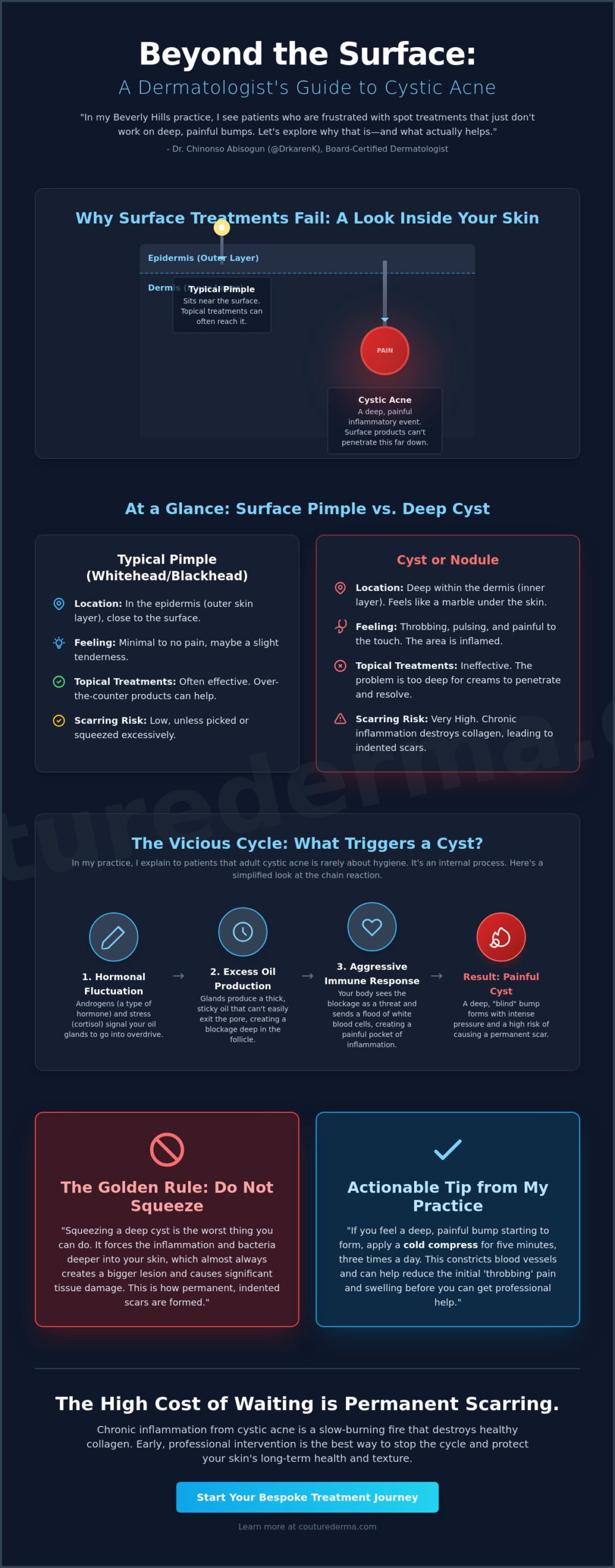
Most people think a breakout is just a clogged pore that needs a good scrub. But in my practice, I see patients who describe their skin as feeling “angry” or “pulsing” from the inside out. These aren’t just surface issues. They are deep inflammatory events occurring in the dermis (the inner layer of your skin). Unlike a standard whitehead that sits on the surface, a cyst is a “blind” bump that creates intense pressure because it has nowhere to go. If you have reached the point where you’re looking for cystic acne dermatologist help, it’s likely because you’ve realized that a simple spot treatment can’t reach the root of this problem.
It is a common myth that these breakouts are caused by not washing your face enough. In reality, these cysts are often an overactive immune response. Your body perceives a blockage deep in the follicle as a foreign invader and sends a rush of white blood cells to the area. This creates a pocket of inflammation that is physically painful to the touch. To better understand how we address these deep-seated issues, watch this helpful video:
Cysts vs. Nodules: Knowing your skin condition
It’s helpful to distinguish between the two severe forms of acne I typically treat. Acne cysts are usually fluid-filled and feel somewhat “boggy” or softer to the touch. In contrast, acne nodules are hard, solid lumps that feel like a marble under the skin. Both are incredibly persistent. But here’s the golden rule: neither should ever be “popped” at home. Squeezing a deep cyst forces the bacteria and inflammation deeper into your tissue. This almost always leads to a bigger disaster and significant tissue damage.
Actionable Tip: If you feel a deep bump starting to form, apply a cold compress for five minutes, three times a day. This constricts blood vessels and can help reduce the initial “throbbing” pain before you can get into our office.
The high cost of waiting for help
Waiting for these to “clear up on their own” is a gamble I don’t want you to take. Chronic inflammation acts like a slow-burning fire that destroys healthy collagen. This leads to atrophic (indented) scarring that is much harder to treat later. Professional intervention is usually necessary within weeks of a flare-up to prevent permanent damage. In my experience, early treatment is the best way to ensure your skin’s long-term health. You can read more about what a dermatologist wants you to know about acne to understand how we structure these clinical journeys.
Cracking the code: Why is this happening to your skin right now?
Many of my patients assume they will outgrow breakouts once they leave their teenage years behind. But in my practice, I frequently see women in their thirties and forties dealing with deep, painful cysts for the first time. It feels like a betrayal. You did the work and you grew up, but your skin didn’t get the memo. Research indicates that adult acne is on the rise, currently affecting up to 15% of women. This isn’t usually about your face wash. It is about an internal “blueprint” that dictates how your body responds to hormones and environmental stress.
The primary drivers here are androgens (hormones that stimulate oil production). When these hormones fluctuate, they tell your oil glands to go into overdrive. This creates a thick, sticky oil that gets trapped deep within the follicle. If your genetics lean toward a more aggressive immune response, your body attacks that blockage with intense inflammation. This is where seeking professional acne treatment becomes vital. Without a clinical strategy, your body stays in a state of high alert, leading to those persistent, marble-like bumps that just won’t flatten.
Hormonal triggers in adult women
In most cases, hormonal cysts love to cluster around the jawline and chin. This is often called the “hormonal U-zone.” When you’re under high stress, your body releases cortisol (the stress hormone), which can further aggravate these oil glands. It becomes a cycle that feels impossible to break on your own. Actionable Tip: Start tracking your menstrual cycle and your skin flare-ups for three months. If you notice cysts appearing like clockwork 7 to 10 days before your period, we can use that data to tailor your treatment timing perfectly.
The Beverly Hills environment and your skin
Living in Los Angeles adds a specific layer of complexity to your skin journey. The year-round heat and humidity in Beverly Hills can trigger sweat and oil production, but the sun is the real hidden culprit. I see many patients who fall for the “sun-masking” myth. They think the sun dries out their acne, but it actually causes the outer layer of skin to thicken. This traps more oil underneath. Even worse, the intense UV rays darken the red or purple marks left behind by cysts, turning them into stubborn dark spots (post-inflammatory hyperpigmentation). Using a specialized, non-clogging SPF is non-negotiable to prevent these marks from becoming permanent. If your current routine isn’t keeping up with the California sun, it might be time to schedule a personalized skin consultation to get your glow back on track.
The professional toolkit: How we treat cystic acne in my practice
When you finally decide to seek cystic acne dermatologist help, the goal is to stop the pain and prevent the marks. In my practice, I don’t believe in a one-size-fits-all prescription pad. Instead, I use what I call a “Couture” approach. This means we tailor the strength and speed of your treatment to your specific lifestyle. If you’re a performer who needs to be on camera or an athlete dealing with constant sweat, your medical blueprint will look very different from someone else’s. We treat the person, not just the pathology.
One of the most powerful tools we have is Isotretinoin, often known by the brand name Accutane. Here’s the thing: it isn’t just for “worst-case” scenarios anymore. In my practice, I often recommend it earlier in the process if I see that a patient’s cysts are causing deep tissue damage. Waiting too long can lead to permanent indentations that require intensive acne scar refinement later on. For many women, we also look at Spironolactone. It is a targeted hero for those stubborn jawline cysts because it blocks the hormones that over-stimulate your oil glands. It’s about finding the right fit for your skin’s unique needs.
The 20-minute rule for Tretinoin
Most patients struggle with prescription retinoids because of the “peeling” phase. But I’ve found that timing is everything. Actionable Tip: Wait exactly 20 minutes after washing your face before applying your Tretinoin. If you apply it on damp skin, the moisture acts like a conductor, pulling the medication too deep and too fast. This is what causes that “angry,” red irritation. If your skin is particularly delicate, try the “sandwich method” by applying a thin layer of moisturizer both before and after your medication. This ensures you get the benefits without the uncomfortable downtime.
Oral antibiotics: A bridge, not a destination
I often use oral antibiotics like Doxycycline to “calm the storm” of a major flare-up. But let’s be honest; antibiotics are a bridge, not a permanent home. We typically limit these to a 3 to 4-month window to protect your gut health and prevent antibiotic resistance. They are excellent for lowering the immediate “throbbing” inflammation while our long-term topicals or hormonal treatments begin to work. We want to move you toward a routine that is sustainable and predictable, rather than relying on a temporary fix that doesn’t address the root cause.
Beyond the pill: Advanced lasers and light therapy for active cysts
Sometimes a prescription or a topical cream just isn’t fast enough, especially when you have a high-stakes event on the calendar. In my practice, we move beyond traditional medicine by utilizing light-based technology to treat inflammation where it lives. When you seek cystic acne dermatologist help, you aren’t just looking for a long-term plan; you often need immediate relief from the throbbing pressure of an active flare-up. This is where the artistry of laser medicine meets clinical necessity.
In our office, the Vbeam laser is a gold standard for addressing the “angry” redness of active cysts. The laser energy specifically targets hemoglobin (blood vessels) within the inflamed area. By shutting down these micro-vessels, we essentially starve the inflammation of the blood supply it needs to persist. For those “emergency” situations where a cyst feels like it has its own zip code, I often use a precisely placed cortisone injection to flatten the lesion within 24 to 48 hours. Preventing the collapse of skin tissue now is the best way to ensure the future success of any acne scar refinement we might do once your skin is clear.
The Vbeam advantage for active inflammation
The treatment itself is remarkably quick. Most patients describe the sensation as a quick rubber band snap against the skin, followed by a cooling mist. It’s my preferred choice for patients who need to look their best for a wedding or a red carpet event because it works rapidly without the “purging” period associated with many medications. Actionable Tip: Don’t wait until a cyst is massive and purple. Coming in for a quick laser session or a steroid shot at the first sign of a “blind” bump can prevent the deep tissue damage that leads to permanent pitting. Precision early on saves you from intensive resurfacing later.
Preventing the “shadow” of acne
Let’s be honest; the bump is only half the battle. Once the cyst flattens, it often leaves behind a stubborn dark spot (hyperpigmentation) or a persistent red mark. This is especially true in the Beverly Hills sun, where UV rays darken these areas almost instantly. We use specialized light therapy settings to even out your skin tone while the active acne is still clearing. It’s vital to use a bespoke approach here because every skin tone reacts differently to heat. We use specific protocols for all skin types to ensure the “shadow” of acne disappears along with the breakout. If you’re tired of waiting for your skin to catch up with your life, book an advanced laser consultation to see which technology fits your unique medical blueprint.
Your clear skin journey: Starting your bespoke treatment plan
Think of your first appointment as a master tailor’s initial fitting. Finding the right cystic acne dermatologist help is about more than just getting a prescription; it is about building a medical blueprint that evolves as your skin does. In my practice, I don’t just look at the current inflammation. I look at the texture, the tone, and the underlying structure of your face to ensure our plan leads to long-term harmony. Clear skin is a beautiful progression, not a 24-hour miracle. It takes patience to undo months or years of deep tissue stress. When patients seek cystic acne dermatologist help at our Beverly Hills practice, we focus on a collaborative, transformative journey that prioritizes your unique needs. If you’re just starting your search, reading my guide on how to choose the best dermatologist in Los Angeles can help you find a partner who understands this high-detail approach.
What to expect during your first visit
I see patients who have tried every laser and cream under the sun before they reach my office. Because of this, our first conversation is often about your history. We’ll discuss what failed and why, and then we’ll map out your specific goals for the next 3, 6, and 12 months. I want to know how your skin feels when you wake up and how it reacts to the California heat. Actionable Tip: Bring your current skincare products, or even just photos of the labels, to your first appointment. This helps me identify hidden irritants or “pore-cloggers” that might be sabotaging your progress without you even realizing it.
Maintaining the Couture glow
Once the active cysts are under control, we pivot from medical clearing to aesthetic refinement. This is the most rewarding part of the journey. We might use advanced lasers to smooth out texture or explore jawline contouring to restore the definition that chronic swelling often hides. In my practice, we believe that aesthetic improvement should be a gradual, intentional progression. Here’s the thing: you don’t have to live with the pain or the marks. In most cases, a customized clinical path can give you the confidence to go makeup-free in the bright Beverly Hills light. Let’s start the work of reclaiming your skin together.
Reclaiming your confidence and your skin
Living with deep, painful breakouts is a burden you don’t have to carry alone anymore. We have explored how these “blind” bumps are actually deep inflammatory events in the dermis and why surface-level retail products simply can’t reach them. By combining clinical medications with advanced laser technology, we can stop the active pain and protect your skin from permanent tissue loss. It is about moving from a state of constant flare-ups to a predictable, clear routine that respects your skin’s unique biology.
In my practice, I utilize my Harvard-trained expertise to ensure that every patient, regardless of their skin type or tone, receives a medical blueprint that actually fits their life. This level of Beverly Hills clinical excellence is what turns a cycle of frustration into a journey of transformation. If you’re ready for professional cystic acne dermatologist help that looks beyond the surface, I’m here to guide you through every step of the process.
Schedule your bespoke acne consultation with Dr. Abisogun today. You deserve to look in the mirror and see the smooth, clear reflection you have been working toward. Your journey to radiant skin starts with a single, intentional step.
Your Questions Answered: Navigating Cystic Acne Care
How can I tell if my acne is cystic or just a bad breakout?
Cystic acne feels like a painful, deep-seated knot under the skin that never comes to a head. Unlike standard whiteheads, which sit on the surface and are easily visible, cysts are “blind” bumps that throb and create intense pressure. In my practice, I often identify these by the lack of a visible pore and the significant inflammation that spreads beyond the bump itself. If it’s marble-like and hurts to touch, it’s likely cystic.
Will my cystic acne go away without a dermatologist’s help?
In most cases, cystic acne requires professional intervention because the inflammation is buried too deep for over-the-counter washes to reach. While a single bump might eventually flatten, the underlying cause often persists, leading to a cycle of chronic breakouts. Seeking cystic acne dermatologist help early is the only way to prevent the deep tissue damage that results in permanent scarring. Waiting too long often makes future refinement much more difficult.
Is it true that dairy or sugar causes cystic acne?
Diet doesn’t “cause” acne by itself, but foods with a high glycemic index, like sugary snacks, or certain dairy products can certainly trigger a flare-up. These foods can spike your insulin levels, which then stimulates your oil glands to produce more sebum (skin oil). If you suspect your diet is a factor, I recommend keeping a food diary to see if your skin reacts 48 to 72 hours after eating specific items. It’s about identifying your personal triggers.
What is the fastest way to flatten a painful acne cyst at home?
The most effective thing you can do at home is apply a cold compress for five minutes, several times a day, to constrict blood vessels and reduce swelling. Avoid the temptation to use “DIY” remedies like toothpaste or lemon juice, as these often cause chemical burns on the outer layer of skin. If the pain is unbearable, a warm, but not hot, compress can sometimes help the fluid drain naturally, but you must never force it or squeeze.
Can I use retinol if I have active, painful cystic acne?
Yes, but you must be strategic about it to avoid making the inflammation worse. Retinol is excellent for speeding up cell turnover, but applying it directly onto an inflamed, broken cyst can lead to severe irritation. I typically advise patients to use the “sandwich method” mentioned earlier or to wait until the initial “angry” redness has calmed down. Using it on healthy skin around the cyst can also help prevent new ones from forming.
How long does it typically take to see results from professional help?
You should start to feel less pain within 24 to 48 hours of a clinical treatment like a steroid injection, but clearing the skin entirely usually takes three to four months. This timeline aligns with your skin’s natural 28-day renewal cycle. In my practice, we view the first 90 days as the “clearing phase” where we stabilize your oil production. Consistency is the key to seeing a permanent change in your skin’s texture and tone.
Will a dermatologist’s treatment for cystic acne cause my skin to peel?
Some peeling is a common side effect of medical-grade topicals, but it doesn’t have to be a dealbreaker for your lifestyle. In our practice, we use a “slow and steady” approach, starting with lower concentrations to build your skin’s tolerance. Using a high-quality moisturizer and waiting exactly 20 minutes after cleansing before applying your medication can significantly reduce the “peeling” effect. We want your skin to feel healthy, not stripped or raw.
Are there laser treatments that work for active cystic acne?
Absolutely, and we often use them to speed up the healing process. We use specialized laser treatments like the Vbeam to target the blood vessels that feed active inflammation. Another option is the Fotona laser, which can help destroy bacteria and shrink oil glands. These advanced tools allow us to provide cystic acne dermatologist help that works much faster than oral medications alone by addressing the “angry” redness and swelling on contact.