
You wake up, look in the mirror, and there it is. A heat that feels like a sunburn you didn’t earn, paired with that telltale, angry flush across your cheeks. In my practice at Couture Dermatology & Laser Beverly Hills, I see patients who feel completely defeated by these sudden shifts in their skin. Knowing how to calm a rosacea flare up in the moment is the difference between a day spent hiding and one lived with confidence. It’s incredibly frustrating when your face feels like it’s burning or stinging, and those persistent bumps start to mirror a breakout you thought you’d left behind years ago.
But here’s the thing; you don’t have to just wait it out. I’m going to share the exact clinical steps I use to soothe redness and stop a flare-up in its tracks using professional dermatological insights. We will explore immediate cooling strategies, the specific ingredients that act like a custom-fit balm for your unique skin, and a long-term plan to prevent the next flush before it starts. Let’s turn that heat into a calm, refined glow.
Key Takeaways
- Discover how to use mineral-rich thermal water and specific cooling techniques to immediately shrink blood vessels and stop the burning sensation.
- Learn how to calm a rosacea flare up by identifying your unique environmental triggers, a process I recommend to all my patients at our Beverly Hills practice.
- Identify the essential “wardrobe” of ingredients, like Azelaic Acid and Niacinamide, that work to heal the skin barrier and reduce persistent redness.
- Find out when over-the-counter options aren’t enough and why medical dermatology treatments like the Vbeam laser are the gold standard for visible capillaries.
- Build a seasonal maintenance plan that evolves with your skin to ensure your results remain consistent and your complexion stays serene.
Immediate Crisis Management: How to Cool the Fire Right Now
The heat starts as a whisper then quickly turns into a roar. When you’re standing in front of the mirror watching the flush deepen, the instinct is often to throw every product in your cabinet at the problem. But in my practice at Couture Dermatology & Laser, I’ve found that the most effective way to address a crisis is through curated restraint. Learning how to calm a rosacea flare up requires a tactical approach that prioritizes cooling over correction.
To see these techniques in action, watch this helpful guide on immediate remedies:
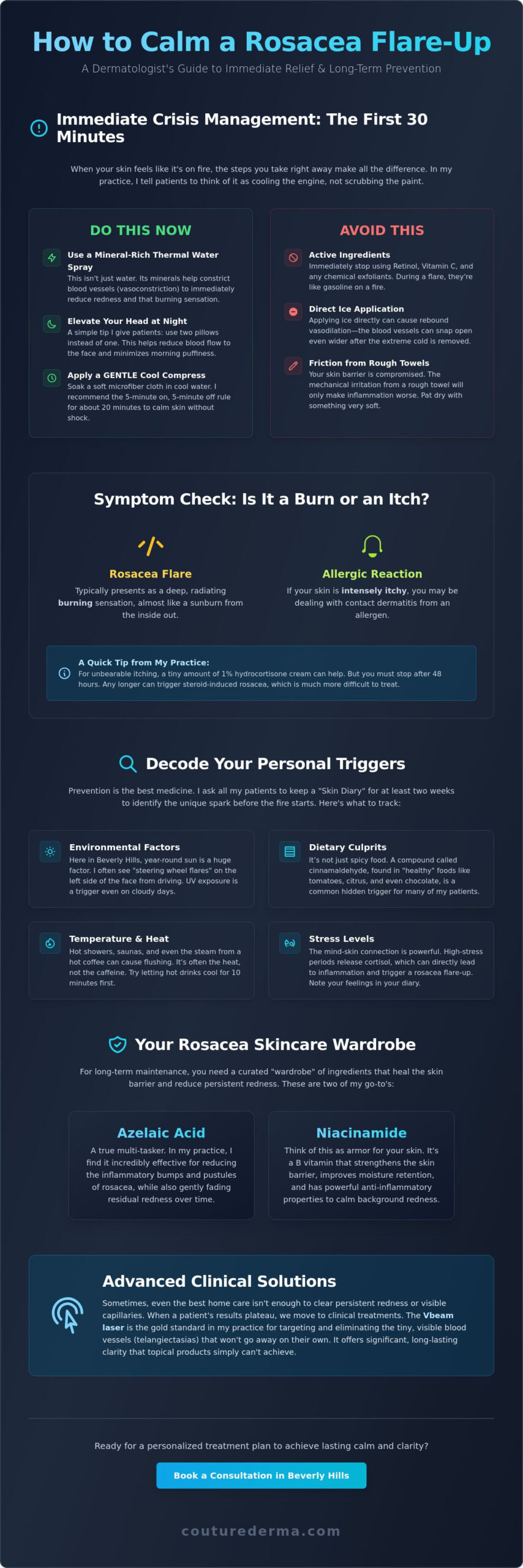
Your first move should be a mineral-rich thermal water spray. These aren’t just fancy water; the specific mineral compositions help trigger vasoconstriction (the shrinking of blood vessels) to pull the heat out of the skin. At the same time, you must strip your routine to the bare essentials. Stop using your Retinol, Vitamin C, or any chemical exfoliants immediately. These active ingredients are wonderful for maintenance, but during a flare, they act like gasoline on a fire. And here is a tip I often give for nighttime: sleep with your head elevated. Using two pillows instead of one reduces facial blood flow and prevents the morning puffiness that often accompanies a severe flush.
The Science of the Cooling Compress
Ice feels like the logical answer, but it’s actually your enemy. Applying something freezing can cause rebound vasodilation, where the vessels snap open even wider once the cold is removed. Instead, soak a soft microfiber cloth in cool water. I tell my patients to use the 5-minute on, 5-minute off rule for about twenty minutes. This gentle cadence cools the skin without the mechanical irritation (friction) that a rough towel might cause.
Identifying the Burning vs. Itching Sensation
It’s vital to distinguish between a rosacea flare and contact dermatitis (an allergic reaction). Rosacea typically presents as a deep, radiating burn. If your skin is intensely itchy, you might be dealing with an allergy. For a comprehensive overview of rosacea symptoms, you’ll find that the outer layer of skin (the barrier) is usually the first point of failure. If the itching is unbearable, you can use a tiny amount of hydrocortisone cream. But you must stop after 48 hours; using steroids for too long can actually trigger a different type of steroid rosacea that is much harder to treat.
Decoding Your Personal Triggers: The Art of Prevention
In my practice at Couture Dermatology & Laser Beverly Hills, I see patients who are baffled by their skin’s behavior despite following a “clean” diet. The reality is that rosacea is a master of disguise. What works for one person might be a disaster for another. This is why I ask all my patients to keep a “Skin Diary” for at least two weeks. You need to track what you eat, the weather, your stress levels, and even the temperature of your morning shower. It’s the most effective way to learn how to calm a rosacea flare up by identifying the specific spark before the fire starts.
The Beverly Hills factor plays a significant role here. We deal with year-round sun that is far more intense than many realize. I often see “steering wheel flares” where the left side of a patient’s face is significantly more red than the right due to sun exposure while driving. Even on a “June Gloom” day, the UV index can be high enough to trigger a vascular response. If you find yourself flushing after a short drive, your window tint might not be providing enough UV protection. For those looking for a deeper dive into clinical management, the Mayo Clinic provides an excellent guide on Rosacea treatment options that mirrors many of the protocols we use.
Dietary Triggers Beyond Spicy Food
Most people know to avoid ghost peppers, but the “cinnamaldehyde” connection is often a surprise. This compound is found in tomatoes, citrus fruits, and even chocolate. In many cases, these healthy foods are the hidden culprits behind persistent erythema (facial redness). It’s also rarely just the caffeine in your coffee that causes a problem; it’s usually the steaming temperature of the liquid. Try letting your coffee or tea sit for ten minutes until it reaches room temperature. You’ll likely find you can enjoy your morning ritual without the 3-hour glow. Histamine-rich foods like aged cheeses and processed meats also contribute to vessel dilation, making your face feel heavy and warm.
Environmental Stressors in Los Angeles
Living in LA means constant transitions. We move from 68-degree air-conditioned offices directly into the dry, 90-degree heat of the afternoon. This thermal shock is a major trigger. To manage this, I recommend misting your skin with a thermal spray before you leave the office to provide a cooling buffer. We also have to consider the “Cocktail Effect.” At a social event, it isn’t just the alcohol. It’s the combination of a sugary mixer, a crowded room with high ambient heat, and the social stress of the evening. If you’re struggling to pinpoint your triggers, a professional assessment can help you map out a personalized prevention strategy that fits your lifestyle.
Don’t forget the wind. A drive through the canyons with the top down feels iconic, but the windburn can mimic or trigger a severe rosacea episode. Always use a physical barrier, like a silk scarf or a high-collared jacket, to protect your lower face from the friction of the wind. Stress management is your final clinical tool. The brain-skin connection is real; when your cortisol spikes, your skin barrier weakens. Taking just five minutes for deep breathing when you feel a flush starting can actually help constrict those surface vessels.
The Rosacea Skincare Wardrobe: Curated Ingredients That Heal
Think of your skincare routine as a bespoke wardrobe. You wouldn’t wear a heavy wool coat in the middle of a July afternoon in Beverly Hills, so why would you apply aggressive acids to skin that is already on fire? I see patients who have spent thousands on luxury serums that actually perpetuate their redness because the formulas are too stimulating. When you’re learning how to calm a rosacea flare up, the goal is to curate a collection of ingredients that act as a soothing, protective layer rather than an irritant. We want to move away from “correction” and toward “cohesion.”
Azelaic acid is the undisputed gold standard in my practice. It’s a naturally occurring acid that reduces the bumps and persistent redness associated with papulopustular rosacea (the type that looks like acne). I often pair this with Niacinamide (Vitamin B3). Niacinamide is essential because it strengthens the skin barrier, which is the outer layer of skin responsible for keeping moisture in and irritants out. For those dealing with active pustules, I frequently recommend sulfur-based cleansers. It’s a vintage clinical choice, but it works beautifully to calm inflammation without the harshness of traditional acne washes.
Here’s the most important tip I give my patients: the “Wait 20 Minutes” rule. Most people are taught to apply products to damp skin to increase absorption. But for rosacea, that’s a mistake. Damp skin is more permeable, meaning ingredients penetrate deeper and faster, which can trigger an immediate flush. Wait 20 minutes after cleansing until your skin is completely dry before applying any active treatment. It’s a small change that makes a massive difference in how your skin tolerates ingredients.
What Kind of Sunscreen Should You Use?
Sunlight is the number one trigger for the patients I see at Couture Dermatology & Laser. But the type of filter you choose matters immensely. I always recommend physical filters like Zinc Oxide or Titanium Dioxide over chemical ones. Chemical filters work by absorbing UV rays and converting them into heat, which is the last thing a rosacea patient needs. Physical filters sit on top of the skin and reflect the light away. And here’s a professional secret: look for a green-tinted primer or sunscreen. The green pigment neutralizes redness instantly on a visual level while the Zinc protects your vessels from further dilation.
Ingredients to Blacklist Immediately
Let’s be honest; “natural” doesn’t always mean safe for sensitive skin. I frequently see flares caused by witch hazel, menthol, and peppermint, all of which are common in “organic” toners. These ingredients create a cooling sensation by irritating the nerve endings, which eventually leads to more redness. You should also avoid physical scrubs or exfoliating brushes. Friction is a mechanical trigger that can break the delicate capillaries near the surface of your skin. Finally, check your labels for fragrance. Even if it’s from a high-end French brand, fragrance is a silent trigger that can keep your skin in a state of low-grade inflammation for weeks.
Advanced Clinical Solutions: When Home Care Isn’t Enough
In my practice at Couture Dermatology & Laser Beverly Hills, I see patients who have spent years trying every over-the-counter remedy without lasting success. While lifestyle changes and specific ingredients are foundational, there often comes a point where medical dermatology treatments are necessary to break the cycle of inflammation. Understanding how to calm a rosacea flare up at a clinical level involves moving beyond surface-level cooling to address the underlying vascular structure of your skin. It isn’t just about the flush you see today; it’s about the structural health of your complexion for the years to come.
When topicals fail, we often turn to the Vbeam laser, which is a Pulsed Dye Laser. This technology is fascinating because it targets the hemoglobin (the protein in red blood cells) specifically. It collapses the visible broken capillaries without damaging the surrounding tissue. In some cases, I also recommend laser skin resurfacing to help thicken the skin. By building up the collagen in the outer layer of skin, we can essentially create a denser “fabric” that better hides the underlying blood vessels. For active bumps, prescription topicals like Metronidazole or Ivermectin (a cream that targets skin mites called Demodex) are much more effective than anything you’ll find at a traditional beauty counter.
The Vbeam Experience at Couture Dermatology
Many of my patients are nervous about lasers, but the Vbeam is quite tolerable. It feels like a quick snapping rubber band against the skin, followed by a cooling mist. Here is the thing; you might look more red for a few days before the clarity appears. We call this purpura (a type of clinical bruising), and it’s a sign that the laser successfully reached its target. Typically, a couture result requires three to five sessions spaced about a month apart to fully collapse the overactive vessels. If you’re tired of the daily struggle with redness, you can schedule a clinical consultation to see if this path is right for you.
Managing Ocular Rosacea
I frequently see patients who don’t realize their eye irritation is actually rosacea. Ocular rosacea (rosacea that affects the eyes) causes a gritty sensation, persistent redness, and frequent styes. It can make you look tired even when you’re well-rested. In these cases, I might suggest under-eye brightening treatments to manage the overall aesthetic while we treat the inflammation with clinical eye drops. Lid hygiene is also vital. A specific tip I give my patients is to use a warm (not hot) compress on the eyelids for three minutes every morning to help the oil glands flow properly, which prevents the dryness that triggers ocular flares. Low-dose oral antibiotics can also be a game-changer here, as they act as a potent anti-inflammatory rather than a simple germ-killer.
The Couture Long-Term Plan: A Journey to Timeless Clarity
Let’s be honest; rosacea is a chronic condition that requires lifelong attention. But it doesn’t have to define your look or dictate your social calendar. In my practice at Couture Dermatology & Laser, I view skin health as a collaborative, transformative journey rather than a series of isolated appointments. Maintenance is a progression. It’s about refining your strategy as your skin evolves. Understanding how to calm a rosacea flare up is a vital skill, but the ultimate goal is to reach a state of serene skin where flares are rare and manageable.
Living in Los Angeles means your skin is constantly negotiating with the environment. You must learn to tailor your routine for the “Santa Ana” winds, which bring a harsh, dry heat that can strip your skin barrier in hours. This is a stark contrast to the damp, heavy air of “June Gloom.” I often see patients who forget to swap their light summer lotions for richer, barrier-protecting creams when the humidity drops. This seasonal tailoring ensures your skin remains resilient year-round. A specific tip I give my patients is to switch to a cream-based cleanser during the windy months to avoid over-stripping the outer layer of skin.
Bespoke Consultations in Beverly Hills
There is immense value in having a meticulous, Harvard-trained eye evaluate your progress. I see patients who have misdiagnosed their own triggers for years, leading to unnecessary frustration. We look at your skin as a custom-fit project, not a textbook case. Every flush tells a story; our job is to read it accurately. If you feel your current routine has plateaued, it might be time for a Couture-level consultation to recalibrate your path to clarity.
Beyond the Face: Neck and Chest Flushing
Rosacea rarely stops at the jawline. Many of the patients I treat also struggle with Poikiloderma of Civatte, which is a specific type of sun-induced redness on the neck and chest. It often appears as a mottled, reddish-brown discoloration that can be quite aging. You must extend your skincare wardrobe below the jawline. This means applying your Zinc-based SPF and soothing serums to your chest every single day. Achieving aesthetic harmony across all visible skin is what separates a standard treatment from a truly bespoke experience. We want your neck and chest to match the refined, calm glow of your face.
Remember, this is a journey to self-assurance. While we utilize elite medical technology, the most powerful tool is your own consistency. Stay patient. Stay intentional. Your skin has the capacity for incredible transformation, and we are here to guide every step of that progression.
Embrace Your Skin’s Transformation
Mastering how to calm a rosacea flare up is the first step toward reclaiming your confidence and comfort. We have covered the essentials; from the immediate relief of mineral-rich thermal sprays to the long-term power of identifying your unique Beverly Hills lifestyle triggers. It’s about moving beyond the temporary flush and building a resilient, healthy skin barrier that reflects your inner well-being. Whether you are adjusting your “skincare wardrobe” or seeking the precision of a Vbeam laser, remember that your journey is entirely bespoke. There is no one-size-fits-all solution for a condition as personal as this.
At our practice, we treat every patient as a custom project rather than a textbook diagnosis. As a Harvard-trained dermatologist, I specialize in treating all skin types and tones at Beverly Hills’ premier medical and aesthetic dermatology practice. You don’t have to navigate this inflammatory path alone. Begin your transformative journey to calm, clear skin with a Couture Consultation. We are here to help you move from a state of constant reaction to one of timeless clarity and calm. Your most radiant, serene skin is waiting just beneath the surface.
Frequently Asked Questions
How long does a rosacea flare-up usually last?
A rosacea flare-up typically lasts anywhere from a few days to several weeks. In my practice, the duration depends heavily on how quickly you learn how to calm a rosacea flare up by identifying the trigger and implementing cooling protocols. If left untreated, the inflammation can become a cycle that feels never-ending. But with a tailored approach, most of my patients see the initial heat dissipate within 48 to 72 hours.
Can I use Retinol if I have rosacea?
You can often use Retinol (a Vitamin A derivative) if your condition is well-managed, but never during an active flare. I typically suggest starting with a very low concentration only twice a week. Applying it over a layer of moisturizer, a technique known as buffering, helps protect your barrier. This allows you to gain the anti-aging benefits without triggering a new vascular crisis or persistent stinging.
Is rosacea the same thing as adult acne?
Rosacea and adult acne are distinct conditions, even though they both cause bumps. The key difference is that rosacea does not produce comedones (blackheads or whiteheads). Instead, it involves overactive blood vessels and persistent erythema (facial redness). Treating rosacea with harsh acne products like benzoyl peroxide will usually make the condition much worse by stripping the outer layer of skin and increasing inflammation.
Why does my rosacea get worse at night?
Your skin temperature naturally rises at night due to your body’s circadian rhythm. This increase in heat causes blood vessels to dilate, which often makes the redness and stinging feel more intense before bed. I see patients who find relief by keeping their bedroom temperature at 65 degrees and using the elevation tip I mentioned earlier to prevent blood from pooling in the face while they sleep.
Can stress alone cause a rosacea flare-up?
Stress is one of the most common triggers for the patients I see at our practice. When you’re stressed, your body releases cortisol, which can directly cause your blood vessels to expand. This neurovascular response is why a difficult day at the office often leads to an angry flush. Learning how to calm a rosacea flare up often involves managing these emotional peaks alongside your daily topical treatments.
What is the best makeup for hiding rosacea redness?
The best makeup for rosacea is mineral-based and contains green color-correcting pigments. Green sits opposite red on the color wheel; it effectively neutralizes the look of a flush without requiring a thick layer of foundation. I recommend avoiding heavy, oil-based products that can trap heat against your skin. Look for non-comedogenic (products that won’t clog pores) labels to ensure the formula won’t cause further irritation or breakouts.
Does drinking water help calm a rosacea flush?
Drinking water is excellent for your overall health, but it won’t immediately stop an active flush. Proper hydration does support the outer layer of skin, which helps your barrier function more effectively over time. However, be careful with icy water. If the temperature shift is too sudden, it can actually trigger a rebound flush as your body tries to regulate its internal heat in response to the cold.
When should I see a dermatologist for my facial redness?
You should see a dermatologist if your redness is persistent or if you notice visible broken capillaries. If your eyes feel gritty or your skin starts to thicken, these are signs that your condition is progressing. In my practice, we use advanced medical dermatology treatments to address these issues before they cause permanent changes. For those looking for similar specialist care in London, you can visit Dr Jinah Yoo Dermatology & Anti-Ageing Clinic for expert support. Early intervention is the key to maintaining a calm, clear, and refined complexion.