

Last Tuesday, a patient sat in my Beverly Hills office and sighed as she pulled a dozen “miracle” brightening creams from her bag, none of which had touched her stubborn dark spots. It’s a scenario I see often in my practice. You’ve likely spent a small fortune on serums, but the California sun keeps winning. Finding a skilled dermatologist for hyperpigmentation los angeles is the first step toward stopping that cycle. I know you’re probably frustrated by products that don’t work and terrified that a laser might cause rebound pigmentation (darkness that returns even worse after a treatment).
Let’s be honest, your skin isn’t a “one-size-fits-all” project. I agree that the confusion over different types of spots and the fear of making things worse can feel paralyzing. But here’s the thing; a bespoke, clinical approach can transform your complexion and restore your confidence. In this guide, I’ll explain how we use tailored protocols to clear your skin safely. We’ll also cover the new 2026 medical regulations that protect you and the specific steps to maintain a radiant, makeup-free glow in the Los Angeles sun.
Key Takeaways
- Learn why the year-round Southern California sun requires a “couture” strategy that balances clinical clearing with protective maintenance to break the pigment cycle.
- Discover why identifying your specific type of dark spots is the essential “first stitch” when visiting a dermatologist for hyperpigmentation los angeles.
- Compare professional options like laser treatment and medical-grade chemical peels to see which approach safely fits your unique skin tone and lifestyle.
- Master Dr. Abisogun’s signature at-home protocols, including the correct way to use tretinoin, to ensure your bathroom cabinet supports your clinical results.
- Understand the 2026 California regulations and why choosing a board-certified specialist offers a level of safety and precision that a standard med spa simply can’t provide.
Why the Los Angeles Sun Makes Hyperpigmentation a Unique Challenge
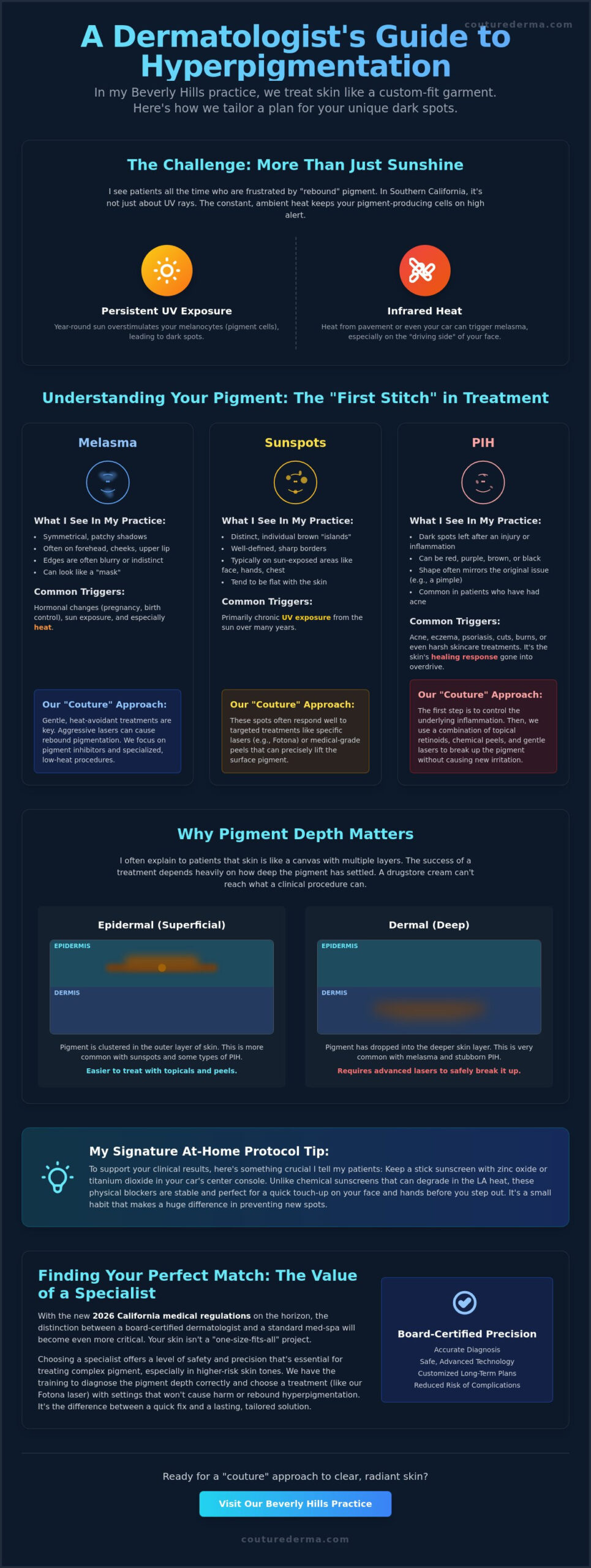
Living in Southern California is a dream for our lifestyle but often a nightmare for our skin. I see patients who follow every rule, yet they still struggle with “rebound” pigment after a simple weekend in Santa Barbara or a hike in Runyon Canyon. As a dermatologist for hyperpigmentation los angeles, I’ve realized that the sun here isn’t just bright; it’s persistent. This isn’t just about a few freckles. It’s about how the constant heat and light exposure in Beverly Hills keep your pigment-producing cells in a state of high alert. If we treat the spots but ignore the environment, the pigment simply returns.
To better understand how we approach these complex cases in Beverly Hills, watch this helpful video:
What exactly is hyperpigmentation?
In my practice, I explain it as a protective response gone wrong. Understanding Hyperpigmentation starts with your melanocytes (cells that produce skin pigment). These cells act like tiny umbrellas, releasing melanin to protect the deeper layers from damage. But when they get overstimulated, they don’t just tan; they create pathological clusters. These clusters can sit in the outer layer of skin (epidermis) or deeper down. Think of your skin as a canvas. If the pigment is only on the surface, it’s easier to lift. But if it has dropped into the deeper layers, a “one-size-fits-all” cream from a drugstore usually fails.
How does the LA climate affect my dark spots?
Here’s the thing; it isn’t just the UV rays. It’s the heat. In Los Angeles, infrared heat from the pavement and even your car’s engine can trigger melasma. I often notice “driving-side” pigmentation on the left side of a patient’s face. It’s a classic sign of years spent commuting on the 405. This is why we use a “Couture Dermatology” approach. When you visit a dermatologist for hyperpigmentation los angeles, you shouldn’t get a generic plan. We treat your skin like a custom-fit garment, adjusting for your specific exposure and skin type. Our approach focuses on:
- Precise diagnosis of pigment depth and type
- Heat-safe treatment options that avoid rebound darkening
- Long-term maintenance protocols tailored to the Beverly Hills lifestyle
Actionable Tip: Keep a physical-block SPF (look for zinc oxide or titanium dioxide) in your car’s center console. Heat in the car can degrade some chemical sunscreens, but physical blockers are more stable for a quick mid-day touch-up on your hands and face before you step out into the sun.
Understanding Your Pigment: Melasma, Sunspots, and PIH
In my Beverly Hills practice, I view the diagnostic process as the “first stitch” in a bespoke garment. If that initial assessment is slightly off, the entire treatment journey loses its precision and elegance. I see patients who have spent months using lightening creams meant for sunspots on what is actually melasma, only to see their condition worsen. When you consult a dermatologist for hyperpigmentation los angeles, the priority is to identify exactly which type of pigment we are managing before we ever touch a laser.
Is it melasma or just sun damage?
Melasma is perhaps the most frequent and complex issue I treat. It typically presents as symmetrical, patchy shadows on the forehead, cheeks, or upper lip. Because it’s often triggered by hormones or heat, we sometimes call it “the mask of pregnancy.” Contrast this with sunspots (solar lentigines), which have very defined borders and appear as distinct brown “islands” on the skin. Treating melasma with the aggressive settings used for sunspots can backfire, causing the pigment to rebound even darker than before.
Actionable Tip: Examine your pigment in a well-lit mirror. If the marks are symmetrical (appearing on both cheeks in a similar pattern), it’s likely melasma and requires a heat-avoidant protocol rather than aggressive scrubbing or high-heat lasers.
What about the marks left behind by acne?
Post-Inflammatory Hyperpigmentation (PIH) is a different story entirely. This is your skin’s response to an injury, such as a breakout or a scratch. I see patients who have tried to “pop” a blemish and ended up with a dark mark that outlasts the actual pimple by months. Picking at your skin causes trauma that pushes pigment deeper into the outer layer of skin. This is a particularly sensitive concern when managing hyperpigmentation in skin of colour, where the cells are naturally more reactive to inflammation.
For many of my clients, these dark marks are paired with texture changes. In these cases, we often integrate pigment clearing with acne scar refinement to achieve that truly polished, couture finish. If you’re ready to stop guessing and start a professional plan, you can schedule a clinical assessment to pinpoint your specific pigment type. Let’s be honest; your skin deserves a strategy as unique as you are.
The Couture Palette: Professional Treatments for Every Skin Tone
In my practice, I often tell patients that selecting a treatment is like choosing the right fabric for a custom gown. You wouldn’t use heavy wool for a summer slip, and you shouldn’t use an aggressive, high-heat laser on skin prone to melasma. As a dermatologist for hyperpigmentation los angeles, I curate a “palette” of options that includes medical-grade chemical peels, advanced laser treatment, and topical therapies. The goal is always the same; we want to lift the pigment without triggering the skin’s defense mechanisms.
I see patients who are terrified of lasers because they’ve heard horror stories about “rebound” darkening. This fear is valid, especially for those with deeper skin tones. In our practice, we often utilize the Fotona laser because it allows for incredibly precise control. It targets the pigment specifically without overheating the surrounding tissue. To ensure the best outcome, we sometimes incorporate “liquid gold” (platelet-rich plasma), which uses your own growth factors to calm the pigment response and accelerate healing.
Are lasers safe for my skin tone?
The short answer is yes, provided the technology and the expert behind it are matched to your needs. We distinguish between ablative lasers (which remove the surface) and non-ablative lasers (which work beneath the surface). For most pigment cases in Beverly Hills, non-ablative options are safer because they keep the outer layer of skin intact. This reduces the risk of inflammation. We also rely heavily on “cooling” technology to keep the skin temperature stable during the procedure. This is a key finding in any medical review of hyperpigmentation treatments; controlling heat is the best way to prevent new spots from forming.
Actionable Tip: If you’re considering a laser, ask if the device has a built-in cooling system or if the provider uses a “chiller” during the session. Keeping the skin cool is your best insurance policy against post-treatment darkening.
When is a chemical peel the better choice?
Sometimes, a laser isn’t the right tool for the job. For stubborn melasma that has resisted other methods, I often recommend the Cosmelan peel. Unlike a quick spa treatment, this is a high-potency medical protocol. It works by “exfoliating” (shedding) the pigmented outer layer of skin while simultaneously blocking the enzymes that create new melanin. It’s an intensive process, but the results for uneven texture and deep-seated shadows are often unparalleled. Just keep in mind that under the 2026 California regulations, these deep peels must be administered by a licensed medical professional after a Good Faith Exam.
Actionable Tip: Plan for 5 to 7 days of “social downtime” after a high-potency peel. Your skin will likely flake and peel as it reveals the fresh, even-toned layers beneath, so don’t schedule your treatment right before a major Beverly Hills event.
Beyond the Clinic: Dr. Abisogun’s Signature At-Home Protocols
I see patients who walk into my Beverly Hills office with a bag full of expensive products but skin that looks angry and inflamed. It’s a common mistake; people think more is better. Finding a dermatologist for hyperpigmentation los angeles is about getting a specific blueprint for your morning and evening rituals. Let’s be honest; what you do in your bathroom for 360 days a year matters more than what I do in my laser suite for five. In my practice, I call this the “Couture Protocol.” It’s a meticulous approach to layering that ensures your skin stays calm while the pigment lifts.
Think of your at-home routine as the daily upkeep of a custom-fit garment. If you use the wrong detergent, you’ll ruin the silk. Many people come to me after trying “miracle” creams that caused more damage because they didn’t understand the chemistry of their own skin. We focus on a balance of suppression and protection. We want to tell your melanocytes (cells that produce skin pigment) to stop overreacting, but we have to do it without causing the inflammation that triggers them in the first place.
The 20-minute rule for Tretinoin
Here’s the thing; most people apply their tretinoin (a powerful vitamin A derivative) immediately after washing. That’s a recipe for disaster. Damp skin is significantly more permeable than dry skin. When you apply an active ingredient to wet skin, it absorbs too quickly and too deeply. This leads to redness, flaking, and irritation. In most cases, that irritation actually triggers your pigment cells to produce more melanin as a defense. It’s a frustrating cycle where your “cure” causes more spots.
Actionable Tip: After cleansing your face, set a timer for 20 minutes. Only apply your retinoid once your skin is completely dry to the touch. If you’re still experiencing dryness, try “sandwiching” by applying a thin layer of moisturizer both before and after your tretinoin to create a protective buffer.
What ingredients should I look for in a brightener?
In our practice, we don’t just stick to one ingredient. We use a rotating palette. Hydroquinone (a medical-grade bleaching agent) is the gold standard for lifting dark spots, but it’s not for long-term use. We typically cycle it every 3 to 4 months with Kojic Acid (a natural lightener derived from fungi) or Tranexamic Acid (which helps calm the blood vessels that feed melasma). Cycling prevents a rare but serious condition called ochronosis (permanent blue-black skin darkening) and keeps your skin from thinning. We also prioritize antioxidants like Vitamin C in the morning to neutralize the free radicals caused by the Los Angeles smog and sun.
Actionable Tip: Look for a “tinted” SPF that contains iron oxides. These minerals are the only way to block visible blue light from your smartphone and the sun. Recent clinical observations suggest that blue light can worsen melasma just as much as UV rays, making tinted protection a non-negotiable for Beverly Hills residents.
Actionable Tip: Use only a pea-sized amount of any medical-grade active for your entire face. Using more won’t speed up the results; it will only increase the likelihood of a “rebound” pigment flare that could take months to correct.
Actionable Tip: Give any new brightening routine at least 12 to 16 weeks to show results. Your skin cells take about 28 to 40 days to turn over, and we need several of these cycles to see a visible change in deep-seated pigment.
Consistency is the final stitch in your couture plan. If you’re ready to stop the guesswork and start a protocol that actually works for your unique skin type, you can book your personalized clinical assessment here. Let’s build a routine that restores your confidence and protects your investment in your skin.
Finding Your Perfect Match: The Value of a Beverly Hills Specialist
Selecting a dermatologist for hyperpigmentation los angeles is a deeply personal decision that goes beyond a simple Google search. In a city where aesthetic options are on every corner, it’s easy to feel overwhelmed by flashy marketing and “instant” results. I see patients who have spent years bouncing between providers, only to feel like a number in a crowded waiting room. In my practice, we view your care as a long-term partnership. We don’t just treat a spot; we manage the health and harmony of your entire complexion through a structured, clinical path.
Let’s be honest; the “quick fix” culture of many Los Angeles med spas often ignores the complex biology of pigment. Starting January 1, 2026, California law now strictly requires a “Good Faith Exam” by a physician or advanced practitioner before any medical aesthetic treatment. This change was designed to protect you from generic standing orders and unqualified oversight. When you choose a clinical dermatology practice over a retail spa, you’re choosing a level of safety and medical rigor that simply cannot be replicated in a non-clinical setting.
Why credentials matter for hyperpigmentation
I see patients who come to me to correct burns or permanent scarring caused by improper laser settings used elsewhere. This is why board certification and elite training are non-negotiable. Expertise, such as Harvard-trained clinical backgrounds, allows a physician to navigate the nuances of complex skin cases with precision. If a provider doesn’t understand the difference between the outer layer of skin and the deeper dermis, they risk causing irreversible damage. For a deeper dive into what to look for, you can read our guide on How to Choose the Best Dermatologist in Los Angeles.
Actionable Tip: Always verify that your provider is a board-certified dermatologist for hyperpigmentation los angeles. Check their specific experience with your skin type, especially if you have a deeper skin tone that is more prone to reactive darkening.
The collaborative, transformative journey
Your first “Couture Consultation” is where the transformation begins. This isn’t a rushed five-minute chat. It’s a comprehensive analysis where we look at your history, your lifestyle, and your goals. We often find that pigment issues are layered. For example, we might address under-eye brightening alongside your dark spots to create a total, refreshed look. We treat your skin like a custom-fit garment; we adjust the “stitches” as your skin evolves and responds to therapy.
Actionable Tip: Bring your current skincare products to your first visit for a “closet audit.” I often find that patients are using conflicting ingredients that cancel each other out or cause the very irritation that keeps their pigment active. Knowing exactly what you’ve been using helps us build a cleaner, more effective protocol from day one.
Remember that managing pigment is a journey, not a destination. The Los Angeles sun is a constant factor, but with the right specialist and a bespoke plan, radiant skin is entirely within your reach. It takes patience, clinical expertise, and a commitment to the process. But when you finally feel the confidence to go makeup-free in Beverly Hills, you’ll know every step was worth it.
Your Path to a Polished, Radiant Complexion
We’ve covered a lot of ground, from the way the Beverly Hills sun triggers your pigment cells to the specific 20 minute rule for your at-home tretinoin. Here’s the thing; your skin is a living, breathing canvas that deserves more than a generic solution. By distinguishing between melasma and sun damage and utilizing a “couture” palette of advanced laser treatment and medical peels, we can finally break the cycle of rebound darkening. Finding the right dermatologist for hyperpigmentation los angeles is about more than just clearing spots. It’s about a collaborative journey toward lasting confidence.
In our bespoke Beverly Hills clinical environment, I prioritize safety and precision for all skin types and tones. My Harvard-trained expertise is at your service to ensure every stitch of your treatment plan is perfectly tailored to your lifestyle. You don’t have to hide behind heavy foundations anymore. Begin your journey to clear skin and book a Couture Consultation with Dr. Abisogun. Let’s work together to restore your natural glow and keep it there for years to come. Your most radiant skin is closer than you think.
Frequently Asked Questions
Can hyperpigmentation be cured permanently?
Hyperpigmentation is a condition that is managed rather than permanently cured because your melanocytes (cells that produce skin pigment) have a long memory. Even after we successfully clear a dark spot, heat or UV exposure can retrigger that same cell to produce melanin again. In my practice, I emphasize that clinical clearing is only half the battle; the other half is a lifelong maintenance plan to keep those pigment-producing cells dormant.
How long does it take to see results from professional pigment treatments?
You should typically expect to see visible improvement within 12 to 16 weeks of starting a professional protocol. Because your skin cells take about 28 to 40 days to turn over, we need to move through several of these cycles to lift deep-seated pigment from the outer layer of skin. I see patients who get discouraged after just a month, but patience is the final stitch in a couture skin plan.
Will lasers make my melasma worse?
Lasers can absolutely make melasma worse if they utilize excessive heat or the wrong wavelength for your specific skin tone. This is why seeing a board-certified dermatologist for hyperpigmentation los angeles is vital for your safety. We often use the Fotona laser or other non-ablative technologies that target pigment without overheating the surrounding tissue, which prevents the “rebound” darkening often seen with low-quality treatments.
Actionable Tip: If you feel your skin getting hot during a workout or while cooking, apply a cool, damp cloth to your face immediately. Reducing skin temperature quickly can help prevent heat-triggered melasma flares before they start.
Is hydroquinone safe to use for long periods?
Hydroquinone is a highly effective medical-grade bleaching agent, but it should not be used for more than three to four months at a time. In my practice, we “cycle” this ingredient with alternatives like azelaic acid or tranexamic acid to avoid a rare side effect called ochronosis (permanent blue-black skin darkening). This cycling approach keeps your skin healthy and prevents the structural thinning that occurs with unsupervised, long-term use.
What is the best sunscreen for melasma in Los Angeles?
The best sunscreen for managing melasma in our year-round sun is a tinted physical blocker containing zinc oxide and iron oxides. While standard SPF protects against UV rays, iron oxides are the only ingredients that effectively block visible blue light from the sun and your digital devices. I often tell patients that if their sunscreen isn’t tinted, they aren’t fully protected against the heat-driven pigment we see in Beverly Hills.
Does vitamin C help with dark spots?
Vitamin C is an excellent supportive antioxidant that neutralizes free radicals, but it rarely clears deep-seated hyperpigmentation on its own. It acts more like a protective shield that prevents new damage from forming rather than a corrective tool. In most cases, I recommend using a high-potency Vitamin C serum in the morning under your SPF to boost your skin’s defense against Los Angeles smog and UV rays.
Actionable Tip: To get the most out of your Vitamin C, look for “L-ascorbic acid” on the label and ensure the bottle is opaque. Light and air degrade this ingredient quickly, making clear glass bottles a waste of your investment.
Can I get hyperpigmentation treatments while pregnant?
Most aggressive treatments like laser resurfacing and high-potency peels are typically avoided during pregnancy to ensure total safety. We also pause the use of retinoids and hydroquinone during this time. However, I see patients who successfully manage “the mask of pregnancy” using azelaic acid and mineral sunscreens, which are generally considered safe alternatives for maintaining your glow while you wait for your little one.
How much does hyperpigmentation treatment cost in Beverly Hills?
Pricing for pigment correction in Los Angeles varies significantly based on the technology used and the complexity of your specific case. Across the local market, single laser sessions or medical-grade peels can range from a few hundred to over a thousand dollars. Here’s the thing; the total investment depends on how many sessions your condition requires. Most patients see the best results after a series of 3 to 5 treatments.
Actionable Tip: When budgeting for your skin, always factor in the cost of high-quality maintenance products. A professional treatment is an investment that can be easily undone if you don’t have the correct SPF and brightening topicals to protect the results at home.