
Last week, a patient in my Beverly Hills office looked in the mirror and asked why she looked exhausted despite a full night’s sleep. It’s a story I hear often in my practice. You’re likely realizing that the skincare routines of your 30s no longer address the loss of jawline definition or those stubborn sun spots. Finding the best anti-aging treatments for 40s is no longer about simple prevention; it’s about structural tailoring and precision resurfacing to match your reflection to your vibrant energy.
I agree that it’s unsettling to see your skin change so rapidly during this decade. But here’s the thing: your 40s are actually the most rewarding time to invest in professional clinical protocols. I promise to show you how we can restore facial harmony and refine your texture without ever making you look “worked on” or artificial.
In this guide, I’ll walk you through the specific laser technologies and injectable strategies we use to rebuild collagen, which is the protein that keeps skin firm, and erase years of environmental damage. Let’s look at the exact roadmap to a refreshed, sophisticated version of you.
Key Takeaways
- Understand why skin hits the “collagen cliff” in your 40s and how hormonal shifts fundamentally change your skin’s thickness and elasticity.
- Learn how we use artful Botox Injections and Dermal & Lip Fillers to restore facial harmony and soften deep lines without ever looking “frozen.”
- Discover why laser skin resurfacing is widely considered one of the best anti-aging treatments for 40s to erase years of sun damage and refine texture.
- Identify the specific protocols required to clear up stubborn hyperpigmentation (dark spots) caused by decades of living in the Southern California sun.
- See how I design a “couture” aesthetic roadmap that focuses on gradual, transformative results so you don’t end up with artificial-looking fixes.
The 40s Tipping Point: Why Your Skin Changes Rapidly This Decade
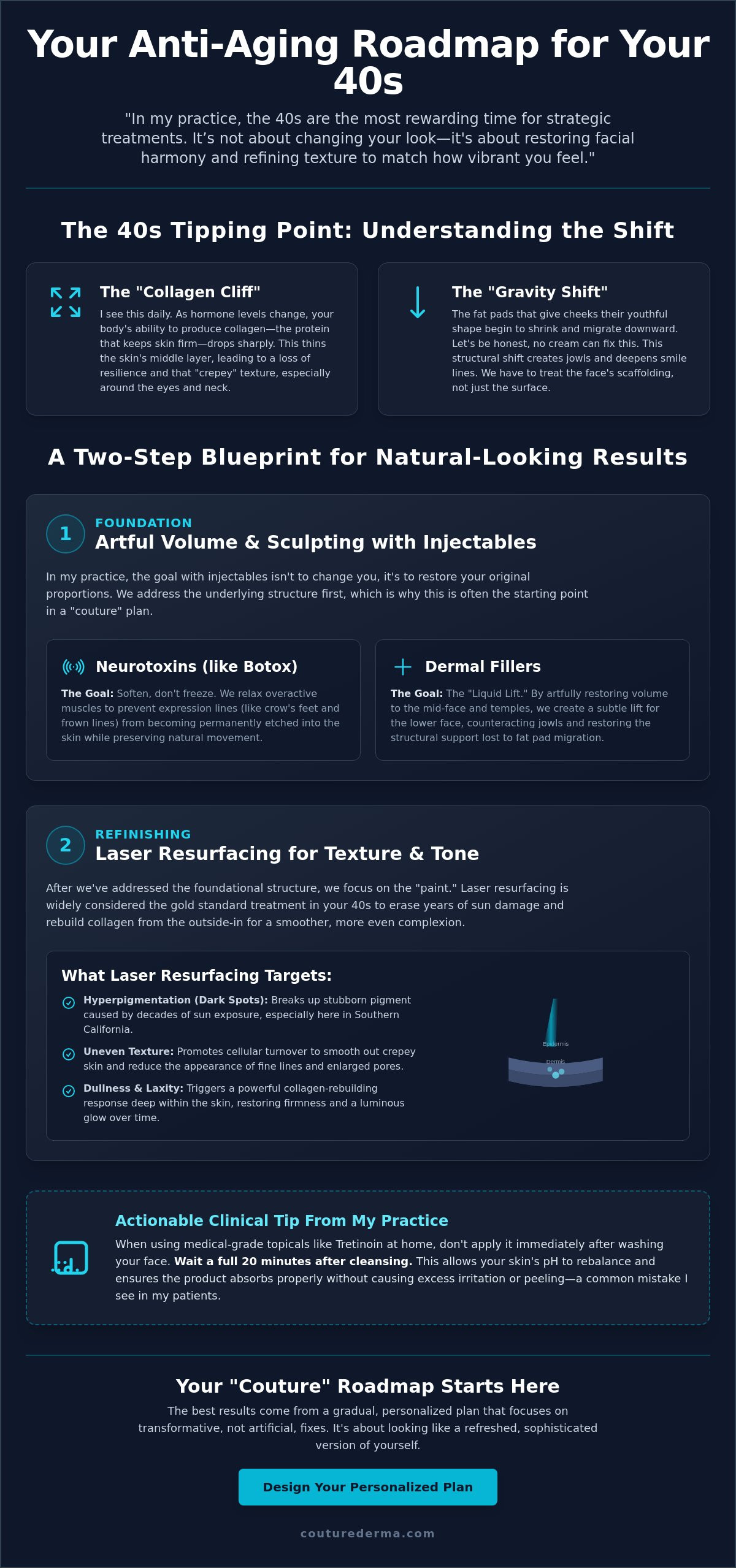
I see patients every day in my Beverly Hills office who feel like they woke up on their 43rd birthday and suddenly didn’t recognize their reflection. It feels like an overnight shift; but in reality, your skin has been navigating a complex biological transition for years. In your 40s, you’re likely noticing that the serums and creams that worked in your 20s just aren’t cutting it anymore. This is because we’ve moved past simple surface issues and into the territory of structural repair. Finding the best anti-aging treatments for 40s requires understanding that your skin is now operating under a different set of biological rules.
To better understand how these professional treatments compare and why some are more effective during this decade, watch this helpful overview:
Understanding the Collagen Cliff and Elastin Loss
The most significant change I observe in my practice is the “collagen cliff.” As estrogen and testosterone levels begin to fluctuate and eventually decline, your body’s ability to produce collagen (the protein that keeps skin firm) and elastin (the fibers that allow skin to snap back) drops sharply. This causes the dermis, or the middle layer of your skin, to thin out significantly. This thinning is what creates that “crepey” texture that often appears first around the eyes and neck. It is a fundamental shift from the surface-level fine lines of your 30s to a deeper loss of resilience.
Clinical Tip: Don’t rely on collagen supplements alone to fix this. While they provide basic amino acids, they don’t “target” your face. Instead, prioritize medical-grade topicals like Tretinoin; but wait 20 minutes after cleansing before applying it to ensure the product doesn’t migrate or cause excess peeling.
The Gravity Shift: Fat Pad Migration in Your 40s
Let’s be honest; no amount of expensive cream can lift a sagging jawline. In your 40s, the fat pads in your face, which provide that youthful “apple” shape to the cheeks, begin to shrink and migrate downward. This shift is what creates jowls and those deeper nasolabial folds, or smile lines, around the mouth. This process is often accelerated by Photoaging, which is the damage caused by years of sun exposure. In my practice, I emphasize that we must treat the “scaffolding” of the face before we worry about the “paint” or surface texture.
If you want to address these structural changes effectively, we often look at jawline contouring and other professional protocols. These are frequently among the best anti-aging treatments for 40s because they address the root cause of the “tired” look. By restoring the underlying support, we can achieve a refreshed appearance that looks entirely natural and sophisticated.
Aesthetic Injectables: Artful Volume Restoration and Sculpting
I often tell my patients that injectables in your 40s shouldn’t be about changing how you look. It’s about tailoring your features back to their original proportions. In my practice, I see many people who worry about looking “frozen” or “overdone.” But here’s the thing: when performed with an artistic eye, Botox Injections and Dermal & Lip Fillers are among the best anti-aging treatments for 40s because they address the structural foundation that skincare alone cannot reach. For patients seeking similar clinical excellence in other regions, such as Botox and fillers The Woodlands TX, Davam Aesthetics offers advanced non-surgical protocols designed to restore facial harmony naturally.
In your 40s, Botox is used to soften active expression lines rather than erasing all movement. We want to maintain your ability to express emotion while preventing those lines from becoming permanent, etched wrinkles. This approach ensures you look refreshed, not robotic. It is a subtle shift from the “prejuvenation” of your 30s to a more intentional strategy of maintenance and refinement.
The Liquid Lift: Dermal Fillers for Structural Support
As we discussed, the fat pads in your face begin to shift downward during this decade. To counter this, I use fillers to restore the midface and temples, which provides a subtle “lift” to the lower face. This often includes jawline contouring to redefine the border between your face and neck. It’s a sophisticated way to manage cosmetic anti-aging treatments without the need for invasive surgery.
Clinical Tip: In my practice, I typically use micro-cannulas (thin, flexible tubes) instead of traditional needles for filler placement. This technique significantly minimizes bruising and allows for much higher precision when sculpting delicate areas like the cheeks or jaw.
Erasing the “Tired” Look: Under-Eye Brightening
One of the most common complaints I hear in Beverly Hills is about the tear trough, or the hollow area under the eyes. This shadow makes you look exhausted even when you’re well-rested. Our under-eye brightening protocols focus on using very thin fillers to bridge that gap. But you must be careful; this area requires an expert hand to avoid the Tyndall effect, which is a bluish tint that happens when filler is placed too superficially under the thin skin of the eyes.
And it’s not just about the product. I take great care to customize these treatments for all skin tones. For patients with deeper complexions, over-filling can lead to “filler fatigue” or a strange graying of the skin texture. We aim for aesthetic harmony that respects your unique heritage. If you’re ready to see how a bespoke plan can work for you, I invite you to explore our online booking options for a personal assessment.
Clinical Tip: Wait at least two weeks after your injection appointment before evaluating your final results. It takes that long for the product to fully integrate with your tissues and for any minor swelling to vanish completely.
Laser Skin Resurfacing: The Gold Standard for Texture and Tone
If injectables are the structural foundation of your aesthetic plan, then lasers are the precision tailoring of the fabric itself. In my practice, I find that laser skin resurfacing is often the most transformative tool for patients in their 40s who feel their skin has lost its natural luminosity. While we’ve addressed volume and structure in previous sections, we now need to focus on the surface texture and the persistent sun damage that years of Beverly Hills living can leave behind. This is where we target melanocytes (cells that produce skin pigment) to break up dark spots and force the skin to regenerate from within.
When searching for the best anti-aging treatments for 40s, you’ll encounter two main paths: ablative and non-ablative lasers. Ablative options, like the Fractional CO2, remove thin layers of skin to prompt deep healing and significant collagen growth. Non-ablative lasers are gentler; they heat the tissue without removing the surface, which means minimal downtime. But for truly transformative results in this pivotal decade, the “heavy hitters” are usually required to see a real difference in skin density and clarity. It is a collaborative process between the technology and your body’s own healing response.
Fractional CO2 Laser: The Heavy Hitter for Wrinkles
The Fractional CO2 laser is my go-to for what I call “deep-tissue refinement.” It works by creating thousands of microscopic injuries in the skin’s surface, which triggers a massive surge in collagen production as the body rushes to repair the area. It’s particularly effective for those deep “elevens” between the brows or fine lines around the mouth that haven’t responded to topical creams. You should expect a healing window of about 5 to 7 days, where the skin will look and feel like a significant sunburn before peeling away to reveal a smoother, tighter surface. This is one of the best anti-aging treatments for 40s when you want to reset the clock on sun damage.
Clinical Tip: To speed up your recovery after a laser session, I recommend using a bland, occlusive ointment (like plain petrolatum) for the first 48 hours. This keeps the skin barrier protected while the new cells migrate to the surface.
Refining Acne Scars and Pore Size
I often see patients who notice their old acne scars or pores suddenly look much larger in their 40s. This isn’t your imagination. As your skin loses the elasticity we discussed earlier, it can no longer “hold” the shape of pores or scar tissue as tightly, making them appear more prominent. Utilizing acne scar refinement protocols allows us to smooth out these indentations and tighten the surrounding tissue. Many Skin anti-aging strategies emphasize the importance of this multi-layered approach to rejuvenation, as addressing texture is just as vital as addressing volume.
Clinical Tip: In my practice, I sometimes combine laser treatments with microneedling in a staggered schedule. This “bespoke” approach addresses different depths of the skin simultaneously, providing a more comprehensive texture fix than any single modality could achieve on its own. Let’s be honest; your skin is a complex organ, and it deserves a treatment plan that’s just as sophisticated.
Addressing Hyperpigmentation and “Beverly Hills Sun Damage”
Living in Beverly Hills means your skin has been working overtime for 40 years. By the time you reach this decade, those “cute” freckles from your 20s have often merged into persistent sun spots (lentigines). When we discuss the best anti-aging treatments for 40s, we must look at the intersection of in-office repair and daily protection. It’s not just about aesthetics; it’s about repairing the cellular damage from decades of UV exposure.
I see many patients who struggle to tell the difference between sun damage and melasma (hormonal pigment). Melasma usually appears as symmetrical, patchy masks on the cheeks or forehead and is often triggered by the hormonal shifts we discussed in section one. Treating these requires a “couture” approach, especially for my patients with deeper skin tones who are at a higher risk for post-inflammatory hyperpigmentation (darkening caused by irritation). Using the wrong laser or peel can actually make the pigment worse.
Clinical Tip: Wait 20 minutes after cleansing before applying tretinoin. Applying it to damp skin increases absorption too quickly; this often leads to unnecessary redness and peeling.
The Power of Medical-Grade Chemical Peels
It is time to move beyond the gentle “spa facial” and look toward medical-grade chemical peels. These treatments reach the deeper layers of the skin to force cell turnover, a process that slows down significantly once you hit 40. In our practice, I often prescribe a pre-peel regimen of hydroquinone or retinoids for two weeks to “quiet” the melanocytes (cells that produce skin pigment) before the actual treatment. This ensures a more even result and a safer recovery.
The 40s Prescription: Tretinoin and Vitamin C Protocols
Your home routine is the “maintenance contract” for your professional treatments. I consider a high-potency Vitamin C in the morning and Tretinoin at night to be the gold standard. These are frequently among the best anti-aging treatments for 40s because they work synergistically to protect and repair. But let’s be honest; none of this works without SPF 50+. In our climate, a lower SPF is simply not enough to prevent new damage from forming while we try to erase the old.
If your over-the-counter retinol has stopped delivering results, it is likely time to graduate to a prescription-strength formula tailored to your specific skin type. We specialize in creating these high-detail home protocols to complement our in-office procedures. If you want to stop guessing and start seeing real clarity, you can schedule a skin analysis with our team to build your custom regimen.
Designing Your Couture Anti-Aging Roadmap
In my practice, we don’t just perform individual procedures; we design a multi-year aesthetic plan that evolves with you. Think of it as a bespoke garment that we tailor over time to ensure the perfect fit as your skin changes. When you’re looking for the best anti-aging treatments for 40s, you need a strategy that considers how your bone structure, fat pads, and skin texture will interact over the next decade. This isn’t a transactional experience; it’s a collaborative journey toward lasting facial harmony.
And let’s be honest; your skin deserves more than a “menu” of services. It requires a clinical eye that understands the complex biological shifts we’ve discussed. I often see patients who have tried various “quick fixes” elsewhere, only to find that their results look disjointed or artificial. Our goal at Couture Dermatology is to provide elegant, natural outcomes that make you look like the best version of yourself, not a different person entirely.
The Importance of Board-Certified Expertise
I see patients who come to me to fix complications from “med-spas,” such as filler migration or poorly managed laser burns. My Harvard training and fifteen years of clinical rigor allow me to navigate these complexities with a level of safety that only a board-certified expert can provide. It’s about more than just the treatment; it’s about the medical-grade safety protocols and the deep understanding of anatomy that prevents issues before they start. If you are wondering how to choose the best dermatologist in Los Angeles, look for someone who prioritizes clinical results over trendy marketing.
Clinical Tip: Always ask your provider what their “complication protocol” is. A true expert should be able to explain exactly how they handle rare adverse events, such as vascular occlusions, with the same confidence they use to describe the treatment itself.
Your First Step: The Couture Consultation
Every transformation begins with a full skin exam and aesthetic assessment. We look at everything from your sun damage history to your specific bone structure. But we also talk about your lifestyle and your budget. In my practice, we prioritize treatments based on what will give you the most “return” on your investment for your specific concerns. Whether we start with Botox Injections or a series of Laser Skin Resurfacing sessions, the plan is always uniquely yours. But remember; aesthetic improvement is a gradual progression, not a hurried task. If you’re ready to begin this transformative journey, book your personalized consultation with Dr. Abisogun today.
Clinical Tip: Bring your current skincare products to your first consultation. It helps me identify if your “at-home” routine is working against your in-office goals, saving you both time and money in the long run.
Your Path to Refined Confidence
Your 40s don’t have to be a decade where you feel like you’re losing ground to time. We’ve explored how a strategic combination of structural volume restoration and precision laser resurfacing can reset your skin’s foundation. In my practice, I’ve seen that the best anti-aging treatments for 40s are always the ones that prioritize facial harmony over quick, artificial fixes. It’s about matching your outer reflection to the vibrant energy you feel inside through a plan designed specifically for your unique features.
Whether we are softening expression lines or erasing decades of Beverly Hills sun damage, every step is part of a collaborative journey. As a Harvard-trained expert specializing in all skin types and tones, I ensure your results at our premier clinical practice are as sophisticated as they are safe. You deserve a level of care that understands the art of the subtle shift. Let’s move beyond the surface and start building your long-term aesthetic legacy today.
Begin your transformation with a bespoke consultation at Couture Dermatology. I look forward to meeting you and helping you rediscover the refreshed, confident person you’ve always been.
Common Questions About Rejuvenation in Your 40s
Is 40 too late to start Botox or fillers?
It’s never too late to begin, and for many, the 40s are the most effective time to start. In my practice, I see patients who achieve incredible results starting at 45 or 50. While “prejuvenation” in your 30s is helpful, the 40s allow us to address actual structural changes rather than just preventing them. We can still significantly soften lines and restore volume even if you’ve never had an injection before.
What is the best laser for skin tightening in your 40s?
In most cases, the best anti-aging treatments for 40s involve technologies that stimulate deep collagen, like the Fotona laser or fractional CO2. These devices don’t just tighten the surface; they rebuild the underlying scaffolding of your skin. For patients who prefer minimal downtime, we often look at non-ablative options that offer gradual improvement over several sessions. The “best” choice depends entirely on your skin’s current density and your recovery goals.
How can I get rid of deep forehead wrinkles without looking frozen?
The key to avoiding a “frozen” look is intentional, conservative dosing of Botox Injections. I use a “baby Botox” technique where I place smaller amounts of product into more specific muscle groups. This allows you to still raise your eyebrows and express emotion while softening the deep horizontal lines. It’s about precision tailoring, not complete immobilization. We want you to look like you’ve had a long vacation, not like you’ve lost your ability to smile.
Do anti-aging treatments hurt?
Most professional treatments are quite manageable with the right preparation. In our practice, we use high-potency topical numbing creams and sometimes local anesthetic to ensure you’re comfortable. For deeper laser work, you might feel a sensation like a rubber band snap, but it’s over quickly. We prioritize your comfort as much as the final aesthetic result because the experience should be as reassuring as the outcome.
What is the difference between a med-spa and a board-certified dermatologist?
The primary difference is the level of clinical training and oversight. A board-certified dermatologist has completed over 12,000 hours of clinical residency and specialized training in the skin’s complex biology. Med-spas often employ technicians who may not have the expertise to manage complications or recognize underlying medical issues. Choosing a medical expert ensures your safety and the longevity of your results, especially when using high-powered lasers or injectables.
Can I treat melasma and wrinkles at the same time?
You can certainly address both, but we have to be very careful with the order of operations. Lasers that treat wrinkles can sometimes flare melasma if the heat isn’t managed correctly. In my practice, I often “quiet” the pigment with topical protocols first before introducing heat-based devices. It’s a staged approach that ensures we don’t fix one problem only to create another. We treat the skin as a whole ecosystem.
How long does it take to see results from laser skin resurfacing?
You’ll see an initial glow about 7 to 10 days after your skin finishes its natural peeling process. However, the real transformation happens over the next three to six months. This is how long it takes for your body to build new, healthy collagen fibers. Patience is part of the process when you’re looking for natural, long-term improvement rather than a temporary fix. True refinement takes time to develop.
What is the most important skincare product to use in your 40s?
If you only use one product, it must be a broad-spectrum SPF 50+. No amount of laser work or filler can overcome the damage caused by daily UV exposure in Southern California. After that, a prescription-strength Tretinoin is the most vital tool for cell turnover and collagen maintenance. These two are the non-negotiables for maintaining any professional result and keeping your skin healthy at a cellular level.