

I see patients walk into my Beverly Hills practice every week with a screenshot of a celebrity at a film premiere, asking the same question: “How can I look like this without a filter?” They’re often exhausted by “skintellectual” marketing that promises the world but leaves them with the same dull texture and persistent dark spots. Let’s be honest, that red-carpet radiance isn’t just about good genes or a lucky lighting setup. Here’s the truth about how to get celebrity skin: it requires a clinical strategy rather than a crowded bathroom cabinet.
You probably feel like you’ve tried every viral serum on the shelf, yet those visible pores and fine lines aren’t budging. It’s frustrating to invest time and money into products that don’t seem to respect your unique skin chemistry. But I promise you that achieving a luminous, healthy complexion is possible when you stop guessing and start treating your skin like a custom-fit garment. In my practice, I focus on building a bespoke architecture for each face, combining medical-grade science with an artistic eye.
This guide previews the exact roadmap we use at Couture Dermatology & Laser to transition from dullness to a professional-level glow. We’ll look at which treatments are worth the investment and how to simplify your routine for real results. And here’s a quick tip to start today: if you use a retinoid, wait at least 20 minutes after washing your face before applying it to minimize irritation and help the product work more effectively.
Key Takeaways
- Move past the “just drink water” narrative by understanding the medical-grade treatments that actually create a camera-ready glow.
- Learn why a streamlined routine of three high-quality products often outperforms a cluttered cabinet of mediocre ones.
- Discover the clinical roadmap for how to get celebrity skin through laser skin resurfacing and precise injectable treatments.
- Identify the realistic six-month timeline required to clear dark spots and refine skin texture for lasting health.
- Explore how a bespoke skin architecture tailored to your specific needs delivers more natural results than any generic procedure.
Why celebrities say they “just drink water” (and what they actually do)
I’ve lost count of how many times I’ve watched a red-carpet interview where an A-lister attributes their glass-like complexion to “drinking plenty of water” and “getting eight hours of sleep.” While hydration is a fundamental building block for healthy cells, it isn’t the magic wand people want it to be. In my practice at Couture Dermatology & Laser, I see patients who are genuinely frustrated because they’ve followed every piece of generic advice they found online but still struggle with dullness. Let’s be honest; if water were the only requirement for how to get celebrity skin, we wouldn’t need advanced medical technology.
To better understand this concept, watch this helpful video:
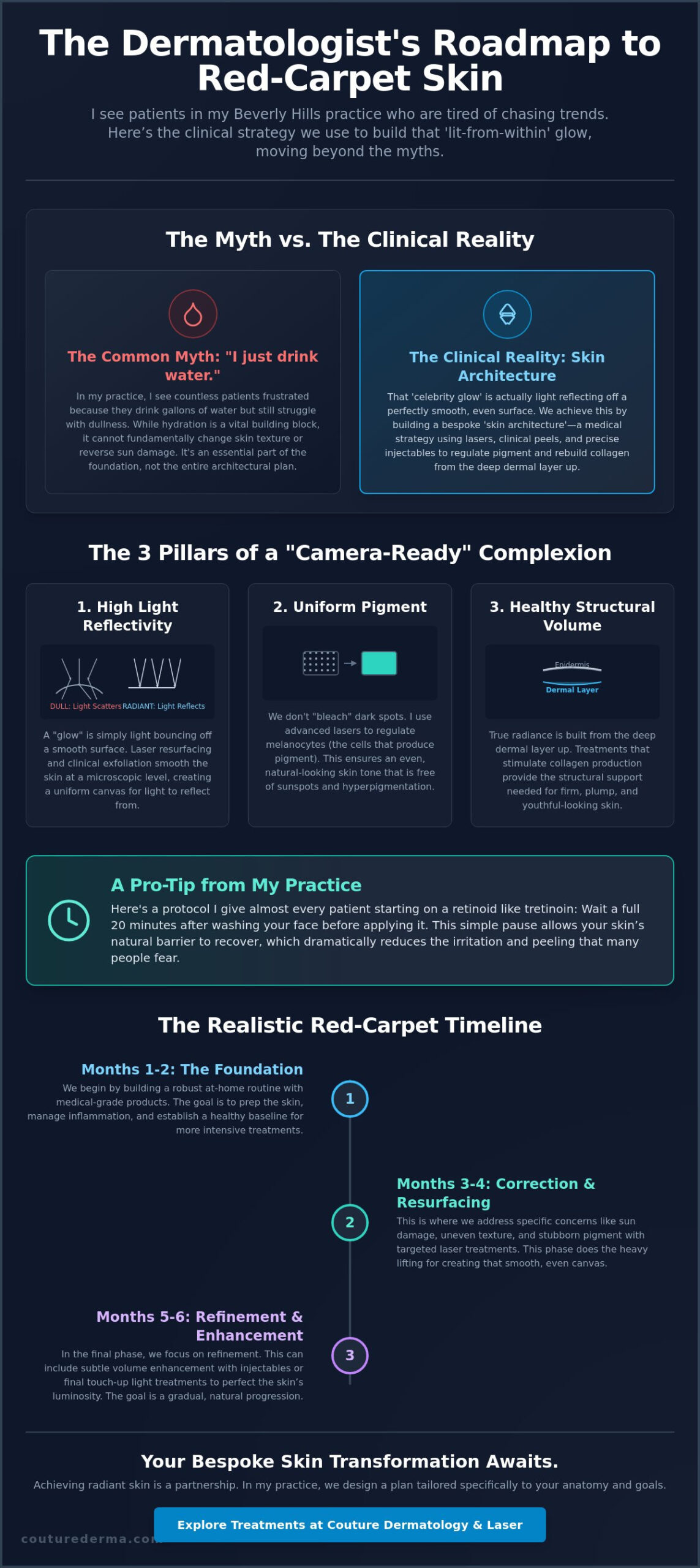
The clinical reality is that a $200 luxury cream simply cannot mimic the structural changes produced by a $2,000 laser treatment. When we talk about “celebrity skin,” we’re really describing a specific set of physical traits: high light reflectivity, uniform pigment, and healthy structural volume. To achieve this, we have to look past the surface and focus on what I call “skin architecture.” This means building beauty from the dermal layer (the deep skin) up, rather than just painting over imperfections with topical products. While daily skincare routines are the foundation of maintenance, they are rarely the architect of a total transformation. In my practice, I often explain that the “glow” you see on screen is actually light bouncing off a perfectly smooth surface. If the texture is uneven or the pores are congested, the light scatters, making the skin look dull. Understanding how to get celebrity skin starts with smoothing that canvas at a microscopic level.
The Beverly Hills Reality
Living and working in Beverly Hills gives me a unique perspective on skin health. The Southern California sun is relentless; it demands a much higher level of preventative care than most people realize. I see the effects of year-round sun damage every day, from premature fine lines to deep-seated pigment issues. In the past, the goal in this zip code was often to look “done,” but today’s aesthetic has shifted toward curated refinement. I often tell my patients that we’re looking for a gradual progression toward their best self, not a sudden, artificial change. It’s about looking rested and radiant, as if you’ve just returned from a month-long retreat. We prioritize long-term skin health over quick fixes that might look good today but cause issues down the road.
Clinical Tip: Here’s a protocol I recommend to almost everyone starting a medical-grade regimen: Wait 20 minutes after cleansing before applying active treatments like tretinoin. This simple pause allows your skin’s natural oils to settle, which significantly reduces the risk of peeling and irritation.
The Role of the Board-Certified Expert
There is a massive difference between a generic spa treatment and the insights provided by a board-certified expert with Harvard-trained clinical experience. In my practice, I prioritize treating all skin types, which requires a deep understanding of how different tones react to heat and chemicals. For example, treating hyperpigmentation (dark spots) in darker skin tones requires specialized protocols to avoid post-inflammatory pigment changes. We don’t use a “one size fits all” template; we tailor every laser setting and injectable placement to the individual’s anatomy. It is about the subtle nuances that create a harmonious look. For instance, when we address dark spots, we aren’t just “bleaching” the skin. We are regulating the melanocytes (cells that produce skin pigment) to ensure a uniform tone that looks natural in any light. This level of precision is what separates a professional medical treatment from a standard facial.
Actionable Tip: For those dealing with puffiness before a big event, try using a cold compress or a chilled jade roller for five minutes in the morning. It won’t replace a clinical treatment, but it helps constrict blood vessels (tubes that carry blood) to temporarily tighten the skin’s appearance and reduce redness.
Designing your bespoke daily ritual
I see patients who walk into my office with a literal suitcase of skincare, yet their skin is often red, irritated, and far from radiant. It’s a common mistake; people assume that a ten-step process is how to get celebrity skin. In reality, your skin isn’t a chemistry set. In my practice, I’ve found that three high-quality, medical-grade products will outperform ten mediocre ones every single time. Off-the-rack skincare often fails for complex issues like melasma or deep scarring because it lacks the concentration of active ingredients needed to actually change your skin’s architecture. We want to keep your melanocytes (cells that produce skin pigment) calm and your barrier strong. To support this barrier, some patients find that integrating adaptogenic and botanical-rich options like House of GRŌ® helps maintain the skin’s natural luminosity and health alongside their medical-grade actives.
Step 1: Morning Protection and Luminosity
Your morning routine is about defense and light reflectivity. I prefer L-ascorbic acid as the primary form of Vitamin C (an antioxidant that brightens and protects) because it offers the most stable results for a clinical glow. But even the best serum won’t work if you aren’t using enough SPF (sunscreen that blocks harmful rays). I teach my patients the “Two-Finger Rule,” which means applying two full strips of sunscreen to your index and middle fingers to cover your face and neck properly. Actionable Tip: Apply your antioxidant serum to damp skin to improve absorption and lock in hydration for a plumper appearance.
Step 2: Evening Repair and Resurfacing
Nighttime is when we focus on cellular turnover and repair. Retinoids are the gold standard here, but they can be tricky for sensitive types. If you’re prone to redness, I suggest you “sandwich” your actives by applying a thin layer of moisturizer, then your retinoid, followed by another layer of moisturizer. This creates a buffer without neutralizing the benefits. I also tell my patients to focus on the neck and chest as much as the face. These areas have thinner skin and show age just as quickly, yet they’re frequently neglected in daily rituals.
Step 3: Targeted Interventions
For those struggling with persistent dark spots, medical-grade brighteners are a necessity. We often combine these with Hyaluronic Acid (a molecule that holds 1,000 times its weight in water) to ensure that “plump” red-carpet reflectivity. While topicals are vital, they can’t restore lost volume; for that, many of my patients look toward clinical options. You can find helpful FDA information on Dermal Fillers to understand how those structural choices complement your home care. Actionable Tip: Use a silk pillowcase to prevent “sleep lines,” which are those temporary creases that can eventually become permanent wrinkles over time. If you’re ready to move beyond the drugstore aisle, you can schedule a personalized skin analysis with our team to start your transformation.
The aesthetic architecture: Lasers, light, and clinical refinement
Most lifestyle magazines suggest that a monthly facial is the ultimate answer to how to get celebrity skin. But I see patients who have spent thousands on spa treatments only to realize that facials are temporary fixes. If you want structural change, we have to talk about medical-grade cosmetic procedures. In my practice, we view this as building an aesthetic architecture. It’s about using light and volume to refine what’s already there, ensuring you look like the best version of yourself in high-definition. Let’s be honest; the “poreless” skin you see on a red carpet is almost always the result of a carefully planned clinical intervention.
Lasers: The “Polishing” Phase
Laser Skin Resurfacing is the true secret behind that glass-like texture. We use fractional lasers to create microscopic channels in the skin, which triggers a deep healing response and builds new collagen (the protein that keeps skin firm). If redness is the primary concern, Vbeam is our go-to for erasing the broken capillaries (tiny blood vessels) that cameras always seem to pick up. For those dealing with persistent texture issues, our protocols for acne scar refinement provide that smooth, high-definition finish that makeup simply can’t replicate. It is about creating a surface that reflects light uniformly.
Injectables: The “Structural” Phase
Injectables are the structural phase of our architecture. We use Botox not to freeze the face, but to soften the repetitive expressions that cause permanent lines. When it comes to dermal fillers, we focus on restoring the “triangle of youth” by supporting the mid-face where volume naturally drops over time. I often perform jawline contouring to create a sharp, camera-ready profile that looks entirely natural. In Beverly Hills, the goal is always “less is more.” We want people to notice your radiance, not your filler. Actionable Tip: Schedule any new injectable treatment at least 4 weeks before a major event. This gives the product time to settle and ensures any minor bruising has completely disappeared.
Brightening the Windows to the Soul
The eyes are often the first place to show fatigue and age. Topical eye creams usually fail because they can’t address the underlying volume loss or vascular (blood vessel) issues that cause darkness. In our practice, we use specialized under-eye brightening protocols that combine gentle lasers or fillers to erase dark circles and hollows. It’s a transformative step for looking rested and vibrant. Clinical Tip: Use a cold compress for 5 minutes every morning to constrict blood vessels and reduce puffiness. This simple step provides a temporary tightening effect while your long-term clinical treatments work their magic. Understanding how to get celebrity skin means realizing that the most impactful changes often happen just beneath the surface.
The “Red-Carpet” timeline: Managing expectations and downtime
I often see patients who arrive at my practice just two weeks before a major event, hoping for a total transformation. I have to be honest; skin health is a marathon, not a sprint. If you’re serious about how to get celebrity skin, we need to work backward from your goal date to ensure every layer of your skin architecture has time to heal and settle. In my practice, we typically plan these journeys months in advance to avoid the stress of unexpected redness or bruising. It’s about giving your cells the time they need to regenerate and reflect light properly.
For deep-seated issues like cystic acne or stubborn hyperpigmentation (dark spots), a 6-month plan is the gold standard. This allows us to regulate your skin’s natural cycles and clear congestion without causing unnecessary inflammation. By the 3-month mark, we shift into the “structural” phase, focusing on laser series and dermal fillers to refine your contours. The final month is reserved for “glow” treatments that focus on surface-level light reflectivity and hydration. Actionable Tip: If you’re targeting a specific event, you can book a consultation at our practice at least six months out to build your personalized timeline.
The 72-Hour Countdown
When you’re three days away from the spotlight, the rule is simple: do nothing new. I’ve seen too many patients trigger an allergic reaction or a breakout by trying a “miracle” mask at the last minute. Avoid aggressive peels or extractions, as these can leave the skin looking angry and inflamed. Instead, we often recommend lymphatic drainage (a gentle massage that moves excess fluid away from the face) to “snatch” the jawline and reduce puffiness. Actionable Tip: Avoid high-sodium foods and alcohol 48 hours before your big day. Salt and alcohol cause the body to hold onto water, which leads to facial puffiness and a duller complexion. This is also the ideal window to focus on non-invasive grooming; to see how professional nail and lash styling can complete your red-carpet look, visit fingerSPA.
Managing the “Social Downtime”
Let’s be honest about what happens after a professional treatment. If we’re performing a deep laser resurfacing session to erase scars, you will experience what we call “social downtime.” Your skin will look and feel like it has a significant sunburn for a few days. In my practice, we use medical-grade healing balms to support the barrier and potentially cut that recovery time in half. But you have to be patient with the process and follow the post-care instructions to the letter. Clinical Tip: Stay out of the direct sun entirely for at least 7 days after any laser treatment. Your skin is incredibly vulnerable during this time, and sun exposure can cause “rebound” pigment, which creates new dark spots that are even harder to treat. Realizing how to get celebrity skin is as much about the recovery as it is about the procedure itself.
Tailoring your transformation at Couture Dermatology
I see patients who have spent years chasing a look they saw in a magazine, only to feel let down by generic treatments that don’t respect their biology. But here’s the thing; the mystery of how to get celebrity skin isn’t actually a mystery at all. It’s a combination of clinical precision and a deep understanding of facial anatomy. In my practice, I merge the scientific rigor of my Harvard training with a meticulous, artistic eye. We don’t do “cookie-cutter” here because your skin is as unique as your fingerprint. Whether we are addressing dark spots or loss of volume, the goal is always a result that looks like you, just more rested and refined.
Think of your treatment plan as a bespoke, custom-fit experience. We look at everything from your genetic history to how the Beverly Hills sun has impacted your skin’s texture over the years. We also consider your long-term goals. We aren’t just looking for a quick fix for a single event; we are building a foundation for skin health that lasts decades. This is why a “Couture” consultation is the essential first step in your journey toward professional-level radiance.
The Collaborative Journey
I treat my patients as partners in this process. We work together to decide which interventions, like laser skin resurfacing or targeted injectables, fit your lifestyle and comfort level. It is about establishing a long-term relationship where we focus on “timeless” rather than “trendy” skin. Or perhaps you’re interested in a broader approach to aging; you can learn more about skin rejuvenation treatments through our detailed guide. Actionable Tip: Keep a “skin diary” for one week before your appointment. Note when your skin feels tight, when it looks oily, and any specific triggers like spicy food or stress that cause redness.
Your First Step in Beverly Hills
Preparing for your initial skin analysis is simple but important. I ask my patients to bring their current products, even the ones that didn’t work, so I can see exactly what your skin has been exposed to. And make sure to come with a clear list of your “top three” concerns. Whether it is persistent hyperpigmentation (dark spots), visible pores, or under-eye hollows, knowing your priorities helps us tailor the architecture of your plan. Clinical Tip: Stop using any strong exfoliants or physical scrubs 48 hours before your consultation so I can see your skin’s natural state without temporary irritation. Ready for your red-carpet moment? Book your bespoke consultation at Couture Dermatology today. We’re ready to help you discover the clinical reality of how to get celebrity skin.
Step Into Your Own Red-Carpet Reality
Achieving a camera-ready glow isn’t about luck or a single viral product. It’s about moving past the marketing noise and investing in a clinical strategy that respects your unique biology. In my practice, I’ve seen that the real secret of how to get celebrity skin lies in a curated architecture of medical-grade lasers, precise injectables, and a simplified daily routine. We focus on long-term health rather than trendy quick-fixes; we want your results to be as timeless as they are radiant.
As a Harvard-trained dermatologist specialized in all skin types and tones, I’m here to guide you through every step of this transformative journey. From our Beverly Hills office, we provide the clinical authority and artistic eye needed to refine your natural beauty. Don’t settle for “off-the-rack” solutions when you can have a treatment plan that’s perfectly tailored to you. It’s time to stop guessing and start glowing with confidence. Begin your skin transformation at Couture Dermatology and let’s build your bespoke roadmap to radiance together.
Frequently Asked Questions
Is it possible to get flawless skin without expensive treatments?
You can achieve healthy, radiant skin with a well-curated home routine, but professional treatments are usually necessary for structural changes like erasing deep scars or significant volume loss. High-quality basics like Retinol and SPF are powerful tools you can use at home. But let’s be honest; those clinical “poreless” results often require the precision of a medical-grade device that over-the-counter products just can’t match.
How long does it take to see results from a professional skincare routine?
You should expect to see initial improvements in texture and hydration within 4 to 6 weeks, which is the time it takes for a full skin cell cycle. However, deeper transformations involving collagen (the protein that keeps skin firm) production or clearing stubborn dark spots typically take 3 to 6 months of consistent use. In my practice, I tell patients that patience is as important as the products themselves.
What is the best laser for getting that celebrity glow?
There isn’t a single “best” laser because we tailor the choice to your specific needs, but the Fotona laser is a favorite in our practice for total skin rejuvenation. It works by targeting different layers of the skin to tighten and smooth without significant downtime. This is a core part of how to get celebrity skin because it refines the surface and boosts structural health simultaneously.
Can people with dark skin tones safely get laser treatments?
Yes, lasers can be very safe for dark skin tones as long as the practitioner uses the correct wavelength and specialized settings. In our practice, we use specific lasers that bypass the surface pigment to target deeper issues without causing burns or new dark spots. It is vital to see a board-certified expert who understands how to regulate heat for diverse skin tones to avoid complications.
What is the “red-carpet facial” that everyone talks about?
The “red-carpet facial” usually refers to a combination of light-based therapy and a deep infusion of Hyaluronic Acid to create instant light reflectivity. In our office, we might use a gentle laser session followed by a medical-grade treatment to plump the skin and reduce redness. It is designed to give you a temporary, high-definition glow without any visible peeling or recovery time before a big event.
How often should I see a dermatologist for maintenance?
I typically recommend a professional check-in or maintenance treatment every 3 to 4 months. This allows us to adjust your bespoke routine as the seasons change or as your skin’s needs evolve. Regular visits ensure we are catching any new sun damage early and keeping your skin’s architecture strong and resilient year-round, especially with the intense Southern California sun.
Does drinking more water actually help my skin glow?
Drinking water is essential for your overall health, but it won’t magically fix surface-level skin issues like acne or wrinkles. While severe dehydration can make your skin look sallow and sunken, “over-hydrating” doesn’t provide extra benefits for your complexion. You’ll get much better results by using a high-quality moisturizer to lock in the hydration you already have and protect your skin’s barrier.
What is the one product I should never skip if I want great skin?
You should never skip a high-level SPF, even on cloudy days or when you’re spending most of your time indoors. Sun damage is the primary cause of premature aging and dark spots, which can undo all the hard work of your other treatments. If you want to know how to get celebrity skin, protection is the most important step; it preserves the integrity of your skin for the long term.