

What if your “self-care” facials are actually delaying your results? Deciding between a dermatologist vs esthetician for acne is the first step in treating your skincare like a high-end investment. In my practice at Couture Dermatology & Laser Beverly Hills, I often see patients who’ve spent years on a cycle of expensive spa treatments only to find their acne persists or leads to permanent scarring.
It’s exhausting to feel like you’re doing everything right and still see no visible results. You want a clear roadmap that tells you exactly where to spend your money for the highest ROI. This article explores the medical and aesthetic differences between clinical treatments and surface level care. We’ll design a couture skin portfolio that combines medical authority with aesthetic artistry to give you natural, clear skin without the need for heavy makeup. And here’s a tip I give my own patients: if your acne is deep and painful, wait no more than three months for over the counter results before seeking a medical diagnosis to prevent long term texture changes.
Key Takeaways
- Treat your face like a high-value asset by understanding the roles of a dermatologist vs esthetician for acne to maximize your skincare ROI.
- Use the 70/30 rule to balance your spending between high-impact medical resets and the surface maintenance that keeps you polished.
- Learn how medical-grade lasers can physically change your skin by quieting oil glands and erasing the memory of old breakouts.
- Discover why professional extractions help “clear the deck” so your clinical topicals can actually reach the deeper layers of your skin.
- Create a bespoke roadmap that ignores “off-the-rack” advice and focuses on what works for your specific skin type and tone.
The Philosophy of the Acne Portfolio: Dermatologist vs Esthetician for Acne
I often tell my patients in Beverly Hills that you wear your face every day. It deserves a higher ROI than a luxury handbag. When you’re deciding between a dermatologist vs esthetician for acne, you’re really deciding how to manage your skin’s long-term value. A dermatologist is a medical doctor (MD) who treats the biology of your skin. An esthetician is a licensed professional who focuses on surface aesthetics.
Let’s be honest about the “Investment Gap.” A $300 facial can feel amazing, but it won’t stop a hormonal breakout from forming deep inside. On the other hand, a prescription might stop new bumps, but it won’t always clear existing clogged pores instantly. At our practice, we use a “Couture” approach. We tailor your treatment mix based on your unique skin tone and whether your acne issue is comedonal (blackheads and whiteheads) or cystic (deep, painful nodules).
To better understand this concept, watch this helpful video:
What is the primary difference between these experts?
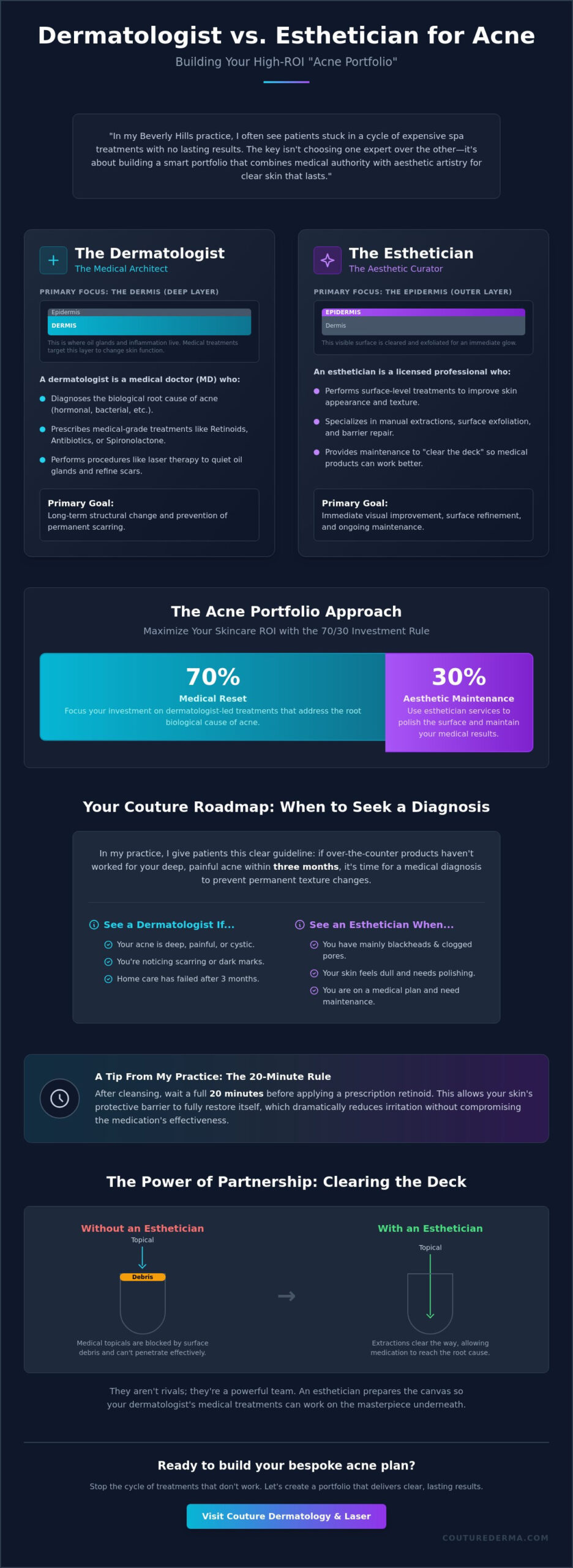
The main distinction comes down to depth. Dermatologists target the dermis, the deeper layer where oil glands and inflammation live. Estheticians work on the epidermis (outer layer of skin) to manually clear debris. I use the “Dinner Party Test” to explain this. An esthetician makes you look glowing tonight. A dermatologist ensures you aren’t dealing with acne scar refinement needs later. Understanding The difference between dermatology and skin care helps you invest where it counts.
Why your “Skin Ceiling” matters
Every person has a “skin ceiling.” This is the limit of how clear your skin can get using only non-medical facials. In my practice, I see patients hit this wall after months of “extraction cycles” that never end. When weighing a dermatologist vs esthetician for acne, remember that medical intervention is often the only way to break through that ceiling. It’s about changing the biological function, not just the appearance.
Here is a specific protocol I recommend. Wait 20 minutes after cleansing before applying a prescription retinoid like tretinoin. This simple step helps reduce irritation and keeps your skin barrier intact. If your breakouts are painful, deep, or leaving dark marks, stop the spa visits for a moment. Start with a clinical diagnosis to address the inflammation before it causes permanent structural damage.
The Esthetician’s Role: Daily Maintenance and Protecting Your Aesthetic Capital
Think of your esthetician as the “maintenance crew” for your acne portfolio. They handle the tasks that keep the surface polished and refined. In my practice, I see the best results when patients use professional extractions to “clear the deck.” This allows the medical topicals I prescribe to penetrate and work better. When weighing a dermatologist vs esthetician for acne, it’s helpful to see the esthetician as the expert of the “Big Three.” These are manual extractions, surface exfoliation, and barrier repair. A maintenance routine can even include under-eye brightening for a full-face refresh that complements your clear skin goals. This holistic approach ensures that while we tackle the root cause, your overall aesthetic remains vibrant and rested.
When I talk about clearing the deck, I mean removing the physical blockages like sebum (skin oil) and dead cells that sit in your pores. Without this step, your expensive prescription creams are just sitting on top of a traffic jam. An esthetician uses specialized tools to gently remove these plugs. It’s a delicate process that requires a steady hand and a trained eye. This is why we often pair our medical protocols with aesthetic maintenance to ensure every dollar you spend is working toward a visible result.
When is an esthetician splurge actually worth it?
Let’s be honest about where your money goes. Splurge on professional extractions and high-quality chemical peels that target the epidermis (outer layer of skin). But avoid “luxury” facials that are mostly massage and very little active ingredients. If your goal is clearing acne, you need precision, not just pampering; you can check out Devotion Beautique as an example of a destination that focuses on these types of customized facial treatments. Extractions performed by a pro prevent the trauma that leads to scarring. Here’s a simple trick. Switch your pillowcase every two nights. Silk is best because it reduces the bacterial load on your healing skin and minimizes friction during the night.
Skincare as the insurance policy for your face
Your daily routine is the insurance policy that protects your professional treatments. Retinoids (Vitamin A derivatives) are the gold standard for keeping pores clear. To avoid the “Beverly Hills peel,” I suggest the sandwich method. Apply a light moisturizer, then your retinoid, then more moisturizer. This buffers the active ingredient without making it useless. This is especially helpful during the dry Santa Ana wind season when the skin barrier is already under stress.
Wait 20 minutes after cleansing before applying your tretinoin. This gives your skin’s natural pH a chance to reset and ensures the product doesn’t penetrate too quickly, which is the main cause of that red, flaky irritation. If you aren’t sure how to start your journey, you can always book a consultation online to get a tailored plan that fits your lifestyle.
The Dermatologist’s Medical Reset: Structural Treatments for High-Impact Results
In my practice, I often encounter patients who have spent years cycling through every “miracle” facial in town without seeing lasting change. When the issue is rooted in your biology, you need a medical reset. When comparing a dermatologist vs esthetician for acne, think of the doctor as the architect of the skin’s foundation. We use tools that change the physical structure and biological function of your pores. This is the heavy lifting required to break the cycle of chronic inflammation.
In my Los Angeles practice, we use medical-grade lasers to shut down overactive oil glands. This isn’t just about clearing a current breakout; it’s about erasing the “memory” of old inflammation. For those dealing with the aftermath of severe breakouts, acne scar refinement serves as the ultimate structural reset. It smooths the texture and restores the skin’s surface in ways that topical spa treatments simply cannot achieve.
Dermatologists are also the only professionals equipped to address PIH (post-inflammatory hyperpigmentation) effectively in diverse skin tones. We understand how melanocytes (cells that produce skin pigment) react to heat and trauma. This specialized knowledge is vital. It prevents the “halo effect” or the worsening of dark spots that can happen when aggressive spa treatments are applied to melanin-rich skin. We don’t just treat the spot; we protect the harmony of your natural tone.
Prescription Power: Beyond Over-the-Counter
We have access to internal solutions that target the root cause of “hormonal” patterns. I often see patients who struggle with deep, painful bumps along the lower face. In these cases, I frequently prescribe oral medications like Spironolactone to regulate the oil-triggering hormones. Once the skin is clear and calm, jawline contouring can complement your clear jawline for a truly refined silhouette. For the most stubborn, cystic cases, Isotretinoin (Accutane) remains the gold standard for achieving long-term remission.
Clinical Procedures: Lasers and Medical Peels
We utilize advanced technologies like the Vbeam and Fotona lasers to target the redness and bacteria of active acne. Here is the thing about medical lasers. One session can provide a “compounded return” by shrinking oil glands and reducing the frequency of future flare-ups. It’s a strategic move for your skin’s future.
If you feel a “blind” cystic pimple forming-the kind that hurts but has no head-ice it for 5 minutes every hour. Don’t squeeze it. Squeezing a deep cyst almost always leads to a permanent scar that will require much more expensive laser work to fix later. Let the ice bring down the swelling while your medical topicals do the work from the outside in.
The Acne Portfolio Approach: Balancing Your Spending for Maximum ROI
Let’s be honest about the cost of beauty. Most people have a finite budget for their face, and in my Beverly Hills practice, I help patients manage their skin like a high-value financial portfolio. When you’re weighing a dermatologist vs esthetician for acne, you’re really looking for the highest ROI (return on investment). I suggest the 70/30 Rule. Spend 70% of your budget on high-impact medical resets and 30% on high-quality maintenance to keep the surface polished.
Buying a $500 luxury serum while skipping a $200 dermatologist consult is a poor financial and aesthetic move. I often see patients caught in the “Maintenance Trap.” This happens when you spend thousands on facials while your acne continues to scar deep beneath the surface. By the time you seek medical help, the damage is structural and far more expensive to repair. A clinical diagnosis ensures your money is spent on biology that works, not just packaging that looks good on a vanity.
Budgeting by Acne Type: A Couture Roadmap
For mild issues or simple clogged pores, a 50/50 split works well. You can balance regular esthetician visits for manual clearing with medical-grade retinoids. But for cystic or hormonal acne, you should shift to a 90/10 split. Focus almost entirely on a dermatologist until the inflammation is controlled. Once the “fire” is out, you can return to a more balanced maintenance schedule.
Here is a protocol I recommend to my patients. Take a “skincare sabbatical” every 6 months. Strip your routine back to just a gentle cleanser, moisturizer, and SPF (sunscreen) for two weeks. This allows you to see what your skin actually needs without the noise of ten different active ingredients fighting for space on your face.
The ROI of Early Intervention
Treating an active pimple today might cost you $50 in clinical topicals. Treating the deep scar it leaves in two years can easily cost $5,000 in laser resurfacing. It’s much cheaper to stop the inflammation than to rebuild the skin’s texture later. I see patients who spent a fortune at department store counters but still have melasma (dark patches) that only a medical laser can fix. Early medical intervention is the ultimate insurance policy for your face.
Bring your current skincare products to your first consultation so we can “audit” your investment. I’ll tell you which “luxury” items are actually working for your skin type and which ones are just causing more irritation. If you’re ready to stop the guesswork and start a plan that actually delivers, you can book your skin audit today to begin your transformation.
Building Your Bespoke Acne Plan at Couture Dermatology
At Couture Dermatology & Laser Beverly Hills, our philosophy rejects a one-size-fits-all approach to skincare. When considering a dermatologist vs esthetician for acne, the key is identifying the ideal expert for your unique requirements. I often encounter patients frustrated by years of generic routines that overlook their distinct biological makeup. Your skin is a singular asset, deserving of a meticulously crafted strategy. Our commitment is to customize every treatment, ensuring results are as individual as you are.
The expertise of a board-certified dermatologist encompasses a deep understanding of varied skin types and the manifestation of acne across different ethnicities—a crucial factor for enduring success. For instance, a regimen effective for a teenager with oily skin could trigger a significant ‘purge’ or intense irritation for a professional woman battling adult hormonal acne. At our practice, a Couture-level consultation involves a thorough assessment of your lifestyle, hormonal profile, and long-term aesthetic aspirations before any treatment is prescribed. Our aim extends beyond merely clearing blemishes; we are actively shaping the future health and appearance of your complexion.
Our objective is to construct a treatment plan that offers a significant return on investment for your self-confidence. We integrate rigorous scientific principles with a refined aesthetic sensibility. This approach means addressing the individual holistically, not just the visible imperfection. We strive to guarantee your skin maintains its resilience and radiance for decades to come, far beyond just preparing for a specific occasion. Ultimately, the most valuable investment is a plan you can adhere to, guided by an expert you implicitly trust.
The Dr. Abisogun Difference
My unique approach blends Harvard-trained medical expertise with an artistic discernment for facial harmony. We prioritize achieving natural-looking outcomes, ensuring you resemble the finest version of yourself, rather than an altered imitation. Our clinic seamlessly
Your Path to Timeless Skin Clarity
Your journey to clear skin is about more than just the products on your shelf. It’s about the strategic partnership you build with your providers. Balancing the roles of a dermatologist vs esthetician for acne ensures you are addressing both the deep biological triggers and the surface level polish. By following the 70/30 rule, you protect your “aesthetic capital” while making high-impact structural changes that prevent future scarring. I see patients who finally find peace with their reflection once they stop chasing trends and start following a medically backed, bespoke roadmap.
As a Harvard-trained, board-certified dermatologist with over 15 years of clinical experience in Beverly Hills, I specialize in tailoring treatments for all skin types and diverse tones. We don’t just treat the breakout; we treat the person. It’s time to stop the guesswork and invest in a portfolio that yields real, lasting results. You deserve to feel confident in your skin every single day. Your transformation is waiting.
Book Your Couture Acne Consultation with Dr. Abisogun
Frequently Asked Questions
Is it better to spend money on expensive skincare or professional facials for acne?
It is better to invest in medical-grade active ingredients than in the prestige of a luxury brand name. I see patients who spend hundreds on department store serums that contain mostly fragrance and water. For real change, your budget should go toward clinical topicals that alter your skin’s biology. Facials are a lovely addition for surface maintenance, but they can’t replace the deep structural work of a medical routine.
How do I know if I need a dermatologist or an esthetician for my breakouts?
You need a dermatologist if your acne is deep, painful, or leaving permanent marks. When deciding between a dermatologist vs esthetician for acne, remember that doctors handle the internal and structural causes. If you just have a few blackheads or want a temporary glow before an event, an esthetician is the right choice. Chronic breakouts that don’t clear within three months of over the counter use always require a clinical diagnosis.
Can an esthetician prescribe acne medication in California?
No, an esthetician cannot prescribe medication in California. State law limits their scope to the epidermis (outer layer of skin). They are prohibited from performing any service that penetrates living tissue or requires a medical license. In my practice, we handle the prescriptions and medical resets, while estheticians provide the manual extractions and surface polishing that keep your results looking their best.
What is the highest ROI treatment for acne scarring?
Laser Skin Resurfacing provides the highest ROI for acne scarring because it physically rebuilds the skin’s texture. While topical creams can slightly fade dark spots, they cannot fill in the pits or craters left by cystic acne. In our Beverly Hills office, we use technologies like the Fotona laser to stimulate new collagen. This structural reset provides a permanent improvement that no amount of surface level facials can match.
Is Botox a better investment than high-end anti-wrinkle creams for acne-prone skin?
Botox is a significantly better investment for visible results. Creams often sit on the surface and provide temporary hydration, but they can’t stop the muscle movements that cause deep lines. For acne-prone patients, Botox is also cleaner because it doesn’t involve heavy oils or clogging waxes found in many anti-aging creams. It delivers a smooth, refined look without the risk of triggering a fresh breakout.
What happens if I get clinical treatments but don’t use good skincare at home?
Your results will likely fade or stall. I often tell patients that clinical treatments are the reset, but home care is the insurance policy. If you get a medical-grade laser treatment but use products that clog your pores at home, you’re essentially undoing the doctor’s work. A bespoke daily routine keeps the oil glands quiet and the skin barrier healthy between your professional appointments.
How much should I realistically spend on my acne routine each month?
When balancing a dermatologist vs esthetician for acne budget, focus on the quality of the ingredients rather than a specific monthly figure. I suggest following the 70/30 rule. Allocate the majority of your budget to high-impact medical consultations and clinical treatments. The remaining portion should go toward high-quality maintenance products. This strategy ensures you aren’t wasting money on fluff that doesn’t advance your clear skin goals.
Can professional laser treatments replace my daily skincare routine?
No, they cannot. Laser Treatment is a powerful tool for changing the skin’s function, but it’s not a replacement for daily hygiene and protection. You still need a gentle cleanser to remove daily pollutants and a high-quality SPF to protect your new, sensitive skin from the Beverly Hills sun. Think of the laser as the renovation—much like the high-end craftsmanship of Countertops and Cabinetry By Design in a luxury bathroom—and your skincare as the daily cleaning that keeps the house beautiful.