

You’ve spent months layering “brightening” serums and undergoing expensive facials, only to have those stubborn brown patches return darker after a single afternoon in the California sun. If you feel like you’re stuck in a cycle of temporary fixes, you aren’t alone. Seeking effective melasma treatment in Beverly Hills often feels like a moving target because this isn’t just a surface level dark spot. I see patients in my practice every day who are exhausted by “rebound” pigmentation and the constant anxiety of hiding behind heavy foundation. It’s a complex condition where your melanocytes (cells that produce skin pigment) are essentially stuck in the “on” position.
I agree that the frustration of seeing your progress vanish is overwhelming, but there is a path to lasting clarity. In this guide, I’ll show you why this condition requires a bespoke, medical grade “tailored suit” approach rather than a one size fits all solution. You’ll discover how we use a combination of advanced protocols and intentional management to even your skin tone and, more importantly, keep it that way. Let’s look at how we can move past the confusion and build a plan that finally works for your unique skin.
Key Takeaways
- Learn why identifying the depth of your pigment, whether it sits in the outer layer of skin or deeper, is the essential first step for a successful protocol.
- Discover how a board-certified approach to melasma treatment in Beverly Hills moves beyond temporary fixes by addressing the “internal thermostat” that triggers overactive pigment cells.
- Explore the “tailored suit” philosophy of combining medical-grade topicals with advanced laser technology to achieve a refined, even complexion.
- Understand how to manage hidden triggers like heat and hormonal shifts to prevent the dreaded “rebound” effect.
- See how a meticulous consultation maps out your skin’s unique history to transform a frustrating cycle into a clear path toward restored confidence.
Why Melasma in Beverly Hills Is So Hard to Treat
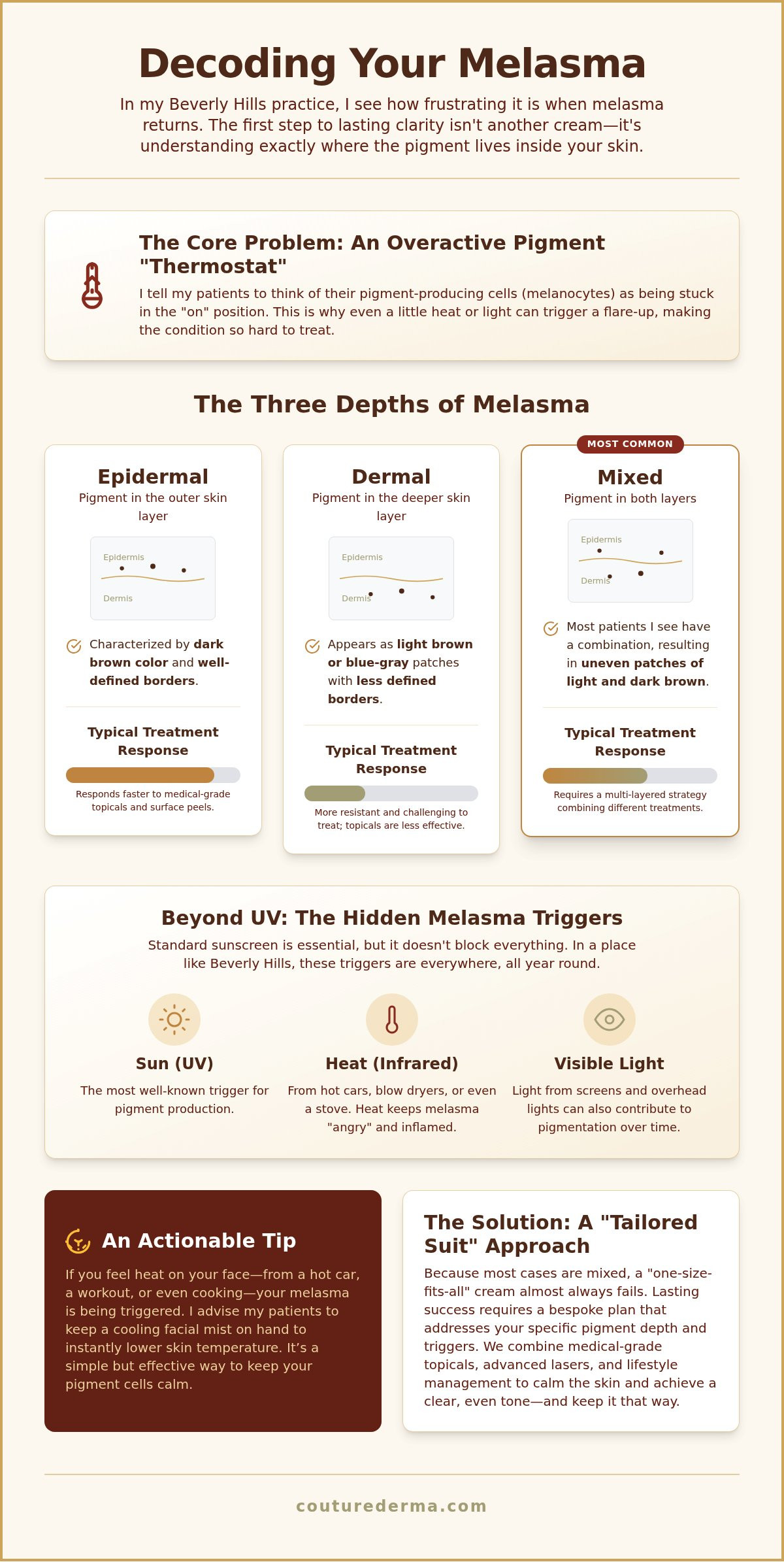
In my practice, I often see patients who are exhausted by the “cat and mouse” game of pigmentation. It’s a moving target. Melasma isn’t just a simple surface stain that you can scrub away with a harsh exfoliant. It’s a chronic skin condition that creates symmetrical brown or gray-brown patches, usually on your forehead, cheeks, and upper lip. I like to tell my patients to think of melasma as an overactive internal thermostat for your pigment producing cells. Once that thermostat is broken, even a tiny bit of heat or light can trigger a flare. This is why finding effective melasma treatment in Beverly Hills is so uniquely challenging; our environment is essentially designed to keep your pigment cells in a state of high alert.
It’s more than just “dark spots.” It involves your hormones, your genetics, and even your skin’s vascular (blood vessel) health. When the blood vessels under the skin are overactive, they can actually feed the pigment cells, making the patches look more prominent and harder to budge. This complexity is why a “one size fits all” cream from the drugstore almost always fails. You need a strategy that addresses every layer of the issue. When patients seek melasma treatment in Beverly Hills at our practice, we focus on calming the underlying inflammation before we even think about aggressive removal.
The “Mask of Pregnancy” and Beyond
We often call this the “mask of pregnancy” because estrogen and progesterone fluctuations are notorious for triggering melanocytes (cells that produce skin pigment). But let’s be honest, hormones are only one piece of the puzzle. Men get melasma too, though it’s far more common in women. Beyond the biology, there is a heavy emotional toll. I see how it affects my patients’ confidence every day. Many feel like they have to “hide” under layers of heavy foundation just to feel comfortable. It’s not just about the spots; it’s about the loss of freedom to have a “bare skin” day.
The Beverly Hills Factor: Sun, Heat, and Visible Light
Living in Southern California means we deal with intense sun year round. Standard sunscreen protects against UV rays, but it doesn’t always block heat or visible light. Heat, or infrared radiation, plays a massive role in keeping your melasma “angry” and inflamed. And in our climate, heat is everywhere. It’s in the air, the pavement, and even our cars. If your skin stays hot, your pigment stays active. This is why your patches might look darker after a “protected” day at the beach or even a long commute in the sun.
Decoding Your Pigmentation: Is Your Melasma Epidermal, Dermal, or Mixed?
I see many patients who come to me frustrated after trying every over the counter brightening serum available. While many beauty enthusiasts look to blogs like Beauty and the Mountains for honest reviews on the latest products, the issue with melasma often isn’t the product itself, but a lack of understanding about where the pigment actually lives. Understanding the depth of your pigment is the first step in our tailoring process. If we treat dermal melasma like epidermal melasma, you won’t see the results you deserve. This is why melasma treatment beverly hills must be highly customized. In most cases, I use a specialized light to determine exactly where the excess melanin is sitting before we design your protocol.
Here’s the thing: most patients I treat for Melasma: Treatment, Causes & Prevention actually have “mixed” melasma. This means the pigment is scattered across different levels of the skin, requiring a multi-layered strategy. It’s like trying to clean a stain that has soaked through both a silk dress and its lining; you can’t just scrub the surface and expect perfection. When you seek melasma treatment beverly hills at our practice, we start by mapping out these layers to ensure every treatment hits its mark.
Epidermal Melasma: The Surface Layer
This type is characterized by well-defined borders and a dark brown hue. Because the pigment is sitting in the outer layer of skin, it typically responds faster to medical grade topicals like hydroquinone or cysteamine. I often recommend surface level peels as a great “quick start” for this type. These treatments help lift the visible pigment quickly, providing that initial boost of confidence while we work on long term stabilization. It’s the most straightforward version of the condition to manage, but it still requires a meticulous touch to avoid irritation.
Dermal and Mixed Melasma: The Deeper Challenge
Dermal pigment looks more blue gray or “shadowy” because it sits deeper in the skin. It lacks the sharp edges of surface pigment, making it look more like a cloud than a spot. Mixed melasma is the most common presentation I see in my Beverly Hills clinic, combining both surface and deep characteristics. This requires a more patient, intentional approach. We often have to use specific laser settings or deeper reaching topicals to reach those stubborn “shadows” without causing unnecessary heat or trauma to the surrounding tissue.
If you’re tired of guessing which layer you’re dealing with, it might be time for a professional assessment. You can schedule a consultation to start your personalized transformation today.
The Couture Treatment Menu: Professional Solutions for Lasting Clarity
I don’t believe in “cookie cutter” skincare. Your skin is unique, and your journey to clarity should be as personalized as a bespoke gown. In my practice, we prioritize safety for all skin types, especially those with more natural pigment who are often most vulnerable to “rebound” hyperpigmentation. This is the primary reason why melasma treatment beverly hills requires a board certified expert. If we use the wrong laser setting or a peel that is too aggressive, we risk making the pigment worse. We focus on a multi modal approach that calms the skin while gently lifting the shadows.
Our protocols typically combine high potency medical grade topicals with light based energy. This combination allows us to address the overactive pigment cells from multiple angles. It’s a gradual, intentional process. We aren’t just treating the surface; we’re retraining your skin to behave differently. By layering these professional solutions, we can achieve an aesthetic harmony that looks natural and lasts long after you leave the office.
Medical-Grade Topicals and the “Couture” Compound
The American Academy of Dermatology on melasma treatment often references “Triple Cream” as a clinical favorite. This is a powerful blend of hydroquinone, tretinoin, and a mild steroid that works to slow down pigment production while speeding up cell renewal. But here is the thing: long term use of hydroquinone isn’t always the answer. I often transition my patients to non hydroquinone alternatives like azelaic acid or tranexamic acid for maintenance. This prevents the skin from becoming overly sensitive or thin.
Advanced Lasers: Fotona and Vbeam
Lasers are transformative, but they must be used with extreme caution. I often use the Vbeam laser to target the redness and vascular components that sit underneath many melasma patches. By treating these blood vessels, we cut off the “fuel” that keeps the pigment active. For deeper pigment, we utilize the Fotona laser to gently break it up without generating the excessive heat that causes rebound issues. This fits into our broader approach to Laser Skin Resurfacing, where we prioritize refined, healthy outcomes over aggressive, high heat treatments.
Chemical Peels: Controlled Renewal
Professional solutions like the VI Peel or customized PCA peels are significantly more effective than any at home kit. These peels provide a controlled renewal of the skin’s surface. I always require my patients to “pre treat” their skin for at least two weeks with a pigment inhibitor before any peel. This “quiets” the melanocytes so they don’t overreact to the treatment. For those whose pigment extends near the eyes, we often incorporate under-eye brightening techniques to ensure a seamless, even tone across the entire face.
The 24/7 Melasma Defense: Managing Heat, Light, and Hormones
I often tell my patients that the work we do in our office is just the first stitch in a much larger design. Effective melasma treatment beverly hills requires a 24/7 commitment from you because your skin is essentially “always on.” Think of your complexion as a piece of delicate, hand woven silk. You wouldn’t leave it out in the rain or throw it in a high heat dryer without expecting damage. Your pigment cells are just as sensitive. In my practice, I see how even the most advanced protocols can be undermined by a few hours of unprotected exposure to hidden triggers.
It isn’t just about the sun anymore. We now know that visible light from your smartphone and computer can keep your pigment cells in a state of chronic alarm. And let’s be honest about the Los Angeles lifestyle. While we love our wellness routines, things like hot yoga and saunas are often melasma’s worst enemies. This condition is a marathon, not a sprint. To maintain the clarity we achieve in the clinic, you have to become an expert in your own environmental defense.
The Iron Oxide Secret
Here is a mistake I see almost every day. Patients believe they are protected because they use a standard, high SPF sunscreen. But if your sunscreen is stark white, it isn’t protecting you from your computer screen. To block visible light, your product must contain iron oxides. These are the minerals that give tinted sunscreens their color. They act as a physical shield against the “blue light” coming from your digital devices and even the bright overhead lights in your office. Without iron oxides, your melasma treatment beverly hills is only doing half the job.
Cooling the Skin
We’ve talked extensively about light, but heat is the silent saboteur. When your internal body temperature rises, it triggers an inflammatory response that tells your melanocytes (cells that produce skin pigment) to start producing color. This is why I recommend avoiding steam rooms or intense infrared treatments if you are in the active phase of your journey. Even a long commute in a hot car can be enough to make your patches feel “angry” and dark again. Keeping your skin’s temperature regulated is just as important as blocking the sun.
If you’re tired of seeing your progress disappear every time the temperature rises, it’s time for a professional defense strategy. You can book your consultation at our Beverly Hills practice to start your transformative journey today.
Designing Your Transformative Journey at Couture Dermatology
Every successful transformation begins with a meticulous blueprint. In my practice, we don’t just look at the surface of your skin; we map out its entire history to understand how we got here. Seeking melasma treatment beverly hills shouldn’t feel like a transaction. It’s a collaborative journey where we look at everything from your current skincare regimen to your hormonal health and aesthetic goals. Our goal isn’t a temporary fix that fades in a month. We’re working toward a sustainable, glowing refinement that allows you to step out into the California sun with confidence. You deserve to feel beautiful in your skin without the “mask” of heavy makeup.
And let’s be clear about the process. This is a partnership. I provide the clinical expertise and the advanced technology, but your daily commitment to the “defense” we discussed is what makes the results last. We are essentially tailoring a new future for your skin. It’s a patient, intentional progression that prioritizes health over haste.
What to Expect During Your Consultation
We start with a deep dive analysis of your pigment depth and vascularity. This isn’t a quick glance under a bright light. We use specialized diagnostics to see exactly where your melanocytes (cells that produce skin pigment) are overacting and if underlying blood vessels are fueling the fire. From there, I create a customized “home care” calendar for you. It takes the guesswork out of your morning and evening routines by detailing exactly when and how to use your actives. Once we stabilize your pigment, many patients find it’s the perfect time to explore complementary treatments like jawline contouring for a total facial refresh that highlights your newly cleared complexion.
The Couture Commitment
Why does elite academic training matter? Melasma is one of the most complex conditions a dermatologist treats. My background at Harvard provided the scientific rigor needed to manage high risk skin types safely. At Couture Dermatology, we combine that medical authority with a sophisticated, welcoming environment where you are always the priority. We believe in the tailoring metaphor because your skin deserves a custom fit, not a generic solution. It’s about more than just medicine; it’s about the artistic refinement of your natural beauty. In our melasma treatment beverly hills protocols, we ensure that every step of your journey is handled with the highest level of care.
Start Your Transformation Toward Lasting Clarity
Melasma doesn’t have to be a permanent fixture in your life. We’ve seen how understanding the depth of your pigment and maintaining a 24/7 defense against heat and visible light are the true keys to success. It’s about moving away from generic fixes and toward a protocol that respects your skin’s unique biology. In my practice, I use my Harvard training and years of experience with all skin tones to ensure your path to clarity is both safe and effective. You’ve learned that the right melasma treatment beverly hills requires a meticulous, bespoke approach that addresses both the surface and the underlying vascular triggers.
But here is the most important part: you don’t have to navigate this complex condition alone. We are here to provide a sophisticated, clinical environment where your transformation is the priority. It’s time to trade the frustration of “rebound” spots for the calm confidence of an even, radiant complexion. You can Schedule Your Couture Melasma Consultation with Dr. Abisogun today to begin your journey. Let’s work together to restore your skin’s natural harmony and your self assurance.
Frequently Asked Questions
Is melasma treatment in Beverly Hills permanent?
Melasma is a chronic condition, so while we can achieve significant clarity, the results aren’t considered permanent in the traditional sense. I often tell my patients that we are effectively “quieting” the overactive pigment cells rather than deleting them forever. Because your skin’s internal thermostat remains sensitive, you’ll need a long term management plan to prevent the patches from returning. Consistent sun protection and periodic maintenance treatments are essential for keeping your skin clear and radiant over the years.
Can I get laser treatment for melasma if I have dark skin?
Yes, you can absolutely receive laser treatment for melasma if you have a deeper skin tone, provided the technology is used with a meticulous touch. In my practice, I specialize in treating all skin types and tones using specific devices like the Fotona laser. This technology allows us to break up pigment without generating the excessive heat that often triggers “rebound” darkening in melanin rich skin. It’s all about using the right settings and a gentle, gradual approach to ensure a safe and beautiful outcome.
How much does professional melasma treatment typically cost?
The investment for a professional protocol varies significantly because every plan is as unique as a tailored suit. Your total cost will depend on the depth of your pigment, the number of sessions required, and whether we combine medical grade topicals with laser therapies. During your initial consultation, we provide a detailed breakdown of your customized journey. We focus on creating a sustainable plan that delivers high detail results rather than suggesting a series of unnecessary or repetitive procedures.
Will my melasma come back after pregnancy?
While melasma often fades after pregnancy as your hormones stabilize, it doesn’t always disappear entirely without professional intervention. I see many patients whose “mask of pregnancy” lingered long after their child was born because the pigment had settled into the deeper layers of the skin. Even if it does fade, those pigment cells remain “primed.” This means a single weekend of unprotected sun exposure in the California heat can cause the patches to resurface just as dark as they were before.
What is the best sunscreen for melasma in the Los Angeles sun?
The best sunscreen for the Los Angeles sun is a tinted mineral formula with an SPF of 50 or higher that specifically contains iron oxides. Standard sunscreens often only block UV rays, but iron oxides are necessary to shield your skin from visible light and the blue light from your digital devices. In my practice, I consider a tinted physical blocker to be a non negotiable part of your daily defense. It acts as a sophisticated veil that protects your complexion from the hidden triggers found in our bright environment.
How long does it take to see results from a professional melasma protocol?
In most cases, you’ll begin to see a visible improvement in your skin’s clarity within 4 to 8 weeks of starting your professional protocol. Surface level pigment typically lifts faster, while deeper, shadowy patches require more patience and intentional treatment. It is important to remember that aesthetic improvement is a gradual progression. We aren’t just “scrubbing” the skin; we are retraining it to behave differently, which is a process that unfolds over several months of dedicated care.
Are there any foods or supplements that help with melasma?
There are specific supplements, such as Polypodium leucotomos (an extract from a tropical fern), that I often recommend to help protect your skin from the inside out. This supplement acts as an internal antioxidant that helps your skin resist the inflammatory effects of the sun. While no pill can replace a high quality sunscreen, these “internal blockers” can provide an extra layer of defense. I typically suggest them as a booster for patients who spend a lot of time outdoors or have highly reactive pigment.
Can I use Retinol while treating my melasma?
You can typically continue using Retinol while receiving melasma treatment beverly hills, but the timing of your application is crucial for avoiding irritation. Retinol helps by speeding up cell turnover, which allows the fragmented pigment to reach the surface and shed more quickly. However, you must be careful not to over sensitize your skin. I often advise my patients to wait 20 minutes after cleansing before applying their Retinol to ensure the skin is completely dry and the barrier remains intact.