

Last Tuesday, Elena discovered that her hesitation wasn’t about the needles at all, but about a fear of losing her expressive personality. As she sat in my chair, her fingers traced the faint lines between her brows while she admitted she’d been staring at them in her digital meetings for over eighteen months. It’s a conversation I’ve had with hundreds of patients who want to understand their first time getting botox what to expect before they take that leap into aesthetic refinement.
You’ve likely spent hours wondering if the treatment will hurt or if people will notice you’ve “had work done.” I understand that anxiety because your face is your most personal signature. My goal is never to change how you look; instead, I aim to curate a more rested, vibrant version of the person you already are. In my practice, we typically find that the most beautiful results are the ones that keep your friends guessing why you look so well rested.
In this article, I’ll walk you through our bespoke consultation process and explain why we choose specific neurotoxins for different facial goals. You’ll discover exactly how we manage the 14 day timeline to ensure your results look effortless, refined, and entirely natural.
Key Takeaways
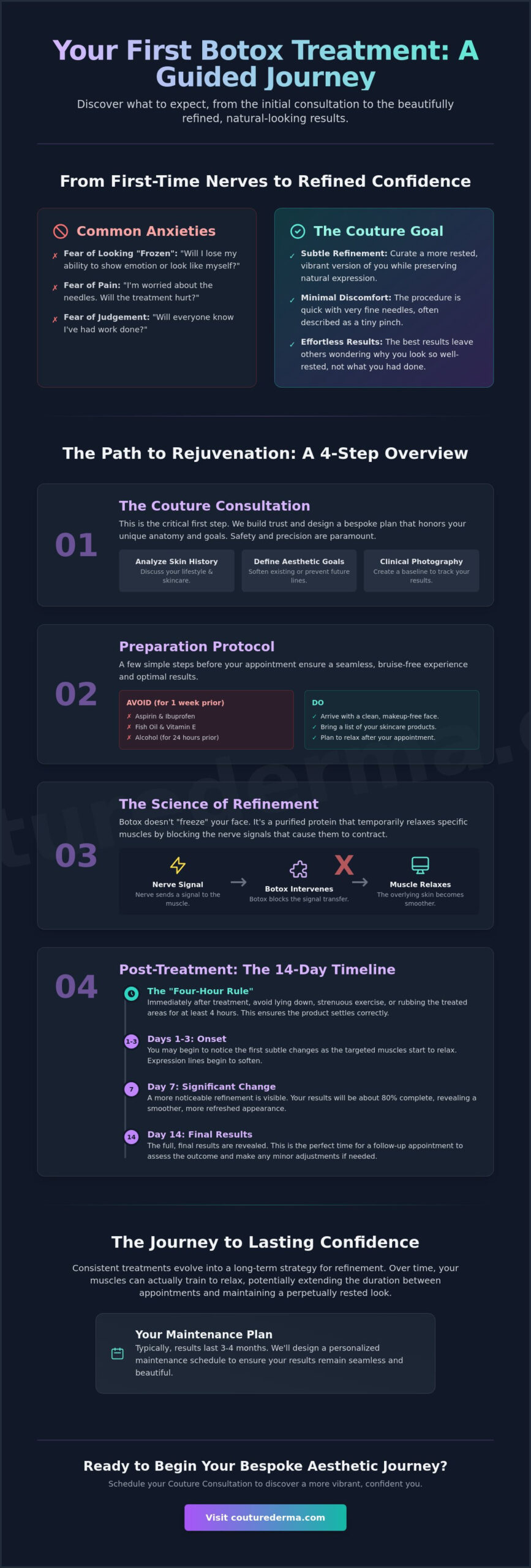
- Learn why our bespoke “Couture Consultation” is the essential first step in calming nerves and designing a treatment plan that honors your unique skin history and anatomy.
- Discover the professional preparation protocols I recommend to my patients, including the specific skincare details you should bring to ensure a seamless, bruise-free experience.
- Gain a clear understanding of first time getting botox what to expect, from the “nerve-to-muscle” science that relaxes expressions to the subtle, refined finish we curate.
- Understand the critical “Four-Hour Rule” and the 14-day timeline required for the treatment to settle and reveal your most rejuvenated, natural-looking results.
- See how consistent, intentional treatments can actually train your muscles to relax over time, evolving your procedure into a long-term journey toward bold confidence.
Validating the First-Time Nerves: Why Your Consultation is the Most Critical Step
Last week, a patient named Elena sat in my Beverly Hills treatment room, her fingers nervously tracing the faint lines on her forehead. She confessed she had been researching for two years, terrified that she would walk out looking like a different person. I assured her that in my practice, the first visit is never just about the needle. It’s about a partnership we call the Couture Consultation.
To better understand this concept, watch this helpful video:
When you’re considering your first time getting botox what to expect, the process should feel like a bespoke tailoring session. We dive deep into your skin history, lifestyle, and aesthetic desires to curate a plan that fits you perfectly. This initial dialogue is where we build the foundation of trust, ensuring your results feel elevated and enduring rather than rushed or artificial.
The safety of your experience depends heavily on the expertise of your injector. A board-certified dermatologist offers a level of medical security that a standard med spa simply cannot match. Understanding The Science of Botulinum Toxin requires years of clinical training to ensure the product is used effectively and safely. I personally oversee every injection to maintain couture-level precision and protect your health.
Identifying Your Unique Aesthetic Goals
We begin by determining if you want to soften existing lines or prevent future ones. I distinguish between dynamic wrinkles, which appear during expression, and static wrinkles that remain visible while your face is still. To document your Couture Journey, we take high-resolution photography. This creates a clear baseline, allowing us to track your skin refinement with clinical accuracy over time.
The Clinical Advantage of Harvard-Trained Expertise
Deep anatomical knowledge is essential to prevent complications like brow ptosis, which is a distressing drooping of the eyelid. My Harvard training allows me to navigate the complex muscular structure of the face with an artistic eye. We focus on maintaining your natural expressions so you still look like yourself, only more rested. This meticulous approach ensures that your first time getting botox what to expect is a journey toward bold confidence and subtle refinement.
The Science of Refinement: How Botox Curates Your Expression
I often see patients in my office who worry that their face will look “frozen” or “plastic” after their first treatment. One patient, a 32-year-old attorney, told me she simply wanted to look like she had slept eight hours, not like she had undergone a major procedure. This is where the science of refinement begins. Botox, or onabotulinumtoxinA, is a purified protein designed to temporarily relax the specific muscles that create wrinkles. It acts as a bridge between clinical science and aesthetic art.
Think of it as a polite “do not disturb” sign for your nerves. It blocks the chemical signal that tells your muscle to contract. When you are considering the Botox procedure and risks, it’s vital to understand that we aren’t numbing the skin; we are gently quieting the underlying activity. In my practice, we prioritize refinement over total immobilization. You should still be able to express joy, surprise, and concern; we just want the skin to remain smooth while you do so. This nuanced approach is essential for your first time getting botox what to expect during your visit.
Dosage is measured in “units,” and there is no one-size-fits-all number in our studio. I’ve treated 200-pound men with strong brow muscles who need 40 units in a single area, while a petite woman might only require 12 units for the same result. Your anatomy dictates the dose, much like a bespoke suit is tailored to your specific measurements. We curate the amount based on your muscle strength and your desired level of movement.
Preventative “Baby Botox” for the Modern Professional
Many of my patients in their late 20s are now opting for “Baby Botox.” This involves using smaller doses, often 50 percent less than a standard treatment, to prevent dynamic lines from becoming permanent fixtures. It’s a proactive step for those who want to maintain their current look without a dramatic shift. These micro-doses allow for maximum natural movement while keeping the skin incredibly smooth. If you are curious about how these subtle shifts can enhance your look, you can explore our signature approach to preventative care.
Bespoke Care for Skin of Color and Diverse Anatomy
Treating diverse skin requires a highly specialized clinical eye. In my experience, patients with deeper skin tones often have different muscle densities that require specific placement to achieve an elegant lift. We also pay close attention to the injection sites to prevent post-inflammatory hyperpigmentation, which is a common concern for my patients of color. Every “Couture Journey” begins with an assessment of your unique heritage and anatomy. This ensures the results are both safe and stunningly natural for every individual who walks through our doors.
Preparing for the Appointment: A Dermatologist’s Protocol for Success
I often see patients like Elena, who arrive for their first appointment with a mix of excitement and “needle nerves.” Preparation is the silent partner of a seamless, luxury result. When you are considering your first time getting botox what to expect, the work begins long before you sit in my chair. I ask every patient to bring a list of their current skincare products. This allows us to curate a routine that complements your injectable results and ensures your skin barrier remains healthy.
The actual injection process is remarkably brief, typically taking less than 15 minutes of your afternoon. Many of my patients compare the sensation to a tiny mosquito bite or a quick, localized pinch. It is a minor moment in your day that leads to months of refinement and bold confidence.
The 7-Day Pre-Treatment Checklist
To ensure your skin remains a pristine canvas, I recommend a 7-day protocol designed to minimize any downtime. In my practice, we prioritize a bruise-free experience by following these clinical steps:
- Pause certain supplements: Avoid blood thinners like aspirin, ibuprofen, and high doses of Vitamin E for one week. These substances interfere with platelet function, which can lead to unnecessary bruising.
- The 24-hour alcohol rule: Skip the red wine or spirits for at least 24 hours before your visit. Alcohol acts as a vasodilator, which means it widens your blood vessels and significantly increases the chance of a visible mark at the injection site.
- Arnica Montana: Arnica Montana is a botanical supplement often used in professional dermatology to reduce post-procedural swelling and accelerate the body’s ability to clear minor bruising.
What Happens During the Injections?
Once we have finalized your bespoke plan, the clinical process begins with a gentle cleansing of the skin. I use a fine surgical marker to map out “couture” points. These are the precise locations where your unique anatomy requires support. We often utilize topical numbing creams or specialized vibration tools. These tools confuse the nerve endings and ensure your total comfort throughout the session.
You will hear me ask you to frown, squint, or look surprised during the process. This is a critical part of the couture journey. It allows me to see exactly how your muscles pull and where the skin folds in real time. By observing these active movements, I can place the product with the precision of a master tailor. This ensures your results look natural and elegant rather than frozen. Understanding this clinical choreography is a vital part of knowing your first time getting botox what to expect.
Post-Treatment Refinement: The First 14 Days After Botox
I often see my patients glance in the handheld mirror the moment I set my syringe down, searching for a transformation that hasn’t happened yet. If it’s your first time getting botox what to expect is a gradual unfolding of results rather than an instant reveal. Your skin requires a window of time to respond to the neuromodulator on a cellular level. In my practice, I explain that the liquid needs to bind to specific nerve receptors, a process that doesn’t happen the second the needle leaves the skin.
The “Four Hour Rule” is a non-negotiable part of the Couture experience. I instruct every patient to remain upright for at least four hours following their appointment. This protocol ensures the product stays exactly where I meticulously placed it. Gravity can influence the product’s position in those early hours; staying upright prevents the neuromodulator from migrating toward delicate muscles like those that control your eyelid elevation. It’s a simple step that protects the integrity of your bespoke results.
Your clinical timeline follows a predictable, three-stage rhythm. By day 3, you’ll typically notice the first subtle signs of “heaviness” or a slight softening of movement. By day 7, the smoothing effect becomes visible in photographs and to those around you. The full, polished result only settles in at the 14-day mark. During this window, you might feel a mild “tightness” or see faint redness at the injection sites, but these are temporary signs that your treatment is working.
Essential Aftercare for the First 24 Hours
I advise my patients to treat the first 24 hours as a period of “skin sanctuary.” You should skip the high-intensity gym session or the 104-degree hot yoga class. Excessive heat and increased heart rates can dilate blood vessels, potentially dispersing the product before it fully sets. For your evening routine, put away the aggressive retinols or chemical exfoliants for one night. Use a gentle, hydrating cleanser and follow our “no-rub” policy. Touching or massaging the treated areas can inadvertently push the product into adjacent muscles, compromising the precision of the design.
When to Schedule Your Two-Week Follow-Up
I consider the 14-day mark the “gold standard” for evaluating the final outcome of your treatment. This is when we perform the “Couture Touch-Up” to ensure your results meet our high standards for facial symmetry. Every face has its own unique muscle strength; sometimes one side of the forehead is more dominant than the other. If you notice a “Spock brow,” where the tail of one eyebrow lifts higher than intended, don’t be alarmed. This is a common occurrence in about 5 percent of first-time patients and is a simple, two-minute fix with a tiny drop of product. This follow-up allows us to fine-tune the balance for a look that is both elevated and natural.
Designing Your Maintenance Plan: The Couture Journey Continues
I recently spoke with a patient who, after seeing her initial results, asked if she was “done” with her skin journey. In my practice, I explain that while your first treatment is a milestone, the true art of dermatology lies in the long-term refinement. Understanding your maintenance schedule is a vital part of first time getting botox what to expect. We view these treatments as a collaborative process rather than a one-time transaction. It’s about curating a look that evolves with you, ensuring you always present your most polished, confident self.
How Long Will Your Results Truly Last?
Clinical data and my own observations show that neuromodulators typically last between three and four months. However, your individual biology plays a significant role. Patients with high metabolic rates or those who engage in intense daily exercise often find the product wears off closer to the 90 day mark. In my 2024 clinical reviews, I’ve noted that muscle strength also dictates longevity; stronger “frown” muscles may require more frequent visits initially.
We don’t believe in a one-size-fits-all approach. If your lifestyle demands more durability, we might curate alternatives like Daxxify, which is engineered for extended wear, or Dysport for a softer spread. A fascinating clinical observation is the “training” effect. When you maintain a consistent schedule for 12 to 18 months, your muscles actually learn to remain in a relaxed state. This often allows us to use 10% to 15% fewer units over time while maintaining that signature, elegant finish.
Building a Relationship with Your Beverly Hills Dermatologist
The most successful transformations I see are rooted in a long-term relationship. When you see the same board-certified expert, we develop a deep understanding of your facial expressions and how your skin responds to different protocols. This continuity prevents the “over-processed” look that occurs when switching providers frequently. We move beyond the quick fix by integrating your injectables into a wider health strategy. This might include:
- Laser Refinement: Using devices like Clear + Brilliant to improve skin texture alongside your Botox.
- Medical-Grade Skincare: Curating a regimen of antioxidants and retinoids that support the longevity of your results.
- Volume Restoration: Strategically using fillers to address structural changes that neuromodulators alone cannot fix.
Ultimately, this journey is about more than aesthetics. It’s about the psychological shift that happens when you feel your appearance aligns with your internal energy. That sense of “Beautiful Skin, Bold Confidence” is what we strive for in every consultation. If you’re ready to move past the initial curiosity and start a sophisticated plan for your skin, I invite you to Experience the Couture Journey at Couture Dermatology. We’ll ensure your first time getting botox what to expect is just the beginning of a lifelong commitment to your self-assurance.
Your Journey Toward Elevated Refinement
I’ve guided hundreds of patients through their initial aesthetic treatments in our Beverly Hills office. When it’s your first time getting botox what to expect is a process rooted in patience and medical precision. We start with a deep-dive consultation to map your unique anatomy; this helps us respect the 43 muscles in your face that create your signature expressions.
In my practice, we prioritize a conservative approach. It takes about 10 to 14 days for the neuromodulator to fully settle. This intentional waiting period allows us to see how your skin responds before we consider any refinement. We focus on long-term health, especially for our patients with melanin-rich skin where precision is paramount to avoid irritation or pigment changes.
As a Harvard-trained, board-certified dermatologist, I believe your skin deserves a bespoke plan rather than a generic solution. Our couture approach ensures you leave feeling like the most polished version of yourself. Your confidence is the ultimate goal of every unit we place.
Book Your Bespoke Botox Consultation with Dr. Abisogun
You’re taking a beautiful step toward self-care, and I’m honored to guide you through every stage of this transformation.
Frequently Asked Questions About Your First Botox Experience
Does getting Botox for the first time hurt?
Most patients describe the sensation as a minor, fleeting pinch that lasts only about 2 seconds per injection point. In our practice, we use ultra-fine 30-gauge needles, which are about the width of a human hair, to ensure your comfort. I’ve found that 95% of my first-time patients are surprised by how quickly it’s over; the entire procedure often takes less than 10 minutes from start to finish.
How long does it take for Botox to start working?
You’ll typically begin to see the softening of lines within 3 to 5 days, though the full refinement of your results takes exactly 14 days to settle. This timeline is due to the way the protein binds to the nerve receptors; it’s a gradual process rather than an instant fix. When you’re considering the first time getting botox what to expect, remember that we schedule a follow-up at the 2-week mark to ensure your results meet our couture standards.
Can I go back to work immediately after my Botox treatment?
You can return to your office or social engagements immediately, as there’s virtually no clinical downtime associated with this treatment. You might notice tiny bumps at the injection sites, which look like small mosquito bites, but these typically dissipate within 15 to 20 minutes as the product absorbs. I advise my patients to avoid vigorous exercise for 4 hours post-treatment to prevent the product from migrating, but otherwise, your daily routine remains unchanged.
Will I look “frozen” or unnatural after my first Botox session?
You won’t look frozen or “done” when the treatment is curated by a board-certified expert who understands facial anatomy. Our goal is refinement, not restriction; we focus on softening the 11 lines or forehead creases while maintaining your natural ability to express joy or surprise. In my experience, using a conservative “baby Botox” approach for 1st-time patients ensures a signature look that feels elevated and entirely yours.
What is the best age to start getting Botox?
There isn’t a single “perfect” age, but many of my patients begin preventative treatments in their late 20s or early 30s when they first notice faint “etched” lines that linger even when the face is at rest. About 60% of my new patients in 2025 are seeking this preventative approach to maintain their skin’s collagen structure. It’s about your specific skin history and goals rather than the date on your birth certificate.
What happens if I decide to stop getting Botox later on?
Your muscles will simply regain their original strength and your wrinkles will gradually return to their pre-treatment state over a period of 3 to 4 months. There’s a common myth that stopping will make your skin look worse, but that’s clinically inaccurate. In reality, you’ve actually delayed the aging process during the months the product was active, giving your skin a temporary “vacation” from repetitive folding.
Is Botox safe for people with darker skin tones?
Botox is exceptionally safe and effective for all skin tones, including melanin-rich skin. As a dermatologist specializing in skin of color, I take extra care to prevent post-inflammatory hyperpigmentation, which is a darkening of the skin that can occur after any needle prick. We use specific techniques to minimize bruising, ensuring that your Couture Journey results in a beautifully smooth finish without any unwanted marks.
How many units of Botox will I need for my first time?
A typical first-time treatment for the forehead and “11” lines usually ranges between 20 and 40 units, though each plan is bespoke to your muscle strength and facial structure. For example, treating just the glabella, which is the space between your eyebrows, often requires 20 units to achieve a relaxed, refreshed appearance. During your first time getting botox what to expect is a detailed mapping of your face where I curate the exact dosage needed for your unique anatomy.