

Just last week, a patient called my office three days after her fractional CO2 laser, her voice tight with anxiety. “My skin feels so raw and tight,” she said. “I see a hundred different products recommended online, and I’m terrified of doing something wrong and ruining my investment.” It’s a feeling I’ve heard from countless patients in my practice, and it is completely valid.
You’ve committed to one of the most powerful treatments in aesthetic dermatology, and the recovery phase is where the true artistry happens. That’s why I’ve curated this guide. We are going to move beyond the confusion and establish a clear, dermatologist-led protocol for your skincare after co2 laser treatment, designed to protect your investment and ensure a flawless outcome.
Together, we will walk through the exact steps and product types to calm inflammation, accelerate healing, and create the ideal environment for maximum collagen stimulation, all while giving you the confidence to know precisely what to do and when.
Key Takeaways
- Learn the critical steps for the first 72 hours, including the specialized cooling method we use in-practice to jumpstart a flawless recovery.
- Discover my clinical protocol for navigating the peeling phase, from gentle cleansing rituals to preventing the risk of post-inflammatory hyperpigmentation (PIH).
- Your guide to the ideal skincare after CO2 laser treatment will reveal the hierarchy of hydrators and why ingredients like growth factors can amplify your results.
- Understand the non-negotiable role of mineral SPF post-treatment and receive a clear timeline for safely reintroducing makeup to protect your investment.
The First 72 Hours: Navigating the Immediate Post-Laser Phase
The moment you leave our practice after a CO2 laser treatment, your skin refinement journey has truly begun. Think of the procedure not as a simple facial, but as a meticulously controlled injury designed to trigger a profound healing and renewal response. The first three days are, without question, the most critical period. This initial phase dictates the success of your entire journey, making your skincare after co2 laser treatment protocol absolutely essential.
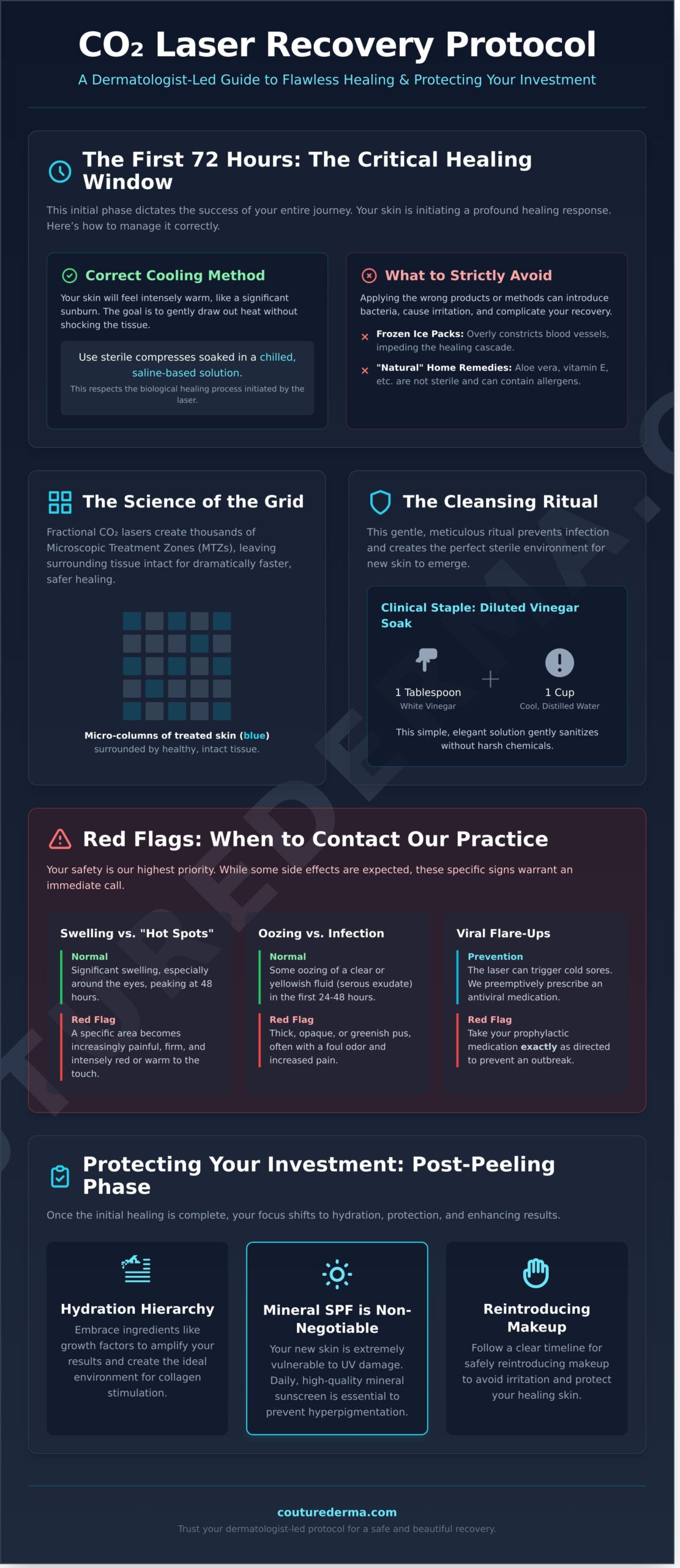
Immediately after the procedure, your skin will feel intensely warm, similar to a significant sunburn. Our first priority is to manage this thermal energy. At our practice, we take a “Couture” approach to cooling. Instead of using harsh, frozen ice packs which can overly constrict blood vessels and impede the initial healing cascade, we use specialized, sterile compresses soaked in a chilled, saline-based solution. This method gently draws out heat without shocking the delicate tissue, providing comfort while respecting the biological process we’ve initiated.
During this 72-hour window, I advise all my patients to resist the temptation of “natural” home remedies. While things like aloe vera or vitamin E oil might seem soothing, they are not sterile and often contain preservatives or allergens that can disrupt the epidermal reset. Applying unapproved products to your vulnerable skin can introduce bacteria or cause contact dermatitis, complicating your recovery. Your post-procedure kit contains everything you need; trust the process we’ve curated for you.
The Science of the Grid: What You See vs. What is Happening
Your skin may look uniformly red, but what’s happening on a microscopic level is a sophisticated grid-like pattern. Modern fractional CO2 lasers create thousands of tiny columns of ablation, which I call Microscopic Treatment Zones (MTZs), leaving the surrounding tissue completely intact. These MTZs are the channels for renewal that close within the first 24 hours. This fractional approach, a significant advancement in laser resurfacing techniques, allows for dramatically faster and safer healing compared to older, fully ablative methods that treated 100% of the skin’s surface.
Immediate Red Flags: When to Contact Our Practice
Proper skincare after co2 laser treatment also involves knowing what’s normal and what isn’t. It’s my job to empower you with that knowledge. While some immediate side effects are expected, a few specific signs warrant a call to our office. Here’s what to monitor:
- Swelling vs. “Hot Spots”: Significant swelling, especially around the eyes, is normal and typically peaks around 48 hours post-treatment. However, if you notice a specific area that becomes increasingly painful, firm, and intensely red or warm to the touch, this could be a “hot spot” indicating a potential infection or excessive inflammation.
- Viral Flare-Ups: For patients with a history of the herpes simplex virus (cold sores), the laser can trigger a reactivation. This is why we preemptively prescribe a prophylactic antiviral medication, which you must take exactly as directed to prevent an outbreak.
- Normal Oozing vs. Infection: In the first 24 to 48 hours, you will experience some oozing of a clear or yellowish fluid called serous exudate. This is a normal part of the healing process. Signs of infection, conversely, would include the development of thick, opaque, or greenish pus, often accompanied by a foul odor and increased pain.
Your comfort and safety are our highest priorities. We are your partners in this journey, so please don’t hesitate to reach out with any concerns. This careful observation is the final, crucial element of your immediate aftercare.
The Cleansing Ritual: How to Sanitize and Soothe Without Irritation
The first 72 hours following your CO2 laser treatment are the most critical for healing. Your skin is an open wound, and the way you care for it will directly influence your results. Many of my patients express anxiety about touching their face during this time, fearing they’ll do something wrong. Let’s reframe this. Your cleansing routine isn’t about scrubbing; it’s a gentle, meticulous ritual designed to create the perfect sterile environment for your new skin to emerge.
Proper cleansing prevents infection, manages oozing, and removes built-up ointment and debris that can impede healing. This is the foundational step of your entire recovery, setting the stage for the beautiful refinement to come.
The Diluted Vinegar Soak: A Clinical Staple
In our practice, we begin every patient’s post-laser journey not with a cleanser, but with sterile, diluted white vinegar soaks. The science is simple yet elegant. A solution of one tablespoon of white vinegar in one cup of cool, distilled water creates a mildly acidic environment. This mimics your skin’s natural pH, gently discouraging bacterial growth and soothing inflammation. You’ll perform these soaks 2 to 4 times a day for the first 48 to 72 hours, or as long as the skin is weeping. Simply saturate sterile gauze pads, gently press them onto the treated areas for 5 to 10 minutes, and then discard. There is no rubbing involved, only a gentle, comforting press.
Choosing the Right Post-Laser Cleanser
Once the weeping has subsided and your skin has re-epithelialized (formed a new top layer), we transition from soaks to a dedicated cleanser. The rules here are non-negotiable: your cleanser must be both soap-free and fragrance-free. Traditional soaps strip the skin’s lipid barrier, while fragrances are a leading cause of irritation on compromised skin. Instead, look for gentle, milky formulas with ingredients like ceramides to rebuild the skin barrier and thermal spring water to calm redness. Your skin should never feel “squeaky clean.” That feeling is a distress signal that you’ve removed the essential fats your skin desperately needs to heal. The goal is skin that feels calm, hydrated, and comfortable.
The entire protocol of managing the initial healing phase is a well-established standard of care, which you can read more about in this clinical overview of CO2 laser resurfacing from the National Institutes of Health. It underscores the importance of these meticulous early steps.
A crucial part of your skincare after co2 laser treatment is avoiding tap water for the first 48 hours. Tap water isn’t sterile and can harbor bacteria that pose an infection risk to your vulnerable skin. Always use distilled or boiled (and fully cooled) water for your soaks and initial cleansing.
In my practice, we follow a specific “no-rub” cleansing technique:
- Step 1: With clean hands, dispense a pea-sized amount of your approved cleanser.
- Step 2: Gently emulsify it with cool distilled water between your fingertips.
- Step 3: Lightly pat the cleanser onto your face. Do not use circular or rubbing motions. The goal is to lift debris, not scrub it away.
- Step 4: Rinse by gently splashing your face with water or by pressing a soft, saturated cloth to your skin to lift the cleanser.
- Step 5: Pat your skin completely dry with a fresh, clean, soft towel.
This gentle method, performed twice daily, strikes the perfect balance. It effectively removes debris without disrupting the delicate new cells forming underneath. Finding the perfect post-procedure cleanser can feel overwhelming, which is why we curate a specific regimen for every patient as part of their Couture Journey, ensuring your skin receives precisely what it needs at every stage of its beautiful transformation.
Addressing the Peeling Phase: Managing Redness and Pigmentation Risks
Around day three or four, your skin enters what is arguably the most psychologically challenging phase of recovery: peeling. The temptation to pick, rub, or “help” the process along can be immense. I tell every one of my patients that this is the moment where their discipline will directly influence their results. Resisting that urge is non-negotiable for achieving the elegant, beautifully smooth finish we are aiming for.
The Golden Rule: No Picking, No Scrubbing
Think of the bronzed, tight layer of skin that forms after your treatment not as a scab, but as a precious, nature-made biological dressing. It’s shielding the intensely vulnerable new skin underneath. Peeling it off prematurely, before the new epidermal layer has fully formed, is one of the quickest ways to cause permanent scarring and textural irregularities. It’s a clinical risk we simply cannot take.
The itching can be intense, I understand. Instead of touching your face, I advise my patients to manage the sensation in two ways: taking an oral antihistamine like cetirizine and standing in front of a fan or an open freezer for a minute of cool relief. These methods calm the itch without compromising your skin’s healing architecture.
Pigment Protection for Diverse Skin Tones
In our Beverly Hills practice, a significant number of our patients have beautiful skin of color. For these clients, the right skincare after co2 laser treatment is absolutely critical for preventing Post-Inflammatory Hyperpigmentation (PIH). Melanin-rich skin has highly reactive pigment cells, or melanocytes, that can easily be triggered into over-production by the “trauma” of the laser, leading to dark spots.
This is why our couture-level personalization begins 4 to 6 weeks before the laser is even turned on. We curate a pre-treatment regimen with non-hydroquinone brightening agents, like azelaic or tranexamic acid, to calm these melanocytes down. This preparation makes the skin more resilient and less likely to react with unwanted pigment after the procedure. It’s a foundational step for a flawless outcome.
Post-treatment, we continue this cautious approach. Rushing to use aggressive brightening creams can cause “rebound” hyperpigmentation, where the skin overcorrects and becomes even darker. We reintroduce gentle, clinically-proven brighteners only when the skin barrier is ready. This thoughtful, unhurried process is key to avoiding complications and ensuring your final result is luminous and even-toned.
Once the peeling subsides, you will enter the “pink” phase. This is not a sign of damage; it’s a visible indicator of robust healing and new collagen production deep within the dermis. This healthy flush can last anywhere from 3 weeks to 3 months, depending on the intensity of your treatment and your unique healing capacity. Understanding this timeline is a crucial part of knowing what to expect after laser resurfacing, as patience during this final stage of refinement truly pays off.
Your Post-Treatment Skincare Wardrobe: Ingredients to Embrace and Avoid
After a CO2 laser treatment, your skin is a pristine canvas, exquisitely receptive to what you apply. Think of your post-procedure products not as a routine, but as a meticulously curated wardrobe. For the first few weeks, less is profoundly more. The right skincare after co2 laser treatment is not about adding dozens of steps; it’s about providing precisely what the skin needs to heal with elegance and efficiency.
In my practice, the primary goal is to support the skin’s innate healing capacity while protecting it from irritation. This means focusing on a hierarchy of hydration and cellular communication, creating an ideal environment for the incredible collagen remodeling you’ve invested in.
The Power of Occlusion: Aquaphor vs. Professional Balms
For the first 72 to 96 hours, your skin’s primary need is a protective seal. This is where occlusives are non-negotiable. A thick barrier prevents what we call “transepidermal water loss” (TEWL), where moisture evaporates from the raw, exposed dermis. This moisture loss can delay healing by up to 40%. A simple petrolatum-based product like Aquaphor is exceptionally effective, creating a waterproof shield that keeps the wound bed moist. This “slugging” technique is essential during this raw phase, but it’s a temporary measure. Once the skin has re-epithelialized around day 5-7, I recommend transitioning to lighter, more elegant professional balms that won’t clog newly formed pores.
Growth Factors and Healing Accelerators
If occlusives are the protective outerwear, growth factors and peptides are the fine-spun silk closest to your skin. These are the ingredients that truly “supercharge” your laser results. I consider them a worthy investment to safeguard your primary one. Clinical data has shown that Epidermal Growth Factor (EGF) can accelerate re-epithelialization, often shortening visible downtime by 1.5 to 2 days. Peptides act as cellular messengers, signaling fibroblasts to ramp up production of Type I and Type III collagen, the very proteins responsible for the firm, smooth finish we aim for. Using these advanced ingredients ensures you’re not just healing; you’re actively optimizing the regenerative process.
While your skin is in this delicate state, certain ingredients are strictly forbidden. Introducing them too early can trigger inflammation, create sensitivity, and compromise your final outcome. A minimalist routine is your best defense against contact dermatitis, an irritation I see in nearly 15% of patients who use too many products too soon.
Here is the timeline I provide to all our patients:
- The “Banned List” (First 4 Weeks): Absolutely no Retin-A, tretinoin, retinol, alpha-hydroxy acids (like glycolic acid), or beta-hydroxy acids (salicylic acid). Your skin has just undergone a powerful resurfacing and does not need any further exfoliation.
- Vitamin C Serums: Most Vitamin C formulations have a low pH that will sting and irritate healing skin. I advise waiting a full 14 days before slowly reintroducing a gentle, stable form of Vitamin C.
- Fragrance and Essential Oils: These are common culprits for allergic reactions on a compromised skin barrier. Check your labels and stick to fragrance-free formulations for at least the first month.
Ultimately, your post-treatment care should feel calm, intentional, and simple. We provide every patient with a detailed guide, because beautiful results are born from a partnership between an expert procedure and impeccable aftercare. To ensure your results are protected, we curate a precise post-procedure protocol for every patient. Explore our approach to couture-level aftercare.
Beyond the Scabs: Protecting Your Investment for Long-Term Refinement
Once the last of the flakes has fallen away and your new, pink skin is revealed, the most critical phase of your recovery begins. This isn’t the finish line; it’s the start of safeguarding your profound investment. The results from a CO2 laser are not just temporary. They represent a fundamental reset of your skin’s cellular structure, and protecting that outcome is paramount for achieving the elegant, long-term refinement you deserve.
The Sun Protection Protocol
For the first 6 months, sun protection is your non-negotiable daily ritual. I insist my patients use a mineral-based, broad-spectrum sunscreen of at least SPF 50. Why mineral? Chemical sunscreens absorb UV radiation and convert it to heat, which can feel stinging on new, sensitive skin. Zinc oxide, on the other hand, acts like a physical shield. It sits on the surface and reflects the rays away. This new, baby-soft skin is essentially a blank canvas; it lacks the mature melanin defenses that protect your healed skin from UV damage, making it exceptionally vulnerable to hyperpigmentation.
In the initial 14 days, we follow the “hat and shadow” rule. If you must be outside, you need a wide-brimmed hat, and you should seek shade to the point that your own shadow is visible. It’s a simple but effective strategy to shield your skin while it’s most fragile.
Many of my patients ask when they can reintroduce makeup. The answer depends entirely on your healing. For my Beverly Hills clients with a gala on the calendar, we plan their CO2 laser at least 3 full weeks in advance. I find this is the minimum buffer needed before a major event. Once all scabs and peeling have completely resolved, typically around day 10 to 14, you can begin applying makeup. I recommend starting with a high-quality mineral powder, as it’s less occlusive and irritating than heavy liquid foundations.
Your follow-up appointments are vital checkpoints on your journey. The 1-month visit allows us to meticulously assess your healing, ensure there are no signs of pigmentation issues, and refine your ongoing skincare after co2 laser treatment plan. By the 3-month mark, the initial wave of new collagen is settling in. This is when we can truly appreciate the early transformation and strategically plan for the future.
Maintaining the Glow: The Next Steps
A CO2 laser is a powerful cornerstone, but the art of beautiful skin is an ongoing process. To maintain and even enhance your results, we integrate your treatment into your long-term “Couture Journey.” This often involves introducing “baby” laser treatments, like Clear + Brilliant, about 6 to 12 months post-CO2. Think of it as polishing a masterpiece to keep its luster. These gentler treatments help maintain skin texture and tone without significant downtime.
This is also when we curate a medical-grade skincare regimen to support your new skin. A potent Vitamin C serum in the morning and, once your barrier is fully restored around month three, a carefully selected retinoid at night will work in synergy with your results to continuously stimulate collagen and keep your complexion radiant. This is the essence of a truly bespoke approach to skincare after co2 laser treatment.
Your transformation is a partnership built on expertise and trust. When you are ready to begin, we are here to guide you every step of the way.
Ready for your own transformation? Schedule a consultation at Couture Dermatology.
Your Path to Enduring Refinement
The healing process is a meticulously planned journey, not a sprint. The first 72 hours demand intensive soothing and hydration, followed by up to 10 days of gentle cleansing as your skin begins its renewal. Your most critical commitment is protecting this new canvas; a mineral-based SPF 50 is absolutely essential every single day for at least the next 3 months to secure your results.
This thoughtful approach to your skincare after co2 laser treatment is what safeguards your investment and ensures an elegant outcome. Your skin’s story is unique, and I believe its care should be too. This is especially true for Skin of Color, which requires a highly specialized and experienced hand to achieve refinement without complications.
As a Harvard-trained dermatologist in Beverly Hills, my passion is crafting these bespoke experiences. We don’t just treat skin; we curate confidence. If you’re ready for truly personalized care, I invite you to Begin your Couture Journey with Dr. Abisogun.
The most radiant version of your skin is waiting.
Your Post-Treatment Questions, Answered
Is it normal for my face to swell significantly after CO2 laser?
Yes, significant swelling is an entirely normal part of the healing process. In our practice, we find that swelling typically peaks around 48 to 72 hours after your procedure, especially around the delicate eye area. This is your body’s natural inflammatory response. I advise my patients to sleep with their head elevated on two or three pillows for the first few nights to help reduce this puffiness.
When can I sleep on my side again after the treatment?
We generally recommend waiting at least 5 to 7 days before you resume sleeping on your side. During this initial period, your skin is incredibly delicate, and sleeping on your back prevents unnecessary friction and pressure that could disrupt the healing process. Once the peeling has subsided and your skin feels less raw, you can comfortably return to your preferred sleeping position.
Can I use Vitamin C serum to help with healing?
You must avoid using Vitamin C serum and other active ingredients for at least 10 to 14 days. While it’s a wonderful antioxidant, its low pH can be far too irritating for a compromised skin barrier, causing stinging and inflammation. Once your skin has fully re-epithelialized, we will guide you on how to gracefully reintroduce it to protect your newly refined complexion.
What happens if I accidentally pick a scab?
Accidentally picking at the skin can unfortunately increase your risk for scarring and hyperpigmentation. If this happens, don’t panic. Simply cleanse the area as instructed, apply your post-care healing ointment, and resist the urge to touch it further. Allowing your skin to shed on its own timeline is a critical step in achieving the elegant, uniform results you desire.
How soon can I wear makeup to cover the redness?
You should wait a minimum of 10 days before applying any makeup. Your skin’s barrier is rebuilding during this time, and applying cosmetics can introduce bacteria, clog pores, and cause irritation that may delay your healing. A patient and meticulous approach to your skincare after co2 laser treatment is paramount; this includes giving your skin the pristine environment it needs to recover beautifully.
Why does my skin look like a “grid” or “screen door”?
That subtle grid-like pattern is a temporary and expected outcome of fractional laser technology. The laser creates microscopic treatment zones surrounded by healthy, untreated skin, which is what creates this appearance. This pattern, which we call micro-dotting, is a sign the treatment is working and typically resolves completely as your skin exfoliates over the first 7-10 days.
Is it safe to exercise or go to the sauna after laser resurfacing?
No, it is not safe to engage in strenuous exercise, saunas, or steam rooms for at least 7 days post-treatment. These activities raise your core body temperature and increase blood flow, which can exacerbate swelling and discomfort. Sweat can also introduce bacteria to your healing skin. I advise my patients to enjoy light walks and to postpone their typical fitness regimen until all peeling has stopped.
When will I see the final results of my CO2 laser treatment?
You will notice significant improvements in tone and texture once the initial healing is complete, usually around the 2-week mark. However, the most profound results appear gradually. The treatment stimulates deep collagen remodeling, a process that continues for 3 to 6 months. Your final, beautifully refined outcome will be most apparent around the 6-month milestone, revealing smoother, firmer, and more luminous skin.