

You’re standing in front of your bathroom mirror, tilting your head just so, trying to convince yourself that the patch of scalp peeking through is just the lighting. But let’s be honest, you know it’s more than that. In my practice, I see patients who feel this exact weight of emotional distress every single morning. If you’ve been searching for a specialized alopecia treatment beverly hills offers, you probably feel overwhelmed by the endless cycle of over-the-counter foams and “miracle” supplements. It’s frustrating to spend money on products that don’t understand your specific hair type or the medical root of the issue.
I agree that you deserve better than a one-size-fits-all solution that leaves you fearing a “fake” or unnatural look. You can discover a personalized, medically-backed journey to reclaiming your hair and your confidence under my board-certified guidance. In this guide, we’ll explore how a couture approach to hair restoration treats your scalp like a fine fabric, using precise medical protocols to create visible density. Before your first visit, I suggest taking photos of your hair part under consistent lighting to track your baseline, as this helps us build your customized plan for alopecia (the medical term for hair loss).
Key Takeaways
- Stop guessing with “off the rack” solutions and learn why a precise medical diagnosis is the first step in creating your unique restoration pattern.
- Explore how a comprehensive alopecia treatment beverly hills plan combines clinical science with an artistic eye to achieve results that look entirely natural.
- Learn how PRP acts as a biological booster to wake up sleepy follicles and restore your hair’s foundation.
- Uncover the “hidden” factors like Vitamin D and iron levels that often play a massive role in how well your scalp responds to therapy.
- Rely on Harvard-trained expertise to turn a clinical necessity into a personalized, artistic journey toward self-assurance.
Why is my hair thinning? Starting with the diagnostic pattern
I see patients who walk into my office with a look of quiet exhaustion. They’ve spent months counting the strands in their shower drain or checking the pillowcase every morning. It’s an emotional weight that most people don’t discuss openly, but it’s the very first thing we address. When you’re looking for an effective alopecia treatment beverly hills provides, you’re looking for more than just a prescription. You’re looking for a partner who understands that your hair is a vital part of your identity.
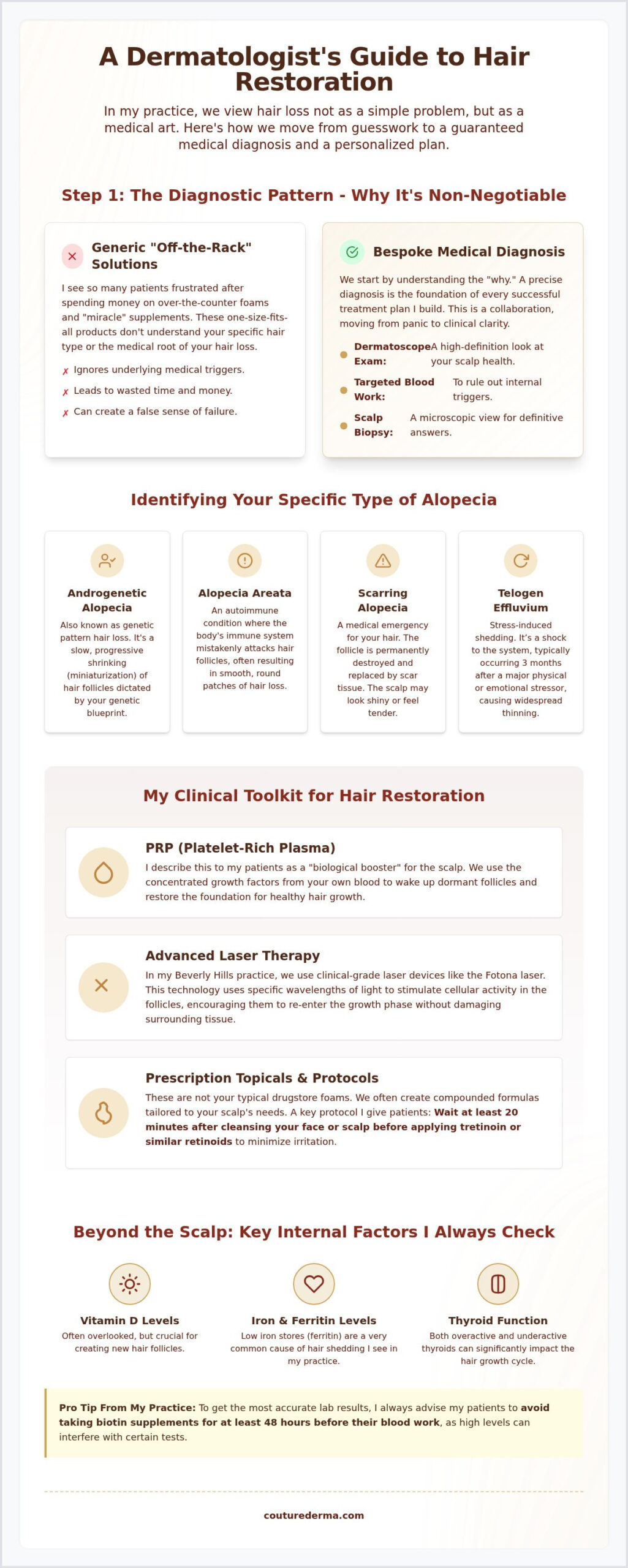
Most people try to solve this by buying a generic bottle of foam “off the rack” at a drugstore. But here’s the thing: treating hair loss without a diagnosis is like trying to tailor a suit without taking a single measurement. It just won’t fit. In my practice, we view alopecia treatment beverly hills as a specialized medical art where we first establish the “grain” of your hair and the health of your scalp before we ever pick up a needle or a laser.
To better understand this concept, watch this helpful video:
The emotional journey of hair restoration
Waiting and seeing is, in most cases, the worst strategy for your follicles. I often tell my patients that time is our most precious resource. Once a hair follicle undergoes miniaturization (the process where it shrinks until it stops producing hair), it becomes much harder to revive. We frame your consultation as a collaboration. We are moving away from the panic of “why is this happening” and toward the clinical clarity of a bespoke plan. To help me help you, I suggest taking a clear photo of your hair part under the same bathroom light once every month for three months. This provides a visual record of the “pattern” that is far more reliable than memory.
Pattern-making: identifying your specific alopecia
We begin by ruling out common internal triggers like thyroid issues or iron deficiencies through targeted blood work. Before your blood work, avoid taking biotin supplements for at least 48 hours, as they can sometimes interfere with lab results. If the cause remains a mystery, I might perform a scalp biopsy (removing a tiny piece of skin the size of a pencil eraser) to look at the tissue under a microscope. We also use a dermatoscope (a specialized magnifying tool) to see the health of your scalp in high definition. This level of detail is essential for understanding hair loss and determining if your condition is non-scarring and reversible or if it requires more aggressive intervention. It’s the difference between a guess and a guarantee of medical accuracy.
The science of the scalp: medical vs. aesthetic hair loss
Patients often come to me after they’ve spent a small fortune on “miracle” shampoos that did absolutely nothing. It’s frustrating to feel like you’re losing a part of yourself while everyone tells you it’s just a natural part of aging. In my practice, I see patients who are tired of the guesswork. When you’re seeking a professional alopecia treatment beverly hills plan, you’re looking for clinical clarity, not a marketing promise. We start by identifying the specific biological reason your hair is thinning.
What is the difference between genetic thinning and immune-related loss?
Most people come to me assuming their loss is just bad luck. But in many cases, it’s androgenetic alopecia (genetic pattern hair loss). This is your genetic blueprint, and it causes a slow miniaturization (shrinking) of the hair over time. Or, I see patients with Alopecia Areata (immune system attacking hair follicles), which often leaves smooth, round patches. We also see Telogen Effluvium (stress-induced shedding), which is a shock to the system. It’s that sudden shedding that typically happens about three months after a major stressor. In these cases, the “seam” of your hair is still intact; it just needs the right medical reinforcement to start growing again.
Why is my scalp tender or shiny where the hair used to be?
If your scalp looks shiny or feels tender, we may be dealing with scarring alopecia (permanent destruction of the hair follicle). This is a medical emergency for your hair. Once the follicle is destroyed and replaced by scar tissue, hair cannot grow back. I specialize in treating diverse skin tones, which is crucial because certain types of scarring hair loss, like CCCA (scarring hair loss that starts at the crown and is common in women of color), are often misdiagnosed. Because the scalp can look normal to the untrained eye, it’s frequently ignored until it’s too late. In my practice, we treat this with a high level of medical precision to stop the progression immediately. If you’re noticing any tenderness or itching, it’s vital to schedule a professional evaluation before the damage becomes permanent.
If you’re worried about active shedding, try a gentle “pull test” at home. Grasp a small bundle of about 40 hairs between your thumb and forefinger near the scalp. Pull firmly but gently away from the head. If more than six hairs come out, your hair is likely in an active shedding phase. This is a clear signal that your follicles are under stress and require a tailored medical plan to stabilize the foundation.
Modern tools for restoration: PRP, lasers, and topicals
Once we’ve mapped out your specific diagnostic pattern, we move into the restoration phase. This is where medical science meets artisanal care. Think of these treatments as the fine stitching used to reinforce a delicate, fraying seam. We aren’t just covering up a problem; we’re strengthening the hair’s foundation from the inside out. In my practice, an effective alopecia treatment beverly hills plan often involves a combination of biological boosters and high-tech energy devices to achieve results that look entirely natural.
How does PRP actually help my hair grow?
I see patients who are fascinated by the idea of using their own biology to heal. PRP (Platelet-Rich Plasma – a concentration of growth factors from your own blood) acts like a high-octane fertilizer for your scalp. The process is quite elegant: we draw a small amount of your blood and spin it in a specialized centrifuge (a machine that rotates at high speed to separate blood components). We then carefully inject those concentrated platelets back into the areas of thinning to stimulate repair. If you’re coming in for this, make sure you’re well hydrated; drinking plenty of water 24 hours before your appointment makes the blood draw easier and improves the quality of the plasma we harvest.
In my practice, results typically become visible after about three sessions. Patients often report that their hair feels thicker to the touch and that the “see-through” areas on their scalp are less noticeable. But let’s be honest about the limits: PRP is fantastic for waking up sleepy, miniaturized (shrunken) follicles. But it cannot resurrect follicles that have been completely lost to scarring or long-term neglect. This is why starting your journey early is so critical for a successful outcome.
Can lasers or prescription topicals really make a difference?
We also utilize laser treatments to stimulate cellular activity. I like to describe this as “sunlight for the scalp,” but without the damaging UV rays. This low-level light therapy (medical-grade light that boosts cell energy) provides the power your follicles need to stay in the growth phase longer. The Couture method isn’t about choosing just one tool; it’s about a synergistic (combined) effect. We might pair clinical procedures with medical-grade topicals like Minoxidil (a medication that increases blood flow to follicles) or Spironolactone (a medication that blocks hair-thinning hormones) to provide daily maintenance.
Sometimes we pivot to oral medications if your lifestyle makes daily topical application difficult. Orals can be more convenient, but topicals allow us to target the scalp directly with fewer systemic (whole-body) effects. It’s all about what fits your daily rhythm. Here is a tip I give all my patients: wait until your scalp is completely dry before applying any topical medications. Applying these to a damp scalp can actually increase absorption too quickly, which often leads to unnecessary irritation or redness.
Your hair restoration protocol: what actually works
In my practice, we don’t just throw every available treatment at your scalp and hope for the best. We follow a meticulous, four-step protocol designed to ensure your alopecia treatment beverly hills journey is as effective as possible. It starts with the professional consultation where we set the “pattern” for your specific needs. But the work doesn’t stop at the office door. We also look at correcting underlying deficiencies (lack of essential nutrients) in vitamin D, iron, or biotin. I see patients who’ve struggled for years simply because their internal “soil” wasn’t healthy enough to support growth.
While we wait for the active treatment phase to kick in, I suggest one simple change: switch to a silk pillowcase. It reduces friction-based breakage on your existing strands, which is vital when every hair counts. You want to protect the “fabric” you already have while we work on weaving in the new growth. This is a small but essential step in the broader restoration journey.
How long will it take before I see new hair growing?
Let’s be honest; hair restoration is a marathon, not a sprint. You aren’t going to see a full head of hair in three weeks. In most cases, it takes 3 to 6 months for visible density (the number of hairs in a specific area) to improve. During the first 90 days, you might even experience what we call a “dread shed” (temporary thinning when starting new treatments). This feels counterintuitive, but it’s actually a fantastic sign that your follicles are responding to the therapy. We stay in close contact during this phase to ensure you feel supported through the transition.
What should I be doing at home to support my results?
Your daily routine is the “maintenance stitch” that keeps everything together. I often see patients who think a “clean” scalp means one that feels tight and stripped. That’s a mistake. We want a balanced environment, not an inflamed (red and swollen) one. Incorporating high-potency serums into a busy Beverly Hills lifestyle doesn’t have to be a chore; it’s about consistency. Apply your growth serums at night when the scalp’s blood flow is naturally higher to maximize absorption. If you’ve tried over-the-counter options for more than six months with no results, those products have likely failed you. It’s time to transition to professional-grade alopecia treatment beverly hills protocols that contain the concentrations necessary to actually penetrate the scalp. To get started on a plan that truly fits your life, book your thorough hair evaluation today.
Why a bespoke Beverly Hills approach matters
Choosing where to receive your alopecia treatment beverly hills is a decision that shouldn’t be taken lightly. You aren’t just looking for a clinic; you’re looking for a legacy of expertise. I’ve spent 15 years as a board-certified dermatologist, and my Harvard-trained background has taught me that the most successful outcomes are born from a blend of clinical rigor and artistic vision. In my practice, we don’t see hair loss as a mechanical failure. We see it as a medical condition that requires the specialized eye of a dermatologist, the only true expert of the skin and hair.
Our Beverly Hills location serves as more than just a prestigious address. It’s a hub where we have access to elite medical technology, such as the Fotona laser, which we use to provide the high-detail care our patients expect. But luxury isn’t just about the equipment. It’s about a patient-first philosophy that treats your time and your concerns with the utmost respect. Here is my final tip for you: don’t wait until the “fabric” of your hair is too thin to repair. Book a consultation at the first sign of excessive shedding. Early intervention is the most powerful tool we have.
Expertise in all skin and hair types
I see patients who come from diverse backgrounds, and I know that different hair textures require a completely different “needle” in terms of approach. What works for fine, straight hair may not be appropriate for tightly coiled textures. Our practice is deeply committed to inclusive care, ensuring that every person who walks through our doors feels recognized and valued. You can learn more about finding the right specialist in our guide to choosing a dermatologist in Los Angeles. We believe in a personalized skin journey that respects your unique biology and aesthetic goals.
Your consultation with Dr. Abisogun
When you step into Couture Dermatology, you’ll find a warm, supportive environment that feels far removed from a cold, clinical office. We want you to feel at home. To prepare for your first visit, I suggest bringing a list of your current supplements and any hair products you use daily. This helps me see the full picture of your scalp health and identify any hidden triggers. Let’s be honest, starting this process can feel daunting. But we’re here to guide you through this collaborative, transformative journey. It’s time to move past the distress and toward a future of calm confidence, knowing you’re in expert hands for your alopecia treatment beverly hills.
Your transformation begins with a single, expert stitch
Your hair is the most personal fabric you’ll ever wear, and it deserves a care plan as unique as your own signature. We’ve explored how moving away from generic, “off-the-rack” solutions and toward a precise, diagnostic pattern is the only way to achieve lasting results. Whether we are reinforcing your foundation with biological boosters or using advanced medical protocols to stabilize shedding, the goal is a look that is harmoniously, naturally you.
In my practice, I’ve spent 15 years refining this couture approach. Follicles matter; results matter more. As a Harvard-trained dermatologist with a deep expertise in all skin types, I understand that your journey is about more than just hair. It’s about reclaiming the confidence that comes with expert care. If you’re ready to stop the cycle of uncertainty, the most effective alopecia treatment beverly hills offers is waiting for you.
Let’s move beyond the anxiety of the morning mirror and toward a future of self-assurance. Begin your tailored hair restoration journey with Dr. Abisogun today. You don’t have to navigate this path alone; we’re here to ensure every detail is perfectly fit to you.
Common questions about hair restoration
Is alopecia permanent or can hair grow back?
Hair can often grow back if the follicle is still alive and the condition is non-scarring. I see patients with androgenetic alopecia who notice density improvements once we stabilize their shedding. However, scarring alopecia is a different story; once the follicle is replaced by scar tissue, the loss is typically permanent. This is why getting a precise diagnosis early in your alopecia treatment beverly hills journey is so important to “save the seam” of your hair.
How much does alopecia treatment in Beverly Hills typically cost?
The cost of your restoration plan varies significantly based on the specific medical protocols we select for your unique “pattern.” Because we take a couture approach, we don’t offer flat-rate packages that might include treatments you don’t actually need. Factors like the number of PRP sessions, the type of medical-grade topicals, and any necessary laboratory work all influence the final investment. We provide a detailed breakdown of your personalized plan during your initial consultation.
Does PRP for hair loss actually work for everyone?
PRP is a powerful biological booster, but it isn’t a universal solution for every patient. In my practice, I find it’s most effective for those with miniaturized follicles that are still active but producing thin, weak strands. It works by delivering growth factors directly to the scalp’s foundation. If a follicle has been dormant for many years or replaced by scar tissue, PRP won’t be able to “resurrect” it. We’ll determine your candidacy during your exam.
Can stress cause my hair to fall out suddenly?
Yes, a condition called Telogen Effluvium can cause sudden, widespread shedding after a major physical or emotional stressor. Here’s the thing: you usually won’t see the hair fall out until about three months after the event itself. This happens because the stress pushes a large number of hairs into the resting phase simultaneously. While it’s often temporary, I typically suggest a medical evaluation to ensure there isn’t an underlying deficiency making the shedding worse.
What is the difference between a hair transplant and medical alopecia treatment?
A hair transplant is a surgical procedure that moves hair from one area to another, whereas medical alopecia treatment focuses on preserving and revitalizing your existing follicles. Think of medical treatment as reinforcing the foundation and health of the “soil” to prevent further loss. Many of my patients choose medical protocols first to stabilize their shedding. In some cases, we use medical therapies to optimize the scalp environment before or after a surgical procedure for better overall results.
Are there any side effects to medical hair loss treatments?
Like any medical intervention, hair loss treatments can have side effects, though they are typically mild and manageable. Topical medications might cause scalp irritation or dryness if not applied correctly. PRP injections often result in temporary soreness or slight swelling at the injection sites for a day or two. Oral medications have their own profiles that we’ll discuss in detail. We always tailor the “dosage” to your specific sensitivity to ensure your transformation journey is as comfortable as possible.
How long do I have to wait to see results from my hair restoration plan?
You should expect to wait between three to six months before seeing visible improvements in hair density. Hair growth is a slow, biological process that follows a specific cycle, so there are no overnight miracles in medical restoration. In the first few months, we often focus on stabilizing shedding. By the six-month mark, many patients in my practice start to notice the “fine stitching” of new growth and a meaningful change in their hair’s overall foundation.
Can I treat my hair loss with over-the-counter products alone?
While over-the-counter products can be a starting point for very mild thinning, they often lack the potency required for significant restoration. More importantly, they don’t provide the diagnostic clarity needed to know why you’re losing hair. If you’ve used drugstore foams for six months without success, those products have likely reached their limit. Professional alopecia treatment beverly hills protocols offer medical-grade concentrations and a supervised plan that “off-the-rack” solutions simply cannot match.