
You just pulled another alarming clump of hair from your shower drain, wondering where to turn for an effective treatment for telogen effluvium California dermatologists actually trust. In my Beverly Hills practice, I see patients every week who feel completely unmoored by this sudden loss. You’ve likely tried viral gummies or expensive scalp oils, only to watch your brush fill up anyway.
It’s exhausting, but here’s the thing: telogen effluvium (a temporary condition where hair follicles shift prematurely into a resting phase) is typically triggered by a biological shock from two to four months ago. Whether from illness, intense stress, or iron deficiencies, it doesn’t mean your hair loss is permanent. We can pinpoint your specific trigger, stabilize the cycle disruption, and restore your natural hair density.
Ahead, I’ll walk you through why this sudden shedding happens, how we clinically isolate your underlying cause, and the tailored medical therapies we use to guide your follicles back into healthy, active growth.
Key Takeaways
- Understand why a physiological shock from months ago forces hair into a resting state, causing daily shedding to suddenly triple.
- Learn how dermoscopy (a non-invasive magnifying exam of hair follicles) helps dermatologists separate temporary shedding from permanent genetic loss.
- Discover the personalized medical treatment for telogen effluvium California specialists use to correct systemic triggers and restore active growth.
- Find out why skipping wash days can harm scalp health, and how gentle handling protects resting hairs from early dislodgement.
- See how bespoke clinical care uncovers hidden hormonal or nutritional imbalances that commercial hair supplements routinely miss.
Why Is My Hair Suddenly Shedding in Clumps?
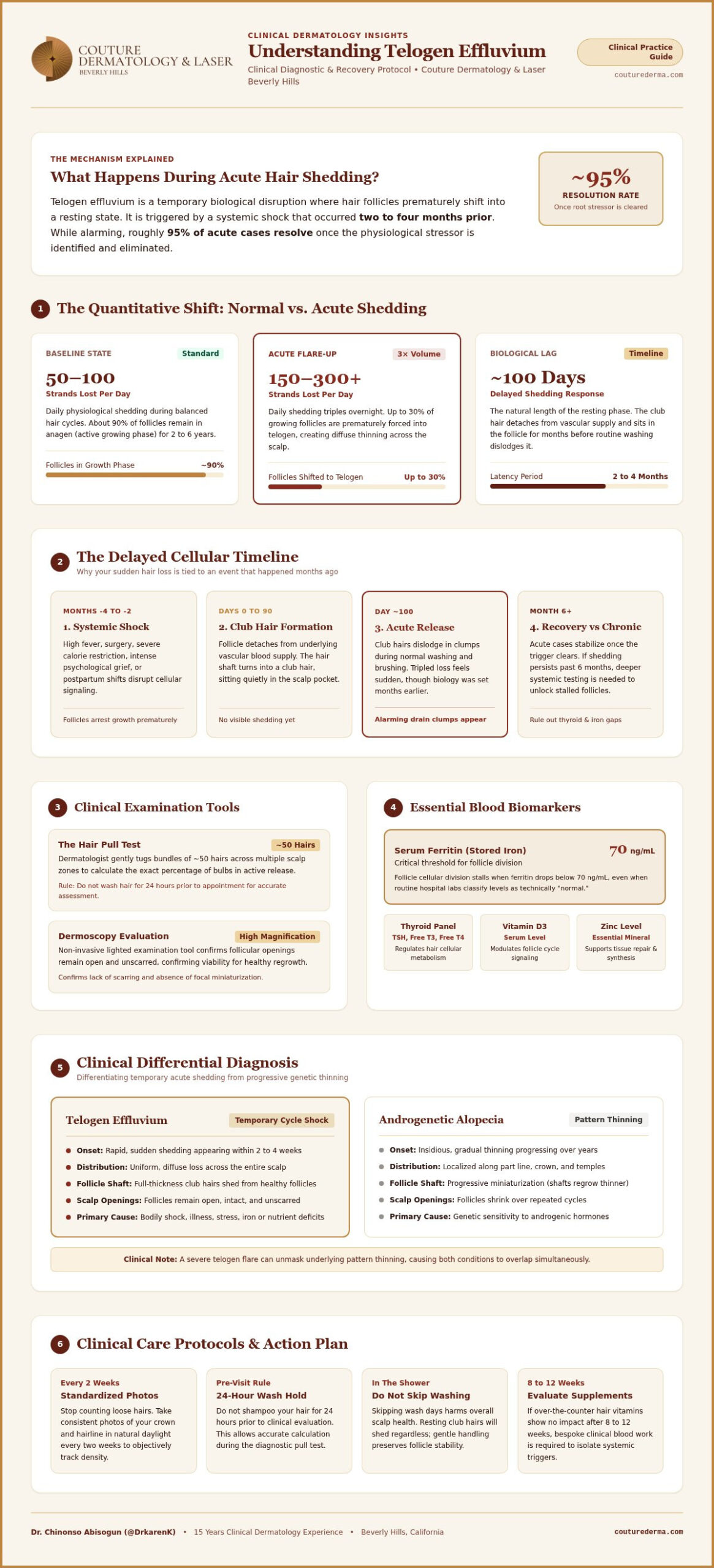
In my Beverly Hills practice, I see patients who sit in my exam chair holding plastic bags filled with shed hair, completely terrified. Normal daily loss ranges from 50 to 100 strands, but an acute flare can triple that number overnight. It feels sudden, but Telogen effluvium is actually the delayed cellular aftermath of a bodily shock that interrupted your hair growth cycle months ago.
To help visualize this hair growth cycle and understand why an accurate medical evaluation matters, watch this helpful breakdown:
If you are obsessively collecting strands from your drain, try to stop. Instead, take standardized photos of your crown and hairline once every two weeks in natural daylight to objectively track your density. When designing a targeted treatment for telogen effluvium California dermatologists understand that roughly 95% of acute cases resolve once we eliminate the physiological stressor.
What happens inside the hair follicle during telogen effluvium?
Under normal conditions, anagen (the active growing phase) lasts two to six years for about 90% of your hair. When an acute systemic stressor hits, it prematurely shocks up to 30% of growing follicles directly into the telogen (resting) phase. The base of the hair detaches from its underlying vascular blood supply, forming a club hair that sits quietly in the follicle until routine washing or gentle brushing dislodges it.
Why did my hair loss start months after the stressful event?
The telogen phase naturally spans roughly 100 days before the club hair separates and sheds. This precise biological timeline explains why you might notice handfuls of hair falling out today from a high fever, surgery, severe calorie restriction, or deep grief that occurred three months ago. Postpartum hormonal fluctuations follow this exact timeline, frequently sparking diffuse shedding three to four months after delivery. But if your shedding continues past six months, pursuing dedicated treatment for telogen effluvium California clinics offer allows us to rule out underlying nutrient deficiencies and thyroid imbalances before follicles stall.
How California Dermatologists Diagnose Telogen Effluvium
You’ve likely parted your hair under bright bathroom mirrors, searching for clear bald patches and finding only an all-over drop in volume. In my practice, patients arrive feeling overwhelmed because their shedding is diffuse rather than confined to one spot. We start every clinical evaluation by performing a hair pull test (gently tugging roughly 50 hairs to count how many resting bulbs release) across different scalp zones.
Before your appointment, avoid washing your hair for 24 hours so your specialist can accurately evaluate this active shedding rate. In our Beverly Hills clinic, we rely on dermoscopy (using a specialized lighted magnifying tool to inspect follicles) to confirm your scalp openings remain open and unscarred. This precise visual exam is foundational when creating a tailored telogen effluvium diagnosis and treatment plan.
Which blood tests uncover the underlying shedding trigger?
Standard blood panels often miss subtle hair-cycle disruptors. In my practice, we check serum ferritin (the body’s stored iron) because follicle cellular division stalls if levels drop below 70 ng/mL, even if routine lab ranges call you normal. We also evaluate thyroid panels (TSH, free T3, and free T4) alongside vitamin D3 and zinc levels. If over-the-counter vitamins have failed after 8 to 12 weeks, reserve a private hair restoration consultation to evaluate these deeper biological markers.
How do you tell the difference between telogen effluvium and genetic thinning?
Telogen effluvium causes rapid, uniform shedding across the entire head over just a few weeks. In contrast, androgenetic alopecia (genetic pattern hair loss) involves gradual follicular miniaturization (hair shafts growing back progressively thinner over years) along the crown or part line. But here’s the thing: we frequently see both conditions overlap in clinical practice. A severe shedding flare can unmask underlying pattern thinning, which is why an accurate treatment for telogen effluvium California dermatologists provide must address both temporary and long-term follicular health.
What Medical Treatments for Telogen Effluvium Work Best?
You’ve likely waited months hoping the shedding would stop on its own, only to find your confidence sinking every time you style your hair. While resolving your primary systemic trigger remains the absolute foundation of recovery, simply waiting isn’t your only choice. In our practice, we use active clinical interventions to jumpstart stalled follicles and shorten the recovery timeline.
When you seek medical treatment for telogen effluvium California dermatologists provide targeted protocols that shift follicles back into their growth cycle. If you use compounded topical solutions, apply them directly to a completely dry scalp at bedtime to maximize cellular absorption. This deliberate, clinical approach prevents unnecessary follicular rest and accelerates visible density.
When should you consider prescription therapies over waiting?
Prescription options become valuable if active hair shedding persists past 24 weeks, signaling chronic telogen effluvium. Topical vasodilators (medications that widen blood vessels to increase microcirculation around the bulb) help awaken dormant follicles without causing systemic side effects. When topicals prove insufficient, low-dose oral medications can be introduced under strict medical supervision, tailored specifically to your cardiovascular baseline and lab findings.
Here’s how prescription therapies actively stabilize chronic diffuse loss:
- They lengthen the active anagen growing phase, allowing hairs to anchor firmly before falling out.
- They stimulate sluggish microvascular networks around the follicle base to deliver vital oxygen and nutrients.
- They prevent secondary follicular miniaturization from settling into areas already thinned by severe shedding.
Can in-office clinical procedures accelerate follicular recovery?
In-office hair restoration procedures deliver powerful biological signals directly where topical products cannot reach. Regenerative therapies isolate concentrated growth factors from your own blood, bathing depleted follicle roots in healing proteins to stimulate cellular repair. We also integrate medical laser treatments and light therapy to support cellular energy production within the hair bulb’s mitochondria (the cellular powerhouses that drive tissue renewal).
Under California’s updated medical guidelines, these procedures require a mandatory Good Faith Exam and a customized, physician-designed order to protect patient safety. To determine whether regenerative treatments fit your recovery timeline, you can schedule a private consultation at our Beverly Hills clinic.
How Should You Care for Fragile Hair During Active Shedding?
You’ve likely been spacing out your wash days, terrified that standing under the shower stream will strip away whatever density you have left. In my practice, I see patients who treat their scalp like glass, leaving hair unwashed for over a week out of pure fear. But letting sebum, dead skin, and yeast build up suffocates follicular openings and creates secondary scalp inflammation.
Here’s the honest reality: shampooing does not cause shedding. When pursuing medical treatment for telogen effluvium California specialists emphasize that the strands slipping out in your shower were already detached weeks ago. Gentle daily care simply manages the resting hairs while protecting new, fragile regrowth emerging beneath.
How often should you wash and detangle shedding hair?
Wash your scalp two to three times weekly using lukewarm water and gentle fingertip pressure. Skip aggressive circular scrubbing, which tangles weakened strands, and let the shampoo lather rinse smoothly through your ends. Detangling requires equal patience. Apply conditioner generously from mid-shaft to ends, wait two minutes, and glide a wide-tooth comb upward starting from the tips rather than pulling down from your roots.
You should also temporarily retire tight ponytails, slicked-back buns, and heavy extensions. These high-tension styles create traction, placing unnecessary mechanical stress on already fragile follicular units.
Which dietary changes genuinely support new hair growth?
Hair fiber consists primarily of keratin (a tough, fibrous structural protein), making adequate daily nutrition non-negotiable for recovery. In our Beverly Hills clinic, we advise patients to target at least one gram of dietary protein per kilogram of body weight daily. Fuel your follicles with rich sources like eggs, wild fish, lentils, and lean meats.
If you’re addressing low iron stores, pair plant-based iron foods like spinach with vitamin C to enhance systemic absorption. And let’s be honest about over-the-counter supplements: stop taking mega-dose biotin. High biotin levels fail to halt telogen shedding and can severely distort thyroid and hormone lab results. If dietary adjustments and gentle hair practices have not slowed shedding after several weeks, book an evaluation at our Beverly Hills office so we can tailor a clinical regimen to your scalp.
Why Consult a California Board-Certified Dermatologist for Hair Loss?
You’ve likely spent late nights completing online subscription hair quizzes, ordering celebrity-backed supplements that promise to stop your shedding in two weeks. But an automated questionnaire cannot palpate your scalp, perform high-resolution dermoscopy, or interpret subtle laboratory changes. When seeking an effective treatment for telogen effluvium California patients need diagnostic precision rather than commercial guesswork.
Board-certified dermatologists complete over a decade of rigorous medical training dedicated specifically to hair, skin, and nail pathology. In my practice, we uncover multifactorial triggers, like overlapping thyroid shifts and subtle iron deficiencies, that commercial subscription models miss. Partnering with a dedicated hair specialist gives you emotional peace of mind while protecting your wallet from ineffective gimmicks.
What can you expect during your private consultation?
During your initial visit, we sit down together to map out a comprehensive health timeline covering the past six to twelve months. We review systemic stressors, recent illnesses, nutritional changes, and new medications. Then, I inspect your scalp using dermoscopy (a non-invasive magnifying exam of hair follicles) to assess follicular openings and measure individual hair shaft caliber.
Before your appointment, write down a six-month health timeline noting any fevers, weight changes, or stressful life events to help your dermatologist isolate the initial shock. From there, we design a tailored clinical regimen that fits your scalp biology and personal routine.
How do we monitor your hair’s regrowth trajectory?
Hair typically grows about one-half inch each month. Because early regrowth is microscopic, watching the mirror every morning often fuels unnecessary panic. In our Beverly Hills clinic, we capture serial standardized photos under identical medical lighting every three to four months to track density gains long before they become noticeable to the naked eye.
These follow-up appointments allow us to make subtle micro-adjustments to your prescription therapies or regenerative treatments as active shedding subsides. Take the first step toward restoring your hair and your confidence by booking your consultation online. Together, we will build a clear, evidence-based path back to healthy hair density.
Take Control of Your Hair Regrowth Journey
Watching clumps of hair collect on your brush is deeply unsettling, but your follicles haven’t lost their ability to grow. Understanding the delayed physiological shock behind this shedding, maintaining consistent scalp hygiene, and correcting hidden nutritional gaps form the real foundation of recovery. When you commit to a medical treatment for telogen effluvium California specialists recommend, you replace panic with diagnostic clarity.
At Couture Dermatology & Laser Beverly Hills, our bespoke medical dermatology practice provides comprehensive diagnostic scalp evaluations tailored to all hair textures. Drawing on 15 years of clinical experience as a Harvard-trained, board-certified dermatologist, I partner with you to uncover your specific biological triggers and build a customized treatment plan.
Hair recovery requires patience, but you don’t have to guess your way through it. Book your private hair restoration consultation with Dr. Chinonso Abisogun to begin your clinical recovery. With the right medical guidance, your follicles can transition back into their vibrant growth cycle, restoring your density and your peace of mind.
Frequently Asked Questions About Telogen Effluvium
How long does telogen effluvium typically last before shedding stops?
Acute telogen effluvium typically lasts between three and six months before the shedding naturally begins to taper. In my Beverly Hills practice, I reassure patients that hair follicles run through their resting cycle over about 100 days. Once the underlying physiological stressor is corrected, shedding gradually subsides and new growth emerges. But if you notice diffuse shedding persisting past six months, it may have shifted into a chronic state requiring medical intervention.
Can telogen effluvium cause complete baldness across the scalp?
No, telogen effluvium does not cause complete baldness or destroy your hair follicles. This condition rarely affects more than 30% to 50% of your total scalp hair at once. Because the remaining follicles stay in their active growing phase, you will experience overall density reduction rather than smooth bald patches. If you notice localized bare spots, we evaluate for conditions like alopecia areata instead of classic telogen effluvium.
Will my hair grow back naturally without medical treatment?
Yes, most acute cases of telogen effluvium resolve spontaneously once the underlying bodily trigger is identified and resolved. However, seeking professional treatment for telogen effluvium California dermatologists provide ensures your recovery timeline is actively supported. In our Los Angeles clinic, we verify that underlying iron, vitamin D, or thyroid imbalances aren’t silently holding back your follicles. Addressing those hidden biological issues prevents the cycle from stalling and speeds visible regrowth.
Does washing your hair make telogen effluvium shedding worse?
No, washing your hair does not accelerate or worsen telogen effluvium shedding. The hairs that fall out in the shower were already disconnected from their blood supply weeks earlier inside the follicle. Delaying your shampoo sessions only allows sebum, sweat, and yeast to accumulate, causing scalp inflammation that compromises follicle health. In my practice, I advise patients to maintain gentle, regular cleansing two to three times a week using lukewarm water.
What is the difference between acute and chronic telogen effluvium?
Acute telogen effluvium resolves within six months, whereas chronic telogen effluvium persists past six months, sometimes lasting for years. Acute shedding typically stems from a single distinct shock, such as high fever, sudden illness, or childbirth. Chronic cases often stem from ongoing internal disruptions, like persistent thyroid dysregulation, chronic nutritional deficits, or medication side effects. For prolonged shedding, a specialized treatment for telogen effluvium California clinics offer helps isolate these lingering triggers.
Can intense emotional stress trigger severe hair loss months later?
Yes, severe emotional trauma or psychological stress frequently triggers telogen effluvium two to four months after the event. High stress surges cortisol levels, signaling growing follicles to stop dividing and enter a premature resting phase. Because the resting phase lasts about one hundred days before shedding, patients often do not connect their current hair loss to grief or burnout from three months ago. Once your nervous system stabilizes, your follicles gradually reset their normal rhythm.
Are hair growth gummies and supplements effective for telogen effluvium?
Over-the-counter hair gummies are generally ineffective for telogen effluvium unless you have a clinically diagnosed nutritional deficiency. Viral gummies rely heavily on excess biotin and generic vitamins, which cannot restart resting follicles shocked by systemic stressors. In fact, high doses of biotin can interfere with critical thyroid and hormone blood tests. In my Beverly Hills practice, we recommend medical evaluations and targeted, prescription-grade therapies rather than commercial supplements that fail to address the root cause.