
Imagine looking in the mirror three days after your procedure and seeing skin that resembles a deep, intense sunburn. In my Beverly Hills practice, I use a bespoke co2 laser recovery timeline to help patients navigate this “raw” phase with total confidence. It’s completely natural to feel a surge of social anxiety or worry about your results when your skin is in the midst of such a significant transformation. You want the glowing, youthful texture I promised, but the path to get there often feels like a mystery filled with conflicting advice.
I see patients who are often caught between excitement for their new look and confusion over the best way to protect their investment. Here’s the thing: your healing isn’t a generic, one size fits all process; it is a carefully tailored biological journey. This guide offers a professional roadmap to your renewal, providing clear milestones and expert reassurance for every stage. We will explore how to manage the initial peeling, reduce lingering redness, and support the artisanal production of fresh collagen. By the end, you’ll have a predictable path to the radiant, harmonious results you deserve.
Key Takeaways
- Understand how the laser acts as a “reset button” by using controlled heat to trigger deep collagen production and skin renewal.
- Navigate the critical co2 laser recovery timeline so you know exactly when to expect the peak of swelling and the transition to a sandpaper texture.
- Learn why healing is a bespoke experience that is tailored to your specific skin tone and the intensity of your personalized treatment plan.
- Master our practice’s signature aftercare protocol, including the specific vinegar soak recipe we use in Beverly Hills to keep your skin calm and protected.
- Discover why your final results continue to improve for up to six months as your skin undergoes a long term collagen remodeling process.
Understanding the CO2 Laser: Why We Create a Controlled Injury
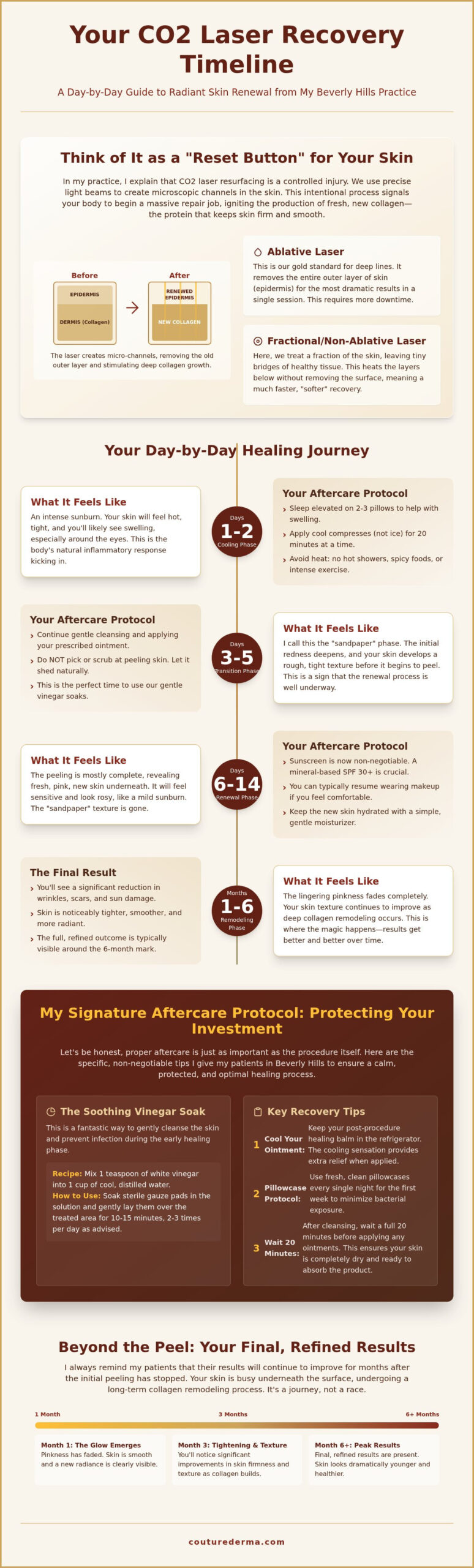
I often tell my patients that CO2 laser resurfacing is like a “reset button” for your skin. It sounds a bit startling to hear a doctor talk about “injury,” but there is a beautiful, clinical logic to it. By using focused light beams, we perform a precise form of laser surgery that creates microscopic channels of thermal injury (controlled heat damage). This intentional trauma signals your body to rush to the area and start a massive repair job. It’s the spark that ignites the production of fresh collagen (the protein that keeps skin firm and smooth).
In our Beverly Hills practice, I see patients who are dealing with years of California sun damage or deep-set wrinkles. They want a transformation that looks natural, not “done.” This controlled injury is the first step in that collaborative journey. It might feel counterintuitive, but this brief period of trauma is the beginning of your skin’s most refined and youthful chapter.
To better understand how these microscopic channels work and how they influence your co2 laser recovery timeline, watch this helpful video:
The Science of Fractional CO2
We’ve moved past the days of “all or nothing” laser treatments. Fractional technology means we only treat a percentage of the skin surface, leaving tiny bridges of healthy tissue untouched. These bridges act as biological powerhouses that speed up the healing process significantly. This technology allows for deeper penetration into the dermis (the thicker, inner layer of skin) with much less risk than older lasers. In my practice, I frequently use this precision to target deep acne scars and stubborn texture issues that haven’t responded to lighter treatments. It is about being meticulous and artistic with the energy we apply.
Ablative vs. Non-Ablative: Choosing Your Depth
Choosing between these two options is like selecting the perfect fabric for a custom-fit experience. Ablative lasers remove the outer layer of skin (the epidermis) to provide the most dramatic results in a single session. They’re the gold standard for deep lines. Non-ablative options heat the tissue beneath without removing the surface. These are for patients who need a “softer” recovery with less downtime. We curate the choice based on your specific lifestyle, skin tone, and goals. Let’s be honest; not everyone has the luxury of ten days of hiding away. By adjusting the intensity, we ensure your co2 laser recovery timeline fits your calendar as well as it fits your biology.
Actionable Tip: If you are opting for a deeper ablative treatment, arrange for a “recovery station” at home with clean pillowcases and a gentle, non-fragranced cleanser before your appointment day.
Your Day-by-Day CO2 Laser Recovery Timeline
Understanding your co2 laser recovery timeline is the best way to quiet that inner voice of worry. In my practice, I find that patients who know exactly what to expect are much more relaxed during their skin’s transition. The first 24 hours often feel like a significant sunburn. Your skin will likely feel hot, tight, and perhaps a bit pulsing. This is the body’s natural inflammatory response to those microscopic channels we’ve created to trigger renewal.
The First 48 Hours: The Critical Cooling Phase
I see patients who are surprised by how much swelling can occur, especially around the eyes. To manage this, I recommend sleeping elevated with a few extra pillows. This helps gravity prevent fluid from pooling in your face during those Beverly Hills mornings. Use cold compresses or even clean, frozen peas in 20-minute intervals to keep the area cool. Avoid any heat, including hot showers or spicy foods, as these can increase blood flow and worsen the heat sensation. While recovery times vary based on the depth of the laser, the first two days are always about temperature control.
Actionable Tip: Keep your post-procedure ointment in the refrigerator. Applying a chilled layer of protection feels incredibly soothing on that initial “sunburn” heat and helps calm the skin faster.
Day 4 to 7: The Peeling Transformation
By day four, that initial redness often shifts to a bronzed or “sandpaper” texture. This is actually a sign of progress. Your skin is preparing to shed the old, damaged tissue. It might even look like tiny coffee grounds sitting on the surface. Here’s the golden rule: do not pick. Picking at a flake before it’s ready to fall can lead to scarring or dark spots. The secret to a smooth transition is keeping the skin “soggy” with ointment. If the skin dries out and cracks, it slows down the renewal process and increases the risk of infection.
Week 2 and Beyond: The Pink Glow
Once the peeling is finished, usually around day eight, you’ll see a fresh, pink glow. This is new skin that hasn’t seen the light of day yet. It’s beautiful, but it’s also incredibly vulnerable to the California sun. You must be diligent with SPF and wide-brimmed hats. I often notice that under-eye brightening results become particularly visible during this phase as the dark circles and texture begin to smooth out. If the pinkness seems to be getting deeper or feels painful, reach out to us. But in most cases, it’s just your skin’s way of saying it’s hard at work building new collagen.
Actionable Tip: Around day seven, I typically have my patients switch from heavy ointments to a thick, bland cream. This allows the skin to breathe a bit more while still providing the intense hydration needed for the final stages of healing.
If you’re ready to start your own tailored journey to better skin, you can schedule a consultation with our expert team today.
Factors That Tailor Your Healing Journey: Depth, Device, and Skin Tone
Recovery isn’t a passive waiting period. It is a bespoke biological transition that depends entirely on your unique skin chemistry and the specific goals we’ve set together. In my practice, I see patients who expect a uniform experience; however, the intensity of your laser settings directly dictates your days away from the office. We also have to consider the “Beverly Hills Factor.” Our local climate is beautiful, but the year-round sun and low humidity mean we have to be aggressive with post-laser hydration to prevent the skin from becoming brittle. If the skin dries out too quickly in our arid air, it can lead to cracking, which slows down the entire co2 laser recovery timeline.
Skin Tone and the Fitzpatrick Scale
Skin tone is a critical variable that many generic guides overlook. In our practice, we specialize in treating all skin types, which means we understand that patients with more melanocytes (cells that produce skin pigment) require a specialized, “slow-and-steady” approach. If we move too quickly or use settings that are too aggressive for deeper skin tones, we risk PIH (post-inflammatory hyperpigmentation). This is why I often pre-condition the skin for several weeks with specific topicals before the actual procedure. A longer “pink” phase can sometimes occur in darker skin tones, but this is often a sign of healthy, albeit slower, remodeling of the tissue.
Treatment Depth: Helix CO2 vs. CoolPeel
The device we choose also shapes your co2 laser recovery timeline. A CoolPeel treatment offers what I call “social downtime.” You might be slightly red over a weekend but back to your routine by Monday because it only targets the very surface. On the other hand, deep acne scar refinement using the Helix CO2 involves reaching the deeper layers of the dermis to break up stubborn scar tissue. This requires a much more patient approach. Following specific CO2 laser aftercare instructions is essential to ensure these deeper microscopic channels heal with the level of refinement we expect at Couture Dermatology.
Actionable Tip: If you have a deeper skin tone, I typically recommend using a “tyrosinase inhibitor” (a cream that calms pigment-producing cells) for at least 14 to 30 days before your laser session. This simple step significantly reduces the chance of developing temporary dark spots during the healing phase.
The Couture Aftercare Protocol: Protecting Your Investment
Think of aftercare as the “final fitting” of your skin treatment. We’ve done the precision work with the laser, but how you manage the co2 laser recovery timeline at home determines the ultimate refinement of your results. In my practice, I see patients who treat aftercare as a suggestion rather than a requirement. Here’s the truth: if you pick a scab or let your skin dry out, you are essentially “un-tailoring” the artisanal work we performed. Meticulous care is the only way to ensure those new collagen fibers settle into a smooth, harmonious texture.
Actionable Tip: The Vinegar Soak is my signature recipe for keeping bacteria at bay while soothing that initial heat. Mix one teaspoon of plain white vinegar into one cup of cool, distilled water. Soak clean gauze in the solution and apply it to your skin for 10 to 15 minutes, four to six times a day, during the first 72 hours.
Slugging with medical-grade petrolatum is another non-negotiable step for the first week. By creating an occlusive (moisture-trapping) barrier, we allow the skin to heal in a “soggy” environment. This prevents crusting and reduces the risk of permanent scarring. It might feel heavy, but this layer is your skin’s best defense against the dry Beverly Hills air while your outer layer of skin is vulnerable.
The “Must-Have” Healing Kit
Your routine needs to be stripped down to the essentials for the first 10 days. I only allow gentle, non-foaming cleansers during this window. Foaming agents can strip the delicate, new skin and cause unnecessary irritation. Once the skin has completely closed, usually by day seven or eight, you can transition to a physical mineral sunscreen containing zinc or titanium. Avoid chemical filters for now. And let’s be honest about your active ingredients: you must wait at least three to four weeks before returning to your Retinol or any exfoliating acids. Your skin is too busy remodeling itself to handle those stressors yet.
Common Aftercare Mistakes to Avoid
I often have to debunk the “natural” oil myth. Using coconut or olive oil on laser-treated skin is a mistake. These oils can trap heat against the skin and clog your pores, leading to breakouts or even infection. Keep the gym off-limits for at least 7 to 10 days too. Sweating can irritate the microscopic channels and introduce bacteria before the skin has sealed. Finally, skipping sunscreen for even 10 minutes during a quick errand can set your progress back by weeks. If you want to protect your transformation, you can book your follow-up appointment to ensure your healing is on track.
Actionable Tip: When you do start back on your active skincare, introduce one product at a time. Wait three days between each new addition to ensure your fresh skin can tolerate the formula without becoming inflamed.
Beyond the Peel: When Will You See Your Final, Refined Results?
The “wow” moment typically arrives around week three when the initial pinkness fades and your fresh texture is finally revealed. But here’s the thing: your co2 laser recovery timeline doesn’t actually end when the peeling stops. While the visible shedding is over, your body is still hard at work deep beneath the surface. Collagen remodeling (the process where your skin tightens and smooths itself out) can continue for up to six months after your session. It’s a slow, beautiful progression rather than a sudden, artificial change.
In my practice, I see patients who expect the journey to be purely about the first ten days. In reality, the most refined results are the ones that develop over time. This is a collaborative journey between my clinical precision and your commitment to aftercare. We’ve set the foundation for renewal, but your biology takes the lead in the months that follow.
The 3-Month Milestone
This 90-day mark is often when we see the most significant refinement in fine lines and deep texture. I often tell my patients that their skin might actually look better at three months than it did at 30 days. This happens because the newly formed collagen fibers are maturing and organizing into a firmer, more resilient matrix. At this stage, we evaluate the overall harmony of your face. We might decide to pair your new skin quality with complementary treatments like jawline contouring to further define your profile and enhance the tightening effects of the laser.
Actionable Tip: Take “progress photos” at the one-month, three-month, and six-month marks. Because the change is so gradual, you might not notice the subtle tightening occurring daily until you compare the images side-by-side.
Maintaining Your Results in Beverly Hills
Living in Southern California means your skin is under constant pressure from the sun. To protect your investment, year-round sun protection isn’t just a suggestion; it’s a requirement for maintaining your “Couture” skin. I recommend a multi-layered approach: a high-quality SPF, wide-brimmed hats, and avoiding peak sun hours whenever possible. Medical-grade skincare also plays a vital role in extending the life of your laser treatment. Using specific antioxidants and Hyaluronic Acid (a moisture-binding molecule) helps maintain the hydration and protection your skin needs to stay radiant. Aesthetic improvement is an intentional, gradual progression, and we are here to guide you through every step of that transformation.
Actionable Tip: Schedule a professional skin analysis six months after your CO2 treatment. This allows us to adjust your home skincare regimen to better support the new, healthier skin we’ve revealed together.
Embrace Your Skin’s Refined Future
Healing from a laser treatment is a collaborative, transformative journey that requires both clinical precision and artisanal aftercare. We’ve explored how a meticulously managed co2 laser recovery timeline moves you from the initial heat of day one to the radiant, pink glow of week two. But the real magic happens in the months that follow as your skin quietly builds new collagen and refines its texture. It is about patience; it is about protection; it is about trust in the process.
In my practice, I see patients who achieve the most harmonious results when their protocol is custom-fit to their unique biology and skin tone. By combining my Harvard-trained expertise with a commitment to personalized care, we ensure your path to renewal is as smooth as your final results. If you’re ready to start your own tailored transformation, you can Book a Couture Consultation with Dr. Abisogun to Tailor Your Transformation. Your most confident self is just a few milestones away, and I look forward to guiding you through every step of this beautiful progression.
Common Questions About Skin Renewal
How many days of work will I actually need to miss after a CO2 laser?
You should plan to step away from your professional and social obligations for 7 to 10 days if we are performing a deep resurfacing. For lighter treatments like CoolPeel, you might only need a long weekend. In my practice, I see patients who try to return too early and end up feeling self-conscious about the peeling phase. It’s best to wait until the rough texture has shed and your skin has reached the pink glow stage.
Is the CO2 laser recovery painful, or just uncomfortable?
Most patients describe the sensation as an intense, localized heat rather than sharp pain. During the first 24 hours of your co2 laser recovery timeline, your skin will feel very tight and hot, similar to a significant sunburn. We use topical numbing during the procedure to keep you comfortable. Afterward, following our specific cooling protocols and using chilled ointments will help manage the pulsing sensation quite effectively and keep you at ease.
When can I safely wear makeup again after laser resurfacing?
You can typically return to wearing makeup once the outer layer of skin has completely healed and the peeling has finished, which is usually between day 7 and 10. Applying cosmetics to raw or open skin can trap bacteria and lead to breakouts or infection. I always recommend starting with a clean, mineral based foundation. These are gentler on the fresh, pink skin and provide an extra layer of physical sun protection as you transition back.
What happens if I accidentally pick at a peeling area?
Accidentally picking at a flake can lead to pinpoint bleeding, prolonged redness, or even permanent scarring. When you pull skin that isn’t ready to shed, you are essentially tearing the delicate new tissue underneath. In my practice, I’ve seen this result in temporary dark spots. If you find yourself tempted to pick, apply a thick layer of ointment immediately. This “slugging” technique keeps the area soft and prevents the urge to touch or peel it.
Can I exercise during my CO2 laser recovery timeline?
I advise my patients to avoid any strenuous exercise for at least 7 to 10 days after their treatment. Sweating can irritate the microscopic channels and increase inflammation, while the increased blood flow can make your face feel uncomfortably hot and swollen. Let’s be honest; the gym isn’t going anywhere. It’s much better to let your body focus its energy on the complex biological task of remodeling your collagen without the added stress of a workout.
Is it normal for my skin to look darker before it starts peeling?
It is completely normal for your skin to take on a bronzed or darker appearance around day three or four. This darkening is actually a sign that the damaged outer layer of skin is preparing to shed. I see patients who worry they’ve been burned, but this is simply the natural progression of the co2 laser recovery timeline. Once this dark, rough texture peels away, it will reveal the fresh, vibrant skin that we have been working to reveal.
How long does the redness last after a CO2 laser treatment?
The initial intense redness usually fades into a soft pink glow by the end of the first week. While the most noticeable “raw” phase is over quickly, a subtle pinkness can linger for two to four weeks. In some cases, especially with deep resurfacing for acne scars, it may last a bit longer. This is actually a positive sign that your skin is still actively producing new collagen and healing itself from the inside out with refined results.
What is the best way to sleep during the first few nights of recovery?
You should sleep with your head elevated on at least two or three pillows for the first three to five nights. This uses gravity to help minimize the morning swelling that is so common in our Beverly Hills climate. It’s also important to stay on your back to avoid rubbing your face against the pillowcase. I often suggest using clean, silk pillowcases to reduce friction and keep the skin as calm as possible during these critical early hours.