

You’ve spent months applying that “miracle” luxury cream every night, but those stubborn patches of pigment just won’t budge. Or perhaps you’re hesitant to try dark spot removal beverly hills because you’ve heard horror stories about lasers causing post-inflammatory hyperpigmentation (discoloration that happens after skin inflammation or injury). In my practice at Couture Dermatology & Laser, I see patients every day who feel defeated by their skin. It’s frustrating to hide behind heavy foundation when you just want to feel confident without makeup. In most cases, I suggest waiting twelve weeks to see results from a new brightening product before deciding it doesn’t work.
I understand that hesitation because your skin is unique, and a generic approach often fails to address the root cause of the darkening. But there’s a more precise way to achieve a luminous, even complexion through medical treatments tailored specifically to your biological fingerprint. In this guide, I’ll walk you through how we use advanced tools like the Fotona laser to erase pigment safely while protecting your skin’s health. You’ll discover the exact steps to transition from hiding your spots to enjoying a simple, expert-led plan for lasting results.
Key Takeaways
- Understand why most luxury creams fail to reach deep pigment and how medical-grade treatments target the root cause of your skin concern.
- Discover how professional dark spot removal beverly hills utilizes the Fotona laser to safely clear stubborn melasma while protecting your skin’s natural harmony.
- Learn why we tailor every procedure to your specific skin tone to avoid triggering melanocytes (the cells that produce pigment) and prevent unwanted rebound darkening.
- Get the exact protocol for maintaining a clear complexion, including the critical rule of applying sunscreen 15 minutes before you step into the sun.
- See how 15 years of clinical expertise at our practice transforms a routine appointment into a personalized journey toward a makeup-free, even skin tone.
Why those stubborn dark spots aren’t fading with creams
You’ve likely cycled through three different brightening serums this season, hoping that each one would finally be the “magic” fix for your skin. But after weeks of diligent application, those brown patches look exactly the same. It’s frustrating to watch your investment go to waste. In my practice, I see patients who feel like their skin is simply “stubborn,” but the reality is usually about depth.
To better understand why these treatments require a professional eye, watch this helpful video about common pitfalls:
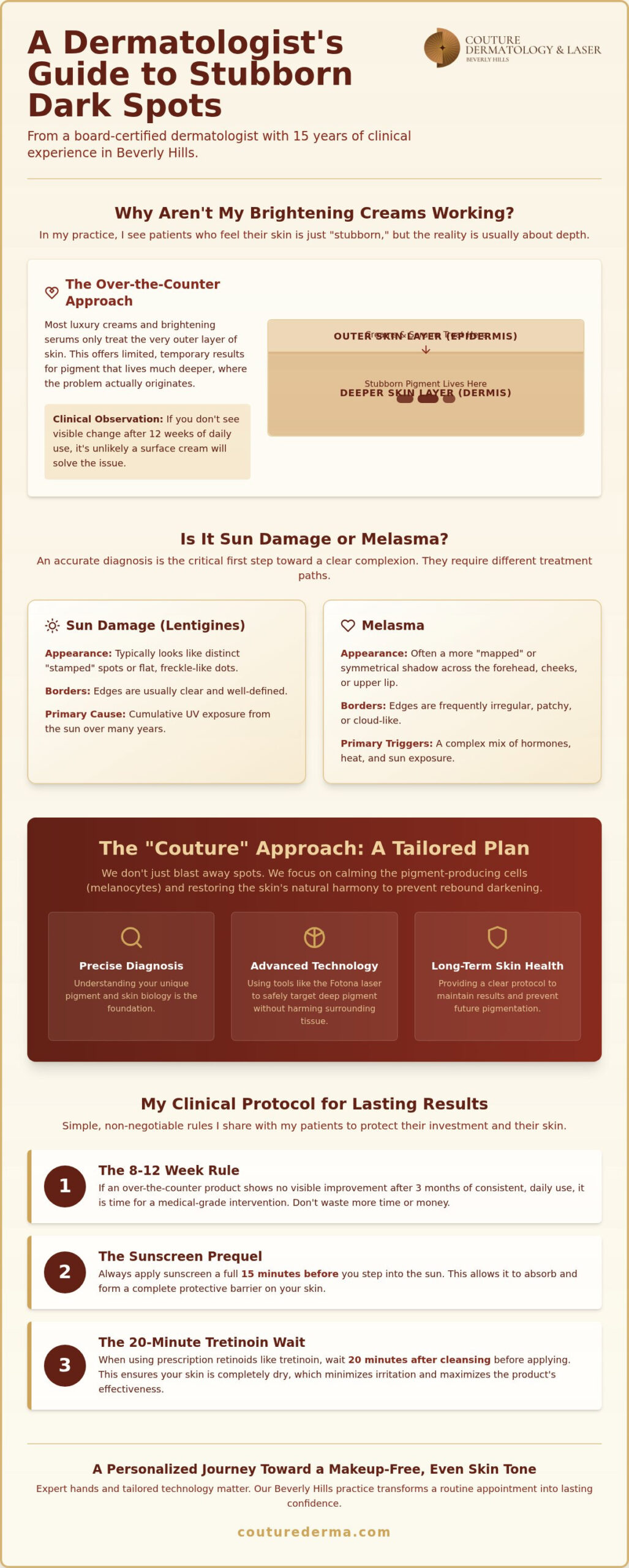
When we talk about dark spot removal beverly hills, we have to look at the science of hyperpigmentation (the process where your skin produces excess melanin or pigment). Most over-the-counter creams only treat the very outer layer of skin. But often, that excess pigment lives much deeper, tucked away in the lower layers where a surface cream just can’t reach. And here’s the thing: not all spots are created equal. You might have sunspots, also called lentigines (flat, brown spots caused by UV exposure), or you could be dealing with melasma (a complex, hormonal pigment issue). Treating them the same way is a recipe for disappointment. That’s why our “Couture” philosophy focuses on a tailored approach rather than a one-size-fits-all solution.
Is it sun damage or melasma?
In my practice, I see patients who confuse these two constantly. Sun damage typically looks like distinct “stamps” or freckle-like spots with clear borders. But melasma is different. It’s often a more “mapped” or symmetrical shadow that spreads across the forehead or cheeks. And it’s tricky because it’s triggered by heat or hormones, not just the sun. If you treat melasma with the wrong laser, you might actually make it worse. But getting an accurate diagnosis is the first step toward a clear complexion.
The limits of over-the-counter brightening
Let’s be honest about drugstore products. While Vitamin C or hydroquinone (a skin-lightening agent) can help with minor dullness, they often hit a “plateau” because the concentrations aren’t high enough to change deep-seated pigment. I tell my patients to follow the 8-12 week rule. If you don’t see a visible change after three months of daily use, it’s time for a medical-grade intervention. Living in Beverly Hills means our sun exposure is intense, and your skin needs more than just a basic moisturizer to recover. For example, if you’re using prescription creams, you should wait 20 minutes after cleansing before applying tretinoin (a vitamin A derivative) to minimize irritation and help the product work effectively.
The science of pigment: understanding your unique skin tone
In my practice, I look at your skin as a complex landscape with its own unique biological fingerprint. Your melanocytes (the cells that produce skin pigment) act like tiny factories that respond to every internal and external signal. My 15 years of experience has taught me that the outer layer of skin (the epidermis) is a delicate barrier that requires meticulous care. If we are too aggressive with our approach, we risk triggering PIH—post-inflammatory hyperpigmentation (darkening that happens after an injury or inflammation).
This is why a generic approach to dark spot removal beverly hills can be so dangerous. In our clinic, I emphasize that “all skin types” require a specific, safe approach to avoid rebound pigment. We aren’t just trying to blast away a spot; we’re trying to calm the pigment-producing cells. When you look for dermatologist-recommended treatments, you’ll find that the most successful outcomes happen when we respect the skin’s natural balance. If you’ve struggled with spots that seem to get darker after treatment, it’s often because this balance was ignored.
Why does skin tone dictate laser safety?
We use the Fitzpatrick scale (a system to classify skin types by their reaction to sunlight) to guide every laser choice we make. For patients seeking dark spot removal beverly hills, this classification is non-negotiable. In most cases, darker skin tones need “cooler” or slower laser settings to prevent thermal damage. I often tell my patients that we treat their skin like a piece of fine, delicate fabric that needs a custom-fit setting. A custom-fit setting. This tailored approach ensures we target the pigment effectively while keeping the surrounding skin perfectly safe.
But it requires an expert hand to know exactly when to push and when to be gentle. Wait 10 minutes after applying your morning moisturizer before layering on a physical sunblock to ensure the barrier remains intact. This small pause helps your skincare settle so the protection can do its job without being diluted.
How does the Beverly Hills climate affect your spots?
The Southern California environment presents a unique challenge for anyone dealing with chronic pigment stimulation. Not just the bright light. In reality, heat alone can keep dark spots active, especially in cases of melasma. Chronic heat can dilate blood vessels and signal your melanocytes to keep producing pigment even if you’re wearing a hat. I always suggest seeking shade whenever possible and prioritizing physical blockers, like zinc or titanium, over chemical sunscreens. If you feel like your current routine has hit a wall, you might want to book a consultation to explore a more medical-grade path.
Lasers vs. Peels: Which tailored approach fits your life?
You might be wondering if a laser is too aggressive or if a chemical peel is enough to fix your pigment. In my practice, I find that the best results come from choosing the exact tool for the specific depth of your concern. Think of a chemical peel as a light steam for a silk dress to remove surface wrinkles. A laser, however, is more like a full structural alteration to the garment. Both have their place in dark spot removal beverly hills, but they serve very different purposes for the health of your skin.
But choosing between them isn’t about which is “better” in a general sense. It’s about what your skin needs at this exact moment. In most cases, I recommend avoiding heavy exercise for 48 hours after any heat-based procedure to prevent excess sweat from irritating the treated area. This small pause helps your skin focus on healing rather than reacting to irritation.
Is the Fotona laser the right choice for melasma?
For patients dealing with hormonal pigment, the Fotona StarWalker protocol is often the cornerstone of our “Couture” treatment menu. This technology is gentle yet powerful for the outer layer of skin because it uses picosecond pulses (ultrafast bursts of energy) to shatter pigment without overheating the surrounding tissue. And this is crucial for avoiding the rebound darkening that many patients fear. If you want to dive deeper into these options, you can read The Couture Guide to Laser Skin Resurfacing.
When should you choose a chemical peel instead?
Medical-grade options like a TCA peel (trichloroacetic acid) are excellent for surface-level refinement and improving overall tone. But let’s be honest, you will see some “shedding” or visible peeling for a few days after the procedure as the old cells move off the surface. In our clinic, I often use these as a “bespoke” prep to clear away dull cells before moving on to more intensive laser work. Or we might use them as a standalone option if your pigment is strictly on the surface.
Why does my dark spot look red?
Many patients don’t realize that their brown spots actually have a red, vascular component (related to blood vessels) hidden underneath. This is where the Vbeam laser (a tool that specifically targets blood vessels and redness) becomes essential. The sensation feels like a cold spray followed by a quick rubber band snap. It’s an important part of The Art of Skin Rejuvenation because clearing the redness makes the overall complexion look much more uniform. Or we might combine these treatments in a single session to address both colors at once.
Your post-treatment ritual for lasting, luminous results
You’ve just stepped out of our Beverly Hills clinic with a fresh sense of hope. But here’s the reality: the work we do in the office is only half the battle. In my practice, I tell every patient that aftercare is 50% of the final result. If you don’t protect the investment you’ve made in dark spot removal beverly hills, the pigment can return faster than it left. It’s a collaborative effort between my expertise and your daily habits.
I see patients who want to rush their recovery, but aesthetic improvement is a gradual progression. It’s not a hurried task. You must follow a strict timing protocol to keep those melanocytes (cells that produce skin pigment) from overreacting. Apply sunscreen 15 minutes before sun exposure, every single day. And when you start using your active creams again, wait 20 minutes after cleansing before applying tretinoin. This prevents the product from sinking in too fast and causing irritation on your new, delicate skin.
The ‘Golden Rules’ of sun protection
Living in Los Angeles means your skin is under constant UV assault. Reapplying your SPF every two hours is non-negotiable if you want to keep your results. Think of your wide-brimmed hats and oversized sunglasses as physical tailoring for your face. They provide a structural barrier that even the best creams can’t match. I also suggest using a tinted sunscreen. These often contain iron oxides that help block blue light from your phone and computer screens, which can also trigger pigment.
Maintaining your ‘Couture’ glow
Transitioning back to your regular routine should be a slow, intentional process. We usually wait about a week before reintroducing exfoliants or heavy acids. Sometimes, a patient’s results look so good that they notice other areas needing attention. I often suggest under-eye brightening to complement your spot removal for a truly rested appearance. The real transformation usually takes hold around the 4-6 week mark during your follow-up appointment. That’s when the deeper layers of skin have finally cycled to the surface. Or we might decide then if a second session is needed to refine the outcome.
If you’re ready to start this journey toward a more even complexion, you can book an appointment online to begin your personalized transformation.
The Couture experience: why expert hands matter in Beverly Hills
You’ve likely walked into a medspa before and felt like just another appointment on a busy schedule. In my practice, I see patients who come to me seeking dark spot removal beverly hills after a generic laser treatment left them with more pigment than they started with. My 15 years of experience and Harvard-trained background have taught me that we cannot treat skin like a factory product. We are treating the whole person, not just a skin symptom (the physical way a condition shows up on your body) on the outer layer of skin. This is why our consultation is a collaborative journey to find your custom-fit solution.
Our clinic is a hub for cutting-edge technology and elevated care in the heart of the city. But the technology is only as good as the expert guiding it. I see every patient as a unique canvas that requires a specific, artistic eye. And I suggest keeping a skin diary for two weeks before your visit to track your triggers. Note if your spots seem more prominent after a hot yoga session or a weekend in the sun. This information helps me tailor your plan to your lifestyle and specific biological needs.
Why a board-certified dermatologist is different
There’s a significant gap between a medspa tech and a board-certified dermatologist. A technician might know how to turn on a machine, but they often lack the clinical authority to manage complex melasma or unexpected reactions. In my practice, I use my medical training to ensure every pulse of light is safe for your specific ethnicity and skin tone. If you are researching how to choose the best dermatologist in Los Angeles, look for credentials that prove a deep understanding of skin biology. It’s the difference between a temporary fix and a long-term transformation.
Booking your personalized consultation
We don’t believe in quick fixes that offer temporary results. We believe in timeless elegance and a gradual progression toward your best skin. Our Beverly Hills location is designed to be a sanctuary where your concerns are heard and your transformation is meticulously planned. I suggest bringing your current skincare bag to our first meeting so we can review your active ingredients together. Or perhaps you simply want to refine your current maintenance plan. Schedule your visit to our Beverly Hills practice today.
Reveal your most luminous complexion yet
You don’t have to settle for stubborn pigment or a skincare routine that simply doesn’t deliver. We’ve explored why generic creams often miss the mark and how a tailored approach to dark spot removal beverly hills can finally reach those deeper layers of skin. By respecting your unique skin tone and using advanced protocols like the Fotona laser, we can clear the path for a more even, radiant tone. It’s vital to remember that your melanocytes (the cells that produce skin pigment) respond best to a gentle, expert hand rather than a rushed solution.
In my practice, I’ve spent 15 years refining these transformative journeys for patients of all skin tones. As a Harvard-trained, board-certified dermatologist, I’m here to ensure your care is as safe as it is effective. It’s time to stop guessing and start a plan that’s custom-fit for your unique biology. Book a bespoke pigment consultation with Dr. Abisogun at our practice today. Let’s work together to reveal the healthy, confident complexion you deserve.
Frequently Asked Questions
How many sessions of laser dark spot removal will I need?
In most cases, you will need between 3 and 6 sessions to see a significant change in your complexion. The exact number depends on whether the pigment lives on the outer layer of skin or deeper in the tissue. I see patients who achieve their goals faster, while others with complex melasma (hormonal pigment) require a longer, more patient approach to reach their desired outcome.
Is dark spot removal painful for sensitive skin?
Most patients describe the sensation as a quick, cold snap followed by a feeling of warmth. In my practice, we use integrated cooling technology to protect sensitive skin and ensure the experience is comfortable. While everyone’s threshold is different, the treatment is typically very tolerable and doesn’t require numbing cream for most pigment focused sessions. We prioritize your comfort throughout the entire process.
Can I remove dark spots if I have a darker skin tone?
Yes, you can absolutely pursue dark spot removal beverly hills if you have a darker skin tone. In our practice, we specialize in “all skin types” and use specific, cooler laser settings to prevent PIH, post-inflammatory hyperpigmentation (darkening that happens after an injury). It’s vital to choose a board-certified dermatologist who understands how to protect your melanocytes (cells that produce skin pigment) while targeting the spots.
What happens if my dark spots come back after treatment?
Pigment can return if the original triggers, such as intense sun exposure or hormonal shifts, aren’t managed. This is why I emphasize that your aftercare and maintenance plan are just as important as the laser session itself. If spots reappear, we typically adjust your topical regimen or suggest a light “maintenance” treatment once or twice a year to keep your complexion luminous and even.
How much does dark spot removal cost in Beverly Hills?
The cost for dark spot removal beverly hills varies based on the specific laser technology used and the size of the area we are treating. Because we provide medical-grade procedures with board-certified oversight, the price reflects the high level of expertise and the premium, FDA-approved devices in our clinic. During your consultation, we provide a detailed plan that outlines the investment required for your personalized transformation.
Is there downtime after a pigment laser treatment?
Downtime is typically minimal, though you might see some redness or a “coffee ground” appearance where the pigment has been targeted. These tiny dark specks usually flake off naturally within 3 to 7 days. I suggest you don’t pick at these spots. Instead, keep the area hydrated and follow our specific protocol of waiting 20 minutes after cleansing before applying any active creams to help your skin heal.
What is the best time of year to start dark spot removal?
Can I use makeup immediately after my laser session?
You can often apply mineral makeup immediately after a gentle laser session to cover any temporary redness. For those seeking expert assistance with application, Stylist John offers certified makeup artistry and natural hairstyling services that can help you maintain a polished look while your skin recovers. But for more intensive treatments or chemical peels, I suggest waiting at least 24 hours to let the outer layer of skin settle. It’s important to use clean brushes and products that won’t clog your pores while your skin is in its most delicate, transformative state. This protects your investment.