Last Tuesday, a patient sat in my Beverly Hills office, visibly shaking because she’d read a horror story about “rubber band snaps” during a Brazilian treatment. She was terrified that the pain level of laser hair removal would be an unbearable deal-breaker for her upcoming wedding. Let’s be honest; those conflicting online reviews can make you want to cancel your appointment before you even walk through the door. It’s completely normal to feel a sense of dread about treating sensitive areas like your face or bikini line.
I see patients who struggle with this anxiety every single day, but here’s the thing: pain isn’t a mandatory price you pay for smooth skin. In my practice, I’ve spent 15 years refining bespoke clinical protocols that prioritize your comfort as much as your results. You’re going to learn exactly what to expect from the sensation and how we use advanced 2026 cooling technology to ensure a virtually painless experience. We will walk through everything from hormonal timing to the specific ways a board-certified expert manages your comfort from start to finish.
Key Takeaways
- Understand the clinical reality of the “prickle” sensation and why it’s actually a sign that the laser is effectively targeting your hair follicles.
- Learn why the pain level of laser hair removal is often highest during your first session and how it decreases as hair density thins over time.
- Discover my specific 24-hour shaving protocol and how it prevents surface burns while ensuring the laser energy goes exactly where it’s needed.
- See how “Couture” protocols in Beverly Hills use integrated cooling and medical-grade numbing to make even sensitive Brazilian treatments feel manageable.
- Find out why choosing a board-certified expert who understands melanocytes (pigment cells) is the key to a safe, comfortable journey for all skin tones.
What Does Laser Hair Removal Actually Feel Like?
In my practice, patients often ask me to rank the pain level of laser hair removal before they even sit in the chair. I usually hear them compare the sensation to a rubber band snapping against the skin. It’s the most common clinical description for a reason, but let’s be honest; that’s a bit of a simplification. When we perform Laser hair removal, you’re actually feeling a very localized burst of thermal energy. Unlike the lingering, throbbing ache that follows a wax strip, this sensation is incredibly fleeting.
I see patients who are surprised by how quickly the “sting” vanishes. This happens because of something called thermal relaxation time. This is the time it takes for the hair follicle to lose 50% of the heat we just delivered. Because the laser is so precise, it targets the follicle without cooking the surrounding skin. This creates a “prickle” sensation rather than a deep burn. To better understand this concept, watch this helpful video:
Actionable Tip: If you’re feeling anxious, ask your provider for a “test pulse” on a less sensitive area like your forearm first. This helps your brain calibrate to the sensation before moving to sensitive zones like the face or bikini line.
The Difference Between Discomfort and Damage
Many people worry that any pain means their skin is being harmed. In my 15 years of experience, I’ve learned that a little “zing” is actually productive. It tells us the energy is reaching the root. However, we always establish a “Couture” baseline. Before we start the full session, I’ll fire a test pulse to see how your skin reacts. We want to find that sweet spot where the laser is working but your comfort remains intact.
Sensory Expectations: Tingling vs. Stinging
The actual experience is a sequence of three distinct stages. First, there’s the bright flash, then a split second of heat, and finally a soothing cool-down. Modern systems like the Fotona laser use “pulse-stacking.” This means we deliver smaller amounts of energy in rapid succession rather than one massive, painful hit. It significantly lowers the overall pain level of laser hair removal while keeping the treatment effective.
Actionable Tip: Focus on deep, rhythmic breathing during the first 30 seconds of the session to reset your nervous system. This simple trick prevents your body from tensing up, which often makes the sensation feel more intense than it actually is.
Why Pain Levels Vary: Melanin, Density, and Your Body’s ‘Couture’ Blueprint
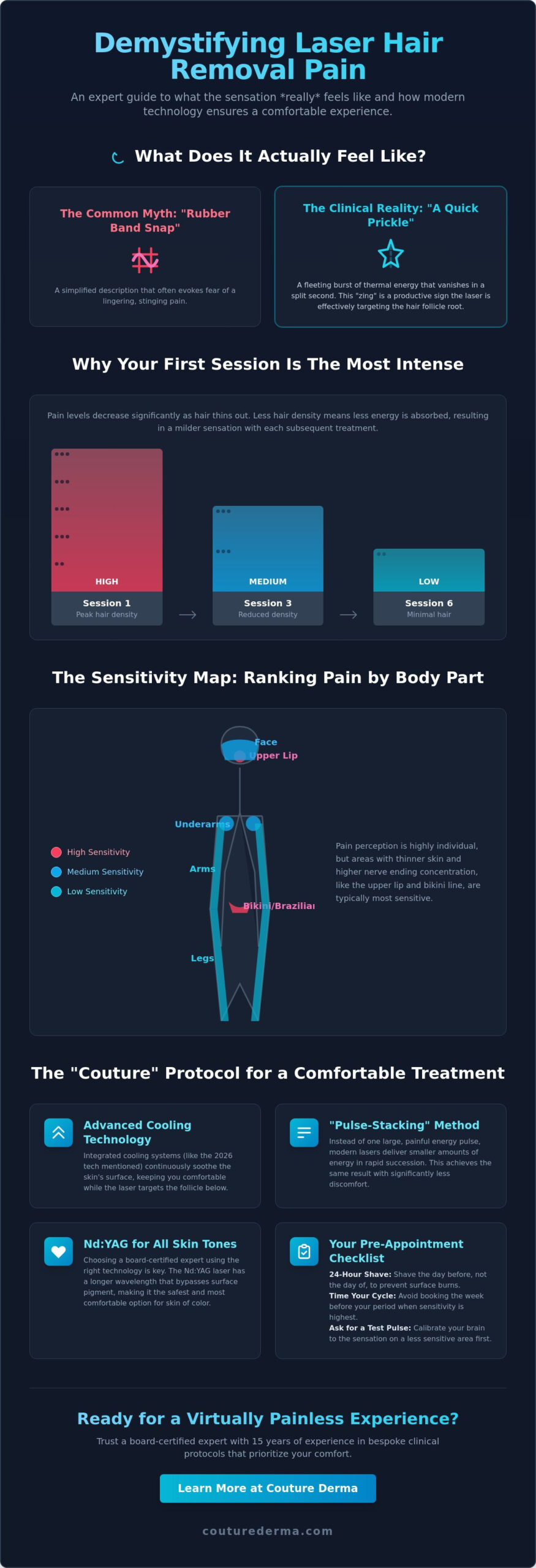
I see patients who walk in for their fifth session and remark on how much easier it is than their first. It’s a common observation in my practice. The pain level of laser hair removal isn’t a static number; it’s a moving target influenced by your unique biology. Your first session is typically the most intense because your hair density is at its peak. There are more follicles to absorb the energy, which creates more heat. As those follicles thin out over time, the sensation becomes significantly lighter and more manageable.
I often notice that patients are their own worst enemies when it comes to scheduling. If you book your appointment during the week before your period, your sensitivity will likely be higher. Your body’s pain receptors are more reactive during this hormonal window. I suggest aiming for the mid-cycle phase of your month to ensure the most comfortable experience possible. Living in Beverly Hills also means we deal with year-round sun. Sun-exposed skin is often more “awake” and reactive, so being honest about your recent outdoor time allows us to calibrate your treatment for safety.
Skin of Color and the Comfort Gap
I see many patients with skin of color who were previously told they weren’t candidates for this treatment. That’s simply not true anymore. In our practice, we use an Nd:YAG laser. This specific technology has a longer wavelength that bypasses the melanocytes (cells that produce skin pigment) in the outer layer of skin. By targeting the root directly, we avoid surface irritation. Precision is actually your best friend here. Using the correct, high-level settings often prevents the need for multiple, painful passes over the same area.
Actionable Tip: Apply a soothing, fragrance-free moisturizer for 48 hours leading up to your treatment. A hydrated skin barrier is much more resilient and recovers faster from the thermal energy of the laser.
The Role of Hair Thickness in Heat Absorption
Coarse hair absorbs more energy than fine hair. This is why a Brazilian treatment feels quite different than treating the fine hair on your arms. We manage this by adjusting the “spot size” of the laser beam. A larger spot size can actually feel more comfortable because it allows the energy to penetrate deeper and more uniformly. According to the Cleveland Clinic on laser hair removal, matching the laser wavelength to your specific hair and skin type is the most critical factor for both safety and comfort. These same principles of precision energy delivery are vital when discussing how laser refinement works for acne scars.
If you’re ready to begin your own transformation, you can schedule a bespoke consultation to find your perfect protocol.
The Sensitivity Map: Ranking Pain by Body Part
In my practice, I see patients who breeze through a full leg treatment but find themselves clenching their teeth during a Brazilian. It’s because your body isn’t a uniform canvas. The pain level of laser hair removal fluctuates based on nerve density and how much “cushion” exists between the skin and the bone. Areas with thinner skin and higher concentrations of sensory receptors naturally feel more intense. Let’s be honest; some areas just have more personality than others.
High-sensitivity zones include the Brazilian, the upper lip, and the underarms. These are the areas where the skin is delicate and the follicles are often quite coarse. Moderate-sensitivity areas are typically the “bony” spots like your shins or ankles. Since there’s less tissue to absorb the energy, you might feel the heat a bit more sharply there. I see patients who describe this as a “ping” against the bone. Low-sensitivity zones, like the thighs, back, and outer arms, are usually the easiest to manage. Most of my patients describe these as almost relaxing; some even catch up on emails during the process.
The Brazilian and Bikini Line: What to Expect
The proximity to major nerve clusters makes the pubic region the “gold standard” for testing your tolerance. But don’t let that scare you. We use targeted cooling protocols to distract your nerves and manage the pain level of laser hair removal effectively. By chilling the skin immediately before and after the pulse, we can significantly mute the sting. This level of precision is similar to how we approach other sensitive areas, such as when we are combining jawline contouring and laser refinement to create a sleek, polished look.
Facial Laser: Upper Lip and Chin
Working near the nose and mouth often triggers a “startle” reflex. It’s not necessarily the pain; it’s the proximity to your airway and the bright flash of light. In our Beverly Hills practice, we take a very “couture” approach here by timing our pulses with your natural breathing rhythm. According to Mayo Clinic’s guide to laser hair removal, proper eye protection is a non-negotiable safety step that also provides a helpful psychological barrier. When you can’t see the flash, your nervous system stays much calmer and less reactive.
Actionable Tip: Avoid caffeine for at least 4 hours before your facial laser appointment. Caffeine is a stimulant that can make your nerves more “jittery” and sensitive to the sensation of the laser.
Professional Strategies to Minimize Discomfort Before Your Appointment
I see patients who treat their pre-appointment prep like a loose suggestion. Let’s be honest; it’s the most important part of the process. In my practice, the difference between a comfortable session and a difficult one usually comes down to what you did 24 hours before your visit. Proper prep is the secret to keeping the pain level of laser hair removal at a minimum. When you follow a strict clinical protocol, you’re not just preventing discomfort; you’re ensuring the laser works with maximum efficiency.
The 24-hour shave rule is my first non-negotiable requirement. If you leave even a tiny bit of hair above the skin, the laser will singe it on the surface. This creates that unpleasant “burnt hair” smell and a sharp, unnecessary stinging sensation. You want the energy to travel straight to the root; you don’t want it wasted on the surface. Also, “juicy” skin handles heat much better than dry, flaky skin. I recommend using a basic, fragrance-free moisturizer for three days leading up to your visit to keep your skin barrier resilient.
Living in Beverly Hills means we have to be extra cautious about sun exposure. You must avoid active tanning for at least 14 days before your appointment. If you’re using Retinol or AHAs (Alpha Hydroxy Acids), stop them 7 days prior. These ingredients make your outer layer of skin more “photosensitive” (sensitive to light). This can dramatically increase the pain level of laser hair removal and lead to irritation.
The Numbing Protocol: Timing is Everything
If we’ve decided to use a medical-grade numbing cream, usually a combination of Lidocaine and Prilocaine, timing is everything. Apply your prescribed cream exactly 45 minutes before we start. No sooner, because the effect will peak too early; no later, because it won’t have reached the deeper nerves yet. Actionable Tip: Wait 20 minutes after cleansing your skin before applying any pre-treatment soothing gels or numbing creams to ensure your skin isn’t too reactive from the wash.
What to Take (and Avoid) for Pain Management
I often tell my patients that Ibuprofen is a better choice than Acetaminophen for managing laser-induced inflammation. Ibuprofen helps block the “prostaglandins” (chemicals that signal pain and swelling) that the heat from the laser can trigger. Also, please skip the glass of wine the night before. Alcohol dehydrates your skin and makes your nervous system more “irritable” and sensitive to touch.
Actionable Tip: Wear loose, breathable silk or cotton clothing to your appointment. Post-laser skin is sensitive to friction, and tight synthetic fabrics can cause unnecessary chafing after you leave the office.
Ready to start your transformation with a team that prioritizes your comfort? Book your bespoke session today and let’s begin your Couture Journey.
Why Your Choice of Laser Technology (and Expert) Dictates Your Experience
I see patients who have tried the “bargain” route at local med-spas before finding their way to our Beverly Hills practice. It’s a frustrating cycle. They often report that their previous sessions were agonizing or simply ineffective. This usually happens because lower-grade equipment delivers energy in inconsistent spikes. When the energy isn’t uniform, it creates “hot spots” on the skin. These spikes make the pain level of laser hair removal feel significantly higher than it is with medical-grade technology. In my practice, we prioritize precision over speed.
Choosing a board-certified, Harvard-trained dermatologist means you’re getting more than just a technician. You’re getting an expert who understands how to calibrate the laser for your specific skin history. We use the Fotona laser system in our office. This technology is a game-changer because it uses high-speed pulses. These pulses are so fast that they often outrun your body’s pain signals. Your nerves don’t have enough time to fully register the heat before the pulse is already over. This makes the pain level of laser hair removal much more manageable for sensitive patients.
Actionable Tip: Before you book your first session, ask the provider if they use an external chiller like the Zimmer. This single piece of equipment can reduce the perceived heat by as much as 40 percent by numbing the skin with a continuous stream of cold air.
Advanced Cooling Systems in Our Practice
We don’t rely on just the laser itself to keep you comfortable. We use the Zimmer chiller; it provides a continuous flow of sub-zero air directly to the treatment area. It acts like a localized anesthetic that numbs the skin while we work. Some of our lasers also feature a Dynamic Cooling Device (DCD). This system releases a quick burst of cryogen spray milliseconds before the laser pulse hits. This dual-layer approach is the same level of care we describe in The Couture Guide to Laser Skin Resurfacing.
Why an Artistic Eye Matters for Comfort
The “Couture Journey” is about more than just hair removal. It’s about how you feel during the process. I never “rush to the finish line” during a session. If I see a patient tensing up, we pause. We take a sensory reset. Mapping your treatment with an artistic eye allows us to avoid over-treating sensitive spots. We curate the experience so it feels like a luxury service rather than a medical chore. Beautiful skin is a journey. We make sure the path is as elegant as the result.
Actionable Tip: If you feel a “hot spot” during treatment, tell your provider immediately. A simple adjustment to the cooling flow or the pulse duration can instantly reset your comfort level without compromising your results.
Your Journey to Effortless, Smooth Confidence
We’ve explored the clinical reality of the “rubber band” sensation and the specific ways your unique biology, from hair density to hormonal cycles, dictates your experience. But here’s the most important thing to remember: smooth skin shouldn’t come at the cost of your peace of mind. By combining a strict 24-hour shaving rule with medical-grade numbing and advanced cooling technology, we’ve turned a once-dreaded procedure into a manageable, luxury experience.
In my practice, I focus on ensuring the pain level of laser hair removal stays well within your personal comfort zone. With my Harvard-trained oversight and our investment in the latest Fotona and GentleMax technology, we provide a level of precision and safety that standard equipment simply cannot match. We curate bespoke pain management protocols for every skin type; this ensures that your journey is as refined as the results we achieve together.
If you’re ready to leave the razors and the anxiety behind, it’s time to take the next step. Begin your Couture Journey with a personalized consultation in Beverly Hills. You deserve to feel seen, valued, and completely comfortable in your own skin. I look forward to helping you achieve that beautifully smooth finish with the care and expertise you deserve.
Frequently Asked Questions
Is laser hair removal more painful than waxing?
Laser is typically less painful than waxing because the sensation is incredibly brief. Waxing involves the mechanical pulling of the skin and follicles; this creates a lingering throb that can last for hours. With laser, the heat is gone in milliseconds. I see patients who switched to laser and reported a 70 percent reduction in overall discomfort compared to their monthly wax. It’s a much more elegant solution for long-term hair reduction.
Can I use numbing cream before my laser hair removal appointment?
You can certainly use numbing cream, provided you follow a specific clinical protocol. I recommend applying a medical-grade Lidocaine cream exactly 45 minutes before we begin. You must remove all traces of the cream before the first pulse. If residue remains on the outer layer of skin, it can interfere with the laser’s energy delivery and potentially cause surface irritation or inconsistent results.
Does the pain get better with each laser session?
Yes, the pain level of laser hair removal almost always decreases as you move through your sessions. During your first visit, hair density is at its highest, meaning more follicles absorb the thermal energy. By your fourth or fifth session, there is significantly less hair to target. This results in less heat absorption and a much milder sensation for most of my patients as they progress.
What happens if the laser feels too hot during my treatment?
If the sensation feels too intense, we stop the procedure immediately and adjust our settings. I always establish a “Couture” baseline with a test pulse first. If you feel a sharp “hot spot” during the session, we can increase the flow from the Zimmer chiller or modify the pulse stacking. Your comfort is a vital part of the clinical outcome in my practice; never feel like you have to “tough it out.”
Can I take Advil or Tylenol before my laser hair removal session?
I often suggest taking Ibuprofen about 60 minutes before your appointment. Ibuprofen is an anti-inflammatory that helps block the prostaglandins (chemicals that signal pain) triggered by the laser’s heat. This is typically more effective than Acetaminophen for this specific type of thermal discomfort. Just be sure to check with your primary doctor if you have any history of stomach issues or other contraindications.
How long does the skin feel sensitive after a laser treatment?
Most patients find that any sensitivity or redness vanishes within 2 to 24 hours. It typically feels like a very mild sunburn on the treated area. In my practice, I advise using a fragrance-free moisturizer or chilled aloe vera immediately after your session. Avoid hot showers, saunas, or intense exercise for at least 24 hours to give your skin barrier time to reset and cool down properly.
Is it safe to get laser hair removal while on my period?
It’s perfectly safe, but I often advise patients that their sensitivity might be higher. Your nervous system is more reactive during the week of your period due to hormonal shifts. If you’re concerned about the pain level of laser hair removal, try to book your session for the middle of your cycle. This is when your pain tolerance is usually at its peak and you’ll feel more relaxed.
Does laser hair removal hurt more on dark skin?
It shouldn’t hurt more if your dermatologist uses the correct wavelength and technology. We use the Nd:YAG laser for skin of color because it bypasses the melanocytes (cells that produce skin pigment) in the skin. This allows us to target the hair follicle root without heating the surrounding tissue. This level of precision ensures a safe and comfortable experience for every skin tone we treat in our office.