You’ve spent months applying every brightening serum in your cabinet, yet those stubborn brown patches on your cheeks just won’t budge. In my practice, I see patients seeking a laser treatment for melasma beverly hills because they feel like they’re walking on eggshells with their own skin. They’re often terrified that the wrong move will make their melasma (a complex pigment disorder caused by overactive color-producing cells) even darker. Let’s be honest; it’s frustrating when your complexion feels like a puzzle you can’t solve, especially with the intense Southern California heat working against you.
If you’ve been hesitant because of horror stories about skin darkening after a procedure, I want to offer you some genuine hope. You can achieve a clear, even tone when we treat your skin like a unique fabric rather than using a one-size-fits-all setting. One thing I tell my patients is to keep a facial mist in the fridge; cooling the skin immediately after heat exposure can help prevent pigment flares. We’ll explore how a clinical, couture approach to laser therapy safely clears stubborn pigment and restores your skin’s natural harmony while building a plan that actually lasts.
Key Takeaways
- Learn why a specialized laser treatment for melasma beverly hills requires a low-heat approach to avoid over-stimulating melanocytes (cells that produce skin pigment) and causing rebound darkening.
- Discover how we use selective photothermolysis—a method of using specific light wavelengths—to shatter stubborn pigment without damaging the delicate surrounding skin fabric.
- Understand the three-phase couture journey of prep, procedure, and preservation required to safely clear hormonal pigment and maintain a harmonious glow.
- Find out which specific technologies, such as the Fotona or Pico lasers, are best suited for your unique skin tone and pigment depth.
- Learn how to protect your results from the intense Southern California sun by using advanced protocols like iron-oxide sunscreens to block visible light.
Why does the Beverly Hills sun make melasma so difficult to treat?
You’ve likely spent hundreds on “brightening” serums, yet those stubborn patches on your cheeks seem to deepen every time you step outside. Even with a wide-brimmed hat, the Southern California sun feels like it’s undoing all your hard work. In my practice, I explain that melasma isn’t just a surface stain. It’s a chronic skin symptom involving melanocytes (cells that produce skin pigment) that have become hyper-sensitive to their surroundings.
Here’s the thing; in Beverly Hills, it’s not just the UV rays we’re fighting. The Los Angeles heat itself triggers pigment production in the outer layer of skin (the epidermis). Think of your melasma as a “living” record of your hormones and your environment. It responds to every temperature spike and hormonal shift you experience. For a comprehensive overview of melasma, it helps to see it as a protective response that has simply gone into overdrive.
Why are my dark spots getting worse despite wearing sunscreen?
I see patients who are frustrated because they’re doing “everything right” but still seeing darkening. Most standard SPF products are designed to block UV rays, but they don’t block the infrared heat that activates your pigment. There’s a big difference between simple sunspots and the hormonal “mask” of melasma. If you’re looking for a way to address these underlying triggers, you can check out Pura Wellness RX for expert hormone optimization and wellness care. Sunspots are usually isolated, while melasma appears in symmetrical patches across the forehead, cheeks, or upper lip.
It’s vital to choose the right protection for this specific issue. Actionable Tip: Apply a mineral sunscreen containing iron oxides at least 15 minutes before you leave the house. These minerals act as a physical shield against visible light and heat that chemical filters often miss. Or, try keeping your skincare in a beauty fridge to help lower your skin temperature after a long commute.
Why are my dark spots getting worse despite wearing sunscreen?
In our clinic, we take a “couture” view of your complexion. We see your skin fabric as something reactive that needs a gentle, precise touch. When estrogen levels are high, they put your melanocytes into a state of “overdrive.” Heat then acts like a signal to those cells to produce even more color. It’s a cycle that feeds on itself, especially during our intense summer months. Addressing these hormonal triggers is crucial, and providers like LexMed & Wellness specialize in balancing the internal factors that can influence skin pigmentation.
In my clinical experience, melasma is often much deeper than it looks on the surface. This is why a standard laser treatment for melasma beverly hills must be carefully calibrated. If a laser is too aggressive, the heat it generates can actually trigger more pigment. We focus on calming the “storm” before we ever attempt to break up the color, ensuring your skin stays balanced and bright.
In my practice, I often tell patients that using the wrong laser on melasma is like using a blowtorch on a piece of delicate silk. It causes unnecessary damage that triggers the skin to produce even more pigment as a defense mechanism. To avoid this, we rely on selective photothermolysis, which is the process of using specific light wavelengths to shatter pigment without heating the surrounding skin fabric. This allows us to perform a laser treatment for melasma beverly hills that is both effective and safe for sensitive complexions.
We prioritize “cold” laser energy or ultra-short pulses that act so quickly they don’t have time to create a heat trigger. Our signature tool for this is the Fotona laser, which I’ve chosen for its extreme precision. By following expert treatment guidelines, we ensure the energy is delivered exactly where it’s needed without disturbing the healthy outer layer of skin. This careful approach is what sets a clinical environment apart from a standard spa setting.
What is the difference between shattering pigment and burning it?
Here’s the thing; there’s a world of difference between a “thermal” effect that burns and a “photo-acoustic” effect that shatters. Photo-acoustic energy uses sound waves to break the pigment into tiny particles, almost like a microscopic jackhammer. High-heat lasers, like older CO2 models, are typically a “never” for melasma because they provoke the very inflammation we want to avoid. Shattering the pigment allows your body’s immune system to naturally clear the debris over several weeks.
Clinical Tip: After your session, avoid hot showers, saunas, or intense workouts for at least 48 hours. Keeping your internal body temperature low helps prevent the “rebound” pigment that heat can often cause. If your skin feels warm, you can apply a cold compress for 10 minutes every hour to keep the area calm.
Is laser treatment safe for darker skin tones in Beverly Hills?
Many patients come to me with a deep fear of PIH (post-inflammatory hyperpigmentation, which is the dark spots caused by the treatment itself). This is a valid concern, especially in a sun-drenched city like ours where the skin is already under stress. We address this by “tailoring” the laser wavelength to bypass the surface and target only the deep pigment. Our expertise in treating all skin types means we know exactly how to adjust settings for deeper complexions without increasing the risk of scarring.
If you’ve been disappointed by standard treatments that didn’t account for your unique skin fabric, it might be time to schedule a couture consultation. We can customize a plan that respects your skin’s history while working toward a clearer future.
Which laser technology is right for your unique skin tone?
Choosing a laser is like selecting the right needle for a specific fabric; there is no “one size fits all” in our Beverly Hills suite. In my practice, I see patients who have been treated elsewhere with a generic setting only to find their spots worsened. This happens when the provider doesn’t respect the unique “skin fabric” of the person in front of them. We often use a “multi-modal” approach, which means combining different light wavelengths to address pigment at various depths. By layering different laser options, we can target the dermal (deeper) and epidermal (surface) layers of the skin simultaneously.
Here’s the thing; the technology is only as good as the hand that holds it. Even the most expensive device can cause issues if the operator doesn’t understand the histology (microscopic structure) of your skin. This is why a board-certified dermatologist should always oversee your laser treatment for melasma beverly hills. We want to ensure the energy is shattering the pigment without causing an inflammatory response that could lead to more dark spots later.
Why do we prefer the Fotona laser for stubborn melasma?
I’ve found that the Fotona laser offers unique settings that allow for pigment clearance with almost zero heat buildup. This is crucial because heat is the primary enemy of melasma. It addresses both the visible brown pigment and the underlying vascular (redness) component that often feeds the condition. In my clinical experience, this provides the most natural looking transition between treated and untreated areas. It allows us to clear the “mask” while keeping the rest of your complexion in harmony.
Actionable Tip: If you are using a prescription retinoid as part of your prep, wait 20 minutes after cleansing before applying it to your skin. This reduces the risk of irritation that could make your melanocytes (cells that produce skin pigment) more reactive before your laser session. Applying it to damp skin can often lead to unnecessary peeling and inflammation.
When is a Pico laser or Moxi a better choice for your spots?
But what if your pigment is more superficial? A Pico laser is excellent for “shattering” stubborn patches in lighter skin tones because it uses ultra-fast pulses of energy. Or, we might suggest Moxi as a “pre-juvenation” or maintenance tool for milder cases. It’s a gentler option that keeps the skin bright without the downtime of more intense procedures. We often use this for younger patients who are just starting to see the first signs of sun damage or hormonal shifts.
For a broader look at how we select these tools, you can explore The Couture Guide to Laser Skin Resurfacing. Whether we are using the Fotona or a picosecond device, the goal is always aesthetic harmony. Actionable Tip: Always apply your mineral sunscreen 15 minutes before sun exposure to ensure the film has properly set on your skin fabric. This protects the delicate work we’ve done during your session from the intense Beverly Hills light.
What does the couture treatment journey look like for my skin?
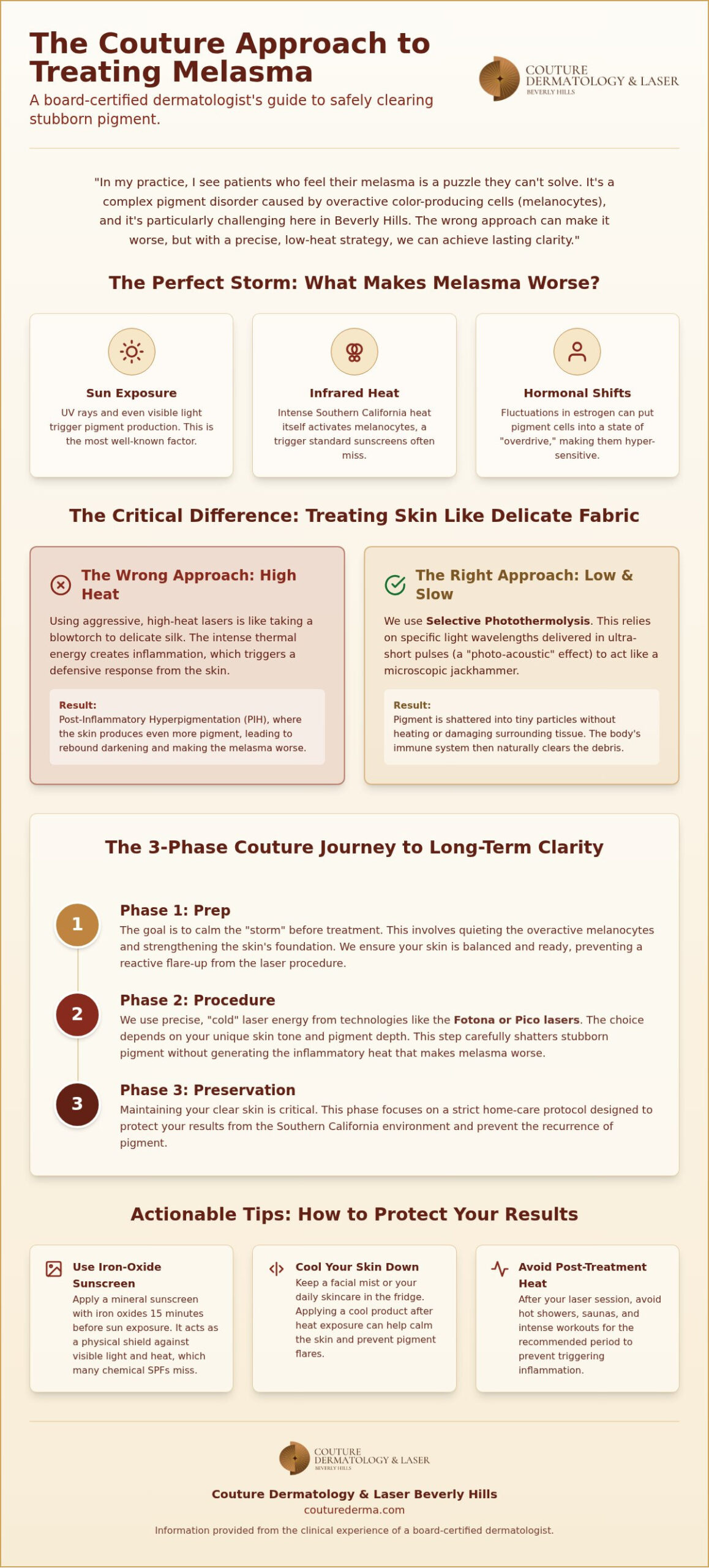
Let’s be honest; you can’t just walk in and get a laser today if you want the best results. In my practice, I view the process as a collaborative, transformative journey rather than a single, rushed appointment. We follow a specific three-phase path that I call Prep, Procedure, and Preservation. This structured approach ensures your laser treatment for melasma beverly hills is safe and provides the long-term clarity you deserve.
I see patients who have tried “quick fixes” elsewhere, only to have their pigment return with a vengeance. You might find more details on our specific philosophy in this guide on Melasma Treatments: Reclaiming Your Skin Tone. We typically start by using pigment inhibitors (medications that slow down pigment production) for 2 to 4 weeks before the first pulse. This “Couture Protocol” calms your melanocytes (cells that produce skin pigment) so they don’t overreact to the laser energy.
How do I prepare my skin for a successful laser session?
I see patients who are eager to start immediately, but patience is truly your best tool here. Actionable Tip: Apply your prescribed “brightening” cream every evening to put those pigment-producing cells to sleep before your session. But you must also avoid direct sun exposure for at least 2 weeks prior to your appointment. That means no beach days in Malibu or long hikes in the hills where the heat is intense.
The goal is to have your skin in its most “quiet” state before we introduce any laser energy. Actionable Tip: Wait 20 minutes after cleansing before applying any active treatments or inhibitors to your skin to prevent irritation. And if you’ve had a recent flare-up from a vacation, we may need to push your session back to ensure safety. We want to treat a calm canvas, not one that is already inflamed.
What should I expect during and immediately after the treatment?
Most patients describe the sensation of the laser as a tiny rubber band snap or a warm tingle across the skin fabric. It is generally quite tolerable and doesn’t require the significant downtime associated with older, more aggressive technologies. You’ll typically notice 24 to 48 hours of “sunburn” redness, but we aim to avoid any raw or broken skin. Actionable Tip: Apply a bland, fragrance-free moisturizer twice daily to support the outer layer of skin (the epidermis) as it heals.
The “Preservation” phase is where your long-term results are actually made. Actionable Tip: Apply your mineral sunscreen 15 minutes before any sun exposure, even if you are just driving to the office. Or, consider wearing a wide-brimmed hat if you’ll be outdoors for more than 10 minutes. If you’re ready to begin this meticulously planned journey, you can book your initial skin assessment online to get started.
Why is board-certified expertise the key to long-term clarity?
In Beverly Hills, you’ll find a “med spa” on nearly every corner, but it’s vital to remember that melasma is a medical condition, not a casual spa service. I see patients who have spent thousands on packages elsewhere only to find their pigment deeper than when they started. In our practice, we ensure your laser treatment for melasma beverly hills is grounded in medical science rather than just aesthetic trends. As a Harvard-trained dermatologist, I look at the histology (the microscopic structure) of your skin to understand how deep the pigment sits.
Our “Couture” philosophy means we aren’t just clearing brown spots; we are restoring your self-assurance and sense of harmony. We look at the “whole” patient, including your hormones, stress levels, and lifestyle habits. If you are concerned about shadows elsewhere, we also offer under-eye brightening to complement your clear complexion. We treat your skin like the delicate, high-end fabric it is, requiring a bespoke touch rather than a standard setting.
Why is a medical consultation better than a quick ‘laser scan’?
I see patients who have been burned elsewhere because their “melasma” was actually a different skin concern. For example, it could be lichen planus pigmentosus (a skin issue that causes gray-brown patches) or post-inflammatory marks from a previous harsh treatment. A clinical exam is the only way to rule out other causes of hyperpigmentation before we ever fire a laser pulse. Actionable Tip: If your current brightening routine hasn’t shown any visible change after 8 to 12 weeks, it’s time for a professional eye to evaluate your progress.
A technician might see a dark spot and turn up the energy, but a physician knows that more power often leads to more problems. We prioritize safety by starting with conservative settings and observing how your skin fabric responds over time. This patient, intentional approach is what prevents the “rebound” darkening that so many people fear. It’s about building a relationship with your skin, not just performing a transaction.
How do we maintain your results in the intense California sun?
Maintaining your clarity in our intense sun requires more than just one session; it takes a long-term plan. Melasma management is a marathon, not a sprint, and we typically schedule 6-month follow-up visits to check for new pigment activity. We may suggest “maintenance” pulses once or twice a year to keep your melanocytes (cells that produce skin pigment) in a quiet state. Actionable Tip: Wear a hat with a UPF (Ultraviolet Protection Factor) rating of 50 or higher if you plan to be outdoors during the peak hours of 10 am to 2 pm.
Think of your skin as your most important “couture” garment that you wear every single day. You wouldn’t trust a bespoke silk gown to a standard dry cleaner, so treat your complexion with the same expert care. By combining medical science with an artistic eye, we can help you achieve a glow that lasts well beyond the initial procedure. Let’s work together to keep your skin fabric as vibrant and even as possible.
Ready to restore your skin’s natural harmony?
Clearing stubborn pigment in our intense California climate requires more than just a standard procedure; it requires a partnership. We’ve explored why melasma is a living record of your environment and how the right “cold” energy can shatter pigment without the heat that triggers rebound darkening. In my practice, I’ve seen how the right laser treatment for melasma beverly hills, paired with a meticulous 3-phase journey, can truly transform a complexion. It’s about moving from frustration to a place of calm confidence in your own skin fabric.
By choosing a Harvard-trained expert who understands the histology (the microscopic structure) of your skin across diverse skin tones, you are investing in a long-term management plan. We utilize cutting-edge Fotona laser technology to ensure your path to clarity is as safe as it is effective. If you’re tired of temporary solutions and want a custom-tailored approach, it’s time to take the next step. Book your couture melasma consultation with Dr. Abisogun today and let’s begin your transformative journey together. You deserve a complexion that feels as vibrant as you do.
Frequently Asked Questions
Is laser treatment for melasma permanent or will the spots come back?
Melasma is a chronic skin symptom, or long-term condition, that is managed rather than permanently cured. While our advanced protocols clear the visible pigment, those overactive melanocytes (cells that produce skin pigment) can be re-triggered by the intense Los Angeles sun or hormonal shifts. Most patients in our practice find that long-term clarity requires a maintenance plan and strict sun protection to prevent the patches from returning over time.
How many sessions will I need to see a difference in my skin tone?
Most patients require a series of 3 to 6 sessions to see a visible improvement in their skin tone. We typically space these appointments 4 weeks apart to allow your skin fabric time to heal and clear the shattered pigment naturally. You might notice a subtle brightening after the first session, but the most significant transformation usually happens after the third or fourth visit to our Beverly Hills suite.
Can I get laser treatment for melasma while I am pregnant or breastfeeding?
I typically advise against seeking a laser treatment for melasma beverly hills during pregnancy or while breastfeeding. Hormonal fluctuations during this time can make your pigment highly unpredictable and more likely to flare up. It’s often better to wait until your hormones have stabilized so we can create a predictable, safe treatment plan that won’t be undone by “pregnancy mask” triggers.
Does laser treatment for melasma hurt or require numbing cream?
Most patients describe the sensation as a series of tiny, warm snaps against the skin fabric. While the procedure is generally tolerable, we often apply a prescription numbing cream 30 to 45 minutes before we begin to ensure your absolute comfort. Our goal is to make the experience feel like a refined, high-end service rather than a stressful medical procedure, so we prioritize a pain-free environment.
What is the difference between ‘cold’ lasers and traditional heat lasers?
Traditional lasers rely on heat to “burn” away pigment, which can often trigger more melasma in sensitive skin types. “Cold” lasers, like the Fotona or Pico technologies we use, utilize ultra-short pulses to shatter pigment through a photo-acoustic effect (sound waves) instead of high temperatures. This approach protects the outer layer of skin (the epidermis) and significantly reduces the risk of making your dark spots worse.
Will I need to take time off work after my Beverly Hills laser session?
You typically won’t need to take any formal time off work after your session. Most patients experience a mild redness, similar to a light sunburn, that lasts for about 24 to 48 hours. It’s often called “social downtime” because you can return to your daily Los Angeles routine immediately, though you should avoid intense heat and direct sun exposure for the first few days.
Can I use my normal makeup immediately after the treatment?
I recommend waiting at least 24 hours before you apply makeup to the treated area. Your skin fabric needs time to breathe and start the recovery process without being blocked by heavy products. Actionable Tip: Wait 20 minutes after cleansing before you apply any active skincare or makeup to ensure your skin is completely dry and less prone to irritation during the healing phase.
What happens if my melasma gets darker after the first session?
It is quite common for pigment to look slightly darker immediately after a session as the shattered debris rises to the outer layer of skin. This is often a sign that the treatment is working and the pigment is being processed by your body. But if the darkening persists or feels inflamed, we adjust your settings or add a calming inhibitor to your home protocol to keep your melanocytes (cells that produce skin pigment) quiet.