

You wake up, look in the mirror, and see that the breakout from three weeks ago is finally gone, but it has left a dark brown mark that refuses to fade. You have tried every brightening serum at the drug store, yet that stubborn spot remains, mocking your efforts to achieve a clear complexion. In my Beverly Hills practice, I see patients every day who are exhausted by this cycle and are searching for a reliable post-inflammatory hyperpigmentation (PIH) treatment los angeles. They often worry that lasers might make their skin worse or cause rebound pigment (a condition where spots get darker after treatment), which is a valid fear if the approach isn’t tailored to your specific skin tone.
Here is the thing: those marks are essentially a form of skin memory where your melanocytes (the cells that produce skin pigment) have gone into overdrive after an injury like acne or a scratch. But you don’t have to hide under heavy foundation forever. I am going to walk you through how a dermatologist-led plan can safely fade these symptoms and give you back your confidence. We will explore the latest laser technologies and why a custom fit is the only way to get lasting results without the risk.
Key Takeaways
- Learn why PIH is a skin symptom caused by melanocytes (cells that produce skin pigment) overreacting to injury and why calming the area is the first step to clearing it.
- Discover why high-heat lasers often lead to rebound hyperpigmentation (a concern where spots become darker) and how our low-heat, bespoke methods keep your skin safe.
- I’ll explain my two-phase protocol that starts by strengthening your skin barrier before moving to active brightening with topicals (creams you apply to skin).
- Find out how to select the best post-inflammatory hyperpigmentation (PIH) treatment los angeles by looking for a dermatologist-led approach that respects your unique skin tone.
- See how a tailored maintenance plan ensures your results last, moving you from a temporary fix to a true transformation journey.
What exactly is Post-Inflammatory Hyperpigmentation (PIH)?
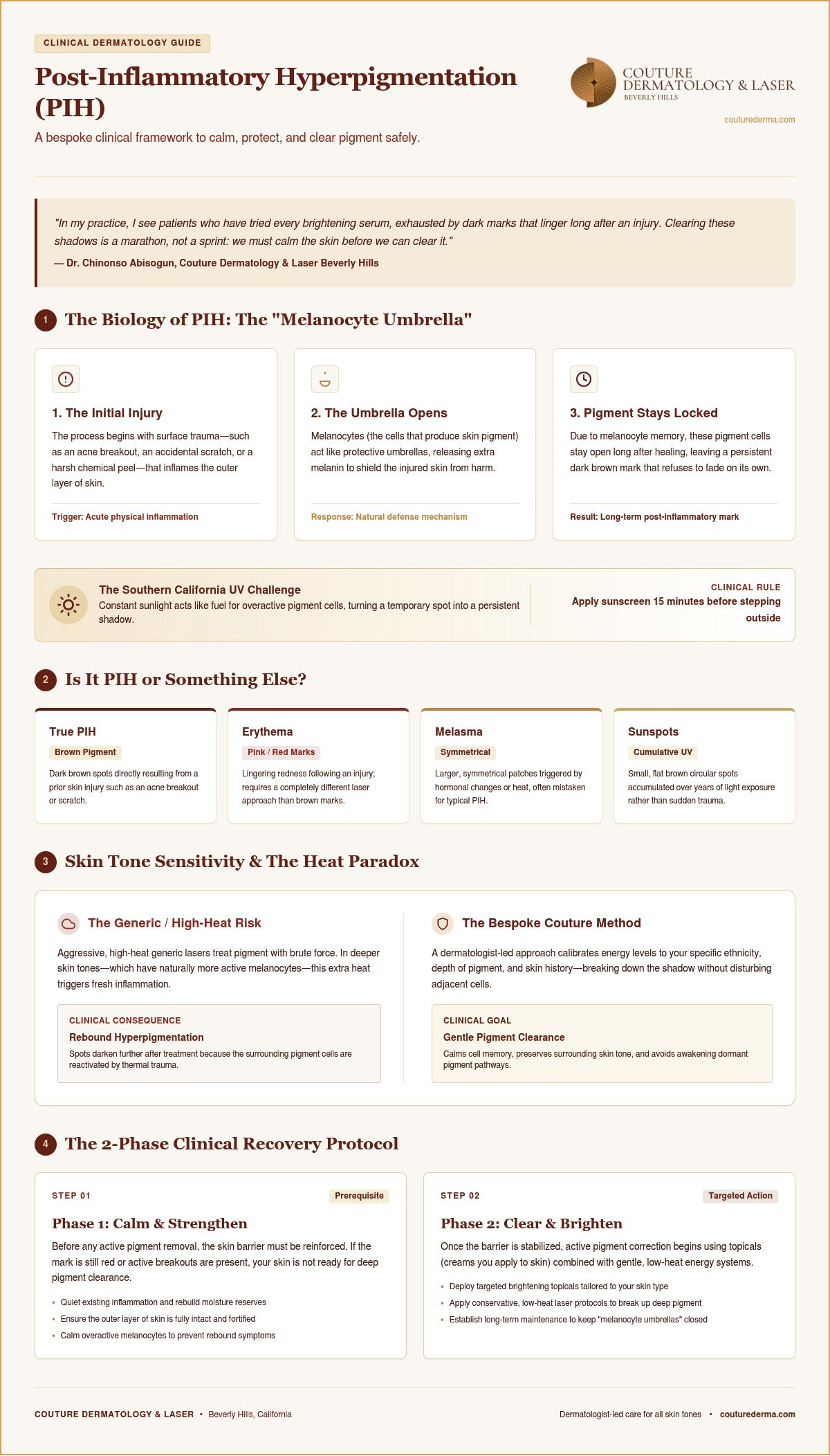
You have finally cleared that stubborn breakout, but you’re left staring at a dark mark that feels like a permanent ghost of the pimple. This is Post-inflammatory hyperpigmentation, or PIH, and it’s a skin symptom where the outer layer of skin produces too much melanin after an injury. I often tell my patients to think of their melanocytes (cells that produce skin pigment) as tiny umbrellas. When your skin is hurt or inflamed, these cells open up to protect the area. But sometimes they stay open way too long.
Living in Southern California makes finding an effective post-inflammatory hyperpigmentation (PIH) treatment los angeles even more challenging because of our constant sun. UV rays act like fuel for those overactive pigment cells, turning a temporary mark into a long-term resident on your face. In my practice at Couture Dermatology & Laser Beverly Hills, I see how frustrating this is. One quick tip: apply sunscreen 15 minutes before you step outside, even on cloudy days, to keep those “umbrellas” from getting darker.
To better understand this concept, watch this helpful video:
Is it PIH or something else?
It’s vital to know what you’re actually treating before you start. PIH usually follows a clear injury like acne, a scratch, or even a harsh chemical peel. Sunspots typically look like small, flat brown circles from years of light exposure. Melasma often appears as larger, symmetrical patches triggered by heat or hormones. But here’s a professional tip: if your mark is still pink or red, it’s likely post-inflammatory erythema (lingering redness), which requires a completely different laser approach than brown PIH marks.
In my practice, I often see patients who have a mix of both PIH and sun damage. Mistaking melasma for PIH is a common mistake that can lead to the wrong treatment choice and potentially make the spots worse. We use a dual approach to ensure we are targeting the right kind of pigment at the right depth.
Why does your skin tone matter for PIH?
I specialize in treating all skin types because I know that deeper skin tones have more active melanocytes. When trauma occurs, these cells react more aggressively. This is why darker skin is more prone to deep, stubborn shadows that last for months. A one-size-fits-all laser can be dangerous here. It might trigger even more pigment, which we call rebound hyperpigmentation (a condition where spots get darker after a procedure).
And that is why our “couture” approach is so necessary. We tailor the energy levels to your specific ethnicity and skin history to ensure we are clearing the spot without waking up the surrounding pigment cells. It’s about finding that perfect balance between being effective and being gentle.
The Science of Shadows: Why PIH requires a delicate touch
Finding the right post-inflammatory hyperpigmentation (PIH) treatment los angeles often starts with unlearning the “more is better” mindset. You might think the fastest way to erase a mark is to use the strongest setting on a laser. But aggressive treatments using high heat can actually backfire. In my practice, I see patients who tried a generic laser elsewhere only to find their spots became darker. This happens because heat can trigger inflammation, which tells your skin to produce even more pigment.
Here’s the thing: I call this “melanocyte memory.” Your pigment-producing cells (melanocytes) are already on high alert from the initial injury. If we add too much heat too soon, we just keep that cycle going. Clearing these marks is a marathon, not a sprint. We have to calm the skin before we can clear it. If your skin is still red or you have active acne, we aren’t ready to target the brown pigment yet.
The danger of the “Med Spa” approach to PIH
Generic laser settings are a major risk, especially if you have olive or deep skin tones. Many places use a one-size-fits-all approach that doesn’t account for how different ethnicities react to light. As a board-certified dermatologist, I understand the physics of how light interacts with your specific skin. We tailor the energy levels in our Beverly Hills clinic to ensure we protect your natural glow while gently breaking up the shadow.
When to start treating your dark spots
I follow the “Active vs. Residual” rule. We must stop the cycle of new marks by treating the underlying acne first. It’s frustrating to wait, but introducing heavy hitters like chemical peels too early can lead to more irritation. If you want to fade dark spots safely, you need to wait for the “calm phase.”
Here is an actionable tip: If you are still breaking out, apply products with azelaic acid to your skin. It helps calm inflammation and gently brightens at the same time. Once the active phase is over, we can move to more advanced options. If you are ready to start your journey, you can schedule a consultation to see which approach fits your lifestyle.
Comparing PIH Treatments in Los Angeles: From Topicals to Lasers
You have likely spent months experimenting with over-the-counter serums only to see minimal change in your skin’s tone. When patients come to our Beverly Hills clinic, they aren’t just looking for a product; they want a bespoke “Couture Menu” that layers different modalities for the best results. A successful post-inflammatory hyperpigmentation (PIH) treatment los angeles requires a strategic blend of daily maintenance and precision in-office procedures. According to this Clinical Review of Post-inflammatory Hyperpigmentation, treating this skin symptom effectively often involves multiple pathways to block pigment production.
In our practice, we use prescription-strength hydroquinone (a powerful skin-lightening agent) for short bursts to jumpstart the process. But we also lean on botanical alternatives like kojic acid or licorice root for long-term safety. And when it comes to chemical peels, I prefer “cool” peels that exfoliate the outer layer of skin without generating excessive heat that might trigger more pigment.
Topicals: Your daily maintenance routine
Your at-home care is the foundation of your transformation journey. I typically recommend the “Big Three”: retinoids to speed up cell turnover, Vitamin C to neutralize environmental damage, and tyrosinase inhibitors (ingredients that block the enzymes that produce pigment). But here is a non-negotiable rule: you must apply sunscreen 15 minutes before sun exposure. Even if you are just driving in LA, the UV rays hitting your face through the window can stall your progress. And if you are using tretinoin, wait 20 minutes after cleansing before applying it to your skin to prevent irritation that could lead to secondary PIH.
In-office procedures: The “Heavy Lifting”
While topicals work slowly, our laser technology handles the deep pigment. We often start with the Vbeam laser for post-inflammatory erythema (the lingering red marks that often precede brown spots). For the actual brown PIH, we use the Fotona laser. This device is incredible because it uses specific pulse durations to break up pigment while sparing the surrounding healthy tissue. It is safe for all skin types, which is essential for my patients with deeper skin tones.
Microneedling is another excellent option for improving both texture and tone. But it must be done by an expert to avoid causing new inflammation. If you are dealing with both dark marks and indented textures, our Acne Scar Refinement protocol can address both concerns in one cohesive plan. Let’s be honest, trying to fix this on your own is exhausting. Professional intervention can save you time and prevent you from wasting money on ineffective serums.
Your Bespoke PIH Protocol: A Step-by-Step Recovery Guide
You have likely spent hundreds of dollars on celebrity-endorsed serums, yet those dark marks remain as stubborn as ever. In my Beverly Hills practice, I emphasize that a successful post-inflammatory hyperpigmentation (PIH) treatment los angeles isn’t a single product but a phased journey. We start with Phase 1, the Calm and Protect stage (Weeks 1-4), where we focus entirely on your skin barrier, which is the protective shield on the outer layer of skin.
Once your skin is stable, we move to Phase 2 (Weeks 4-12) for Active Brightening. This is when I introduce prescription-strength topicals like hydroquinone or tretinoin to your plan. By Month 3, we enter Phase 3, the Professional Refinement stage. This is when we use our Fotona or Vbeam lasers to shatter the deep pigment that creams can’t reach. Finally, Phase 4 is all about maintenance, ensuring those melanocytes (cells that produce skin pigment) stay quiet.
How should I structure my daily skin routine?
Let’s be honest, your morning and evening steps should look very different. In the morning, focus on antioxidants and a non-negotiable SPF 30+. You must apply sunscreen 15 minutes before sun exposure and reapply it every two hours in the intense LA sun. And here is the thing: if you aren’t wearing sunscreen, you’re wasting every penny on your serums.
In the evening, start with a gentle cleanser. If you are using tretinoin, wait 20 minutes after cleansing before applying to skin. This simple step significantly reduces the risk of irritation and secondary PIH. Use this time to let your skin fully dry so the medication doesn’t penetrate too aggressively, which helps prevent further darkening.
What should I do if a new spot appears?
I tell all my patients to follow the Hands-Off rule. Picking even a single pimple can lead to a three-month mark on your face. Instead, use a hydrocolloid patch (a small, sticky dressing that heals wounds) as a physical barrier to stop the urge to pick. It keeps the area moist and protected from your fingers while it heals.
Or, if you have a true pimple emergency, call our clinic for a cortisone injection. This quick procedure can flatten a cyst and stop the inflammation before it ever turns into a dark mark. If you’re tired of guessing and want a professional plan, you can book your assessment online to get a protocol tailored to your unique skin tone.
Why a Couture Approach to Hyperpigmentation in Beverly Hills Wins
You have spent months trying to hide those shadows with thick concealer, hoping they will just vanish on their own. But finding a truly effective post-inflammatory hyperpigmentation (PIH) treatment los angeles requires more than a standard appointment. In our practice, we view your care as a transformation journey rather than a simple procedure. My Harvard training taught me that the best results come from merging rigorous medical science with an artistic eye for aesthetic beauty.
We prioritize the long-term health of your skin over the seductive allure of a “quick fix” that often causes damage. A hurried approach can irritate your melanocytes (cells that produce skin pigment) and make the marks even darker. During your initial couture consultation, we perform a full skin analysis to see exactly where the pigment sits. Then, we build a tailored plan that respects your lifestyle and your unique skin tone.
What is the Beverly Hills standard of care?
It means you have access to the latest technologies, like the Fotona laser, in a sophisticated and private setting. But technology is only half the battle. Our commitment to inclusivity means we have deep expertise that spans the entire Fitzpatrick scale (a system used to classify skin types by how they react to the sun). We understand how to treat all skin tones safely and effectively. And that is why patients often travel from across the country to see us for specialized knowledge in “difficult” pigment cases.
Here is an actionable tip: if your over-the-counter options have failed to show results after 8 to 12 weeks, it is time for a professional intervention. Continuing to use products that don’t work can lead to unnecessary irritation. Or worse, it can lead to more inflammation that creates new marks. During your consultation, ask for a written copy of your treatment timeline so you can track your progress accurately at home.
How do I take the next step toward clear skin?
Let’s be honest, living with persistent dark marks can take a significant toll on your confidence. You deserve to feel comfortable in your own skin without needing a heavy layer of foundation. PIH is a stubborn skin symptom, but it is treatable with the right guidance and patience. We are here to guide you through every step of that process. If you are ready to start your own transformation, you can Book your bespoke PIH consultation with Dr. Abisogun today to get started on a path toward lasting clarity.
Start Your Transformation Journey Today
You don’t have to live with the lingering shadows of past breakouts. As we have discussed, clearing these marks requires a patient, tailored approach that respects the delicate nature of your melanocytes (cells that produce skin pigment). In my practice, I combine my Harvard training with advanced laser technology, including the Fotona and Vbeam, to safely fade spots on the outer layer of skin. Finding the right post-inflammatory hyperpigmentation (PIH) treatment los angeles is about more than just a quick fix; it’s about a long-term commitment to your skin’s health and harmony.
We specialize in all skin types and tones, ensuring that every patient receives the expert care they deserve. If you are ready to stop guessing with over-the-counter products and start a professional refinement plan, we are here to guide you. You can Schedule Your Bespoke PIH Consultation at our Beverly Hills clinic to begin your journey. Clear, even skin is within your reach, and I look forward to helping you achieve it.
Frequently Asked Questions
How long does it take for PIH to fade with professional treatment?
You will typically see noticeable fading within 3 to 6 months of starting a professional plan. The timeline depends on whether the pigment is in the outer layer of skin or deeper down. In my practice, I see patients who start seeing a brighter tone after 8 weeks of consistent topical use. But for deeper shadows, a series of laser sessions is often necessary to achieve a clear, even complexion.
Are lasers safe for dark skin tones when treating PIH?
Lasers are safe for dark skin tones when an expert who understands the physics of light performs the procedure. We use the Fotona laser because it targets the pigment without creating excessive heat that could trigger more darkening. This is crucial for avoiding rebound hyperpigmentation (a condition where spots become darker after treatment). I always tailor the settings to your specific skin tone to ensure a safe transformation journey.
Can I use Vitamin C and Retinol together for my dark spots?
You can absolutely use both, but I recommend applying them at different times of the day. Apply Vitamin C to skin in the morning to protect against environmental damage. In the evening, use your retinol to speed up cell turnover. Remember to wait 20 minutes after cleansing before applying your retinoid to minimize irritation. This balanced approach helps fade stubborn marks without compromising your skin barrier.
Does the Los Angeles sun make PIH harder to treat?
The intense sun here does make finding a successful post-inflammatory hyperpigmentation (PIH) treatment los angeles more difficult. UV rays act as a direct trigger for melanocytes (cells that produce skin pigment), which causes them to overproduce melanin. This is why I tell my patients that sunscreen is their most important anti-aging product. You must apply it 15 minutes before sun exposure and reapply every two hours if you are outdoors.
What is the difference between PIH and acne scars?
PIH is a skin symptom involving a change in color, while acne scars involve a change in skin texture. Scars occur when there is a loss or gain of collagen in the deeper layers, creating indentations or raised bumps. In my Beverly Hills clinic, I often treat both concerns simultaneously. We use lasers to shatter the pigment and microneedling to smooth out the texture, giving you a truly refined outcome.
Will chemical peels help with stubborn brown marks?
Chemical peels are excellent for lifting stubborn brown marks that sit near the surface. These treatments exfoliate the outer layer of skin, which helps remove the cells that are holding onto excess pigment. I prefer “cool” peels that don’t generate much heat, as this protects the skin from further inflammation. If your over-the-counter options haven’t worked after 8 to 12 weeks, a professional peel might be the next logical step.
How much does professional PIH treatment cost in Beverly Hills?
The cost of your treatment depends on the specific modalities we choose, such as lasers, peels, or medical dermatology treatments. Every plan is bespoke, meaning we tailor the number of sessions and types of technology to your unique needs. During your initial consultation, we provide a clear breakdown of the steps involved in your transformation journey. Investing in a dermatologist-led plan often saves you money by avoiding ineffective retail products.
What should I do if my dark spots are getting darker after treatment?
If your spots are darkening, you should stop all active treatments immediately and focus on calming the skin. This could be a sign of rebound hyperpigmentation (a condition where spots get darker after treatment) or irritation from a product that is too strong. Reach out to our practice so we can assess the area. We typically recommend using a gentle cleanser and a barrier-repair cream until the inflammation subsides. It is vital to address this early.