

Last Tuesday, a 26 year old patient sat in my exam room, leaning into the mirror to point out a faint line on her forehead that only appeared after a long day of screen time. She wasn’t looking for a frozen face. Instead, she wanted to ensure that temporary expression didn’t become a permanent fixture by age 30. This is the heart of preventative botox for 20s, a proactive approach that prioritizes your future skin health through subtle, expert intervention.
You’ve likely felt that same tension while looking at your reflection; you worry that a high stress lifestyle or frequent sun exposure is accelerating the clock. It’s valid to feel confused by the difference between preventative and corrective treatments, especially when you’re anxious about looking older because of a “botched” or heavy handed result. In my practice, we believe that your 20s are the perfect time to start a curated journey of refinement rather than a rush to fix deep set damage.
I’ll show you how we use the clinical art of prejuvenation to maintain a smooth, rested appearance without losing your natural charm. We’re going to explore how a bespoke plan can stop deep furrows before they start and help you curate a signature aesthetic that feels entirely like you. This guide provides the medical clarity you need to navigate your first steps into proactive aging with bold confidence.
Key Takeaways
- Understand the clinical art of “prejuvenation” and how shifting your mindset from correction to prevention preserves your skin’s natural elasticity.
- Learn to distinguish between dynamic and static lines so you can address wrinkles before they become permanent features of your face.
- Discover the subtle signs that indicate you are a candidate for preventative botox for 20s, including how your genetics influence your unique aging timeline.
- Explore how a bespoke, conservative approach prevents a “frozen” appearance while protecting your facial architecture for a naturally refreshed look.
- See why an unhurried, couture-level consultation is essential for curating a treatment plan that delivers sophisticated and enduring results.
The Rise of Prejuvenation: Why 20-Somethings are Choosing Preventative Botox
I recently consulted with a 27 year old professional who described a frustration many of my younger patients share. After a ten hour day of back-to-back video calls, she noticed her foundation was consistently settling into faint, horizontal lines across her forehead. These lines weren’t permanent yet, but they were becoming a daily distraction on her high-definition screen. This experience, frequently called the “Zoom Effect,” is a major catalyst for why preventative botox for 20s has become a cornerstone of modern skin care.
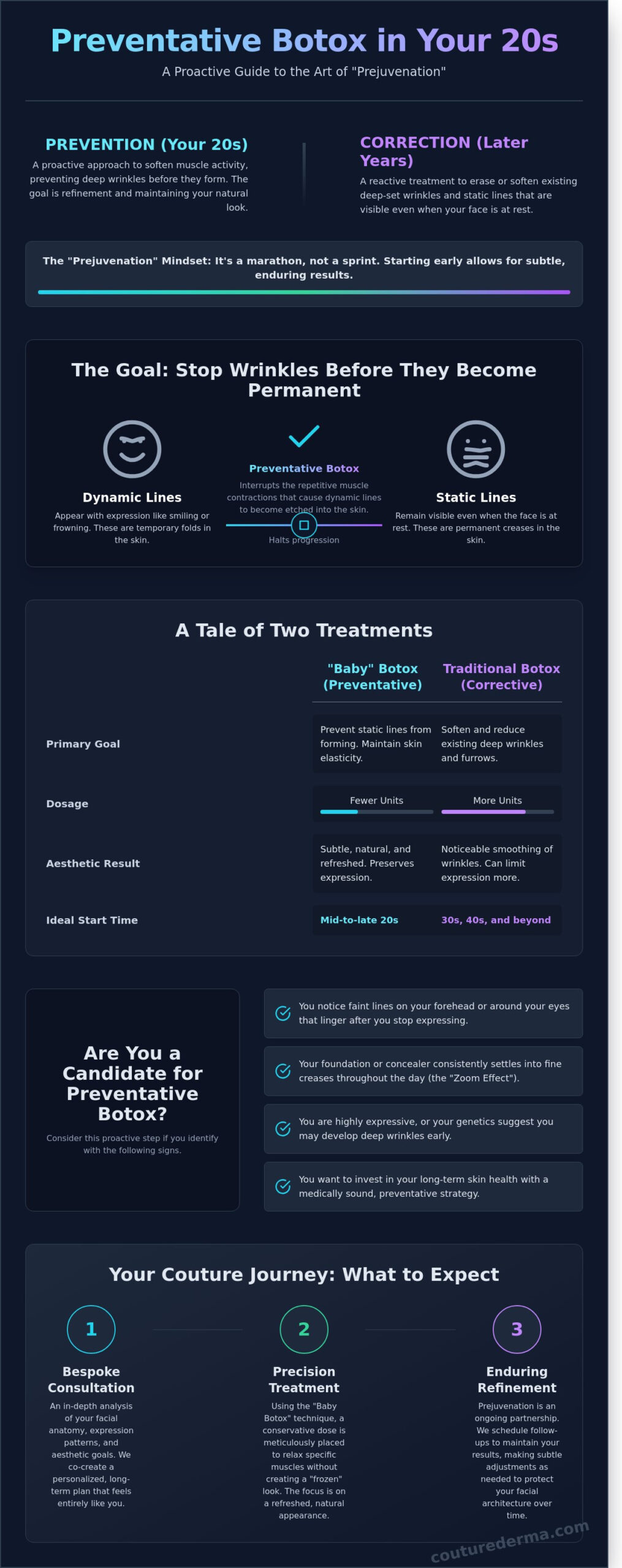
In our Beverly Hills practice, we’ve seen a distinct shift from corrective treatments to “prejuvenation.” This is the intentional use of neurotoxins to soften muscle activity before dynamic lines turn into deep, static wrinkles. It’s about curating a long-term plan for your skin. We view this as a couture-level personalization of your aging process, ensuring your skin remains as smooth as possible for as long as possible.
To better understand this proactive concept, watch this helpful video:
Botox vs. Preventative Botox: What is the Difference?
The main distinction lies in the intention and the dosage. While traditional treatments focus on erasing deep creases, preventative botox for 20s often involves “Baby Botox.” This technique uses fewer units and meticulous placement to preserve your natural expressions. We use Botulinum toxin to gently relax the muscles that cause repetitive folding of the skin.
In my practice, we find that treating these active movements early prevents the skin from “breaking” and forming a permanent scar or wrinkle. The goal is refinement, not a total reversal of age. We want you to look like the most rested version of yourself. This approach ensures your results feel elevated and enduring rather than artificial or frozen.
The Cultural Shift in Beverly Hills Aesthetics
The Los Angeles aesthetic has evolved significantly over the last five years. We’ve moved away from the heavy, obvious look toward a “barely-there” enhancement that celebrates your unique features. This shift reflects a more thoughtful, artistic eye in dermatology. It’s about subtle changes that provide a beautifully smooth finish without looking like you’ve had “work” done.
Starting a relationship with a board-certified dermatologist in your 20s is a pragmatic step. It helps you navigate social media beauty standards with clinical authority and calm confidence. We focus on the “Couture Journey,” emphasizing that skin refinement is a marathon. By starting early, we can maintain your skin’s youthful volume and texture with precision and care.
The Clinical Science: How Preventative Botox Protects Your Future Skin
In my exam room, I often meet 25-year-olds who feel a bit hesitant about starting neurotoxins so early. I explain that your skin is like a fine piece of silk; if you fold that silk in the same place every day, a permanent crease eventually forms. In clinical terms, we track the transition from dynamic lines to static lines. Dynamic lines only appear when you are smiling, squinting, or frowning. Static lines are those that remain visible even when your face is completely at rest. By utilizing preventative botox for 20s, we are essentially pausing the mechanical wear and tear that leads to those permanent etches.
Muscle memory plays a significant role in how we age. When you repeatedly contract the muscles between your brows, often called the “11” lines, those muscles become stronger and more efficient at folding the skin. Neurotoxins like Botox, Dysport, or the long-acting Daxxify work by temporarily blocking the chemical signals that tell these muscles to contract. According to the American Academy of Dermatology, these treatments are highly effective at relaxing the targeted area while leaving the rest of your expressions natural and fluid. The biological window for preventative care exists in that specific interval when expression lines appear only during movement, before the skin’s repeated folding creates a permanent, etched signature.
Training the Muscles: A Long-Term Strategy
Early intervention acts as a form of muscle “weaning.” When we soften the muscle’s pull in your 20s, the muscle eventually learns to be less hyperactive. I have observed in my practice that patients who start with a conservative, couture approach often require fewer units and less frequent visits as they enter their 30s and 40s. The skin quality itself also improves because it isn’t being constantly compressed. This preservation of the dermal matrix ensures the “Beautiful Skin, Bold Confidence” we strive for remains enduring rather than temporary.
Skin of Color and Preventative Care
A couture approach must be culturally competent. Patients with melanin-rich skin often have a denser dermal layer, which can delay the onset of fine lines but may lead to deeper furrows later in life. Dr. Chinonso meticulously curates every treatment to account for these unique dermal thicknesses and the specific risks of post-inflammatory hyperpigmentation. We focus on:
- Adjusting dosage for higher muscle density often found in various ethnicities.
- Preserving the natural “glow” of the skin without over-freezing.
- Strategic placement to avoid any pigmentary changes at the injection site.
If you are curious about how this fits your unique anatomy, you can explore our bespoke consultation process to see if you are ready to begin your journey.
The Fine Line: Can Starting Botox Too Early Actually Age You?
A 26-year-old patient recently sat in my chair, clutching her phone with a look of genuine concern. She’d read a viral article suggesting that preventative botox for 20s could cause her facial muscles to waste away, leaving her looking “older” than her peers. This fear isn’t just internet hyperbole; it’s rooted in the clinical reality of how neuromodulators interact with our anatomy. When we talk about proactive aging, the goal is always refinement, never a total erasure of expression.
The Risk of Muscle Atrophy and “The Frozen Look”
In medical terms, we call the thinning of muscles “disuse atrophy.” If a muscle is completely immobilized for years on end, it naturally loses volume. In the forehead, this can lead to a flattened appearance or even “heavy” brows that sit lower on the face. My philosophy is that “less is more” is a non-negotiable rule for younger patients. I typically aim to soften about 75 to 80 percent of the muscle’s movement. This preserved motion ensures your skin stays smooth while your eyes remain expressive and your brow arch stays lifted. We want to prevent the deep “etched” lines, not create a mask-like finish that feels disconnected from your personality.
Choosing a Surgeon’s Eye over a “Med-Spa” Template
The “uncanny valley” effect usually happens when an injector follows a generic template instead of assessing your unique facial architecture. Many high-volume clinics use the same injection patterns for every patient, which is the opposite of the couture-level personalization we provide. My Harvard-trained background allows me to visualize the specific vectors of your muscle pull. We don’t just inject; we curate. In my practice, I’ve seen hundreds of patients who were over-treated elsewhere, and our first step is always to restore a sense of balance.
- We use precise, small-dose injections to maintain natural facial dynamics.
- We prioritize the “Couture Journey,” ensuring your results look better over five years, not just five days.
- We avoid the “heavy” look by balancing the muscles that pull the brow up with those that pull it down.
By focusing on bespoke placement, our practice ensures that your preventative botox for 20s remains a secret between you and your dermatologist. We’re here to build your bold confidence, not change who you see in the mirror. Skin refinement is a journey, and we’re committed to ensuring you look like the most rested, vibrant version of yourself at every stage.
Determining Your Signature Timeline: Are You a Candidate?
I often see patients in their mid-20s who notice a faint “shadow” in the mirror after a particularly demanding week at work. Determining if you’re truly ready for preventative botox for 20s isn’t about reaching a specific age; it’s about the behavior of your skin under pressure. In my practice, we look for lines that linger. If you stop frowning but a ghost of that expression remains for several seconds, your skin is losing its ability to “snap back” into place.
Genetics play a significant role in this timeline. I frequently ask patients to observe how their parents’ skin has matured. If you share your father’s deep brow furrow or your mother’s delicate eye crinkles, you likely possess the same muscular pull that will etch those lines permanently. Lifestyle factors act as accelerators. I’ve found that patients with high sun exposure or those who use nicotine products often require intervention 3 to 5 years earlier than those with more protected skin.
It’s vital to remember that we occasionally turn patients away. In about 15% of my consultations with younger clients, the skin is still perfectly resilient. If there are no visible signs of dynamic lines becoming permanent, I won’t recommend injections. We prioritize the “Couture” philosophy of intentionality; we never treat for the sake of treating. Instead, we might pivot your plan toward advanced topical nourishment until your skin actually requires a neuromodulator.
The “Static Line” Test
You can perform a simple check at home to evaluate your candidacy. Cleanse your face and sit in bright, natural light. Make a series of exaggerated expressions, then completely relax your face. If you see fine, etched lines that persist while you are at rest, those are transitioning from dynamic to static. It’s easy to mistake dehydration for true wrinkles; dehydration lines often look like a fine, crepey web that vanishes after you apply a rich moisturizer. A professional consultation allows us to map your “wrinkle trajectory” and separate temporary dryness from permanent structural changes.
Beyond Botox: The Role of Laser and Skincare
Botox is an exceptional tool, but it isn’t a silver bullet for skin health. To achieve a truly refined, couture finish, I often recommend integrating “baby lasers” like Clear + Brilliant. This treatment addresses the 1% of collagen that we naturally lose every year starting in our mid-20s. For those seeking texture refinement without significant downtime, Tixel technology can also be a brilliant addition to your journey. Your non-negotiable daily anchors must include:
- Medical-grade Vitamin C: This neutralizes the free radicals that break down your skin’s support system.
- Broad-spectrum SPF: 90% of visible aging comes from UV damage, making daily protection your most important investment.
- Retinoids: These encourage the cellular turnover that keeps the skin surface looking polished and youthful.
The Couture Journey: What to Expect During Your Consultation
Walking into our Beverly Hills clinic feels less like a medical appointment and more like entering a private atelier. We’ve intentionally designed this space to be unhurried because your skin deserves meticulous attention rather than a rushed procedure. During your initial Couture Consultation, we sit down together to align on your aesthetic vision. I don’t just look at static lines; I observe how your muscles interact when you speak, laugh, and frown. This allows me to ensure that preventative botox for 20s looks entirely natural and fluid.
The treatment itself is a masterclass in clinical precision. In my practice, we use ultra-fine needles and specific placement techniques to prioritize your comfort and minimize any potential for bruising. Most of my patients describe the sensation as a tiny pinch that subsides in seconds. The process is efficient, typically lasting about 15 minutes, which means you can return to your day with virtually no downtime. We focus on a “less is more” philosophy to soften the repetitive motions that cause etched lines without sacrificing your ability to express yourself.
Refinement is the final, essential step of our process. I believe that beauty shouldn’t be a guessing game. We follow up to ensure your results are both enduring and elevated, making certain the balance of the face remains harmonious. This proactive approach turns a standard treatment into a signature experience tailored specifically to your anatomy.
A Bespoke Treatment Plan
Every face is a unique canvas, so we never use a one-size-fits-all dosage. I curate the exact number of units based on your muscle strength, skin thickness, and lifestyle. About 14 days after your first visit, we review the results together to ensure the dose was perfect for your specific goals. To maintain these smooth, refreshed results, I typically recommend a maintenance schedule every 3 to 4 months. This consistency prevents the muscles from regaining the full strength that creates deep-set wrinkles over time.
Your First Step Toward Bold Confidence
Choosing preventative botox for 20s is about more than just skin deep aesthetics; it’s a long-term investment in your self-assurance. I’ve treated hundreds of patients who find that taking control of their aging process early provides a profound sense of empowerment. You deserve to feel seen and valued by a provider who understands the nuances of your skin. When you’re ready to begin your Couture Journey, our team is here to provide the expert care and artistic eye you need for a lifetime of bold confidence. Contact us today to schedule your private consultation.
Curating Your Future Radiance
Investing in your skin today creates a foundation for a lifetime of bold confidence. In my practice, I’ve seen how a thoughtful approach to preventative botox for 20s allows patients to maintain their natural expressions while gently softening the repetitive muscle movements that lead to permanent lines. It’s about proactive refinement, ensuring your skin remains as vibrant at age 40 as it looks right now.
Success in prejuvenation requires more than a standard injection; it demands a meticulous, artistic eye. As a Harvard-trained, board-certified dermatologist, I provide a luxury experience rooted in clinical excellence and specialized expertise in all skin types and skin of color. We don’t believe in one-size-fits-all solutions, but rather a bespoke, couture-level personalization for every individual who walks through our doors.
Your skin journey is a personal narrative that deserves the highest level of care and medical authority. I’m ready to help you curate a plan that feels authentic and enduring. Begin Your Couture Journey: Schedule Your Consultation with Dr. Abisogun. Let’s work together to ensure your skin reflects the very best version of yourself.
Frequently Asked Questions About Proactive Aging
Is 22 too young to start preventative Botox?
No, 22 isn’t too young if you’re already seeing the faint beginnings of expression lines. In my practice, I find that about 15 percent of our proactive patients start in their early 20s because they have very expressive faces. If you notice lines that linger for a few seconds after you stop squinting or frowning, it’s an ideal time to begin your couture journey.
Does preventative Botox actually work for long-term wrinkle prevention?
Yes, preventative botox for 20s is highly effective because it trains your facial muscles to move with less intensity. By relaxing these muscles now, you prevent the skin from folding repeatedly, which stops “dynamic” lines from becoming permanent “static” wrinkles. My clinical observations show that patients who start early often maintain smoother skin texture well into their 40s and 50s.
Will my face look “frozen” if I start Botox in my 20s?
Your face won’t look frozen if your treatment is performed with an artistic eye and a conservative touch. We specialize in “micro-dosing,” which uses smaller amounts of product to soften muscle movement while keeping your expressions natural. It’s about refinement rather than total immobilization; you’ll still look like yourself, just a more rested version.
How much does preventative Botox typically cost in Beverly Hills?
While costs vary by provider, 2023 industry data shows that Botox in the Beverly Hills area typically ranges from 20 to 30 dollars per unit. Some boutique practices charge by the treatment area, with prices often starting around 400 dollars per zone. During your consultation, we’ll curate a bespoke plan that outlines exactly what you need for your specific goals.
What happens if I stop getting Botox after starting it young?
If you decide to stop your treatments, your muscles will gradually regain their full strength over three to four months. Your skin won’t suddenly collapse or look older; it simply resumes the natural aging process at its normal pace. I’ve seen many patients pause their treatments for a year or two without any negative impact on their long-term results.
Can preventative Botox help with heavy eyelids or brow position?
We can use neurotoxins to perform a subtle, non-surgical brow lift by targeting the muscles that pull the eyebrows downward. By relaxing these specific muscles, the upward-pulling muscles work more effectively, often lifting the brow by 1 to 2 millimeters. This small adjustment creates a more open, elegant look that beautifully frames your eyes.
How many units of Botox are usually needed for a 25-year-old?
A 25-year-old typically needs a lighter touch, often requiring between 15 and 25 units total for the entire upper face. For instance, we might use 8 units for the forehead and 12 units for the frown lines between the eyes. This conservative approach to preventative botox for 20s ensures your results look sophisticated and never overdone.
Are there side effects to starting neurotoxins early in life?
The side effects of starting early are minimal and typically resolve within 24 to 48 hours, such as tiny pinprick bruises or a mild headache. There’s no clinical evidence that starting in your 20s leads to muscle thinning if the injections are spaced correctly. In my practice, we prioritize your long-term skin health to ensure every treatment contributes to a lifetime of bold confidence.