

You notice fine lines around your eyes in a photo, even though your skin still looks like you. You’re curious whether laser care could help with early signs of aging, but you don’t want to commit to downtime or choose an approach that may not suit your skin tone. At Couture Dermatology & Laser Beverly Hills, I see patients weighing those same questions, including whether preventative laser treatment for aging skin in CA belongs in their skin-care plans.
Here’s the thing: preventative laser care isn’t a race to treat every line. It may help address changes in texture or tone, but it can’t stop natural aging or promise a particular result. I’ll help you understand what laser treatment can and can’t do, how approaches differ, and how laser care may fit alongside daily skin care or other options. The aim is a considered plan based on your skin, goals, and comfort with recovery, not a procedure chosen simply because a concern is beginning to show.
Key Takeaways
- Preventative laser treatment for aging skin ca may be one part of a personalized plan, not a required response to early lines.
- Compare laser approaches based on your skin concern, skin tone, and recovery preferences. No single option suits everyone.
- Daily skin care, dermatologist-directed care, and laser treatment serve different roles in a skin-aging plan.
- Before your consultation, note your skin-care routine, medical history, prior procedures, and goals so your dermatologist can assess your needs.
- At Couture Dermatology, Dr. Chinonso Kagha Abisogun tailors laser planning around your skin assessment, priorities, and recovery considerations.
What Can Preventative Laser Treatment Do for Aging Skin?
You notice a fine line or patchy tone in a photo and wonder if you should act now. I see patients in Beverly Hills asking whether preventative laser treatment for aging skin ca could help when changes are still subtle. The useful first question isn’t how early you noticed them. It’s what may be causing the change and what you hope to address.
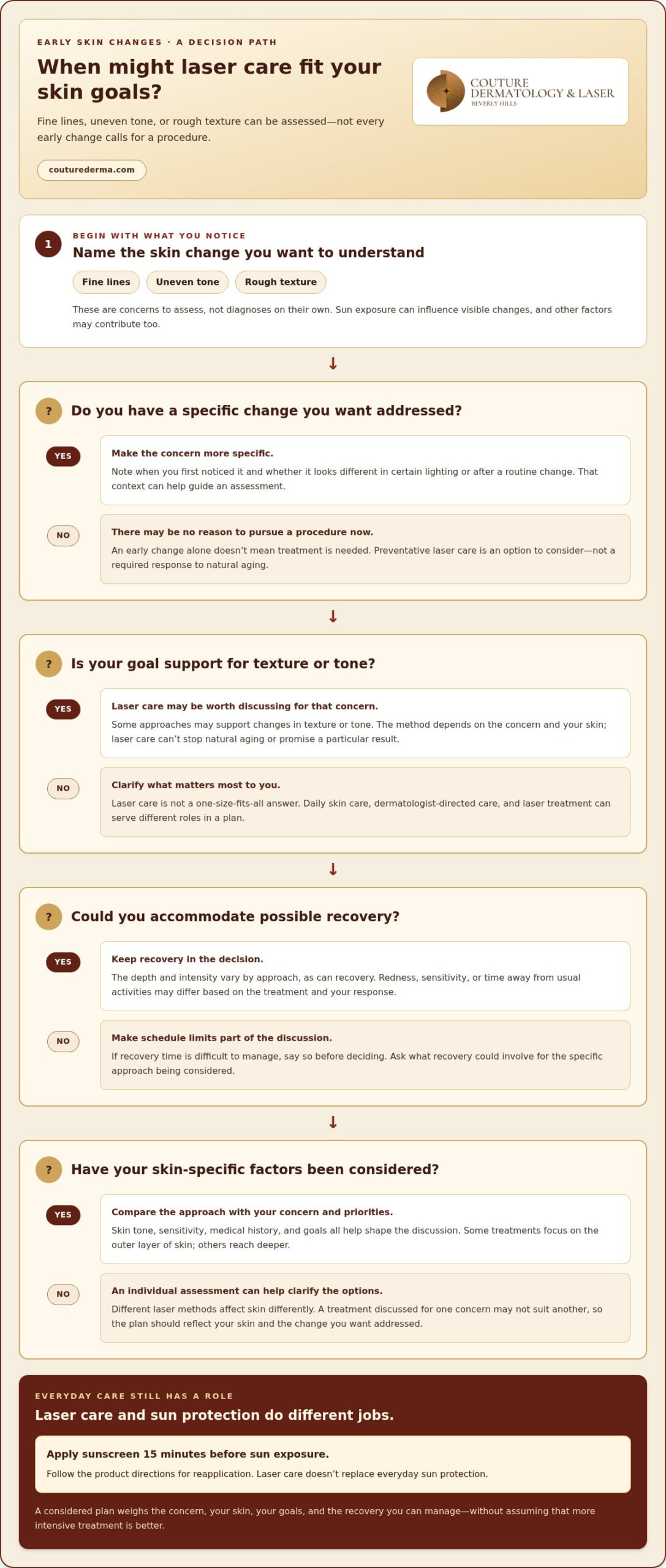
Preventative laser care may be one part of a personalized plan, not a promise or a way to stop natural aging. A laser delivers focused energy to the skin, and some approaches are used to support renewal. Fine lines, uneven tone, and rough texture can have different causes, so a useful plan reflects the concern, your skin history, and your goals.
For a general overview of light-based skin renewal and related approaches, you can read about Photorejuvenation. The video below offers another dermatologist’s perspective on laser options for pigmentation. As you watch, consider how the concern being discussed compares with your own. Treatment should be chosen for the specific skin change, not applied as a one-size-fits-all solution.
What does preventative laser treatment mean?
It means considering laser care before a concern feels pronounced, not treating your skin as if it needs correction simply because you’re getting older. I assess what I can see alongside your skin history, sensitivity, and goals. Depending on the concern, a plan may involve laser care, daily sun protection, or another approach.
Sun protection remains a practical part of caring for your skin over time. Apply sunscreen 15 minutes before sun exposure, then follow the product directions for reapplication. Laser care and everyday habits have different roles, and one doesn’t replace the other. If you’re discussing a procedure, bring your current skin-care routine so we can consider it as part of the plan.
Which early skin changes might prompt a consultation?
Fine lines, uneven tone, and rough texture are concerns to assess, not diagnoses on their own. Sun exposure can influence visible changes, while other factors may contribute too. A dermatologist can help you understand what you’re noticing and whether laser care makes sense for that concern. An early change doesn’t automatically call for treatment.
Before a consultation, note when you first noticed the change and what seems to make it more or less visible. For example, record whether it looks different in certain lighting or after a change in your routine. That timeline gives me useful context and helps shape a plan around your skin, rather than a general idea of what “preventative” should mean.
How Does Laser Treatment Support Skin Renewal Over Time?
You may be comparing laser options and wondering why one person’s plan differs from another’s. Lasers don’t all affect skin in the same way, so the choice depends on the concern, your skin, and the recovery you can manage. Before a consultation, write down your main concern and one secondary priority. That helps keep the discussion focused on what matters most to you.
Some laser treatments create controlled effects in the skin that prompt its natural repair process. Depending on the approach, treatment may support changes in texture or tone. Collagen, a structural protein that helps support skin, is part of the skin’s framework. A treatment may aim to support renewal, but it can’t promise a specific change or stop natural aging.
What happens when a laser treats the skin?
Laser treatment uses focused energy to affect selected areas of skin. The depth and intensity vary by approach, as can recovery. Some treatments focus on the outer layer of skin; others reach deeper. A laser discussed for one concern may not be right for another, so ask which specific change the proposed approach is meant to address.
I talk about the possible goal separately from the limits: what a treatment may address, what it can’t change, and what recovery could involve. Redness, sensitivity, or time away from usual activities may differ based on the treatment and your response. Before deciding, note any schedule constraints and ask how the expected recovery could fit around them.
How does a dermatologist plan for gradual results?
I review your skin tone, sensitivity, medical history, and goals before discussing an approach. These details guide the conversation because laser methods differ in how they affect skin, and individual responses can vary. A plan focused on texture, for example, may differ from one focused on uneven tone.
Laser plans vary because the treatment method, the concern being addressed, and a person’s skin and recovery needs all influence the decision. Expectations and recovery belong in the same conversation. Before you leave a consultation, ask what signs of progress the plan is meant to address and when you’ll review how your skin responds. That helps you understand the process without assuming a particular result.
For someone considering preventative laser treatment for aging skin ca, gradual planning means choosing with care rather than assuming a more intensive approach is better. At our Beverly Hills practice, I discuss the intended goal and recovery before we settle on a plan. If you’re ready to talk through your skin goals, you can book an appointment online.
Is Preventative Laser Treatment Worth Considering Before Deeper Lines Appear?
You’ve started noticing faint lines or uneven tone, but you’re not sure that means you need a laser. In my practice, early changes don’t automatically call for a procedure. Preventative laser treatment for aging skin ca may be worth discussing if it matches your concern and priorities, but daily skin care or a dermatologist-directed approach may be a better starting point.
Think of these options as serving different purposes, not competing with one another. Daily care supports your skin over time. A dermatologist can assess a specific concern and guide care. Laser treatment may address selected visible changes. The right choice depends on your skin tone, sensitivity, goals, and how much recovery time you can accommodate.
How does laser care compare with daily prevention?
Consistent skin care and sun protection are foundational, whether or not you pursue a procedure. Apply sunscreen 15 minutes before sun exposure, and follow the product directions for reapplication. Laser treatment isn’t a replacement for these habits. If you’re weighing laser resurfacing, I’ll discuss its intended goal alongside your routine and what recovery may involve.
| Approach | Possible benefit | Limit to consider | Ask during consultation |
|---|---|---|---|
| Daily skin care and sun protection | Supports ongoing skin care at home | May not address every visible concern | Is my routine suited to my concern? |
| Dermatologist-directed care | Connects an assessment with a tailored plan | May involve options beyond laser treatment | What could we try before considering a procedure? |
| Laser treatment | May target selected skin changes | Recovery and response vary by person and approach | What goal and recovery should I expect? |
Can laser treatment be tailored to different skin tones?
Yes, treatment planning should account for skin tone, but that doesn’t mean one approach is right for everyone. Melanocytes, the cells that produce skin pigment, influence skin color and are one factor I consider when assessing a laser option. I also review sensitivity, medical history, previous procedures, goals, and recovery preferences before recommending a plan.
If texture is your main concern, its cause matters too. Texture related to old acne scars, for example, calls for a different conversation than early fine lines. You can read about acne scar refinement for that distinct concern. Bring your questions and describe what you hope to change. Sometimes the most useful outcome of a consultation is learning that you can wait.
How Should You Prepare for a Preventative Laser Consultation in Beverly Hills?
You’ve noticed a change in your skin, but you’re unsure how to explain what bothers you or what you’d want to change. That’s a good place to start. In a consultation at our Beverly Hills practice, I want to understand your priorities and day-to-day needs before discussing whether laser care might fit.
What should you bring up during a laser consultation?
A little preparation can make the conversation more useful. Before your visit, jot down the concerns you’d like to discuss, when you first noticed them, and whether anything seems to affect them. Bring or write down the skin-care products and prescription treatments you use, along with any past reactions or procedures.
Share your relevant medical history, including medications and supplements. Then tell me what kind of change you’re hoping for and how gradual you’d like the process to be. Questions about possible recovery, follow-up, and how a proposed treatment fits your schedule are part of the planning, not afterthoughts.
What can you do before treatment is planned?
I’ll assess your skin tone and sensitivity, review your history and prior procedures, and consider the recovery time you can reasonably accommodate. These details help shape an approach around your skin and goals. Preparation can vary with the treatment being considered, so don’t start, stop, or adjust products on your own while anticipating a procedure. Follow the instructions your dermatologist gives you.
If you use prescribed tretinoin, a medicine applied to skin, ask how it fits into your individual plan. When your clinician has instructed you to apply it, wait 20 minutes after cleansing before applying tretinoin. That timing isn’t a substitute for treatment-specific directions; your dermatologist can advise whether your routine needs any changes.
Before the consultation, write down your top concern and one practical recovery question, such as what visible changes to expect afterward. It can make it easier to focus on the details that matter most to you. To arrange a dermatologist-led conversation about your skin and goals, book a consultation online.
What Does a Personalized Laser Plan at Couture Dermatology Look Like?
You may come in focused on one early line, a patch of uneven tone, or texture that looks different in certain light. In my Beverly Hills practice, I start by listening to what you’ve noticed and what you’d like to change. Then I consider your skin, history, and priorities together. The aim is a considered plan, not a predetermined procedure.
How does the dermatologist tailor an approach?
I’m Dr. Chinonso Kagha Abisogun, and I lead treatment planning at Couture Dermatology & Laser Beverly Hills. I assess the concern you want to address, your skin’s characteristics and sensitivity, your medical and treatment history, and how much change you’re seeking. I also want to understand what recovery time feels realistic for you. Those details help shape a discussion that fits your life as well as your skin.
Laser skin resurfacing may be one option, but it isn’t automatically the next step. In my clinical experience, the most useful plan is often the one that matches the specific concern and your comfort with the process. General information can explain how treatments work; your assessment helps us decide whether a particular approach makes sense for you.
At Couture Dermatology & Laser Beverly Hills, we can also discuss the Fotona laser in relation to melasma, a type of uneven skin pigmentation. That’s a distinct concern, and it shouldn’t be confused with a general plan for aging skin. I’ll keep the conversation centered on the reason you came in and what an appropriate approach might involve.
What is a sensible next step if you are considering laser care?
Bring one or two priorities rather than arriving committed to a specific procedure. You might say that uneven tone bothers you more than fine lines, or that you want to understand recovery before deciding. If you’d like a broader overview, look for our skin rejuvenation guide alongside this discussion.
Preventative laser treatment for aging skin ca is best considered through a conversation that connects your goals with an individual assessment. I’ll explain the options and their limits, then discuss a plan without promising a particular result. If you’re ready to take that next step, book a consultation online.
Start With a Plan That Fits Your Skin
Preventative laser treatment for aging skin ca is best approached as a personal choice, not a step everyone needs to take as soon as fine lines appear. Laser care may be one option within a broader skin-aging plan, while daily sun protection and consistent skin care remain important. The right approach depends on your concerns, skin assessment, goals, and comfort with recovery.
At Couture Dermatology in Beverly Hills, serving Los Angeles, care is led by Harvard-trained dermatologist Dr. Chinonso Kagha Abisogun. A consultation is a chance to discuss what you’ve noticed, review your skin history, and understand whether laser treatment may suit your priorities. No specific result can be promised, but a thoughtful conversation can help you make a more informed choice.
If you’re ready to talk through your goals, book an online consultation. You can take the next step at a pace that feels right for you.
Frequently Asked Questions
Is preventative laser treatment for aging skin worth considering?
It may be worth discussing if early lines, uneven tone, or texture bother you, but laser treatment isn’t necessary for everyone. Preventative laser treatment for aging skin ca should be considered in light of your specific concern, skin history, tone, goals, and comfort with recovery. A dermatologist can help you weigh laser care against daily skin care or another approach, without assuming a procedure is the right first step.
Can laser treatment prevent wrinkles from forming?
No. Laser treatment may address selected visible skin changes, but it can’t stop natural aging or guarantee that wrinkles won’t develop. I discuss what a treatment may realistically improve and how it might fit alongside sun protection and daily skin care. A useful plan is based on your skin and priorities, not simply on trying to treat it before lines appear.
How early should you consider laser treatment for aging skin?
There’s no single age or timeline that suits everyone. Consider a consultation when a specific concern, such as uneven tone or rough texture, bothers you and you’d like to understand your options. I review your skin history, current routine, and goals before discussing laser care. Sometimes another approach, or waiting, may fit your needs better than starting treatment now.
Is laser treatment safe for every skin tone?
No single laser plan should be assumed to suit every skin tone. Melanocytes, the cells that produce skin pigment, and your skin history can influence treatment planning. I assess your skin and the concern being treated before discussing options. During a consultation, ask about possible risks, recovery, and alternatives so you can make an informed decision rather than rely on a blanket safety claim.
What should I use alongside preventative laser treatment?
Daily sun protection is an important part of a broader skin-care plan, but products should suit your skin and goals. Apply sunscreen 15 minutes before sun exposure, and follow the product directions for reapplication. If you use prescription skin care such as tretinoin, follow your clinician’s instructions. When directed to apply it, wait 20 minutes after cleansing before applying tretinoin.
Can Fotona laser treat melasma and aging skin?
Couture Dermatology’s guidance connects the Fotona laser with melasma, a condition involving patches of increased skin pigment. Melasma and age-related texture or lines are different concerns, so don’t assume one treatment plan addresses both. I consider the specific concern, your skin characteristics, and your goals before discussing an appropriate approach. A consultation can help clarify what the treatment is intended to address.
What happens at a laser consultation in Beverly Hills?
You’ll have a chance to describe what you’d like to change and discuss your skin history, current routine, and expectations. I assess the concern and talk through possible approaches, their limits, and recovery considerations. At Couture Dermatology in Beverly Hills, I use that conversation to shape a plan around your priorities. We serve patients in Los Angeles seeking dermatologist-led laser care.
Should I try skin care before booking a laser consultation?
Skin care can be a useful starting point, but a consultation may help if a concern persists or you’re unsure what to use. The right timing depends on the concern, your routine, and how your skin responds. Bring a list of your current products and questions. A dermatologist can help you consider whether adjusting your routine or discussing laser treatment better fits your goals.