

You notice a widening part, tenderness along your hairline, or a small area where hair hasn’t grown back. It’s natural to wonder whether the loss is temporary or could involve scarring that damages hair follicles. If you’re looking for a scarring alopecia specialist los angeles patients can consult, a careful assessment can help you understand what to consider next.
In my practice, I see patients who arrive unsure whether their hair loss is scarring or non-scarring. That distinction matters. A thoughtful evaluation starts with your symptoms, hair-loss pattern, and medical history, not assumptions. You deserve clear answers and a plan shaped around your needs.
This guide explains what an evaluation may involve, what credentials and care approach to look for, and what to bring to a consultation. I’ll also explain how our Beverly Hills medical dermatology practice approaches alopecia care. Dr. Karen “Chinonso” Kagha Abisogun, MD, FAAD, is a Harvard-trained, board-certified dermatologist. The first step is understanding what your scalp is telling you.
Key Takeaways
- Scarring and non-scarring hair loss can need different care, so a clinician’s assessment can help clarify your next steps.
- When choosing a scarring alopecia specialist Los Angeles patients can consider, look for board certification, relevant medical dermatology experience, and a personalized approach.
- Bring a timeline of changes, a medication list, and notes about hair-care practices or approaches you’ve tried to help guide your consultation.
- Ask how the dermatologist considers your medical history, symptoms, and hair-loss pattern when shaping an evaluation.
- A consultation at Couture Dermatology & Laser Beverly Hills offers a personalized starting point for discussing alopecia care with a dermatologist.
What makes scarring alopecia different, and why timely assessment matters in Los Angeles
You notice a small patch where hair looks thinner than it did a few weeks ago, or your scalp feels tender when you brush it. It’s easy to wonder whether a new hairstyle, irritation, or a health concern could be behind the change. In my practice, I encourage you to treat a new or changing scalp symptom as a reason to seek medical guidance, not as proof of a particular diagnosis.
Hair loss can look similar for different reasons. A dermatologist considers the pattern alongside your history and scalp symptoms. A photo or a single sign can’t reliably show what’s happening beneath the surface. An assessment can help clarify what questions to explore and whether further evaluation is appropriate.
What does scarring alopecia mean?
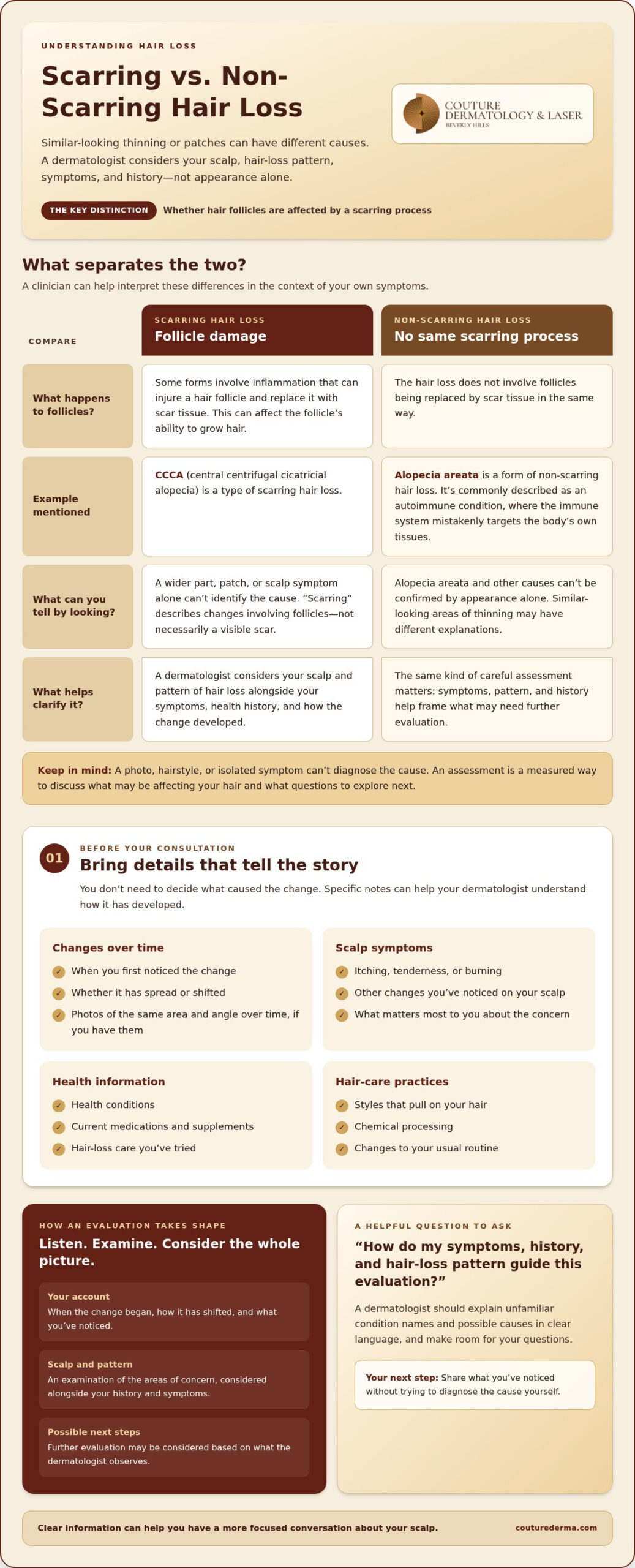
Scarring alopecia is a group of hair-loss conditions associated with damage to hair follicles, the small structures in the skin that produce hair. In some forms, inflammation can injure a follicle and replace it with scar tissue, affecting its ability to grow hair. The word “scarring” describes changes involving the follicle, not necessarily a visible scar that you can identify by looking in a mirror.
There are several conditions under this umbrella, and they don’t all present in the same way. The overview of Scarring Hair Loss (Cicatricial Alopecia) describes different types and causes, but it can’t determine which, if any, applies to you. A wider part, a patch, or scalp discomfort may have more than one explanation. Don’t use a hairstyle, photograph, or isolated symptom to diagnose yourself.
Here’s a practical first step: note when you first saw the change and whether it has shifted since then. If you take photos, try to capture the same area and angle over time. A timeline can help your dermatologist understand what you’ve noticed without asking you to interpret the cause on your own.
How is it different from alopecia areata?
Alopecia areata is a form of non-scarring hair loss. It’s commonly described as an autoimmune condition, meaning the body’s immune system mistakenly targets its own tissues. In this condition, hair follicles aren’t described as being replaced by scar tissue. But appearance alone can’t confirm alopecia areata or distinguish it from other causes.
Scarring hair loss involves damage to hair follicles, while non-scarring hair loss does not involve the same scarring process. That difference helps explain why a professional assessment matters: similar-looking areas of thinning can have different causes and call for different next steps. If you’re choosing a scarring alopecia specialist Los Angeles residents can consult, look for a dermatologist who asks how the change began and what you’ve noticed since.
Timely assessment gives you a chance to discuss the concern while the pattern and symptoms are part of your current experience. It doesn’t guarantee a specific diagnosis or result, and it doesn’t mean you should assume the worst. It’s a measured first step toward understanding what may be affecting your hair and discussing a care plan with a clinician. For individuals researching broader hair restoration options, specialized providers like DHI South Africa emphasize that identifying whether follicles are viable or permanently damaged is essential before exploring advanced treatments.
How a scarring alopecia specialist evaluates hair loss and possible causes
A careful evaluation isn’t a checklist you can complete at home. I start by listening to what you’ve noticed, then consider your scalp and hair-loss pattern in the context of your health and daily hair-care practices. The goal is to understand the concern as a whole, not to make a diagnosis from one symptom.
Your conversation will be more useful when you can share specific details. Write down when the change began, whether it has spread or shifted, and whether you’ve noticed itching, tenderness, burning, or another scalp symptom. These details don’t prove a cause, but they help your dermatologist understand how the concern has developed.
What history can help a dermatologist understand?
Before your visit, note any health conditions, current medications and supplements, and hair-loss care you’ve tried. Include hair practices such as styles that pull on the hair, chemical processing, or changes in your usual routine. You don’t need to decide whether any of these caused the loss. Sharing the details gives your dermatologist a fuller picture.
In my practice, I also want to know what matters most to you, whether that’s understanding a changing area, easing discomfort, or discussing how the concern affects your confidence. A scarring alopecia specialist Los Angeles patients see should explain unfamiliar condition names and possible causes in clear language, then make room for your questions. You can also use the Scarring Alopecia Foundation as an educational and support resource alongside individual medical guidance.
Why can different causes look similar?
Two conditions may both involve visible thinning or a patch of hair loss, yet affect the follicles in different ways. Central centrifugal cicatricial alopecia (CCCA) is a type of scarring hair loss, while alopecia areata is generally described as non-scarring hair loss. Those names can sound intimidating, but your clinician should explain what they mean and why they’re being considered in your case.
Pattern and history help frame the assessment, but neither confirms a diagnosis by itself. Your dermatologist will examine the areas of concern and consider those findings alongside your account of how the change developed. From there, they can decide whether further evaluation is appropriate. The next step depends on what’s observed; a particular test or procedure isn’t right for everyone.
If you’re ready to discuss your hair-loss concern in a medical dermatology consultation, you can book a visit with our practice. Bring your notes and questions. We’ll use them to guide a thoughtful conversation about your history, what you’re noticing, and possible next steps.
How to assess a scarring alopecia specialist in Los Angeles
Choosing a dermatologist for possible scarring hair loss is about more than finding a familiar name. Look for a clinician with relevant medical training who listens closely, explains what they’re considering, and shapes the conversation around your needs. Credentials offer useful context, but they can’t promise a particular diagnosis or result.
Here’s a straightforward way to compare the care priorities that matter:
Clinical credentials: Look for a board-certified dermatologist with clear dermatology training. At Couture Dermatology & Laser Beverly Hills, Dr. Karen “Chinonso” Kagha Abisogun, MD, FAAD, is a Harvard-trained, board-certified dermatologist. She completed a cosmetic and laser fellowship at Harvard Medical School and Massachusetts General Hospital’s Wellman Center.
Relevant medical care: Consider whether the practice provides medical dermatology care that includes alopecia. Couture Dermatology & Laser Beverly Hills’ Medical Dermatology service treats alopecia.
Personalization: Your medical history, scalp concern, and goals should inform the discussion rather than being reduced to a single pattern or symptom. Couture Dermatology & Laser Beverly Hills emphasizes individualized care.
Inclusive experience: The practice should be prepared to care for people with varied skin types and tones. Couture Dermatology & Laser Beverly Hills serves patients with diverse skin types and tones.
Which credentials and care approach matter?
Board certification indicates that a dermatologist has met professional standards in their specialty. Relevant training gives you context about a clinician’s education and experience, but neither credential guarantees a specific diagnosis or outcome. Consider credentials alongside how clearly the dermatologist discusses your concern and possible next steps.
At Couture Dermatology & Laser Beverly Hills in Beverly Hills, I bring your history and individual concerns into a medical dermatology conversation about alopecia. I don’t assume that every person with thinning hair has the same cause or needs the same approach. If a condition name comes up, you should leave understanding what it means and why it may be relevant, not feeling pressured to interpret medical language on your own.
How should skin tone and hair history fit into the conversation?
Your skin tone and hair-care history belong in the discussion without becoming a source of blame. Tell your dermatologist about styles, treatments, or routine changes you think may be relevant, even if you’re unsure they’re connected. Those details add context; they don’t establish a cause by themselves.
As you compare options for a scarring alopecia specialist Los Angeles patients can consult, notice whether the clinician invites these details and listens without judgment. A useful visit makes room for your questions and explains how your concerns will guide the assessment. For a broader framework on evaluating dermatology care, explore our guide to choosing a dermatologist in Los Angeles.
What to prepare before a scarring alopecia consultation in Los Angeles
You don’t need to arrive with a theory about what’s causing your hair loss. It can be more helpful to think about what you want from the conversation: clearer language for what you’re experiencing, a better understanding of the assessment, or help weighing possible next steps. Choosing a few priorities can make it easier to speak up if the visit feels overwhelming.
What information should you bring?
Consider writing a short note about how the concern is affecting you day to day. For example, you might mention that you’re avoiding certain social situations, feeling distracted by the change, or unsure how to style your hair comfortably. This isn’t a diagnostic clue or something you need to justify. It gives your dermatologist a fuller sense of what matters to you.
You can also note any preferences that may help the discussion feel clear and manageable. Perhaps you’d like medical terms explained as they come up, want time to think before making a decision, or prefer to hear the main points summarized near the end. There’s no need to prepare a perfect script. A few reminders on your phone or a small note card can help you return to the questions that matter most.
If you feel self-conscious talking about hair loss, it may help to write your opening sentence ahead of time, such as, “I’m concerned about a change in my hair, and I’d like to understand what might be going on.” Simple and direct is enough. You can also tell the dermatologist if the concern is affecting your confidence or sense of comfort.
What questions can help make the visit useful?
Rather than trying to ask everything at once, choose the questions that would help you feel informed. You might ask how the dermatologist will explain the assessment, what parts are still uncertain, or what choices you may have after discussing the findings. If a term is unfamiliar, pause and ask for a plain-language explanation.
It can also help to ask how you’ll know whether the next step addresses your main concern. If you leave unsure about a recommendation, say so. A useful discussion should give you room to understand the reasoning and consider your options at a pace that feels comfortable.
When you’re ready to begin that conversation with our Beverly Hills practice, schedule a personalized dermatology appointment.
Personalized alopecia care at Couture Dermatology
Online photos can’t tell you what’s happening in your own scalp. Similar patterns may have different causes, and comparing your appearance with an image can leave you with more questions than answers. A dermatologist can help you move from online guesswork toward a conversation grounded in your individual concern.
Couture Dermatology & Laser Beverly Hills is a medical and cosmetic dermatology practice serving Los Angeles. Its Medical Dermatology service treats alopecia, with care tailored to your concerns and goals. A consultation is a starting point for discussing what may be going on, not a promise of a particular diagnosis, treatment, or result.
What can you expect from a personalized discussion?
I want you to feel comfortable describing what concerns you and what you hope to understand. We can talk through the information available, clarify what it may suggest, and address what remains uncertain. The aim is a considered discussion, not pressure to reach a conclusion before you’re ready.
Dr. She completed a cosmetic and laser fellowship at Harvard Medical School and Massachusetts General Hospital’s Wellman Center. Her background informs the medical dermatology care at Couture Dermatology & Laser Beverly Hills, while the conversation remains focused on your needs. You can ask how a recommendation relates to your concern and what other options may be worth discussing.
Hair loss can affect how you feel about your appearance and your sense of ease in everyday situations. You don’t need to minimize that or arrive with the perfect words. Let your dermatologist know what feels most important to address. A personalized discussion makes space for both the medical concern and its effect on you.
How can you take the next step in Beverly Hills?
If you’re considering a scarring alopecia specialist in Los Angeles, a medical dermatology consultation gives you a place to discuss your concern with a clinician. Couture Dermatology & Laser Beverly Hills provides medical dermatology care in Beverly Hills for patients from the Los Angeles area. The conversation can help clarify what is understood and whether further evaluation may be appropriate.
You can help shape the visit by naming what you hope to get from the conversation, such as understanding the clinician’s thinking or learning what choices may be available. It’s also fine to ask for more explanation or time to consider a recommendation. Care should feel like a discussion you can take part in, not a decision made for you.
If you’re ready to discuss your concern with our practice, book an appointment with Couture Dermatology & Laser Beverly Hills.
Take the Next Step Toward Clearer Answers
Uncertainty about hair loss can make it tempting to keep comparing photos or waiting for a pattern to become obvious. You don’t have to solve the mystery on your own. A focused conversation with a dermatologist can help turn your observations and questions into a considered plan for what to explore next.
If you’re looking for a scarring alopecia specialist Los Angeles patients can consult, bring what you’ve noticed and what you hope to understand. You don’t need to have a diagnosis ready. Begin with your concern and ask for a clear explanation of the assessment and possible next steps.
At Couture Dermatology, I want you to feel heard and informed as we discuss your hair and scalp concerns. A consultation is a starting point for personalized medical guidance, not a promise of a specific result. When you’re ready to begin that conversation, book a personalized dermatology appointment.
Frequently Asked Questions
Is scarring alopecia the same as alopecia areata?
No. Alopecia areata is generally described as non-scarring hair loss, while scarring alopecia involves damage to hair follicles. Both may cause visible patches or thinning, so the shape of an area alone can’t tell you which condition is present. A dermatologist considers your scalp and health history together. If you’ve noticed a new patch, avoid labeling it from photos online and arrange an assessment.
Can hair grow back after scarring alopecia?
It depends on whether the follicles in an area have been permanently damaged and on what’s causing the hair loss. Hair may not grow from a follicle that has been replaced by scar tissue, but a dermatologist can discuss what may be possible in your situation. A useful question to ask is whether the care goal is to protect remaining hair, address symptoms, or both. For patients researching hair loss therapies and restoration approaches, educational guides from specialized practices such as BHR Clinic can provide valuable perspective on the effectiveness of various interventions.
What are common signs that hair loss needs a dermatologist’s assessment?
Consider a medical assessment if you notice a steadily changing area, scalp discomfort, or changes such as redness or scaling alongside hair loss. These signs don’t confirm scarring alopecia, and some people have little discomfort. The key is a change that concerns you or continues to progress. Note where you first noticed it and whether any scalp symptoms come and go.
How is scarring alopecia diagnosed?
A dermatologist assesses your history and examines the scalp, then decides whether more evaluation is needed. Depending on what they find, this may include a scalp biopsy, a small tissue sample examined to help identify changes in the follicle. A biopsy isn’t needed in every case. Ask what the clinician is looking for, what each step can clarify, and when you can expect to discuss the findings.
What causes central centrifugal cicatricial alopecia?
The exact cause of central centrifugal cicatricial alopecia (CCCA), a type of scarring hair loss, isn’t fully understood. It may be tempting to blame one styling choice or product, but the cause shouldn’t be assumed from your hair-care history alone. A dermatologist can explain how CCCA is considered and whether other factors may matter in your case. Bring up family history or health concerns you think may be relevant.
Can hairstyles or hair-care practices contribute to scarring hair loss?
Some practices that repeatedly place tension on hair may contribute to hair loss, and ongoing injury can sometimes lead to scarring. That doesn’t mean a particular style caused your concern or that you’re to blame. Until you’ve had an assessment, consider choosing styles that feel comfortable and avoid pulling that causes pain. Tell your dermatologist about styling, chemical treatments, and changes in your routine.
Where can I see a scarring alopecia specialist in Los Angeles?
Couture Dermatology & Laser is a Beverly Hills practice serving Los Angeles, and its Medical Dermatology service treats alopecia. If you’re seeking a scarring alopecia specialist Los Angeles patients can consult, a personalized dermatology visit can help you discuss your concerns and possible next steps. Bring your questions and notes about changes you’ve observed. You can book an appointment with Couture Dermatology.