

You’ve kept up with your moisturizer, yet your skin still looks a little less fresh than you’d like. And you’re not looking for a dramatic change. If you’re considering a skinvive hydrating injectable beverly hills consultation, start with a simple question: what would you like to notice when you look in the mirror?
I see patients who know they want a more refreshed appearance but aren’t sure how to describe it, or how to separate a skin-quality goal from a wish for more facial volume. That uncertainty is worth discussing openly. You don’t need to arrive with a treatment decision already made.
In this guide, I’ll help you clarify what you hope to improve, identify skin details that may matter in a consultation, and prepare questions that make the conversation more useful. The aim isn’t to talk you into a procedure. It’s to help you approach the decision with clearer expectations and a plan shaped around your goals.
Key Takeaways
- Before considering an injectable, clarify whether your goal is improved skin quality or added facial volume.
- Skinvive is discussed for hydration and smoothness, while moisturizers are applied to skin and traditional fillers focus on volume.
- A consultation can help you explore whether a hydration-focused approach fits your goals. Suitability depends on an individualized clinical assessment.
- Before an appointment, note your skin history and prior treatments, gather details about your current skincare routine, and write down questions about expectations.
- Dr. Karen “Chinonso” Kagha Abisogun, MD, FAAD, is a Harvard-trained, board-certified dermatologist who tailors care to your skin history, lifestyle, and goals.
Is Skinvive in Beverly Hills the right fit for your skin goals?
Your skin looks less fresh, even though you’ve kept up with moisturizer. Before choosing another product or considering an injectable, get specific about what you want to change. The question behind a skinvive hydrating injectable beverly hills consultation is whether your priority is skin quality, such as hydration and smoothness, or facial reshaping through added volume.
Here’s the plain-language distinction: Skinvive is a hyaluronic acid microdroplet injectable discussed for skin hydration and smoothness, not for changing facial shape. It may be relevant to a conversation about a refreshed skin appearance without adding cheek, lip, or jawline volume. A clinician can assess your goals and explain what results are realistic for you.
What does Skinvive aim to address?
Hyaluronic acid is a substance that attracts and holds water; you can read a general overview of hyaluronic acid. With Skinvive, the product is placed in small droplets within the skin. The goal is skin quality, rather than building the contours or fullness associated with volume-focused fillers.
That distinction can help you make sense of your options. If you’re bothered by skin that looks dull or feels less hydrated, ask whether a hydration-focused approach fits your goal. If you’re concerned about flatter cheeks, thinner lips, or a jawline that lacks definition, those are volume or contour goals. Skinvive isn’t intended to create that kind of change.
What are you hoping to change?
In my practice, it helps to name the concern you notice first, rather than arriving with a treatment already chosen. Look at your skin in the everyday lighting where you tend to notice it most. Is the main issue a lack of freshness, uneven texture, acne scarring, pigmentation (areas of darker skin color), or a change in facial volume?
Those concerns can call for different conversations. A hydration-focused goal isn’t the same as wanting acne scars softened, pigmentation assessed, or facial contours restored. Skinvive may not address the cause of a particular skin symptom, so describe what you see and when you notice it. Bring relevant skin history and prior treatments so your dermatologist can consider the concern in context.
Before a consultation, try writing one sentence about your goal: “I want my skin to look more hydrated, but I don’t want to change my facial shape.” That gives us a useful starting point. From there, I can assess your skin and discuss whether this approach suits your goal, whether another option is more relevant, and what outcome is reasonable to expect. Suitability calls for an individualized clinical assessment, not a decision based on one feature or preference.
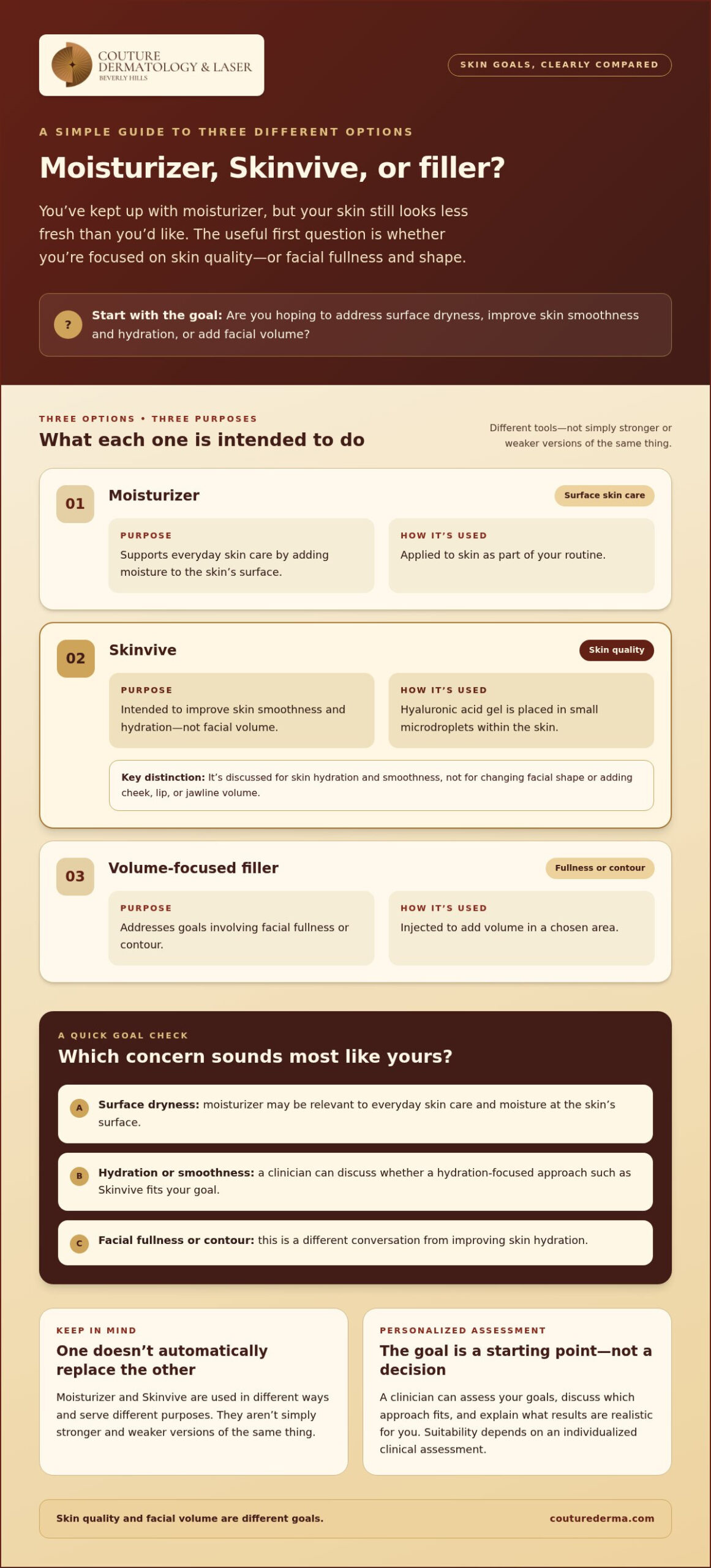
How does Skinvive differ from moisturizer and traditional fillers?
If your moisturizer is part of a routine that works for you, Skinvive isn’t a reason to abandon it. These options serve different purposes and are used in different ways. I find it helpful to compare them by the concern you want addressed, rather than treating skincare and injectables as interchangeable.
| Option | Primary purpose | How it’s used |
|---|---|---|
| Moisturizer | Supports everyday skin care by adding moisture to the skin’s surface. | Applied to skin as part of your routine. |
| Skinvive | Intended to improve skin smoothness and hydration, not facial volume. | Hyaluronic acid gel is placed in small microdroplets within the skin. |
| Volume-focused filler | Addresses goals involving facial fullness or contour. | Injected to add volume in a chosen area. |
A simple distinction: Skinvive is an injectable intended to support skin quality, while volume-focused fillers address facial fullness or contour. The FDA’s approval document for Skinvive offers official product information. A clinician can explain how its intended role relates to your goals.
When might moisturizer address the concern?
Moisturizer remains a useful part of many skincare routines. It’s applied to the skin and can help with surface dryness, while Skinvive is an injectable approach discussed for skin smoothness and hydration. One doesn’t automatically replace the other. They’re different tools, not simply stronger and weaker versions of the same thing.
If a concern continues despite a routine you tolerate well, don’t assume dehydration is the cause or add treatments based on guesswork. Note what you’re seeing, when it appears, and what you already apply to your skin. I can assess whether the concern seems related to dryness, texture, pigmentation, or something that calls for a different plan.
When is volume-focused filler a different conversation?
Think about the result you’re picturing. Wanting more cheek fullness, lip volume, or a more defined jawline is a contour or volume goal, rather than a request to improve skin hydration. If jawline definition is your focus, you can learn about jawline contouring as a distinct aesthetic discussion.
For a skinvive hydrating injectable beverly hills consultation, bring the goal you’d like to address and relevant skincare or treatment history. I can assess your skin and discuss which approach fits, including whether your priority calls for skincare, an injectable focused on skin quality, or a separate conversation about facial volume.
Who may be a candidate for Skinvive in Beverly Hills?
You may want your skin to look more refreshed without changing the shape of your face. That’s a useful goal to bring to a consultation, but it doesn’t by itself establish whether Skinvive is appropriate for you. I assess the concern you want to address, your skin history, and the change you expect before discussing a hydration-focused injectable.
At our Beverly Hills practice in Los Angeles, we approach that conversation with care for different skin tones and histories. The same words, like “dull” or “tired,” can describe different concerns. The right discussion begins with what you notice, not an assumption that one treatment suits everyone.
Which goals are aligned with a hydration-focused injectable?
Skinvive is intended to support skin hydration and smoothness. If you hope for a fresher-looking skin surface rather than fuller cheeks or a more defined jawline, that distinction may help frame the conversation. It’s a starting point, not a promise of suitability or a particular result.
Try describing the change you want without naming a procedure: “I’d like my skin to look less dull, but I don’t want more facial volume.” Then note where you see the concern and what you’ve already tried. This gives your dermatologist a clearer picture of whether your expectation matches the treatment’s intended role.
Share relevant details about your skin and prior care, including past injectable treatments, procedures, sensitivities, or changes you’ve noticed. Don’t leave out a treatment simply because it happened years ago. Your clinician can use that context to assess suitability and discuss realistic expectations. An individualized clinical assessment is needed to guide that decision.
When should you discuss another skin concern?
Some concerns need their own assessment rather than being folded into a Skinvive decision. Acne scarring, for example, involves changes left behind after acne, and the right approach depends on the scar pattern and your skin. If scarring is your main priority, discuss acne scar refinement as a separate goal.
Under-eye darkness or hollowness also deserves a focused conversation. Those concerns can have different causes, so tell your dermatologist what you notice and what you hope to change instead of assuming a hydration injectable will address them. If the area beneath your eyes is your main concern, under-eye brightening is a distinct discussion.
Before booking a skinvive hydrating injectable beverly hills consultation, write down your primary goal and one or two questions about suitability. That small step can keep the appointment centered on your priorities. If you have more than one concern, mention each one so we can discuss them separately and shape the conversation around your skin.
What should you ask before booking a Skinvive consultation?
A useful consultation starts before you arrive. If you’re considering a skinvive hydrating injectable beverly hills appointment, prepare to explain the change you hope to see, not just the name of a treatment you’ve read about. That helps me understand whether your goal matches Skinvive’s intended role and gives us room to discuss other approaches if it doesn’t.
Use this short sequence to organize your thoughts:
- Clarify your goal. Write down the skin concern you notice most and what you’d like to look or feel different.
- Note your history. List relevant skin concerns, previous procedures or injectables, and any sensitivities or reactions you’ve experienced.
- Prepare your questions. Ask how the clinician assesses whether your requested result fits Skinvive, what the treatment is intended to address, and what its limits are.
- Discuss expectations. Describe what would feel like a worthwhile outcome, then ask whether that expectation is realistic for your skin and goals.
Save this checklist: “My main concern is ___. I first noticed it ___. I’ve tried or had ___. I hope to improve ___. What approach fits that goal, and what should I realistically expect?”
What information helps make the consultation useful?
Bring your current skincare routine, including the products you apply to your skin, and details about relevant prior treatments. You don’t need a perfect record. A brief note about what you use, what you’ve tried, and what seemed to bother your skin can make the conversation more specific.
Also note when the concern became noticeable and whether it changes in different lighting or with your routine. In my practice, these details help separate what you’re seeing from what you assume is causing it. Share your skin history openly, including previous procedures, so your dermatologist can consider the full picture rather than make a recommendation from one snapshot.
How can you set clear expectations?
Ask for the treatment’s purpose in plain language. For example: “Is this intended to address the skin concern I’ve described, or am I hoping for a change it isn’t designed to make?” You can also ask what a suitable outcome would look like for your goal and how the clinician will decide whether the approach makes sense for you.
In our Beverly Hills clinic, treatment discussions are tailored to your skin history, lifestyle, and goals. We can talk through potential fit and limitations without assuming a particular plan in advance. Recovery and results are personal, so ask how they may apply to your circumstances rather than relying on a generic timeline or promise.
If you’re ready to discuss your goals and skin history with our team, book a consultation.
What does a personalized Skinvive consultation at Couture Dermatology involve?
A thoughtful consultation connects your skin goals with a clinically grounded plan. At Couture Dermatology & Laser Beverly Hills, I begin with what you want to change and what you want to preserve. If you’re considering Skinvive, we can discuss how its hydration-focused purpose relates to your expectations and whether another approach better fits your goals.
I’m Dr. Karen “Chinonso” Kagha Abisogun, MD, FAAD, a Harvard-trained, board-certified dermatologist. My training includes a cosmetic and laser fellowship at Harvard Medical School and Massachusetts General Hospital’s Wellman Center. I bring that clinical background to aesthetic decisions while listening closely to the personal details that shape what a natural-looking result means to you.
How does dermatologist-led personalization shape the decision?
Your consultation is a chance to look beyond a treatment name. I’ll consider your skin history, lifestyle, and goals, then discuss how your desired change relates to Skinvive’s intended role. If your priority is skin quality, that may lead to a different conversation than a goal focused on facial volume or another skin symptom. The assessment guides the discussion, but it doesn’t guarantee a particular treatment plan or outcome.
Your skin tone and history belong in that assessment, too. Our clinic cares for people with diverse skin types and tones, and I tailor the conversation to the person in front of me rather than relying on a one-size-fits-all recommendation. Ask me to explain unfamiliar terms, and take time to weigh the options.
Bring the notes you prepared, including the concern you notice most, relevant prior treatments, and the result you hope to see. It can help to say what you’d prefer to avoid as well, such as a change in facial shape. Those details give me a clearer picture of your priorities and help keep the discussion specific to you.
What is a clear next step if you are considering Skinvive?
If you’re still weighing your options, that’s a reasonable place to start. You don’t need to arrive certain that Skinvive is the answer. Begin with your questions: what the treatment is intended to address, how your goal will be assessed, and what expectations are realistic for your skin.
That’s the purpose of individualized care: an informed conversation before a decision, with your skin history and preferences at the center. To discuss your skin goals with our Beverly Hills team, book an appointment. We’ll begin with what you hope to change and talk through a suitable next step.
Take the Next Step With Confidence
You don’t need to leave the question of a skinvive hydrating injectable beverly hills consultation with an immediate yes or no. Give yourself room to consider whether the goal you described still feels right after you’ve had time to reflect.
A thoughtful aesthetic decision should feel considered, not rushed. Let your priorities guide you, and remember that choosing to wait is a valid outcome of learning more about your options.
Clarity is a meaningful next step in its own right. You can move forward when the choice feels informed and comfortable for you.
Frequently Asked Questions
What is Skinvive?
Skinvive is an injectable skincare treatment described by Couture Dermatology as using microdroplets. For a useful discussion, name the specific area or skin change that prompted your interest, rather than saying only that you want a “glow.” You might also ask what the treatment is not intended to address. That can help you decide whether the consultation answers the question you’re trying to resolve.
Is Skinvive a filler that adds facial volume?
Skinvive is discussed for skin refinement, not as a treatment intended to add facial volume. If you’re unsure which result you’re seeking, describe it in everyday terms: do you want your skin to look different, or do you want a feature to appear fuller or more defined? I can use that distinction to guide the conversation, explain relevant options, and help you avoid choosing based on the word “injectable” alone.
Can Skinvive replace my moisturizer or skincare routine?
No. Don’t stop or change products you use based only on a general article. Bring the names or photos of your skincare products and ask whether any routine adjustments are appropriate for your situation. That gives your dermatologist a chance to consider your existing care in context, including products you use for dryness, sensitivity, or another concern, rather than treating an injectable and daily skincare as interchangeable.
Who should consider a Skinvive consultation in Beverly Hills?
If you’re curious about whether Skinvive fits a skin-quality goal, you can use a consultation to explore that question without deciding in advance. Think about what would make the discussion worthwhile, even if you don’t proceed with treatment. At Couture Dermatology in Beverly Hills, Los Angeles, you can bring that priority forward and ask for an individualized assessment rather than a preset recommendation.
Does Skinvive change the shape of your face?
Skinvive is described as focused on skin refinement rather than facial structure. If preserving your features is important to you, say so plainly during the consultation and ask the dermatologist to explain how the proposed approach relates to that preference. You can also ask what kind of change would fall outside the treatment’s intended purpose. Clear boundaries help keep the conversation centered on your comfort and aesthetic goals.
How do I prepare for a Skinvive consultation?
Along with notes about your goals and prior care, choose the one question you most want answered and bring it up early in the visit. You might ask, “What would make this a poor fit for my concern?” or “What other approach should I consider?” You can take notes during the discussion and reflect afterward. There’s no need to arrive having already chosen a procedure.