
You’re standing in front of your bathroom mirror in Beverly Hills, pulling your hair back, and realizing that the “baby hairs” you thought were growing in are actually your hairline retreating further back. It’s a gut-wrenching moment I see often in my practice. If you’ve been searching for effective traction alopecia treatment Los Angeles specialists offer, you know the anxiety of watching your edges slowly thin out while “growth oils” fail to deliver.
It’s frustrating to feel like you have to choose between your favorite styles and your hair’s health. But let’s be honest, those over-the-counter bottles can’t address the deep-seated inflammation that’s actually causing the problem. You deserve a solution that’s as meticulously tailored as a piece of fine couture, moving beyond guesswork into clinical results.
And that’s exactly what we’re going to cover today. You’ll learn how to identify your specific stage of loss and discover the medical-grade protocols, such as PRP (platelet-rich plasma) and steroid injections, that can actually wake up your follicles. We’ll also map out a styling journey that protects your progress without sacrificing your personal aesthetic.
Key Takeaways
- Learn how to identify the critical window for regrowth by using the “Tug Test” to distinguish between temporary thinning and permanent scarring.
- Discover why seeking professional traction alopecia treatment los angeles protocols like PRP and medical-grade topicals is essential for waking up dormant follicles.
- Understand how to implement the “50% Rule” to maintain your signature Beverly Hills aesthetic while giving your hairline the necessary recovery time.
- Move past ineffective “growth oils” and embrace a clinical, tailored approach that addresses the underlying inflammation causing your hair loss.
- Explore the transformative path from hiding your hairline to restoring your edges through a customized, medical-grade restoration plan.
Traction Alopecia Treatment in Los Angeles: Beyond the Styling Chair
In my practice, I see patients who have spent years hiding their hairline behind the very styles causing the damage. It’s a quiet, heavy burden. You notice a few broken hairs, then a slight thinning, and suddenly your hairline has moved back two inches. When you’re searching for the best traction alopecia treatment los angeles can provide, you’re usually at a breaking point where camouflage is no longer an option. Let’s be honest; the “baby hairs” you’re trying to save with heavy gels are often a cry for help from your follicles.
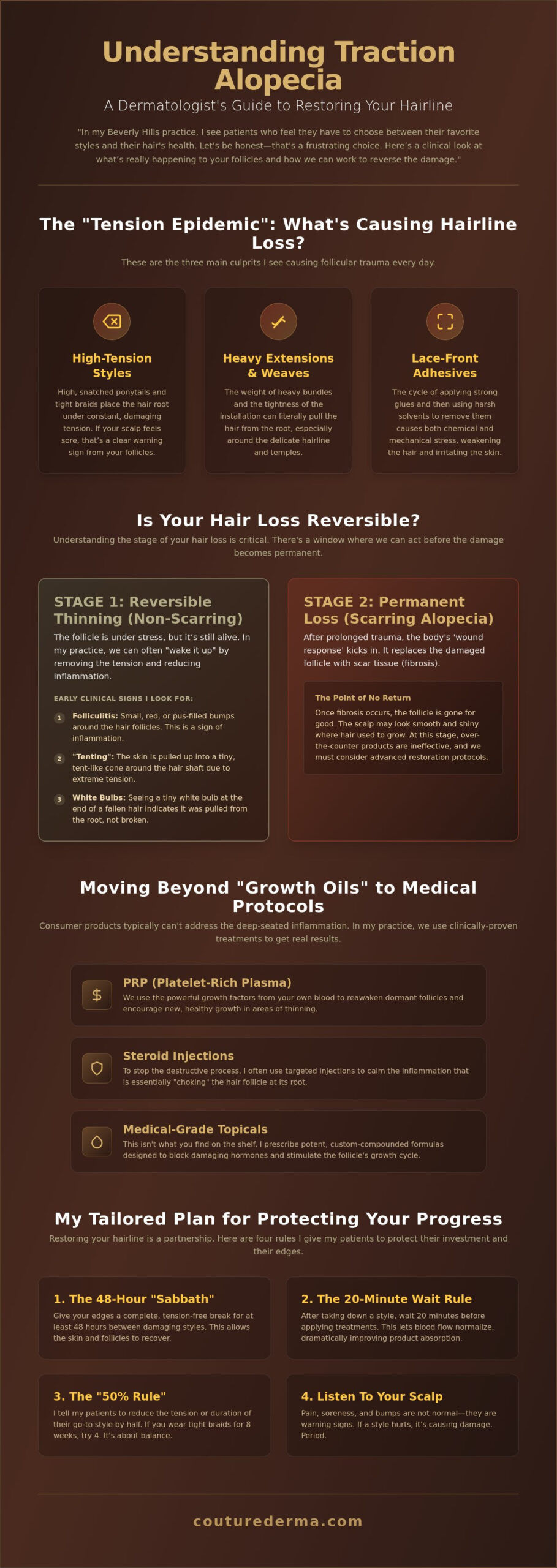
Los Angeles styling culture is built on being “red-carpet ready” at a moment’s notice. This creates what I call a tension epidemic. We see it in the high, snatched ponytails, the heavy bundles of extensions, and the relentless use of lace-front adhesives. While these looks are stunning, they often come at a steep biological cost. To better understand how this tension impacts your scalp, watch this helpful video:
The Los Angeles Tension Epidemic
The pressure to maintain a certain aesthetic in Beverly Hills often leads to long-term follicular trauma. Many of my patients rely on “protective styles” like braids or weaves, but these are often anything but protective if they’re installed too tightly. Here is the thing; if your scalp feels sore or you see small bumps after a salon visit, your hair is being pulled too hard. This repetitive pulling leads to Traction alopecia, a condition where the hair is literally forced out of the root. If you see tiny white bulbs at the end of fallen hairs, that’s a sign of active tension loss.
I also see a lot of damage from lace-front adhesives. The constant glueing and solvent removal can strip the skin and weaken the hair at the temple. If you must use these styles, try to give your edges a “sabbath” by going completely tension-free for at least 48 hours between installs. This small window allows the skin to recover from the chemical and mechanical stress.
Why a Dermatologist is Your Best Ally
A stylist sees your hair, but a board-certified dermatologist sees your scalp’s future. In my practice, we use specialized diagnostic tools to see what’s happening beneath the surface. I look for early clinical signs like folliculitis (inflammation of the hair follicle) or “tenting,” where the skin is pulled up into a tiny cone around the hair shaft. These are warning lights telling us the follicle is under extreme stress. Identifying these signs early is the difference between a temporary thinning and permanent scarring.
Restoring a hairline is much like tailoring a bespoke garment. You can’t just patch the holes; you have to understand the fabric and the structural integrity of the underlying foundation. Here’s a specific protocol I recommend: Wait 20 minutes after removing extensions or a tight weave before applying any medicated scalp treatments. This allows the blood flow to normalize and the skin to settle, ensuring your traction alopecia treatment los angeles protocol actually reaches the intended target rather than just sitting on irritated skin. If you apply products immediately to a “sore” scalp, the irritation can actually block the absorption of the active ingredients.
The Science of Tension: When Hair Loss Becomes Permanent
In my practice, I often explain that traction alopecia is a gradual destruction of the follicle through mechanical force. It’s not merely “breakage” at the ends of your hair; it’s a cellular battle happening beneath the surface. When you subject your scalp to repetitive, prolonged tension, you’re essentially placing the hair root under a state of constant trauma. This mechanical stress triggers a chronic “wound response” in the scalp. Instead of focusing on hair production, the body begins a repair process that leads to fibrosis (scarring), where healthy follicles are eventually replaced by tough, non-productive tissue. Understanding the science of traction alopecia is vital because it helps you recognize the threshold where hair loss shifts from a temporary annoyance to a permanent condition.
The progression usually starts with thinning that many people dismiss. But as the tension continues, the follicles become smaller and weaker until they simply stop functioning. If you’re looking for effective traction alopecia treatment los angeles specialists provide, the goal is always to intervene before this “point of no return.” Once the follicle is scarred over, medical topicals can’t reach the root because the root no longer exists.
The Inflammatory Stage vs. The Scarring Stage
How can you tell if your hair can still grow back? I look for signs of active inflammation. This often appears as redness, itching, or small “tension bumps” (pimples) right at the hairline. These bumps are actually folliculitis, a sign that the hair is being pulled so hard it’s irritating the surrounding skin. If you see these, you’re in the “dormant” phase where follicles are still viable but struggling. But if your scalp looks smooth, reflective, and poreless, we call this the “Shiny Scalp” indicator. This typically means the skin has scarred over, and we’ve transitioned into permanent cicatricial alopecia (scarring hair loss).
Clinical Tip: Perform a “tension check” in a mirror with natural light. If you see “tenting”—where the skin is being pulled up into tiny, peaked cones around the hair shaft—the tension is dangerously high. You must release that style immediately to prevent permanent damage. If you’re noticing these changes, it’s time to schedule a clinical evaluation before the window of opportunity closes.
Is it Really Traction?
Distinguishing traction from other conditions is the most important step in my diagnostic process. I see patients who assume they have traction loss, but they actually have Alopecia Areata (an autoimmune condition that causes smooth, circular patches) or CCCA (Central Centrifugal Cicatricial Alopecia), which often starts at the crown. In my Beverly Hills practice, I may perform a scalp biopsy (taking a tiny sample of skin to look at under a microscope) if the diagnosis isn’t clear. Treating the wrong type of hair loss can waste months of time, allowing the real condition to worsen. Getting an accurate diagnosis for traction alopecia treatment los angeles residents can trust is the only way to ensure your restoration plan is actually tailored to your biology.
Is Your Hair Loss Reversible? A Clinical Comparison
Let’s be honest; not every hairline can be fully restored to its original density. But in my practice, I find that most cases can be significantly improved if we act before the biological clock runs out. When patients come to me for traction alopecia treatment los angeles, the first thing I do is determine exactly where they sit on the spectrum of recovery. It is a diagnostic puzzle that requires a keen eye and a deep understanding of follicular biology.
During a Couture consultation, I perform several clinical markers, including the “Tug Test.” It is a gentle but firm pull on the hairs surrounding the thinning areas. If the hair slides out easily with a tiny white bulb attached, it tells me the tension is currently active and the follicles are under immediate siege. But if the hair is miniaturized (thinner and shorter than the rest) but still anchored, there’s a much higher chance of successful regrowth through medical intervention.
Signs of Reversible Traction Alopecia
I look for the presence of “vellus” hairs, which are fine, baby-like hairs that are barely visible to the naked eye. These are signs that the follicle is still alive but lacks the strength to produce a mature, thick hair shaft. Another positive marker is visible follicular openings (pores) on the scalp surface. If I can see the “holes” in the skin where hair used to be, the door is still open for restoration. Patients often report a positive response to “tension holidays,” where the hair starts to fuzz back slightly after leaving it alone for a few weeks.
Actionable Tip: Take a high-resolution photo of your hairline under a bright LED light and zoom in. If you can still see tiny “dimples” or pores where the hair is missing, your follicles are likely still viable and waiting for the right stimulation. If the area looks as smooth as the palm of your hand, the window for simple regrowth may be closing.
Signs of Permanent (Scarring) Loss
One of the most telling signs of long-term damage is the “fringe sign.” This is a thin, sparse line of hair left along the very edge of the hairline, while the area directly behind it is completely bald. It happens because the very front hairs occasionally escape the full force of the tension that destroys the follicles behind them. I also check for scalp atrophy, where the skin feels thin, tight, or unusually firm to the touch, much like a scar.
If you haven’t seen any visible hair growth for more than 12 to 18 months despite stopping all tight styles, the follicle has likely been replaced by fibrous tissue. The duration of your styling habit often predicts the success of the treatment. A habit that has lasted ten years is much harder to reverse than one that has lasted ten months. This is why getting a professional diagnosis for traction alopecia treatment los angeles residents can rely on is the most important step in your restoration journey.
Medical Protocols for Hair Restoration: The Couture Approach
In my practice, we move beyond simple topicals to “wake up” dormant follicles through targeted stimulation. Many patients arrive at my Beverly Hills office after months of using over-the-counter Minoxidil (Rogaine) with little to show for it. Let’s be honest; Minoxidil is just one piece of the puzzle. It helps with blood flow, but if your follicles are currently under an inflammatory attack, it’s like trying to water a garden while the soil is on fire. This is why a professional traction alopecia treatment los angeles protocol often begins with calming the scalp first.
We often utilize intralesional steroids (Kenalog injections) to address the “tension bumps” and redness we talked about earlier. These tiny, precise injections go directly into the hairline to stop the inflammatory “wound response” before it turns into permanent scar tissue. Once the inflammation is under control, we can begin the actual restoration work. If you’re looking for a specialist who understands these nuances, you might find my guide on How to Choose the Best Dermatologist in Los Angeles quite helpful.
The Power of PRP and Growth Factors
Platelet-Rich Plasma (PRP) therapy is what I call the “fertilizer” for your scalp. It is a natural, drug-free approach that aligns perfectly with a bespoke aesthetic plan. We draw a small amount of your blood, spin it in a centrifuge to concentrate the platelets (growth factors), and then carefully reinject them into your hairline. It sounds clinical, but the process is quite unhurried and focused on your comfort. The typical protocol involves three to four sessions spaced about one month apart.
Actionable Tip: To get the most out of your treatment, wait at least 8 to 12 hours after a PRP session before washing your hair. This gives those concentrated growth factors ample time to settle into the follicular environment without being disturbed. You might notice a bit of “fuzz” returning as early as the third session, which is a wonderful sign that the follicles are responding to the nourishment.
Prescription Topicals and Oral Medications
I often prefer compounded medications over standard drugstore options because we can “custom-fit” the strength to your specific needs. In my practice, I see patients who respond much better to a blend of high-potency Minoxidil, Finasteride, and even Caffeine. This multi-pronged approach targets the follicle more aggressively than a one-size-fits-all foam. But here is the thing you need to know: you might experience a “dread shed” during the first 4 to 6 weeks. Don’t panic. This is actually a positive sign that the weak, resting hairs are being pushed out to make room for new, robust growth. If you are ready to move past the guesswork and start a medical-grade journey, you can schedule your restoration consultation today to see which protocol fits your biology best.
A Tailored Plan: Protecting Your Hairline in a High-Style World
You don’t have to give up your signature look forever. But we do need to “re-tailor” how you wear it. In my practice, I find that a complete ban on extensions often leads to patients abandoning their treatment plan entirely. Instead, I advocate for the 50% Rule. This means for every six weeks you wear a high-tension style, you must spend six weeks in a completely tension-free state. This gives your scalp the recovery time it needs to respond to your traction alopecia treatment los angeles protocol.
Actionable Tip: Ask your stylist to leave at least a quarter-inch of your natural hair out around the entire perimeter of your hairline when installing braids or a weave. These “edge” hairs are the most fragile and should never be used as anchor points for heavy extensions. Communicate clearly with your pro. If a style feels painful during the install, it is too tight. Period. Ask them to rotate the placement of your parts so the same follicles aren’t being stressed month after month.
Styling Without Sacrifice
Choose “knotless” braids over traditional styles. They distribute the weight of the extension more evenly along the hair shaft rather than concentrating it in a heavy knot at the root. And let’s be honest; the danger of “baby hair” styling is real. Excessive brushing and heavy edge-control gels can actually worsen the pulling on already weakened follicles. If you must style your edges, use a soft-bristled toothbrush and a light, water-based pomade rather than a heavy wax.
Your Journey at Couture Dermatology
What can you expect during your first hair restoration consultation? We’ll perform a meticulous analysis of your scalp’s structural integrity. We don’t just look at the hair; we look at the skin’s texture, the presence of inflammation, and the viability of your follicles. It’s a collaborative process where we work with your lifestyle, not against it. We want you to feel as confident in your hair as our patients do after experiencing The Art of Skin Rejuvenation.
Our goal is to move you from a state of anxiety to a state of calm confidence. By combining Harvard-trained expertise with a deep understanding of diverse hair textures, we ensure your traction alopecia treatment los angeles plan is as unique as you are. We’re here to guide you through this transformation, providing the medical-grade care and styling strategies needed to bring your hairline back to life.
Reclaiming Your Confidence and Your Edges
Your hair is more than just a style; it’s a reflection of your identity and your self-assurance. We’ve explored how the high-pressure styling culture in Beverly Hills can lead to a “tension epidemic,” but we’ve also seen that there is a path back to restoration. By understanding the difference between temporary thinning and permanent scarring, you’ve taken the first step toward saving your follicles. Choosing the right traction alopecia treatment los angeles has to offer means moving beyond ineffective “growth oils” and embracing a medical-grade, personalized protocol.
In my practice, I combine Harvard-trained expertise with a deep specialization in diverse hair textures to ensure your journey is as meticulous as a piece of fine couture. We don’t just treat hair loss; we transform your relationship with your scalp. If you’re ready to stop camouflaging and start regrowing, I invite you to Book a Couture Hair Consultation with Dr. Abisogun at our bespoke clinic. Let’s work together to ensure your signature look never comes at the cost of your hair’s health. Your hairline is waiting for its second act.
Common Questions About Hairline Restoration
Can traction alopecia grow back after 10 years?
Regrowth after 10 years depends entirely on whether the hair follicles are still alive or have been replaced by permanent scar tissue. In my practice, I see patients who have waited a decade and still have viable “vellus” (fine, baby-like) hairs that respond well to medical stimulation. But if the scalp has become completely smooth and poreless, the window for non-surgical restoration has likely closed.
How long does it take for edges to grow back with medical treatment?
You should typically expect to see the first signs of visible regrowth within 3 to 6 months of starting a consistent medical-grade protocol. Hair restoration is a gradual progression rather than a hurried task because it follows the natural biological growth cycle. Most of my patients notice a significant improvement in density and coverage after 9 to 12 months of tailored care.
Are Kenalog (steroid) injections painful for the scalp?
Kenalog injections are very well tolerated by most patients and usually feel like a minor, fleeting pinch. We use ultra-fine needles to ensure the process is as comfortable as possible; much like a bespoke tailoring session, our focus is on precision and your personal well-being. If you’re particularly sensitive, we can apply a topical numbing cream before the procedure to make the experience feel effortless.
Will Minoxidil work if my scalp is already shiny and smooth?
Minoxidil will not work on a scalp that is already shiny and smooth because those are clinical indicators of permanent scarring. This “shiny” appearance means the follicles have been replaced by fibrous tissue and can no longer produce hair. If you are seeking effective traction alopecia treatment los angeles residents can rely on, it’s vital to begin medical intervention before your scalp reaches this stage of permanent loss.
Can I still wear a wig while treating traction alopecia?
You can certainly wear a wig during your treatment journey, provided it is a “glueless” unit that doesn’t rely on harsh adhesives or tight combs. It is crucial to give your scalp “breathing room” by removing the wig every night and ensuring the wig cap isn’t creating new tension. We often recommend silk-lined wig caps to minimize friction and protect the fragile new hairs that are beginning to grow back.
How do I know if my braids are too tight?
Braids are too tight if you see small white bumps (folliculitis), experience a headache, or feel any soreness when you move your facial expressions. Your scalp should feel relaxed and comfortable immediately after you leave the styling chair. If you find yourself needing pain medication after a salon visit, the tension is high enough to cause active, long-term damage to your hair roots.
Does PRP for hair loss really work for all hair types?
PRP therapy is a highly effective and inclusive treatment that works across all hair types and textures because it utilizes your own biological growth factors. Whether your hair is straight, wavy, or tightly coiled, the regenerative power of concentrated platelets works at a cellular level to nourish the follicle. It’s a natural, drug-free approach that we often incorporate into our bespoke restoration plans for a wide range of patients.
What is the average cost of traction alopecia treatment in Los Angeles?
The cost of treatment in Los Angeles varies based on the complexity of your hair loss and the specific combination of medical modalities required for your transformation. A personalized restoration plan is a custom-fit experience that may include several sessions of injections or specialized topicals. We provide a thorough breakdown of the investment required for your specific journey during your initial clinical consultation in our Beverly Hills office.