
In my practice at Couture Dermatology & Laser Beverly Hills, I often see patients who are terrified they’ve ruined their results by making one simple mistake. Last week, a client called me frantic because she’d stepped into a hot sauna just twenty-four hours after her session. Understanding what not to do after laser hair removal is actually the second half of your treatment, and it’s where the real transformation happens.
It’s completely normal to feel a bit anxious about temporary redness or confused about when you can finally use your favorite active serums again. You’ve invested in yourself, and you deserve permanent hair reduction without the risk of scarring or lingering discomfort. I’m going to share the essential post-laser protocols and the common pitfalls to avoid so your skin remains smooth, safe, and beautifully refined.
We’ll dive into why you need to skip the gym for a day, how to protect your melanocytes (cells that produce skin pigment), and the specific timeline for returning to your normal activities. Let’s get your aftercare plan tailored to perfection.
Key Takeaways
- You’ll learn why the first 48 hours after your session are the most critical for protecting your skin while it’s in a vulnerable, healing state.
- We’ll break down exactly what not to do after laser hair removal regarding heat, so you don’t accidentally cause blisters by hitting the sauna or gym too early.
- Discover which of your favorite skincare products, like Retinol and Glycolic Acid, need to go on a short break to avoid unnecessary redness.
- Get specific protocols for managing the “pepper spots” (shedding hair) that appear after treatment without damaging your skin’s outer layer.
- Understand how we use advanced technology like the Fotona laser to ensure safe, refined results for every skin tone in our Beverly Hills practice.
Beyond the Zap: Why Your Post-Laser Routine Is Just as Important as the Treatment Itself
In my practice, I see that the best results come from those who respect the 72-hour window following their procedure. I often tell my patients that the laser session is merely the master cut of a bespoke garment. The aftercare? That’s the fine, invisible stitching that ensures the final fit is flawless. While the technology does the heavy lifting, knowing exactly what not to do after laser hair removal is what protects your investment and your skin’s health. It is the second half of a collaborative, transformative journey.
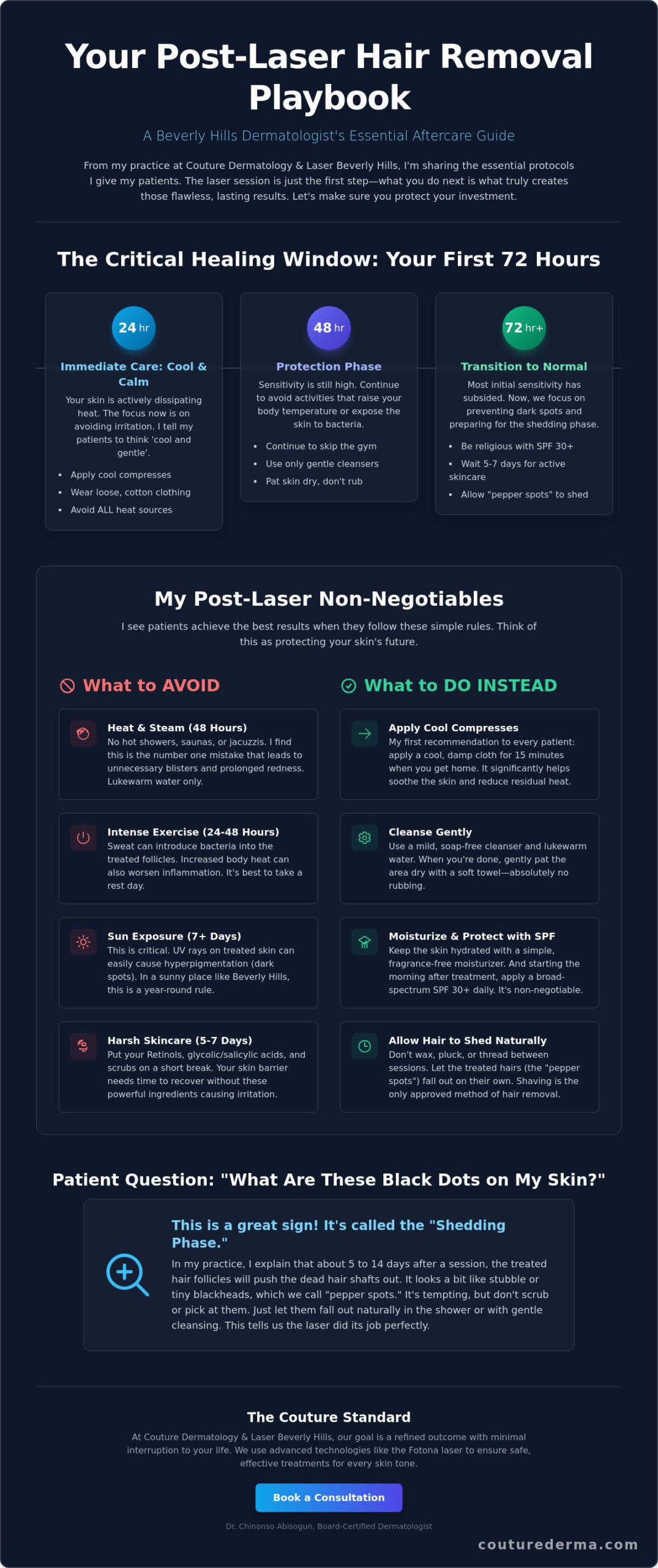
When we perform Laser hair removal, we are essentially creating a “controlled injury” within the follicle (the small pocket in the skin where hair grows). The goal is to disable the hair’s ability to regenerate without harming the surrounding tissue. This leaves your skin in a temporary state of heightened sensitivity. It is a delicate period where the skin is working to dissipate heat and begin its subtle progression toward a smoother texture. Actionable Tip: Apply a cool, damp cloth to the area for 15 minutes immediately after you get home to help dissipate residual heat from the follicles.
What actually happens to your skin during a session?
During your session, the laser emits a concentrated beam of light that is absorbed by melanin (the pigment that gives hair its color). This light energy converts to heat, which can feel like a quick “snapping” sensation against the skin. While our advanced systems use cooling technology to keep you comfortable, that thermal energy lingers. Your outer layer of skin is temporarily sensitized as it processes this heat. I see patients who experience mild redness or a feeling similar to a light sunburn. This is a normal part of the inflammatory response. The heat stays trapped in the hair root for hours after you leave the office.
The ‘Couture’ approach to recovery
At Couture Dermatology & Laser Beverly Hills, we treat every skin type with the meticulous care of an artist. In a city like Los Angeles, where the sun is a constant factor, our protocols must be even more precise. We focus on aesthetic harmony. We want to ensure that the reduction of hair doesn’t come at the cost of your skin’s clarity. Understanding what not to do after laser hair removal helps prevent unwanted pigment changes and ensures the skin heals with a silk-like finish. Actionable Tip: Wear loose, breathable cotton clothing to your appointment and for the first 24 hours to avoid friction against the treated area. Our goal is typically a refined outcome with minimal interruption to your lifestyle. By following a structured path of recovery, you ensure that your journey is both safe and sophisticated. You might also find our Couture Guide to Laser Skin Resurfacing helpful for understanding how we manage thermal energy across different treatments.
The Critical ‘Don’ts’: What to Avoid Immediately to Prevent Irritation and Dark Spots
I see patients who believe that a quick drive through Beverly Hills or a cloudy afternoon doesn’t count as sun exposure. Let’s be honest. Your skin is incredibly sensitive right now. Knowing what not to do after laser hair removal is mostly about protecting your skin from its own protective mechanisms. When you skip SPF, you’re inviting trouble. UV rays can trigger melanocytes (cells that produce skin pigment) to go into overdrive, leading to stubborn dark spots that are much harder to treat than the hair itself.
Sun exposure and the risk of hyperpigmentation
In our practice, we emphasize that heat and UV light are a volatile combination. Your skin has just undergone a thermal event. Adding more heat from the sun can cause post-inflammatory hyperpigmentation (dark spots left after an injury). This is especially true for my patients with deeper skin tones, where the melanocytes are naturally more active. I often suggest following a strict dermatologist’s after-care instructions to ensure your complexion remains even. Actionable Tip: Use a physical blocker containing zinc or titanium for the first week, as these reflect light away rather than absorbing it like chemical sunscreens do.
The danger of ‘helping’ the hair fall out
About a week after your session, you’ll notice small black dots appearing. We call these “pepper spots.” It looks like the hair is growing back, but it’s actually the dead hair being pushed out of the follicle. I see many patients who get impatient and try to scrub these away. Please don’t do that. Picking or exfoliating too early can cause micro-tears in the sensitized skin, leading to irritation or even scarring. Let the shedding happen naturally. It’s a sign the treatment worked. Actionable Tip: Wait at least 5 to 7 days before using a very gentle washcloth in the shower to help the shedding process along.
And you should also avoid tanning beds and self-tanners for at least two weeks. Self-tanners contain chemicals that can irritate the skin, and tanning beds simply double the risk of burns. Think about your wardrobe too. Tight leggings or restrictive jeans cause friction. This friction traps heat and can lead to folliculitis (inflammation of the hair follicles). Stick to loose, flowing fabrics. If you’re unsure about how your specific skin tone will react, you can secure your next refinement session to discuss a customized plan with our team.
Why Heat is the Enemy: Managing Your Internal Temperature After Laser Hair Removal
Here’s the thing about your laser session: the energy doesn’t just vanish once the machine clicks off. I see patients who struggle with persistent redness because they don’t realize the light energy is actually trapped inside the follicle. When considering what not to do after laser hair removal, managing your internal temperature is arguably the most overlooked step for ensuring a comfortable recovery. It is about maintaining the aesthetic harmony we’ve just created.
In my practice, I’ve seen patients trigger hives or even mild blisters just by taking a hot yoga class too soon. We call this residual heat. If you add external heat, like a sauna or a steaming shower, to the internal heat already present, you risk a “laser burn” or significant inflammation. I often point my patients toward the fundamentals of recovery and aftercare to explain why this 48-hour cooling period is so vital to the process.
Can I go to the gym or the sauna?
But let’s be honest about the gym. Sweat is a natural irritant to a newly opened follicle. Gyms are also hotspots for bacteria. When your skin is sensitized from the laser, that combination often leads to folliculitis (inflammation of the hair follicles). This can look like a breakout and feel incredibly itchy. I suggest avoiding any activity that makes you break a sweat for at least two full days. This includes spin classes, heavy lifting, or even a brisk run. Actionable Tip: If you must move, stick to a slow walk in an air-conditioned room to ensure your heart rate, and your skin temperature, stays low.
How should I cool my skin down at home?
Your shower routine needs a temporary adjustment. Lukewarm water is typically your best friend for the first two days. Avoid high-pressure jets directly on the treated area. For soothing, I recommend using pure Aloe Vera. Look for versions without added fragrances, dyes, or alcohols, as these can sting sensitized skin. It helps the skin recover its natural barrier while providing a cooling sensation. In most cases, I advise against placing ice directly on the skin, as the extreme cold can be just as shocking to the tissue as the heat was. Actionable Tip: Apply a cold compress for 10-minute intervals to help draw out that trapped thermal energy safely.
Think of this period as a time of calm. You’re allowing your skin to settle after its transformation. By keeping things cool, you prevent the “controlled injury” of the laser from becoming an actual injury. It’s about respecting the science of the treatment to achieve that refined, hair-free outcome you’re looking for. In most cases, if you follow these temperature rules, your skin will look and feel back to normal within 48 hours.
Skincare and Maintenance: Navigating Shaving, Products, and New Hair Growth
I see patients who are eager to get back to their silky-smooth skin immediately. But here’s the thing: your skin needs a beat to recover before you bring a blade anywhere near it. When I talk to my clients about what not to do after laser hair removal, I emphasize that waiting at least 3 to 4 days before shaving is essential. This gives the outer layer of skin time to calm down and prevents micro-nicks on a sensitized surface. It is a small but vital part of the tailoring process for your skin’s health.
The Shaving vs. Waxing Debate
In my practice, I’m very firm about one specific rule. You must never wax, pluck, or thread between your sessions. It’s not just about avoiding irritation. The laser actually needs the hair root to be present to work its magic. If you pull the hair out from the root, the laser has no target for your next appointment, which effectively stalls your progress. Actionable Tip: When you do resume shaving after the initial 4-day wait, use a fresh, sharp razor to ensure a clean cut without dragging or pulling on the skin.
When to reintroduce your skincare routine
Let’s talk about those powerful “actives” in your beauty cabinet. I recommend putting your Retinol (a vitamin A derivative used for aging and acne), Glycolic Acid (an exfoliating fruit acid), and Vitamin C on a strict hiatus. These ingredients are fantastic for long-term skin health, but on post-laser skin, they can cause unnecessary stinging or persistent redness. I typically suggest a 7-day rule before reintroducing these products. During this week, focus on barrier repair using Ceramides (natural fats that help skin stay hydrated) and Hyaluronic Acid (a molecule that holds 1,000 times its weight in water to plump the skin).
I also see patients who worry about their overall skin texture during this transition. If you’re noticing lingering issues from previous skin trauma or unevenness, you might find our work with Acne Scar Refinement helpful for achieving that total polished look. For the first week, fragrance-free products are non-negotiable. Scents are common irritants that can turn a calm recovery into a reactive mess. Remember that the “growth” you see 10 days out is likely just the treated hair making its final exit. If you’re ready to plan your next step in this transformative journey, you can schedule your follow-up refinement to keep your progress on track and your skin looking its best.
The Couture Standard: Ensuring Your Results Remain Flawless in the Beverly Hills Sun
In my practice at Couture Dermatology & Laser Beverly Hills, I see patients who are often surprised by how much the “sun-kissed” lifestyle of Southern California impacts their final results. It’s not just about the laser session itself. It’s about the standard of care you maintain between your visits. Knowing what not to do after laser hair removal is particularly vital in our climate, where the UV index stays high year-round. We treat your skin with the same precision a tailor uses on a custom suit, ensuring every wavelength is perfectly matched to your unique profile.
Addressing potential side effects with confidence
I see patients who occasionally panic at the first sign of a small, itchy bump. In most cases, this is simply a histamine reaction (a temporary immune response that causes itching and mild swelling). It’s a normal part of the body processing the thermal energy. You can typically manage this with a simple over-the-counter antihistamine. But you should know the difference between a healthy response and a complication that needs professional eyes. Actionable Tip: If your skin still feels “hot” to the touch or looks increasingly red after the first 24 hours, you should call our practice immediately to speak with a member of our medical team.
Your journey to effortless skin
We utilize advanced technology like the Fotona laser because its precision allows us to treat diverse skin tones with incredible safety. Beverly Hills is a melting pot, and “one-size-fits-all” settings simply don’t work here. We always prioritize a thorough consultation and patch testing to see how your specific melanocytes (cells that produce skin pigment) react to the light. This gradual, intentional progression is what prevents complications and ensures aesthetic harmony. Consistency is your best friend. If you skip appointments, you miss the hair’s active growth phase, which can stall your transformation. Actionable Tip: Mark your calendar for your next session 4 to 6 weeks out before you even leave the office to ensure you capture every growth cycle.
Let’s be honest, your skin is a lifelong investment. You should treat it like one. There is an incredible emotional benefit to this process: the confidence of waking up “ready-to-go” without the chore of daily grooming. It’s about more than just hair; it’s about holistic well-being and self-assurance. If you’re ready to start your own collaborative journey toward refined skin, you can book a consultation with Dr. Abisogun to create a bespoke plan that fits your lifestyle.
Step Into Your Most Confident Skin
Your journey to effortless, silk-like skin is a transformation that requires both clinical precision and personal commitment. By mastering exactly what not to do after laser hair removal, you protect the thermal work we’ve done and ensure your results remain beautifully refined. Remember to prioritize cooling, avoid the Beverly Hills sun, and keep your active skincare on hiatus for that critical first week. These small steps are what turn a medical procedure into a lasting aesthetic success.
In my practice, I combine my Harvard training with 15 years of experience to offer specialized care for all skin types and tones. We’ve built a bespoke, luxury environment where your aesthetic harmony is our highest priority. Let’s move beyond the daily chore of grooming and toward a lifestyle of self-assurance. I see patients every day who find a new sense of freedom once they’ve completed their tailored treatment path.
If you’re ready to experience a custom-fit approach to hair reduction, I’m here to guide you through every step of the process. Schedule your bespoke laser consultation at Couture Dermatology to begin your collaborative journey toward flawless results. You deserve skin that feels as sophisticated and refined as you are.
Frequently Asked Questions
Can I wear makeup after laser hair removal on my face?
You should wait at least 24 hours before applying makeup to any treated area on your face. Your skin’s outer layer is temporarily sensitized, and heavy foundations can trap residual heat or lead to breakouts in the vulnerable follicles. If you absolutely must wear coverage for an event, opt for a clean mineral powder. In my practice, I see much faster healing when patients let their skin breathe for that first full day.
How long after laser hair removal can I go in the sun?
You should avoid direct sun exposure for at least two weeks following your session to prevent pigment changes. Even with high-quality SPF, the heat from UV rays can trigger melanocytes (cells that produce skin pigment) and cause stubborn dark spots. In Beverly Hills, where the sun is constant, this is the most important rule for what not to do after laser hair removal. Stick to the shade and wear a wide-brimmed hat.
Is it okay to use deodorant after underarm laser hair removal?
It’s best to avoid deodorant for the first 24 to 48 hours after an underarm treatment. Most traditional deodorants contain alcohol or synthetic fragrances that can sting and irritate the newly opened follicles. I see patients who experience significant itching or a stinging rash when they rush back to their normal routine. If you feel you need something, a fragrance-free, natural balm is a safer alternative only after the first day has passed.
What happens if I accidentally wax between laser sessions?
If you accidentally wax, you essentially remove the target the laser needs to be effective for your next visit. The laser energy needs to travel down the hair shaft to the root to disable growth permanently. Without that root present, your next appointment will likely be a waste of time. You’ll need to wait for a new hair cycle to begin, which typically takes about 4 to 6 weeks of patience.
Can I take a hot shower or go to a sauna the same day?
You should skip hot showers, saunas, and steam rooms for at least 48 hours after your appointment. The laser leaves residual heat in your skin, and adding more external heat can lead to blisters or “laser burns.” I often see patients who think a quick sauna session is fine, only to end up with a persistent, uncomfortable heat rash. Stick to lukewarm water and keep your body temperature regulated to ensure a calm recovery.
How do I know if my skin is burnt or just normally red?
Normal redness typically fades within 24 hours and feels like a mild, manageable sunburn. If your skin stays hot to the touch, starts to blister, or develops a crusty texture, these are signs of a superficial burn. In my experience, true burns are rare when using advanced technology like the Fotona laser, but you should call our practice immediately if the pain increases or the redness spreads after the first day.
When can I start using my Retinol or Vitamin C serum again?
You can typically reintroduce your Retinol or Vitamin C serums after 7 days of healing. These “actives” are powerful exfoliants and antioxidants that can be too aggressive for skin that is still in its initial recovery phase. Focus on “barrier repair” products like Hyaluronic Acid (a plumping moisture molecule) for that first week. This ensures your skin remains resilient and calm before you return to your high-performance, bespoke skincare routine.
Can I go swimming in a chlorinated pool after my treatment?
You should stay out of chlorinated pools for at least 48 to 72 hours after your treatment. Chlorine is a harsh chemical that can severely dry out and irritate sensitized skin, leading to a painful stinging sensation or red, itchy patches. I see patients who ignore this and end up with a “chlorine rash” on top of their post-laser sensitivity. Let your skin’s protective barrier fully reset before diving back into the water.