

You look in the mirror after Botox and wonder whether you should be seeing more of a change by now. If you’re searching “why didn’t my botox work los angeles,” it can be hard to tell whether the effect is still developing or the result simply doesn’t match what you expected. It’s reasonable to want a clear explanation rather than trying to judge the result from one mirror check.
I’m Dr. Chinonso Kagha Abisogun. When someone is concerned about a Botox result, I start with the specifics: what they hoped would look different, what they notice now, and when the change first became apparent. Those details help make a follow-up conversation more useful and keep the focus on the person’s experience rather than assumptions about what went wrong.
This article explains what can shape a Botox result, how to describe what you’re seeing, and what to ask before considering another treatment. You’ll also learn what a review with a Los Angeles-area dermatologist may involve, so you can prepare clear questions for your next step.
Key Takeaways
- If you’re asking “why didn’t my botox work los angeles,” start with how long it has been since treatment and what change you hoped to see.
- Note whether movement is still changing, has improved only partly, or looks uneven. These observations can help guide a clinician’s review.
- When you contact the clinician who treated you, have your treatment date, the areas treated, your goals, and clear photos ready.
- Ask a qualified clinician to assess your result and treatment history before arranging more injections or switching products.
- A dermatologist-led review can consider your facial movement, anatomy, and desired outcome when discussing possible next steps.
Why Didn’t My Botox Work in Los Angeles? Start With Timing and Expectations
You look in the mirror after treatment and still see more movement or lines than you expected. If you’re searching “why didn’t my botox work los angeles,” begin with two questions: How long has it been, and what change were you hoping to see? A disappointing result may reflect effects that are still developing, partial improvement, or a mismatch between the treatment’s purpose and your goal. Each possibility calls for a different assessment.
How soon should Botox results become noticeable?
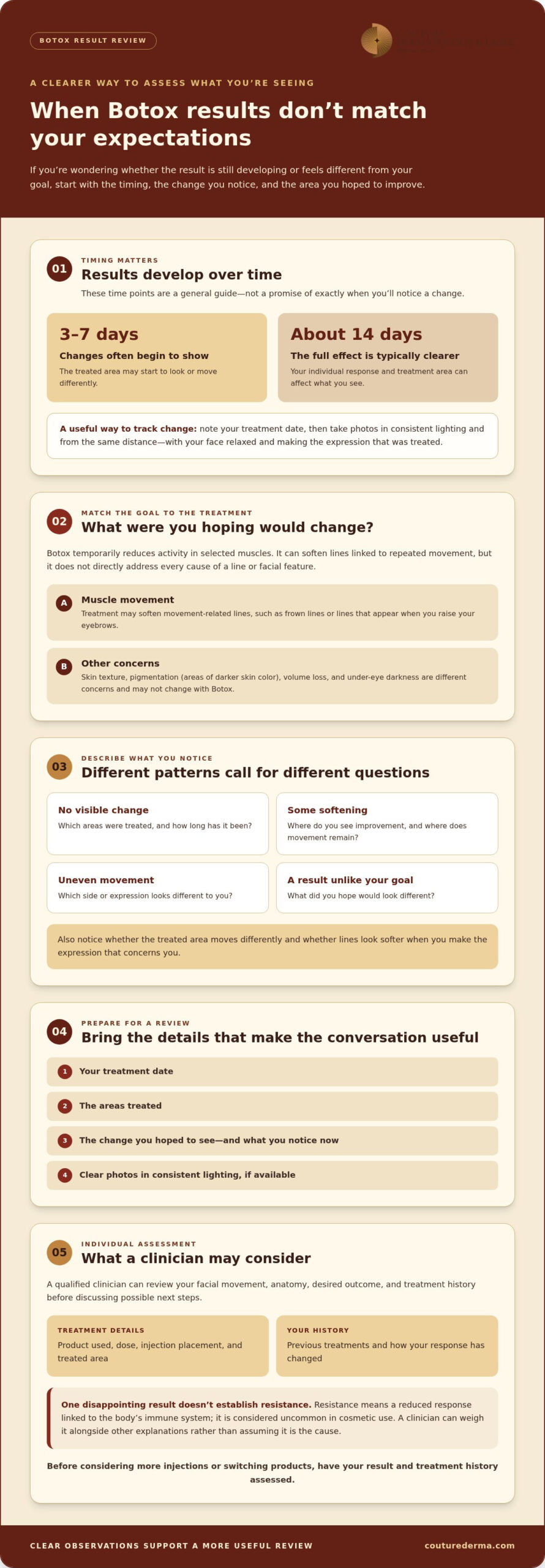
Botox results develop over time rather than appearing as soon as you leave the appointment. They often begin to show within 3 to 7 days, with the full effect typically clearer at about 14 days. This is a general guide, not a promise about exactly when you’ll notice a change. The treated area, your facial movement, and your individual response can all affect what you see.
Checking the mirror repeatedly during the first few days can make it difficult to judge a result that is still developing. Photos taken in different lighting or with different expressions can also be hard to compare. To track changes, note your treatment date and take photos in consistent lighting, from the same distance, with your face relaxed and then making the expression that was treated.
Compare more than just “before” and “after.” Notice whether the treated area moves differently, whether lines look softer when you make an expression, and whether the change matches the plan you discussed. If you’re unsure when to request a review, ask the clinician who treated you about the timing for your specific treatment.
What did you hope the treatment would change?
Botox is a botulinum toxin treatment that temporarily reduces activity in selected muscles. You can read more about what botulinum toxin is. It is used to soften lines linked to repeated muscle movement, such as frown lines or lines that appear when you raise your eyebrows. It does not directly improve every feature that can make a face look tired or aged.
Skin texture, pigmentation (areas of darker skin color), volume loss, and under-eye darkness are different concerns. Botox may not change them because they are not caused by the same muscle movement. Before assessing a result, it helps to be specific about what you notice in the mirror and what you hoped would look different.
Consider the pattern, too. No visible change, some softening, uneven movement, and a result that looks unlike your goal are different experiences. Write down which expression or area still concerns you, then share that observation and your photos with a clinician for a personalized review.
What Can Affect Whether Botox Gives You the Result You Expected?
If you’re still asking “why didn’t my botox work los angeles,” the result may depend on more than the product name or amount used. The treatment area, your muscle movement, your natural facial structure, and the degree of change you wanted all matter. A result that feels limited can have several explanations, so it calls for an individualized assessment rather than a guess based on one detail.
Could the treatment area or goal explain the difference?
Muscles vary in location, strength, and movement from person to person. The glabellar area, between the eyebrows, and the forehead are common treatment areas, but the way those muscles pull can differ. If you hoped to soften a strong frown or forehead movement while keeping natural expression, that goal may call for a different plan than reducing movement as much as possible.
Lines that remain visible when your face is relaxed may relate to skin quality or changes in facial volume, rather than muscle movement alone. Botox is intended to reduce activity in selected muscles; it does not directly address every cause of a line or facial contour. In a review, point out the specific area that concerns you and describe what you hoped would look different.
Could individual response or the treatment plan play a role?
A clinician may review the product used, dose, injection placement, treatment area, and your history with previous treatments. These details help put the result in context. For example, partial change in one area and continued movement in another may prompt different questions than little perceived change across all treated areas.
One disappointing treatment does not establish that your body is resistant to Botox. Resistance, meaning a reduced response linked to the body’s immune system, is considered uncommon in cosmetic use. The treating clinician can consider whether it may be relevant alongside other explanations rather than assuming it is the cause.
Before requesting more injections or switching products, ask the clinician who treated you to assess the result and explain what they’re considering. Any change in dose, placement, product, or goal should follow that review. If you’d like a dermatologist-led assessment in Los Angeles, you can request an appointment to discuss your Botox results.
How Can You Tell Whether Botox Failed or Needs More Time?
If you’re asking “why didn’t my botox work los angeles,” describe the pattern you notice before deciding what caused it. People use “it didn’t work” to describe different experiences, from a result that is still changing to movement that feels uneven. Sorting out what you observe can make a clinician’s review more focused, though your impression alone cannot confirm the reason.
Use this table to organize what you’re seeing, not to diagnose yourself. A clinician can compare your observations with your treatment goal and assess the relevant facial movement.
| Pattern | What you may observe | What a clinician can assess |
|---|---|---|
| Developing results | You notice a change, but it still seems to be evolving. | Whether the timing and observed change fit the treatment plan. |
| Partial improvement | The treated area looks or moves somewhat differently, but not as much as you hoped. | How the change compares with your stated goal and the area treated. |
| Uneven movement | One side or part of the area seems to move differently from another. | Your facial movement and whether the difference needs follow-up. |
| Little perceived change | You see little difference from what you noticed before treatment. | Your treatment details and possible explanations for the result. |
What should you track before contacting your injector?
A clear record can make it easier to discuss your concern. Note the treatment date, areas treated, the goal you discussed, and any changes you’ve noticed. Take photos in similar lighting, from the same distance, and with comparable facial expressions so you can make a more consistent comparison.
Write down questions and any new or concerning symptoms while they’re fresh. Photos can help show what you mean, but they cannot establish the cause. Your clinician will consider them alongside your history and an assessment.
When should a symptom receive prompt medical attention?
Contact your treating clinician about new or concerning symptoms after treatment. If a symptom feels severe or is getting worse, seek medical care promptly rather than waiting for a routine cosmetic review. A cause cannot be determined from a written description alone, so explain what changed, when it began, and whether it is progressing.
What Should You Do If Your Botox Didn’t Work as Expected?
If you’re wondering “why didn’t my botox work los angeles,” pause before changing your treatment. A clear record and a conversation with a qualified clinician can help separate what you’re noticing from what might be causing it. Use these steps to prepare for a review.
- Document what you see. Write down the treatment date, areas treated, the goal you discussed, and the changes you’ve noticed. Take photos in similar lighting, from the same distance, and with comparable facial expressions. Note any new or concerning symptoms, too.
- Follow your clinician’s review timing. Botox effects develop over time, so the right point to assess your result depends on your treatment and your clinician’s guidance. If you’re uncertain when to check in, contact the treating clinician instead of relying only on a general timeline or comparing photos taken in different conditions.
- Contact the treating clinician before pursuing more treatment. Don’t arrange additional injections or switch products based only on an early impression. A clinician should review what was treated and how your face moves before discussing whether an adjustment or another approach may suit you.
What should you ask at a Botox follow-up?
Bring the questions you want answered, even if they seem small. You might ask, “How does the movement I’m seeing compare with the goal we discussed?” “Is this the right time to evaluate the result?” and “Given my anatomy and the degree of change I want, what options, if any, make sense?” These questions encourage a specific review rather than a one-size-fits-all response.
Ask which areas were treated and what changes were expected there. If your concern is concentrated in one spot, point it out in your photos or describe the expression that brings it out. This gives your clinician a clearer starting point for the conversation.
When might a different concern need a different conversation?
Under-eye darkness or hollowing may not be caused by muscle movement, so Botox may not address the concern you’re noticing. If that is your main focus, ask a qualified clinician to assess it separately and discuss whether under-eye brightening options are relevant to your needs.
At Couture Dermatology & Laser Beverly Hills, a Botox review can take your treatment history, facial movement, and personal goal into account. If you’d like to discuss an individualized assessment, you can schedule a consultation.
How a Los Angeles Dermatologist Can Review an Unsatisfactory Botox Result
If you’re still asking “why didn’t my botox work los angeles,” a dermatologist-led review can help you understand what your result shows and what it does not. The discussion can begin with your treatment history and the goal you had in mind, followed by an assessment of the areas treated, how they move now, and what changes you’ve noticed. The purpose is to evaluate your situation, not assume a cause or promise a correction.
What makes a thoughtful review useful?
A useful conversation connects your concern with the expression or area that prompted it. For example, describe a specific movement that still feels prominent or explain that the overall effect seems stronger or softer than you wanted. The clinician can observe the relevant facial movement and consider how it relates to your goal.
Bring the date and details of your treatment, including the areas treated and any information you have about the product or amount used. Photos from before and after treatment can help illustrate what you’ve observed, especially if they show similar lighting and expressions. They provide helpful context, but they do not replace a medical assessment.
When choosing a clinician, consider their training and experience and whether they take time to understand what you want to change. You can ask how they assess facial movement and how they’ll discuss possible next steps before making recommendations.
What can you expect from a personalized conversation?
Couture Dermatology is a cosmetic and medical dermatology clinic in Beverly Hills, serving the Los Angeles area and offering Botox injections. I’m Dr. Chinonso Kagha Abisogun, a Harvard-trained dermatologist. A review can start with your goal and an assessment of your facial movement, followed by a discussion of whether any next step may suit your needs.
Your anatomy, treatment history, and desired degree of change can help shape that discussion. An assessment does not guarantee that additional treatment or a particular adjustment is appropriate. If you’d like to talk through your result in a personalized setting, you can book a consultation in Beverly Hills.
Take the Next Step With a Thoughtful Review
If you’re still wondering “why didn’t my botox work los angeles,” remember that a result that feels off does not identify the cause by itself. A useful next step is an individualized review of your goals, treatment history, and the changes you’ve noticed. That conversation can help clarify whether the result needs more time, differs from your expectations, or merits a different plan.
At Couture Dermatology in Beverly Hills, we serve patients from across Los Angeles. I’m Dr. Chinonso Kagha Abisogun, a Harvard-trained dermatologist. I’ll listen to what you hoped to change and assess your concerns before discussing whether any next step may be appropriate. Bring your questions and any treatment details you have. You don’t need to arrive with a diagnosis.
If you’d value a personalized medical perspective, book a consultation in Beverly Hills. A thoughtful assessment can help you move forward with clearer expectations and greater confidence.
Frequently Asked Questions
Is Botox supposed to work immediately?
No. Botox typically does not create its full effect immediately. Some people begin noticing changes within 3 to 7 days, while the result is often clearer around 14 days. Timing can vary, so an early mirror check may not show the full effect. Note your treatment date and ask your treating clinician when they recommend reviewing your specific result.
Can Botox fail to work after one treatment?
It’s possible to see little or no change after treatment, but one disappointing result does not establish why. Timing, the treated area, your goal, and the treatment plan may all be relevant to a clinician’s assessment. True resistance to Botox is considered uncommon in cosmetic use. Share what you expected and what you observe with your injector before assuming the treatment failed or changing products.
How long should I wait before deciding my Botox did not work?
Botox often begins to take effect within 3 to 7 days, and the full result is typically clearer at about 14 days. These timeframes are general, not a guarantee for every person or treatment area. Follow the review timing your clinician recommends. If you’re unsure, contact them with your treatment date, the areas treated, and the changes you’ve noticed so far.
What should I do if one side of my face still moves after Botox?
Contact the clinician who treated you and describe which side moves, during which expression, and when you noticed the difference. Facial movement and results can vary across areas, so uneven movement alone does not identify the cause. If possible, take photos using similar lighting and expressions, and bring them to your follow-up. Don’t arrange additional injections until a qualified clinician has reviewed your result.
Can the wrong treatment area make Botox seem ineffective?
Yes. If the concern you hoped to address is not mainly caused by movement of the treated muscle, Botox may not create the change you expected. Botox targets selected muscle activity; skin texture, pigmentation, and volume changes may need a different assessment. If you’re wondering “why didn’t my botox work los angeles,” explain your original goal and point out the specific area that still concerns you.
Should I get more Botox if I do not see a result?
Don’t arrange more Botox based only on an early impression or a comparison photo. First, ask the treating clinician when your result should be assessed and whether the movement you observe fits the original plan. They can review the areas treated, your treatment history, and your goal before discussing whether any next step is appropriate. More treatment or a product change may not be the right answer for every concern.
When should I contact a doctor about symptoms after Botox?
Contact your treating clinician about any new or concerning symptoms after Botox. Seek emergency medical care for trouble breathing, swallowing, or speaking, vision changes, or widespread muscle weakness. These symptoms need prompt assessment rather than a routine cosmetic follow-up. If you’re uncertain how serious a symptom may be, get medical guidance instead of trying to diagnose it yourself or waiting for an appearance-related review.