

You’ve tried a new product for dark spots, but your skin became irritated, and now you’re unsure what to try next. In my practice, I see patients weighing several options without knowing which one fits their concern, skin tone, or routine. A bespoke treatment plan starts with your experience, not a preselected procedure.
It’s fair to want to understand the reasoning before making a decision. I’ll explain how a dermatologist evaluates your skin, discusses possible approaches, and considers your goals and day-to-day needs. You’ll also learn how to compare options, what to track between appointments, and how follow-up can guide next steps. The aim is for you to feel informed and comfortable discussing care with a dermatologist in Los Angeles, without pressure to commit before you’re ready.
Key Takeaways
- A bespoke treatment plan starts with understanding your skin concern and may include an evaluation before aesthetic options are discussed.
- Compare approaches by the concern they address, practical planning considerations, and the follow-up they may involve.
- Track changes in your skin and note questions between visits to make conversations about progress more useful.
- Introduce routine changes according to the agreed plan rather than changing several products at once.
- At Couture Dermatology & Laser Beverly Hills, Dr. Abisogun brings Harvard training, board certification, and 15 years of experience to a collaborative planning process.
What does a bespoke treatment plan mean for your skin?
You’ve noticed dark spots after a breakout, tried a few products, and now you’re unsure whether to adjust your routine again or consider a procedure. In my practice, I start by learning what’s bothering you and what you’ve already tried. A bespoke treatment plan is a dermatologist-guided approach shaped around your skin concerns, goals, and clinical context.
That context matters. Personalization means choosing and sequencing options that may suit your skin and circumstances, not promising a particular result. The idea connects with personalized medicine, where care is considered in relation to the individual rather than applied as a single formula.
For another perspective on individualized aesthetic planning, you can watch this conversation:
How is a bespoke skin treatment plan different from a standard menu?
A menu begins with available procedures. A dermatologist-guided conversation begins with your concern, then considers whether it needs medical evaluation, aesthetic care, or a combination over time. A new or changing spot, for example, calls for assessment before decisions about cosmetic treatment.
I listen to what you’ve noticed, examine your skin, and ask what you hope to change. Then we can discuss relevant options and why one might fit better than another. You should understand the reasoning and have room to ask questions before deciding on a next step.
Which details help shape a plan?
Tell me what you want to address, what change you’re hoping to see, and which approaches you’ve already tried. Skin tone, sensitivity, medical history, and everyday routine can all affect which options are appropriate and how they’re planned. A treatment that involves recovery time, for instance, may not fit your current schedule.
Practical tip: Bring a short list of the products and treatments you currently use. Include anything that has irritated your skin or seemed helpful. That gives us a more useful starting point than trying to remember each detail during the visit, and helps shape a plan around your actual routine.
How does a dermatologist build a bespoke treatment plan?
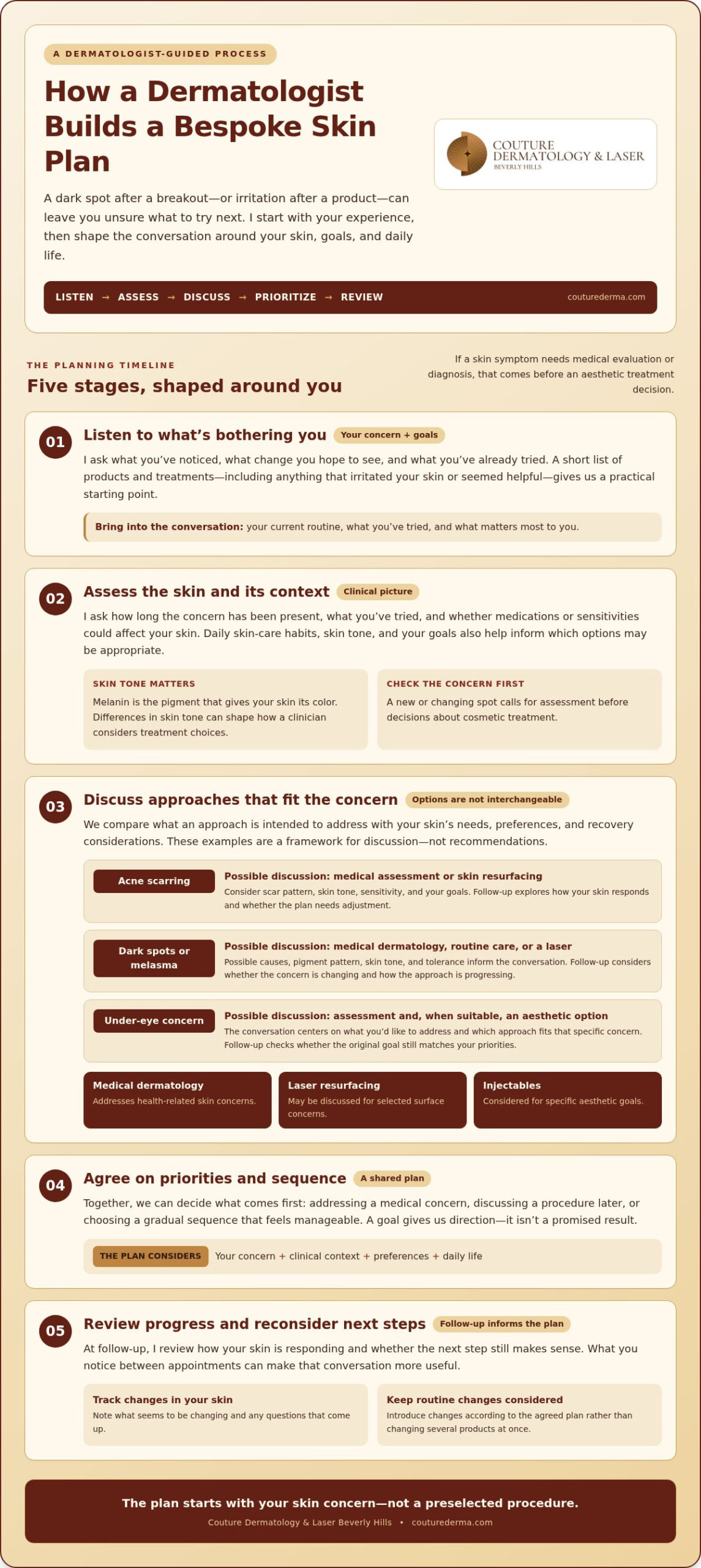
Once we’ve clarified what’s bothering you, the next step is to turn that concern into a practical path forward. In my practice, I move through five stages: listen, assess, discuss options, agree on priorities, and review progress. The order matters. If a skin symptom needs medical evaluation or diagnosis, that comes before an aesthetic treatment decision.
This approach also leaves room for your circumstances. A plan should reflect your goals and daily life, as well as the clinical picture. That’s part of what personalized treatment experiences are meant to capture: care considered for the individual, not simply chosen from a standard menu.
What happens during the assessment and conversation?
I’ll ask what you’ve noticed, how long it’s been happening, what you’ve tried, and whether you take medications or have sensitivities that could affect your skin. I’ll also ask about your daily skin-care habits. These details help me understand what your skin may tolerate and whether a change in routine could be relevant.
Skin tone matters, too. Melanin is the pigment that gives your skin its color, and differences in skin tone can shape how a clinician considers treatment choices. Your skin’s response is individual, so I explain why an option may be worth discussing and which factors could influence the decision.
How are treatment options selected and sequenced?
Next, I weigh the concern you want to address against your desired change, the suitability of each approach, and recovery considerations. The options aren’t interchangeable. Medical dermatology addresses health-related skin concerns; laser resurfacing may be discussed for selected surface concerns; and injectables are considered for specific aesthetic goals. Which, if any, fits depends on your assessment and preferences.
We can then set a priority together. That might mean addressing a medical concern first, discussing a procedure later, or choosing a gradual sequence that feels manageable. A goal gives us a direction, not a promised result. At follow-up, I review how your skin is responding and whether the next step still makes sense.
If you’d like to discuss your skin goals and possible next steps with me, you can book a visit online. The conversation is a chance to understand the reasoning before deciding whether to proceed.
How can you compare treatment options in a personalized plan?
A useful comparison starts with the concern, not the procedure. In a bespoke treatment plan, I look at what an option is intended to address, what your skin and routine may call for, and what we’d need to revisit together. A plan may involve medical evaluation or routine care without a procedure at all. The table offers a framework for discussion, not a list of recommendations.
| Concern | Approach category | Planning considerations | Follow-up discussion |
|---|---|---|---|
| Acne scarring | Medical assessment or skin resurfacing | Scar pattern, skin tone, sensitivity, and your goals | How your skin responds and whether the plan needs adjustment |
| Dark spots or melasma | Medical dermatology, routine care, or a laser discussion | Possible causes, pigment pattern, skin tone, and tolerance | Whether the concern is changing and how the approach is progressing |
| Under-eye concern | Assessment and, when suitable, an aesthetic option | What you’d like to address and which approach fits that specific concern | Whether the original goal still matches your priorities |
How might a plan differ for acne scars, pigmentation, or under-eye concerns?
Acne scarring and dark spots aren’t the same issue, so they may call for different evaluations and conversations. For acne scars, I may discuss the pattern of scarring and whether acne scar refinement is relevant. A dark spot may need assessment before we decide whether routine care or another approach makes sense.
Melasma, which causes patches of darker skin, can also prompt a discussion of options. In our practice, the Fotona laser may be considered for melasma, but it isn’t a universal recommendation. An under-eye concern has its own considerations; the under-eye brightening page offers a concern-specific example.
What trade-offs should you discuss before choosing an approach?
Ask what an option is intended to improve, what its limits may be, whether sensitivity matters, and what recovery could involve. You can also discuss how it fits your schedule and current routine. I help you weigh those points alongside the clinical assessment, then we decide together whether the approach suits your goals.
You don’t have to address every concern at once. We might prioritize a medical issue first, then revisit an aesthetic goal later. That can make the plan easier to follow and gives us a clearer way to discuss progress without treating any outcome as guaranteed.
What should you do between appointments to support your plan?
You’ve started following a new skin-care routine, but you’re not sure whether a small change in irritation is worth mentioning. That’s useful information, not a reason to diagnose yourself or overhaul the plan. A few simple notes between visits can help me understand how your skin is responding and whether the agreed approach still fits.
Keep a brief record of changes in the concern, how your skin tolerates the routine, and which steps you’ve been able to follow. Note when a symptom began or shifted, and write down questions as they come up. Introduce changes according to the plan we discussed rather than adding several products at once. Otherwise, it can be harder to tell what may be helping or causing irritation.
Follow the directions we’ve discussed for sun protection and prescribed care. Apply sunscreen 15 minutes before sun exposure. If I’ve directed you to use tretinoin, a prescription skin treatment, wait 20 minutes after cleansing before applying it. Don’t start, stop, or change a prescription routine on your own. Contact me through the appropriate follow-up process if you’re concerned about how your skin is tolerating it.
How can you tell whether a plan needs adjusting?
Look for patterns rather than trying to label the cause yourself. Is the concern changing? Does your skin feel more sensitive after a particular step? Have you been able to follow the routine as planned? These details help me reassess if your progress or tolerance differs from what we discussed.
Practical tip: Before your next visit, write down one or two specific observations and the questions you want answered. For example, note which step felt uncomfortable and when you noticed it. That gives us a clearer starting point for deciding whether to stay the course or adjust the approach.
When should you discuss prescription options?
If over-the-counter care hasn’t helped after 8-12 weeks, it may be reasonable to discuss prescription options with a dermatologist. That timeframe is a prompt for a conversation, not an automatic reason to start medication. Suitability depends on the concern, your health history, and a clinician’s assessment.
A bespoke treatment plan can evolve as we learn how your skin responds. If you’d like to review your routine or discuss possible next steps, book an appointment online.
What can you expect from a bespoke plan at a Beverly Hills dermatology practice?
You should leave a dermatology visit with a clearer sense of what’s being considered and why, not with pressure to choose a procedure. In my practice, we shape a bespoke treatment plan together: we clarify your goals, discuss options in light of your skin and medical history, and reassess as we learn how your skin responds.
I’m Dr. Chinonso Abisogun, a Harvard-trained, board-certified dermatologist with 15 years of experience. At Couture Dermatology & Laser Beverly Hills, I care for patients seeking medical and aesthetic dermatology in Los Angeles. My training and experience guide careful evaluation and thoughtful discussion, but they don’t allow me to promise a particular result. Your plan should reflect what’s appropriate for your concern and what matters to you.
How does clinical expertise support a more tailored approach?
Some visits center on a medical concern, such as acne or melasma, while others focus on an aesthetic goal. Sometimes both belong in the same conversation. I consider the health of your skin alongside the change you hope to see, so a cosmetic decision doesn’t overlook a symptom that may need medical attention first.
That clinical context helps guide which options we discuss and how we prioritize them. We can talk through the reasoning, practical considerations, and questions you still have before you decide what feels right. And if your skin’s response or your goals change, we can revisit the plan rather than treating it as fixed.
What is a useful next step if you are considering a plan?
Before a visit, choose one main concern to start with and think about what change you hope to see. You don’t need a perfect description. A few notes can make the conversation more focused:
- Write down treatments you’ve tried and products you currently use.
- Note any sensitivities or reactions you’ve noticed.
- Bring the questions you want answered before considering a treatment.
These details help me understand what you’ve experienced and what would fit your routine. You can book an appointment online to discuss your concerns and possible next steps with me, at a pace that gives you room to make an informed choice.
Take a Thoughtful Next Step for Your Skin
A thoughtful plan begins with your concern, your goals, and the clinical context that helps determine which options may suit you. The right approach may involve medical dermatology, laser treatments, aesthetic services, or a measured combination, with progress reviewed over time. You should understand the reasoning before deciding what feels right.
At our Beverly Hills practice, I bring my experience as a Harvard-trained, board-certified dermatologist with 15 years in practice to conversations about your skin. A bespoke treatment plan is collaborative: we can discuss your priorities, consider your daily routine, and adjust the approach as needed. No plan can promise a specific result, but a clear discussion can help you make an informed choice.
If you’re ready to talk through a concern and possible next steps, book an appointment to discuss a treatment plan tailored to you. You can start with one question or one skin concern. We’ll take it from there, thoughtfully and at a pace that feels comfortable.
Frequently Asked Questions
What is a bespoke treatment plan?
A bespoke treatment plan is a dermatologist-guided approach shaped around your skin concern, goals, and clinical needs. In my practice, I consider your skin and medical history, what you’ve tried, and what fits your routine before discussing options. A plan may involve medical care, aesthetic treatments, non-procedure steps, or a sequence of approaches. It’s a way to make considered decisions, not a promise of a particular result.
How does a dermatologist decide which treatment is right for me?
I start by listening to what you want to address, then assess your skin and relevant health details, such as medications and sensitivities. If a symptom needs medical evaluation, that comes before an aesthetic choice. We can then compare suitable options by their purpose, practical considerations, and how they fit your goals. Your preferences matter, and you should understand the reasoning before deciding on a next step.
Can a bespoke treatment plan include more than one treatment?
Yes, a plan may include more than one approach, either together or in a planned sequence, if that suits your concern and clinical assessment. For example, medical dermatology may address a skin condition while an aesthetic option is considered for a separate goal. But a plan doesn’t need a procedure to be personalized. I may recommend focusing on one priority first, then reviewing how things are going before considering anything else.
How long does it take to see results from a personalized skin treatment plan?
There isn’t one timeline for every plan. The time needed to notice a change depends on the concern, the approach, and how your skin responds. Some goals call for gradual care and reassessment rather than a quick judgment. I’ll discuss what to monitor and when we should review progress, so you have a practical way to evaluate the plan without assuming a particular result is guaranteed.
Is a bespoke treatment plan suitable for different skin tones?
A personalized plan can take different skin tones into account. Skin tone, sensitivity, medical history, and the concern being treated can all guide which options we discuss. At Couture Dermatology & Laser Beverly Hills, we care for patients across skin types, and I consider your individual skin and goals rather than relying on a one-size-fits-all approach. Suitability is decided through clinical assessment and conversation, not skin tone alone.
When should I ask a dermatologist about prescription treatments?
If over-the-counter care hasn’t helped after 8-12 weeks, it’s reasonable to discuss prescription options with a dermatologist. That timeframe can prompt a conversation, but it doesn’t mean a prescription is automatically the right choice. The concern, your health history, and a clinician’s assessment all matter. Don’t start or change prescription treatment on your own; ask for guidance about whether an option fits your situation.
What should I bring to a dermatology consultation about a treatment plan?
Bring a short list of your main concern, the change you hope to see, and treatments or products you currently use. Include any skin sensitivities or reactions you’ve noticed, along with relevant questions and medical details you think may affect care. You don’t need to arrive with a solution already chosen. These notes help me understand your experience and make the conversation more focused and useful.