What if the most effective way to reclaim your jawline wasn’t found in an operating room, but through a curated architectural strategy that works with your biology? In my Beverly Hills practice, I see patients every day who want the results of a non surgical face lift but fear the “plastic” look of the past. You’ve likely felt that same hesitation, wondering if you can truly look refreshed without the risks or the long downtime of major surgery.
While fillers add volume, energy-based devices provide the actual structural lift. Ultherapy uses micro-focused ultrasound to reach the SMAS layer, which is the same deep tissue that surgeons tighten. It’s a precise treatment that triggers your body to produce new collagen. On the other hand, Radiofrequency (RF) Microneedling tightens the “envelope” of the skin surface. We also find that integrating professional LED phototherapy from Dermalux helps optimize the skin’s recovery and enhances the long-term collagen-building results. It’s vital to understand that tightening the skin is different from lifting the deeper tissue. In most cases, you need both for a complete non surgical face lift result. Actionable tip: wait at least 90 days before judging your energy-based results, as collagen fibers take time to mature and tighten.
It’s completely normal to feel overwhelmed by the sheer number of lasers and injectables available today. With non-invasive treatments now making up 80 percent of all cosmetic procedures in 2026, the options can feel endless. I promise you that achieving a lifted, rejuvenated appearance is possible through advanced dermatologic science and artful refinement. In this guide, we’ll explore how to restore your cheeks and brighten your eyes so your friends say you look rested rather than asking what you did. Here is a quick tip: avoid high-sodium meals for 48 hours before any injectable treatment to significantly reduce your risk of post-procedure swelling.
Key Takeaways
- Learn why modern rejuvenation focuses on restoring internal structure and volume instead of simply pulling the skin tight.
- Discover how a non surgical face lift uses a curated toolkit of four pillars to create a result that fits your face like a bespoke garment.
- Compare the long-term benefits of “incremental aging” against traditional surgery to see which path preserves your natural features best.
- Identify the specific safety measures required for melanin-rich skin to prevent common issues like hyperpigmentation during your treatment journey.
- Find out how the right combination of energy-based devices and injectables can restore your jawline and brighten your eyes without a single incision.
What is a Non-Surgical Face Lift? Redefining Modern Rejuvenation
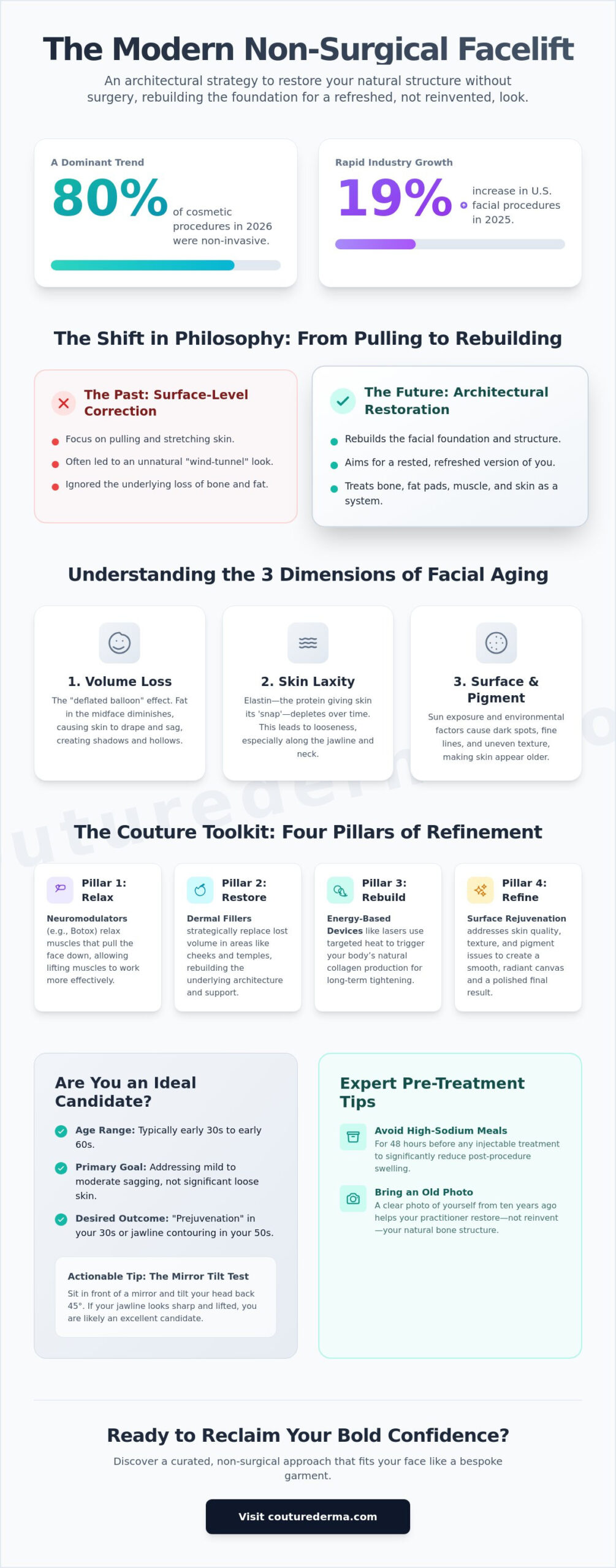
In my Beverly Hills practice, I often tell patients that we aren’t just pulling skin; we are rebuilding the foundation. A non surgical face lift in 2026 is no longer about a single miracle injection or a lucky laser treatment. Instead, it’s a multi-modality approach that treats your face like a custom garment. In the past, the focus was almost entirely on the skin surface. Practitioners would pull and stretch, often leading to that “wind-tunnel” look we all want to avoid. Today, we understand that true beauty comes from volume and structure. We look at the bone, the fat pads, and the muscle to see where the support has faded.
This shift in philosophy is a major part of how we define facial rejuvenation today. It’s about looking like a rested version of yourself, not a different person entirely. To better understand this concept, watch this helpful video:
When we talk about these procedures, we usually divide them into “Liquid Facelifts” and “Energy-Based Lifts.” A liquid lift uses dermal fillers to replace lost volume in the cheeks or temples. Energy-based lifts use technology like the Fotona laser to heat the deeper layers of your skin. This heat triggers your body to produce more collagen (the protein that provides structural support). In 2025, there was a 19 percent increase in facial procedures in the U.S., and nearly 80 percent of those were non-invasive. Here is a quick tip: before your consultation, take a clear photo of yourself from ten years ago. It helps me see your natural bone structure so we can restore, not reinvent, your face.
The Three Dimensions of Facial Aging
Aging happens in three distinct ways. First, there is volume loss, which I call the “deflated balloon” effect. As we lose fat in the midface, the skin begins to drape and sag. Second, we see skin laxity. This occurs when your elastin (the protein that allows skin to snap back) starts to deplete. Finally, surface texture and pigment play a huge role. In Beverly Hills, year-round sun exposure often causes dark spots and fine lines that make the skin look older than it actually is.
Who is the Ideal Candidate for a Non-Surgical Lift?
I see the best results in patients between their early 30s and early 60s. If you’re in your 30s, we focus on “prejuvenation” to keep your collagen levels high. By your 50s, we are often working on jawline contouring to fix mild sagging. But let’s be honest; if there is a significant amount of loose skin hanging off the neck, a non surgical face lift might not be enough. In those cases, I will typically suggest a surgical referral. Here is an actionable tip: perform the “Mirror Tilt Test.” Sit in front of a mirror and tilt your head back 45 degrees. If your jawline looks sharp and lifted in that position, you are likely an excellent candidate for non-surgical tightening.
The Couture Toolkit: Four Pillars of Facial Refinement
Every face I see in my Beverly Hills practice tells a unique story. I don’t believe in a “standard” pattern because your bone structure and skin history are entirely your own. Instead, we curate a specific combination of the latest non-surgical treatments to act as the four pillars of your rejuvenation. In many cases, I find that jawline contouring is the most effective starting point for a non surgical face lift. It restores the sharp boundary between the face and neck that gravity often blurs over time.
Can fillers and neurotoxins actually lift my face?
I see patients who worry that injectables will make them look “puffy,” but when used correctly, they restore the underlying architecture. We typically use neuromodulators like Botox or Daxxify to relax the muscles that pull your face downward. This allows the lifting muscles to do their job more effectively. Then, we use Hyaluronic Acid (HA) fillers to recreate the “Ogee curve;” that soft S-shape that defines a youthful cheek from the side profile. Here is a tip: ask about “micro-droplet” techniques. We use tiny amounts of filler to create a finish that looks like you’ve had a long nap, rather than a procedure.
How do ultrasound and radiofrequency help with sagging?
While fillers add volume, energy-based devices provide the actual structural lift. Ultherapy uses micro-focused ultrasound to reach the SMAS layer, which is the same deep tissue that surgeons tighten. It’s a precise treatment that triggers your body to produce new collagen. On the other hand, Radiofrequency (RF) Microneedling tightens the “envelope” of the skin surface. It’s vital to understand that tightening the skin is different from lifting the deeper tissue. In most cases, you need both for a complete non surgical face lift result. Actionable tip: wait at least 90 days before judging your energy-based results, as collagen fibers take time to mature and tighten.
Can lasers fix my sun damage and fine lines at the same time?
The final pillar is the surface finish. Lasers like the Fotona are excellent for clearing away melanocytes (cells that produce skin pigment) that have accumulated from years in the sun. This process also triggers neocollagenesis (the production of new collagen) to smooth out fine lines and improve overall texture. We can even target specific areas with under eye brightening to remove the tired look that volume loss often leaves behind. If you’re ready to see which pillars your face requires, our online booking makes it easy to schedule your initial evaluation.
Non-Surgical vs. Traditional Facelift: A Curated Comparison
Let’s be honest; the first question I get is whether a non surgical face lift can actually compete with a surgeon’s knife. The short answer is that they serve different masters. I often see patients who aren’t ready for the operating room but want to look 5 years younger by next week. While surgery provides a dramatic, one-time overhaul, it also carries the risk of general anesthesia and permanent scars. In my practice, we prioritize a couture approach that allows for incremental aging. This means we adjust your treatment as your face naturally changes over time, helping you avoid looking stuck in a specific decade.
This method focuses on maintaining your unique character while softening the edges of time. It is a journey of refinement rather than a rush to a finish line that might not look like you. By choosing non-surgical options, we typically avoid the “wind-tunnel” look that often comes from pulling the skin too tight without addressing the underlying volume loss. We are essentially future-proofing your face, one session at a time.
How long will the results really last compared to surgery?
Surgery typically requires a full 14 days of intense recovery. In contrast, a non surgical face lift involves what I call “social downtime.” You might have a few days of minor swelling or a tiny bruise, but you’re back to your life almost immediately. But we have to be realistic about the timeline. A surgical lift might last 10 years, whereas non-surgical refinements usually need a refresh every 12 to 18 months. This isn’t a failure of the treatment; it’s simply the reality of how your body metabolizes fillers and responds to energy-based tightening. Here is an actionable tip: schedule your non-surgical lift at least 3 weeks before a major event like a wedding. This gives your tissues plenty of time to settle and any minor bruising to vanish completely.
Is the financial investment worth it in the long run?
It’s helpful to view the financial side as a “skincare subscription” rather than a one-time massive expense. While the initial cost of a non-surgical session is significantly lower than a surgical fee, the long-term maintenance does add up. But here’s the thing: you’re paying for the ability to look like yourself at every stage of life. In May 2026, the average price for a non-surgical facelift is $2,824, which allows for much more flexibility than an expensive surgical commitment. We focus on enduring results that evolve with you. If you’ve noticed your lower face starting to sag, starting with jawline contouring can be a high-value way to see immediate refinement without the surgical commitment. Quick tip: ask your provider about treatment packages, as bundling energy-based lifting with dermal fillers often reduces the total investment compared to booking them separately.
The Couture Journey: Customizing Your Treatment for All Skin Types
Melanin changes the conversation when it comes to facial rejuvenation. If you have a deeper skin tone, a non surgical face lift isn’t just about lifting tissue; it’s about doing it safely without triggering PIH (post-inflammatory hyperpigmentation), which are dark spots caused by inflammation. I’ve spent 15 years specializing in Skin of Color because I’ve seen too many patients come to me after a “one-size-fits-all” treatment went wrong elsewhere. In my practice, we don’t just rush into a procedure; we curate a plan that respects your specific biology.
The Couture Consultation is where we map out your skin history and lifestyle to ensure the results feel natural and enduring. We often look at under eye brightening as a companion to your lift, as pigment issues in this area often make you look more tired than you actually feel. In Beverly Hills, our constant sun exposure means your skin’s surface needs as much care as the deeper layers. We prioritize the unique way your skin responds to heat, ensuring every step of the process is intentional and thoughtful.
How do we keep melanin-rich skin safe during a lift?
We typically use “color-blind” technologies to protect your complexion. For example, Ultherapy uses ultrasound that bypasses the pigment-producing layers entirely to target the deep foundation we discussed earlier. If we use a laser, I typically reach for an Nd:YAG wavelength, which is safer for darker skin than traditional CO2 lasers. In most cases, we also start with a “pre-conditioning” phase. This involves using specific topicals for 4 to 6 weeks before your procedure to calm your melanocytes (cells that produce skin pigment). Here is an actionable tip: if you have a deeper skin tone, it is typically best to ask for a “test patch” on a hidden area like behind the ear before a full-face laser treatment. This simple precaution helps us predict how your skin will react before we commit to the full journey.
Can this approach help with my acne scars or uneven pigment?
In my practice, we don’t just lift; we clear the canvas. I see many patients who find that their acne scar refinement actually improves once we tighten the skin “envelope.” When the skin is firm, indentations often look shallower and much less noticeable. We also have to manage conditions like melasma (hormonal pigment) while we work on your structural lift. Here is another tip: apply a physical sunblock with at least 20 percent zinc oxide every single morning for 14 days following your treatment. This helps prevent heat-induced pigment from forming while your skin is in its recovery phase. If you’re ready for a plan that respects your unique skin tone, you can schedule your couture consultation today.
Your Experience at Couture Dermatology: Reclaiming Your Bold Confidence
When you walk into our Beverly Hills clinic, the first thing you’ll notice is the calm. It’s an intentional departure from the fast-paced world outside. In my practice, I believe that skin refinement is a journey; it isn’t a rush to a finish line. This is where we begin your non surgical face lift experience, focusing on our core philosophy of “Beautiful Skin, Bold Confidence.” Much like the meticulous attention to detail found at Luxe Drapery and Shades, we treat every face as a bespoke project, ensuring you feel seen and valued from the moment you arrive. Our environment is designed to be as luxurious as the results we deliver.
Let’s be honest; the best results come from a marathon, not a sprint. I see patients who want a total transformation overnight, but I often advise a more patient approach. By layering treatments over time, we achieve a look that is elevated and enduring. This “Refinement Journey” ensures that as you age, your results look natural rather than forced. We aren’t just looking at how you look today, but how you will age over the next decade. It is about creating a version of you that feels rested and empowered.
What Happens During Your Signature Consultation?
As a Harvard-trained dermatologist, I use a combination of artistic intuition and advanced dermatologic science to evaluate your face. During your consultation, we use high-resolution imaging to see what’s happening beneath the surface. We look at your bone structure, fat distribution, and skin quality to build a 12-month “Roadmap to Radiance.” This plan is designed specifically for your lifestyle and your goals. Here is an actionable tip: bring a clear photo of yourself from 5 to 10 years ago to your consultation. It allows me to see your natural aging pattern so we can restore your features with precision rather than just guessing where your volume used to be.
Maintaining Your Results: The Couture Aftercare
Your non surgical face lift doesn’t end when you leave the office. To extend the life of your results, I typically recommend medical-grade skincare protocols that support collagen production. This includes using Retinols (Vitamin A derivatives) to boost cell turnover and Vitamin C to protect against environmental damage. Here is a specific protocol: wait 20 minutes after cleansing before applying your retinol to minimize irritation and ensure the product penetrates evenly. But the “Golden Rule” of Beverly Hills is that SPF is non-negotiable. Without daily sun protection, you are essentially undoing the work we’ve done to tighten and brighten your skin.
Choosing the right partner for your skin is a major decision that requires trust. If you’re still researching, you might find our guide on how to choose the best dermatologist in Los Angeles helpful for your journey. When you’re ready to design your bespoke plan, I invite you to experience a Couture Consultation with us. We’ll work together to reclaim your bold confidence and ensure you look as vibrant as you feel.
Start Your Journey to Bold Confidence
We’ve moved past the era where looking younger required a radical surgical overhaul. In my Beverly Hills practice, I see that the most beautiful results come from a meticulous blend of volume restoration and skin tightening. By focusing on the structural layers of your face, a non surgical face lift allows you to age gracefully while keeping your unique character intact. It is about refinement; not reinvention. We’ve explored how energy-based devices and artful injectables work together to reclaim your jawline and brighten your eyes without the risks of general anesthesia.
Whether you’re looking to pre-condition melanin-rich skin or restore volume lost to time, your plan must be as unique as your own history. As a board-certified dermatologist with 15 years of clinical experience, I am here to ensure your results look rested and natural. Let’s design a roadmap that fits your lifestyle and your goals perfectly. You deserve to feel as vibrant as the city around us. If you’re ready to see what’s possible for your skin, I invite you to Schedule Your Signature Couture Consultation in Beverly Hills today. Your boldest confidence is just one intentional step away.
Frequently Asked Questions
How long does a non-surgical facelift actually last?
In most cases, the results of a non surgical face lift endure for 12 to 18 months depending on your personal metabolism and the specific modalities used. While dermal fillers provide immediate volume, energy-based treatments take about 3 to 6 months to show their full effect as your body builds new collagen. I typically see patients once a year for a “refinement” session to maintain their structural support and keep their results looking fresh.
Is the procedure painful? What does it feel like?
Most patients describe the sensation as a series of warm pulses or a light “snapping” feeling against the skin. We use high-strength topical numbing creams and cooling air to ensure you stay comfortable throughout the process. It is a very different experience than the intense recovery of surgery; in my practice, patients often walk out and go straight to a lunch meeting in Beverly Hills without any significant discomfort.
What is the “Liquid Facelift” and is it right for me?
A liquid facelift uses a curated combination of dermal fillers and neurotoxins (muscle-relaxing injections) like the new Relfydess, which was approved in 2026. This approach is perfect if your main concern is volume loss or a “hollow” appearance in the cheeks and temples. If you also have sagging skin, I will often combine these injectables with ultrasound technology to provide a more comprehensive non surgical face lift that addresses both volume and laxity.
Can I get a non-surgical facelift if I have a darker skin tone?
Yes, but you must choose a provider who specializes in melanin-rich skin to avoid PIH (post-inflammatory hyperpigmentation), which are dark spots caused by heat. In my practice, I use “color-blind” technologies like Ultherapy or specific laser wavelengths that bypass the melanocytes (cells that produce skin pigment). We typically pre-condition your skin with specific topicals for 4 to 6 weeks before your treatment to ensure the safest and most elegant result.
How much downtime should I plan for after my treatment?
You should plan for approximately 2 to 3 days of “social downtime” to account for mild swelling or tiny pin-point bruises. This is significantly less than the 14 days of recovery required for traditional plastic surgery. I recommend avoiding high-intensity workouts for at least 48 hours after your procedure to keep swelling to a minimum and allow your tissues to settle properly.
At what age should I start considering non-surgical lifting treatments?
The “sweet spot” for these treatments is usually between your mid-30s and early 50s. In 2025, about 57 percent of facial plastic surgeons reported an increase in patients under 30 seeking “prejuvenation” to maintain their collagen levels early. Starting in your 30s or 40s often means you’ll need less aggressive work later in life because we are preserving your natural architecture as you age.
What is the difference between skin tightening and a non-surgical lift?
Skin tightening focuses on the “envelope” or the outer layer of skin to improve fine lines and surface texture. A non-surgical lift goes much deeper to target the SMAS (the structural layer of tissue that surgeons tighten) and the underlying fat pads. Think of tightening as ironing the fabric of a dress, while lifting is more like tailoring the actual fit of the garment to your body.