

You’re standing in front of the mirror, tilting your head just so to catch the light, and there it is again. That glimpse of scalp where there used to be a thick canopy. In my practice, I find that many people searching for non-surgical hair thinning solutions are tired of conflicting reviews and fear surgery. It’s a frustrating spot to be in, but you aren’t alone. I see patients every day who want to reclaim their density without the downtime of a traditional transplant.
I’ve spent 15 years as a dermatologist helping people manage this exact challenge. And here’s the thing; if you’ve tried over-the-counter foams for six months with no change, you don’t need a scalpel to see real improvement. Today, I’m showing you how a personalized, medical-grade approach can restore your confidence and hair density without a single incision. We’ll explore how we treat your hair like a piece of couture fabric, tailoring advanced treatments to your specific biology, your hair texture, and your long-term goals for results that look and feel natural.
Key Takeaways
- Identify the root causes of hair loss and learn why early intervention is the secret to saving follicles before they disappear.
- See how bio-regenerative treatments like PRP use your own growth factors to naturally stimulate thicker hair growth.
- Discover the role of laser therapy and microneedling in “recharging” dormant follicles and improving scalp health.
- Find out how non-surgical hair thinning solutions can be tailored to your unique hair texture and lifestyle for maximum results.
- Learn how to combine professional treatments with at-home rituals to create a signature restoration plan that lasts.
Understanding the “Why” Behind Your Thinning Hair
I see patients every day who feel blindsided by their reflection. Many assume that a widening part or a visible scalp is just an inevitable part of “old age.” In my practice, I explain that your hair is like a delicate, high-end fabric that requires specific reinforcement when the threads begin to fray. But here’s the thing; you don’t have to accept thinning as your permanent reality.
Non-surgical hair thinning solutions are medical interventions designed to reverse the shrinking of your follicles before they disappear entirely. Think of it as restorative tailoring for your scalp. We’re strengthening the foundation so the garment stays full and lush. To better understand how these non-invasive options work, watch this helpful video:
Living in Beverly Hills adds a unique layer of complexity to this journey. Our beautiful, year-round sunshine is a draw, but that constant UV exposure can cause significant oxidative stress on the scalp. In many cases, this environmental damage accelerates the aging of the hair follicle. It’s why a “couture” approach is so vital; we must look at your environmental stressors alongside your genetics to find the right fit.
The Mechanism of Follicle Miniaturization
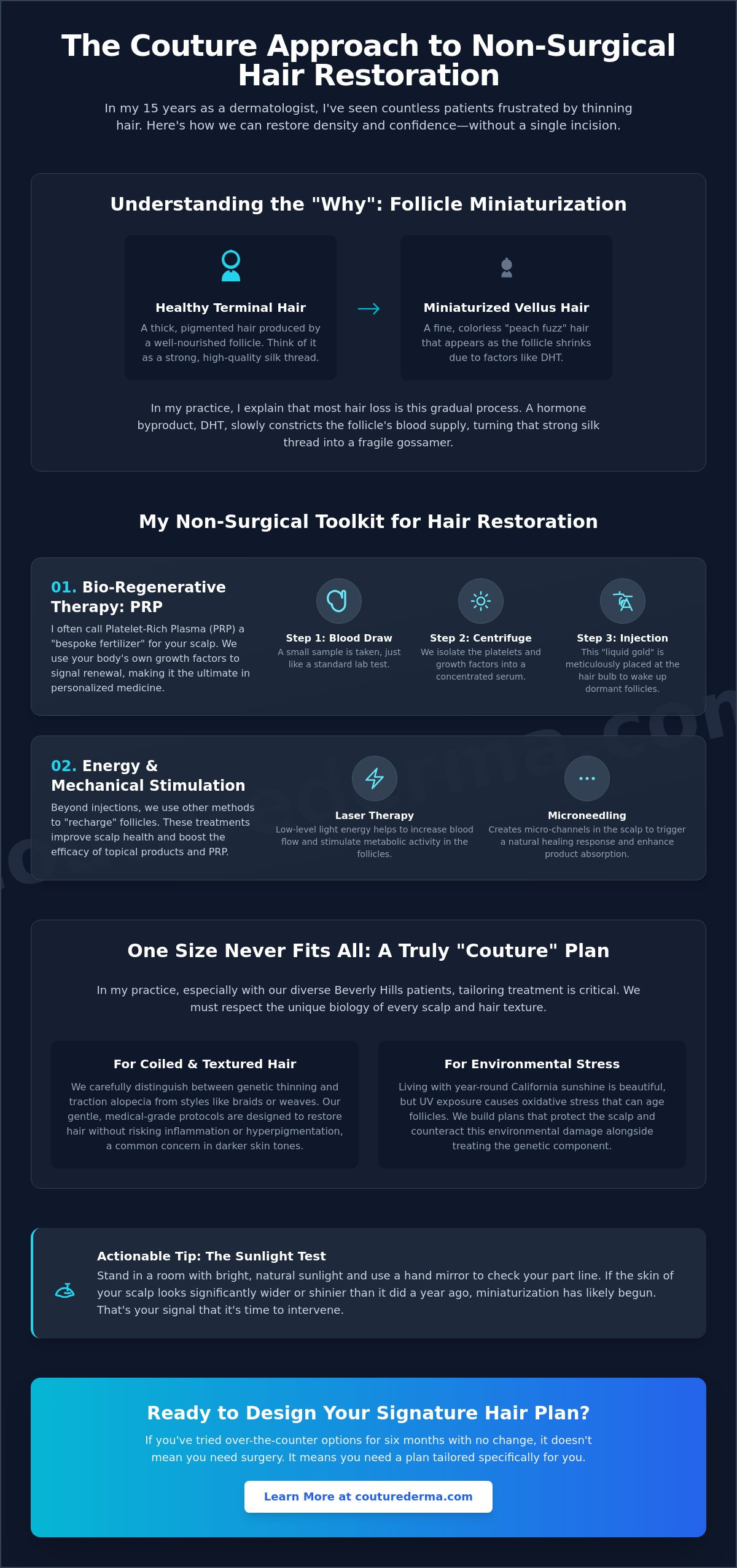
Most cases of Pattern hair loss involve a biological process called miniaturization. This is where DHT (dihydrotestosterone), a hormone byproduct, acts like a slow constriction on the hair’s blood supply. It’s as if a once-thick silk thread is being replaced by a thin, fragile gossamer. Your “terminal” hair, which is thick and pigmented, slowly transitions into “vellus” hair. That’s the fine, colorless peach fuzz that lacks any real volume.
Actionable Tip: Stand in a room with bright, natural sunlight and use a hand mirror to check your part line. If the skin of your scalp looks significantly wider or shinier than it did a year ago, the miniaturization process has likely begun and it’s time to intervene.
Tailoring for All Hair Types and Textures
One size never fits all in dermatology. This is especially true for hair restoration. Coiled or textured hair (Type 4) requires a completely different diagnostic lens than straight hair. In my practice, I find that we must carefully distinguish between genetic thinning and traction alopecia, which is hair loss caused by chronic tension from braids, weaves, or extensions.
And let’s be honest; patients with darker skin tones must be extra cautious with certain scalp treatments. Inflammation in these skin types can lead to post-inflammatory hyperpigmentation or even permanent scarring. That’s why our approach at Couture Dermatology focuses on gentle, medical-grade restoration that respects the unique biology of every patient. We ensure the treatment plan is as refined as the results you’re looking for.
The Science of Growth: PRP and Bio-Regenerative Therapies
When we talk about non-surgical hair thinning solutions, Platelet-Rich Plasma (PRP) stands as one of the most elegant and effective options available today. I often tell my patients that PRP is like a bespoke fertilizer for your dormant hair follicles. We aren’t introducing synthetic chemicals or foreign substances into your scalp. Instead, we are using your own biology to heal your biology. It is the ultimate form of personalized medicine, tailored to your body’s unique regenerative potential.
The process is quite straightforward but requires a meticulous hand and an artistic eye. In our practice, we follow a precise protocol to ensure the highest quality results:
- Drawing a small amount of your blood, much like a standard lab test.
- Placing the blood in a specialized centrifuge to isolate the platelets and growth factors.
- Meticulously injecting this “liquid gold” into the specific areas where your hair is thinning.
But here’s the thing; the technique of the injector matters just as much as the plasma itself. Placing these growth factors at the precise depth of the hair bulb is what separates a standard treatment from a truly transformative one. It requires patience and precision to ensure every injection contributes to your long-term hair density.
How Growth Factors Signal Renewal
Inside that concentrated plasma are cytokines (signaling proteins) that act as wake-up calls for your hair bulbs. These proteins communicate with the stem cells in your follicles to extend the anagen phase (the active growth stage). In cases of Androgenetic Alopecia, this growth phase is often cut short by hormonal changes. By reintroducing these signals, we aim to keep the hair in the growing phase longer, leading to increased thickness and a fuller appearance over several months.
Actionable Tip: Avoid anti-inflammatory medications like ibuprofen or naproxen for at least 48 hours before your PRP session. These drugs can dampen the natural inflammatory response we are trying to trigger, which is essential for the growth factors to do their best work.
Exosomes and the Future of Non-Surgical Restoration
While PRP is a foundational tool, we are now moving into the sophisticated era of exosomes. These are tiny cellular messengers that carry even more concentrated signals than whole cells. Think of them as a high-detail alternative to traditional PRP for patients who need an extra boost. In my Beverly Hills clinic, I find that layering these bio-regenerative treatments often provides the most custom-fit result for patients with stubborn thinning. These are among the most sophisticated non-surgical hair thinning solutions I recommend for long-term density. This isn’t a quick fix, though. Most patients see the full transformation after 6 to 9 months of consistent care. If you’re ready to see if this is your perfect fit, you can schedule a consultation to begin your journey.
Beyond Injections: Laser Therapy and Microneedling Protocols
While bio-regenerative injections are a cornerstone of restoration, they’re only one piece of the garment. In my practice, I find that the most successful non-surgical hair thinning solutions involve a multi-layered strategy. We aren’t just looking for one “hero” treatment; we’re looking for a synergy that supports the hair follicle from every angle. This is where light energy and mechanical stimulation come into play to create a more robust foundation for growth.
Low-Level Laser Therapy (LLLT) isn’t science fiction, even if the sleek devices look the part. It’s a process called photobiomodulation, which is essentially using specific light wavelengths to stimulate cellular activity. Think of it as “recharging the battery” of your hair follicles. When those follicles are sluggish and miniaturizing, the light energy helps kickstart their metabolism. According to the Mayo Clinic’s guide on Hair loss diagnosis and treatment, these therapies are increasingly recognized as effective non-invasive options for those who aren’t ready for surgery.
The Protocol for Low-Level Laser Therapy
Consistency is the “seam” that holds this treatment together. If you only use the device once in a while, you won’t see the results you’re after. In most cases, it’s a commitment of three times a week. Whether you use a clinical-grade panel in our practice or a high-end at-home device, the frequency is what drives the transformation. I see patients who prefer the convenience of a laser cap, but I always remind them that the quality of the device determines the quality of the outcome.
Actionable Tip: If you’re using an at-home laser cap, make sure your hair is damp-dry, not soaking wet. Excess water can refract the light away from your scalp, preventing the energy from reaching the follicles where it’s needed most.
Microneedling: Creating the Perfect Canvas
Then we have microneedling. This involves creating tiny, controlled micro-channels in the scalp. These act like “open doorways” for any topical medications or growth factors we apply afterward. By triggering the body’s natural repair cycle, we encourage fresh blood flow to the area. Learn how we use similar refinement techniques for acne scar refinement to smooth and heal the skin through this same principle of controlled renewal. For the scalp, we carefully control the depth, typically between 0.5mm and 1.5mm. This allows us to reach the hair bulb without causing any permanent scarring or inflammation. It’s a high-detail approach that ensures your scalp remains a healthy environment for new growth to thrive. When we combine this with other non-surgical hair thinning solutions, the results are often far more impressive than what a single modality could achieve alone.
The Daily Ritual: At-Home Maintenance and Topical Mastery
Let’s be honest; what you do at home is the lining of your hair restoration journey. It is the hidden structure that ensures the final result looks seamless and lasts for years. While our in-office non-surgical hair thinning solutions provide the intensive boost your scalp needs, your daily ritual determines how well that progress is maintained. I see many patients who feel frustrated because they’ve tried foams or drops in the past without success. In my practice, I find that most of these cases weren’t failures of the medicine itself, but rather failures of application technique.
Precision matters in every step of your care. A couture approach to hair restoration requires more than just a quick splash of product before bed. It requires an understanding of how your skin absorbs active ingredients. If you’re applying your prescription topical over a layer of sebum (oil) and styling products, the medicine never actually reaches the follicle. You’re effectively treating your hair shafts instead of your scalp. It is like trying to water a dry garden by misting the leaves instead of the roots.
The Couture Topical Application Protocol
To get the most out of your prescription sprays, follow this three-step protocol. First, cleanse your scalp thoroughly to remove any buildup. Second, wait at least 20 minutes after washing before you apply your topical. This reduces the risk of irritation, as wet skin can absorb medication too quickly. Third, use your fingertips or a specialized scalp massager to work the product directly into the skin, not just the hair.
Actionable Tip: Apply your hair serum or topical medication at night. Your body’s circadian rhythm (internal clock) naturally increases skin permeability (how easily things pass through) in the evening. This makes it the ideal time for maximum absorption and follicle repair while you sleep.
Feeding the Follicle from Within
We cannot ignore what is happening inside the body if we want lasting results. In our Beverly Hills clinic, we often find that external thinning is a symptom of internal imbalance. I recommend medical-grade nutraceuticals over generic “hair, skin, and nails” vitamins. These specialized supplements contain higher concentrations of adaptogens (herbs that manage stress). These help balance cortisol (a stress hormone) which can otherwise push hair into a premature shedding phase.
In my practice, we also look at your labs to check for iron or Vitamin D deficiencies. These are often the silent culprits behind a thinning crown or a widening part. When we address these nutritional gaps alongside our non-surgical hair thinning solutions, the transformation is much more profound. If you’re ready to move beyond generic advice and find a plan that fits your unique biology, schedule a personalized scalp analysis today. We’ll ensure your daily ritual is just as refined as your clinical treatments.
Designing Your Signature Hair Restoration Plan at Couture Dermatology
At Couture Dermatology, we don’t just treat hair; we curate a transformation. It’s about more than just filling in a patch or thickening a part. We look at your hair restoration as one piece of a larger aesthetic puzzle. In my practice, I find that patients are most satisfied when their results look so natural that it feels like the hair was always there. This is why our non-surgical hair thinning solutions are never off-the-rack; they are custom-fit to your unique biological fabric.
Your journey begins with a deep-dive consultation at our Beverly Hills clinic. But this isn’t a five-minute chat. We examine your scalp under high magnification to see the health of individual follicles. I see patients who have tried every foam on the market, but they’ve never had someone actually look at the skin of their scalp. We perform a physical “pull test” to assess the current rate of shedding and review your medical history to rule out underlying issues. I often share with my patients that bio-regenerative options like PRP have a success rate of 70-90% for hair restoration when the right candidate is selected.
What to Expect During Your Couture Consultation
We discuss potential combination therapies that fit your lifestyle. If you travel frequently, a daily laser cap might be better than frequent in-office visits. We also consider how your hair frames your face. For instance, we might look at your aesthetic goals for the lower face. See how we balance facial aesthetics with jawline contouring to ensure your new hair density complements a refined profile.
Actionable Tip: Bring a list of all current supplements and hair products to your first visit. Let’s be honest; some over-the-counter “hair growth” pills contain high doses of biotin that can actually interfere with important blood tests, while certain heavy oils might be clogging your follicles instead of nourishing them.
The Long-Term Commitment to Timeless Hair
Think of maintenance as the “alteration” that keeps your results perfect over the years. Hair restoration isn’t a “one and done” event; it is a collaborative journey. There is a profound emotional benefit to being proactive. Knowing you have a plan in place replaces the fear of loss with a sense of calm confidence. By integrating medical expertise with an artistic eye, we ensure your non-surgical hair thinning solutions provide a lasting, sophisticated outcome. Our goal is a result that feels entirely you, only more vibrant and restored.
Taking the First Step Toward Your Restored Density
Reclaiming your hair density doesn’t require a surgical suite or a long recovery period. We’ve explored how non-surgical hair thinning solutions like PRP and laser therapy can wake up sluggish follicles and extend the growth phase. It’s about combining medical science with an artistic eye to ensure every treatment fits your unique biology. Whether you’re managing genetic thinning or environmental stress from the Beverly Hills sun, the key is starting before the follicles are gone for good.
In my practice, I find that the most successful transformations happen when we move away from generic products and toward a bespoke plan. As a Harvard-trained dermatologist with experience in all skin and hair types, I’m here to help you navigate these advanced options with confidence. You deserve a restoration journey that is as refined as it is effective. If you’re ready to see what’s possible, schedule your bespoke hair restoration consultation with Dr. Abisogun at our Beverly Hills clinic today. Let’s build a signature plan that restores your hair and your self-assurance.
Frequently Asked Questions
How long does it take to see results from non-surgical hair thinning solutions?
You should typically expect to see the first signs of visible improvement within three to six months. Hair restoration is a journey of patience because the biological growth cycle moves slowly. In my practice, I find that the most significant changes in density and texture usually appear around the nine month mark. This is when the newly stimulated hairs have had enough time to mature and provide real coverage.
Is PRP for hair loss painful, and what is the downtime?
Most patients describe the sensation as a series of small pinpricks, and there is virtually no medical downtime involved. You might experience some mild swelling or a “tight” feeling on the scalp for about 24 hours. I see patients who return to their normal social schedule the very next day without any issues. We use specialized cooling techniques to ensure the experience is as comfortable and sophisticated as possible.
Can non-surgical treatments work for someone who is already completely bald?
Non-surgical hair thinning solutions generally don’t work for areas of the scalp that are completely bald and shiny. These treatments rely on the presence of a living hair follicle to stimulate and “recharge.” If the scalp is smooth and the follicle has been dormant for many years, it has likely been replaced by scar tissue. I find that patients have the best success when they intervene at the first sign of a widening part.
Are there any side effects to the topical treatments you prescribe?
The most frequent side effects are localized scalp irritation, redness, or a bit of dryness. These are often caused by the vehicle (the liquid base) of the medication rather than the active ingredient itself. I often suggest waiting 20 minutes after washing your hair before applying your topical to help minimize these issues. In some cases, we can use compounded formulas that are specifically tailored to be gentler on sensitive skin.
How do non-surgical hair treatments differ for men versus women?
While the technology is similar, the underlying cause of the thinning often dictates a different approach for men and women. Men typically face issues related to DHT (a hormone byproduct), while women often have a complex mix of hormonal shifts and nutritional gaps. In my practice, I find that women may require different concentrations of medications to avoid unwanted side effects, while men might need a more aggressive hormone-blocking strategy.
What happens if I stop doing the maintenance treatments?
If you stop your maintenance routine, your hair will likely return to its original thinning pattern over several months. Restoration is a continuous process of supporting the follicle against genetics and aging. Without the ongoing signals from treatments like PRP or laser therapy, the process of miniaturization (the shrinking of hair follicles) will eventually resume. It typically takes three to six months after stopping to notice a decrease in density.
Can I combine these hair treatments with other aesthetic procedures like Botox?
You can absolutely combine hair restoration with other aesthetic treatments like Botox or dermal fillers. There are no medical reasons to avoid doing both as part of a broader transformation. In fact, many of my patients prefer to address their hair density and facial harmony in a single, cohesive plan. We often look at how your hair frames your face to ensure your results contribute to a balanced and refreshed appearance.