Imagine standing in front of your vanity mirror, adjusting your hair for the third time this morning, only to realize the thinning isn’t just a bad hair day anymore. In my practice, I see patients who feel this exact knot of anxiety, wondering if they’ll ever find a permanent solution for alopecia treatment in Beverly Hills. It’s an emotional weight that can’t be ignored. You’ve likely grown frustrated with generic, one-size-fits-all options that don’t consider your specific skin tone or the risk of hyper-pigmentation (dark spots) on your scalp.
I believe your restoration journey should be as meticulously crafted as a bespoke garment. You’ll discover how I combine my Harvard-trained clinical expertise with a tailoring-inspired approach to treat hair loss for all skin types. We’ll look at the latest 2026 protocols, including how we protect the health of your melanocytes (cells that produce skin pigment) while aggressively targeting regrowth. Here’s the thing: your hair loss is unique, and your treatment plan should be, too. Let’s explore how a custom-fit medical strategy can restore both your hairline and your confidence.
Key Takeaways
- Discover why a custom-fit approach to alopecia treatment beverly hills is the only way to address your unique hair texture and biological “fabric.”
- Learn why working with your hair’s natural three-phase cycle requires a patient, three-to-six-month timeline for visible restoration.
- Understand how we protect your melanocytes to ensure treatments remain safe and effective for all skin types without the risk of dark spots.
- Explore the “liquid gold” benefits of Platelet-Rich Plasma (PRP) and how medical-grade topicals can be tailored to your specific needs.
- Identify the specific Beverly Hills environmental triggers that can cause temporary shedding and how to reverse the damage.
What Is Alopecia? Understanding Hair Loss in Beverly Hills
I often tell my patients that hair is a barometer for internal health. It’s often the first thing to react when your body is under duress, yet it’s usually the last thing we think to check. In my practice, I see patients who are surprised to learn that alopecia (medical term for hair loss) isn’t a single diagnosis. It’s a broad category that covers everything from genetic thinning to lifestyle-induced shedding. In the high-pressure environment of Beverly Hills, factors like demanding careers and environmental pollutants can trigger telogen effluvium (temporary shedding caused by stress).
To better understand how these conditions manifest, watch this helpful video:
At Couture Dermatology & Laser Beverly Hills, we view the scalp as the foundation for your hair’s fabric. If the soil isn’t healthy, the silk won’t grow. This is why effective alopecia treatment beverly hills requires more than just a surface-level fix. We need to look at the biology beneath the surface to ensure the restoration is both lasting and beautiful. It’s about treating the source, not just the symptom.
Common Types of Alopecia I See in My Practice
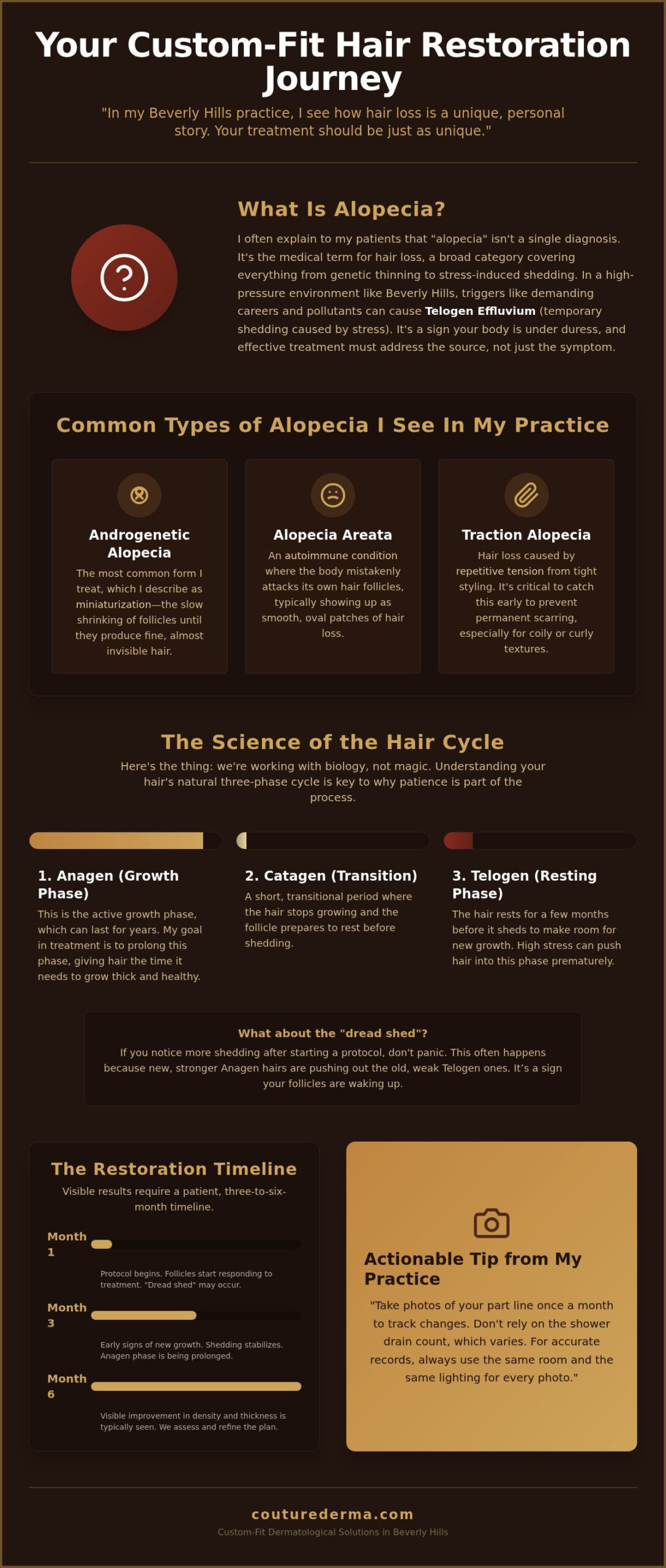
The first step in any restorative journey is identifying the specific weave of your hair loss. Androgenetic Alopecia (genetic thinning) is the most common form of hair loss I treat. I describe it to patients as miniaturization (the slow shrinking of follicles until they produce fine, almost invisible hair). Then there is What is Alopecia Areata? (an autoimmune condition where the body attacks its own follicles). This typically shows up as smooth, oval patches. Finally, Traction Alopecia (loss caused by repetitive tension from tight styling) is a critical concern for patients with coily or curly textures. If we don’t catch it early, the stress can lead to permanent scarring.
Why a Clinical Diagnosis Is the First Step
Let’s be honest; buying a random thickening shampoo from the grocery store is like buying a suit off the rack without knowing your measurements. It rarely fits. Without knowing the root cause, you’re just guessing. In our clinic, we start with a thorough scalp exam and often run blood work to check for vitamin deficiencies or hormonal imbalances. Occasionally, I’ll perform a biopsy (sampling a small piece of skin) to look at the follicles under a microscope. This scientific rigor ensures that your treatment plan is a perfect, custom-fit for your needs.
Actionable Tip: Take photos of your part line once a month to track changes. Don’t rely on the shower drain count, as daily shedding can vary wildly. Try to use the same room and lighting for every photo to keep your records accurate.
The Science of the Hair Cycle: Why Patience Is Part of the Process
In my practice, I see patients who want results yesterday. It’s a natural feeling, especially when you’re dealing with the emotional weight of thinning. But here’s the thing: we’re working with biology, not magic. When we design a plan for alopecia treatment beverly hills, we’re essentially re-weaving the growth cycle. This process requires a steady hand, clinical precision, and most importantly, time.
Every hair on your head is currently in one of three phases. Anagen (active growth phase) can last for years. Catagen (transition phase) is a short period where the hair stops growing. Finally, Telogen (resting phase) is when the hair eventually sheds to make room for the new. If you notice a “dread shed” shortly after starting a new protocol, don’t panic. This often happens because new, stronger hairs are pushing out the old, weak ones. It’s a sign your follicles are waking up.
Anagen vs. Telogen: The Tug-of-War for Your Scalp
High-stress environments in Beverly Hills often “shock” hair into the Telogen (resting phase) prematurely. I find that patients who understand this cycle are much more likely to stick with their protocol. They realize that we aren’t just applying a product; we’re trying to prolong the Anagen (active growth phase) so your hair has the time it needs to grow thick and healthy. When exploring Alopecia Areata Treatment Options, we see how vital it is to calm the scalp so the growth phase can resume without interruption.
How Skin Type Influences Your Hair Health
In my 15 years of experience, I’ve seen how skin tone changes the treatment landscape. For patients with Skin of Color, inflammation is a serious adversary. Central Centrifugal Cicatricial Alopecia (a form of scarring hair loss that typically starts at the crown), often referred to as CCCA, requires immediate attention. We have to be incredibly gentle yet effective. My Harvard training taught me that treating diverse skin types requires a nuanced understanding of how inflammation affects the scalp’s fabric. We focus on cooling the fire of inflammation before we even begin the restoration process.
Actionable Tip: If your scalp feels tender, itchy, or even slightly sore when you move your hair, it’s often a sign of underlying inflammation. Don’t ignore it. This is usually the body’s early warning system before visible thinning begins. If you’re noticing these changes, it might be time to schedule a detailed scalp analysis to see where your cycle stands.
Bespoke Treatment Options: From PRP to Medical Topicals
In my practice, I see patients who have spent months searching for the right alopecia treatment in Beverly Hills, only to be met with generic prescriptions that don’t account for their unique biology. But effective restoration isn’t about finding one “magic” ingredient. It’s about layering therapies to create a synergistic (working together) effect where the whole is greater than the sum of its parts. I often tell my patients that the scalp is simply an extension of the face. This is why we approach hair health with the same artisanal care found in our Art of Skin Rejuvenation guide. We want to ensure the skin of the scalp is vibrant, healthy, and ready to support new growth.
PRP: The Non-Surgical Powerhouse
Platelet-Rich Plasma (PRP) has earned its reputation as the “liquid gold” of hair restoration. The procedure is elegant in its simplicity. We draw a small amount of your blood and place it in a centrifuge (a machine that spins at high speeds to separate blood components). This process isolates the platelets, which are packed with growth factors. These growth factors act like biological messengers that wake up “sleepy” follicles and signal them to return to the Anagen (growth) phase. It’s a way of using your body’s own resources to repair itself.
But here’s the thing: PRP works best when it’s part of a curated plan. In most cases, I see much better results when we combine these injections with medical-grade topicals. For my patients with Skin of Color, we are especially careful with the injection technique. We want to avoid any unnecessary trauma that could lead to post-inflammatory hyperpigmentation (dark spots on the scalp). By being meticulous, we ensure the treatment is safe for all skin types and tones.
Oral vs. Topical Medications: A Curated Choice
When we discuss medications like Minoxidil or Spironolactone, the delivery method matters just as much as the drug itself. Some patients prefer the ease of a daily pill like Finasteride. Others find that custom-compounded topical foams, which we can tailor with specific concentrations, work better for their lifestyle. We might choose a topical version to minimize systemic side effects or an oral version for more aggressive thinning. It’s a choice we make together based on your medical history and daily routine.
Restoring your hair often changes how you carry yourself. I’ve noticed that once my patients see their hairline returning, they often want to refine other areas to match their new confidence. Or, they might look into jawline contouring to create a more defined, youthful frame for their face. It’s all part of a transformative journey that extends beyond the scalp to your overall well-being.
Actionable Tip: If you use a topical minoxidil or custom foam, apply it to a completely dry scalp and wait at least 30 minutes before laying your head on a pillow. This prevents the product from rubbing off on your linens and ensures maximum absorption into the follicles.
The Couture Protocol: Your At-Home and In-Clinic Journey
In my practice, I see patients who expect results from a bottle without realizing that the application is just as important as the formula. Think of your alopecia treatment beverly hills like a custom-fit suit; even the best fabric fails if the measurements are wrong. A successful restoration requires a structured rhythm between what we do in the clinic and what you do at home. We start by ensuring your scalp hygiene is impeccable. If the follicles are clogged with excess oil or product buildup, our medical-grade topicals can’t penetrate the skin. I typically recommend a gentle, non-stripping scalp cleanser to keep the environment pristine for growth.
Actionable Tip: Use a silicone scalp massager for two minutes while you shampoo. This helps break up sebum (waxy scalp oil) and increases blood flow to the follicles without the mechanical stress of using your fingernails.
Step-by-Step: Your First 90 Days of Restoration
The first three months are what I call the Transformation Window. Month 1 is the Foundation phase. We establish your diagnosis and start your medical protocol, whether that’s a custom-compounded foam or oral medication. By Month 2, we enter the Activation phase. This is usually when we perform your first PRP (Platelet-Rich Plasma) session to flood the scalp with growth factors. We also adjust your environment, looking at how your specific hair texture responds to the initial steps. Whether your hair is straight, wavy, curly, or coily, the approach must be tailored to maintain the integrity of the strand. Month 3 is the Observation phase. We aren’t looking for a full head of hair yet, but we’re monitoring for a decrease in active shedding.
Managing Expectations and Lifestyle Factors
Let’s be honest; living in the 90210 zip code comes with a unique set of stressors. High-octane careers and social pressures can spike your cortisol (a stress hormone), which can physically push your hair into a resting state. While hair vitamins are popular, they are secondary to a balanced, protein-rich diet. Your hair is made of keratin (the protein that forms hair structure). If you aren’t eating enough of it, your body will divert those nutrients away from your hair to more vital organs. We also have to protect the “fabric” of your new growth from mechanical damage. New hairs are fragile and need a soft touch to survive the early stages of the growth cycle.
Actionable Tip: Switch to a silk or satin pillowcase to minimize mechanical friction and breakage on fragile new growth. Cotton can be surprisingly abrasive to thinning hair and can pull out strands prematurely during the night.
If you’re ready to stop guessing and start a scientific, tailored journey for your hair, book your initial scalp assessment today.
Why Choose Couture Dermatology for Your Hair Journey?
Let’s be honest; hair loss is deeply personal. In my practice, I see patients who have been to numerous “celebrity” clinics where the care feels transactional and the solutions are rushed. But your hair is your crown, and it deserves a bespoke approach. My 15 years of clinical experience, including my Harvard training, has taught me that the best alopecia treatment beverly hills can offer is one that starts with listening. I don’t just look at your scalp; I look at your lifestyle, your health history, and your aesthetic goals to create a plan that fits you perfectly.
We take immense pride in our expertise with all skin types and tones. Many treatments that work for one person can cause complications like scarring or dark spots in another. Because I specialize in diverse skin, I ensure every laser protocol or injection technique is adjusted for your specific biology. We aren’t interested in quick, artificial-looking fixes. We focus on a gradual, healthy progression that yields long-term results you can feel confident about. It’s about treating the individual, not just the condition.
What can you expect from the Couture experience?
Our clinic is designed to be a sanctuary of calm and sophisticated care. We believe that transformation is a holistic journey. It’s quite common for my patients to coordinate their hair restoration with other aesthetic goals to achieve a total sense of well-being. For instance, if stress and lack of sleep have impacted both your hair and your face, we might discuss under-eye brightening to refresh your entire look. We don’t just treat hair; we restore the confidence that comes with feeling like yourself again. It’s about looking in the mirror and finally seeing the person you recognize.
Actionable Tip: Bring a full list of your current supplements and medications to your first visit. Some common over-the-counter vitamins can actually interfere with certain hair treatments, so knowing exactly what’s in your system helps us tailor your protocol safely.
How do you begin your restoration journey?
Your hair restoration journey starts with a single, tailored conversation. We’ve made the booking process simple because we know how much courage it can take to reach out. During our time together, we’ll perform a deep-dive analysis of your scalp and hair health. Here’s the thing: you aren’t just another appointment on a calendar. You’re a partner in a transformative process. We provide the science, the rigor, and the steady hand, but the journey is yours. If you’re ready to take that first step, your bespoke consultation is just a click away. Let’s work together to re-weave your confidence and bring your hair back to its natural vitality.
Begin Your Personal Hair Transformation
Restoring your hair is about more than just follicle counts. It’s about reclaiming the confidence that belongs to you. In my practice, I’ve seen how a custom-fit medical protocol can turn frustration into hope. By understanding your unique hair cycle and protecting the health of your skin, we move beyond generic solutions to something truly bespoke. Whether you’re navigating genetic thinning or stress-induced shedding, the right alopecia treatment beverly hills provides a structured path toward lasting results.
With 15 years of clinical experience and Harvard-trained expertise, I’m dedicated to ensuring that every patient, regardless of their skin tone or hair texture, receives meticulous and safe care. We don’t believe in shortcuts. We believe in scientific rigor and artistic precision. Your journey from thinning to restoration is a collaborative process, and I’m here to guide you through every step. It’s time to stop worrying about the mirror and start feeling like yourself again. Schedule your bespoke hair restoration consultation with Dr. Abisogun today. You deserve a plan that is as unique as the fabric of your life.
Frequently Asked Questions
How much does alopecia treatment cost in Beverly Hills?
The cost of your restoration plan depends entirely on the complexity of your hair loss and the specific combination of therapies required. In my practice, I don’t offer a flat fee because every scalp is as unique as a fingerprint. Some patients require only a medical topical protocol, while others benefit from a layered approach including PRP. We provide a detailed, transparent estimate after your initial scalp analysis and diagnosis.
Is PRP for hair loss permanent, or do I need maintenance?
PRP is a biological boost rather than a permanent cure, so maintenance is necessary to sustain your results. Typically, I recommend an initial series of three to four sessions followed by a “booster” treatment every six to twelve months. Because hair loss is often a progressive condition, these periodic sessions ensure your follicles remain in the active growth phase and continue to produce healthy hair.
Can you treat hair loss in patients with curly or coily hair textures?
Yes, we specialize in treating all hair textures, including the specific needs of curly and coily patterns. In my practice, I see many patients with coily hair who are prone to traction alopecia or inflammation-based thinning. We tailor our application techniques to protect the integrity of your curls while ensuring the scalp environment is healthy enough to support robust new growth without causing scarring.
Does alopecia treatment hurt? What is the sensation during PRP?
Most patients describe the sensation of alopecia treatment beverly hills as a series of quick, manageable pinpricks. During a PRP session, we use very fine needles to deliver growth factors directly to the scalp. While it isn’t completely painless, we use cooling techniques and topical numbing to ensure you are comfortable. Most of my patients find the process much easier than they initially anticipated.
How do I know if my hair loss is from stress or genetics?
Differentiating between stress-induced shedding and genetic thinning requires a clinical diagnosis using a dermatoscope (a specialized magnifying tool). Stress-related loss, known as telogen effluvium, usually causes sudden, diffuse thinning across the entire scalp. Genetic loss typically follows a specific pattern, such as a widening part line. I look for signs of follicle miniaturization to confirm if genetics are playing a role in your thinning.
Are there any side effects to medical hair loss treatments?
Every medical intervention carries a small risk of side effects, though they are typically mild and easily managed. Some patients might experience temporary scalp irritation from topical solutions or slight tenderness after a PRP session. We monitor your progress closely to adjust concentrations if your skin shows signs of sensitivity. Here’s the thing: we always prioritize the health of your scalp fabric over aggressive, irritating protocols.
What happens if I stop my alopecia treatment protocol?
If you stop your protocol, your hair will likely return to its baseline state over several months. This is particularly true for genetic conditions where the treatment is actively counteracting hormonal effects on the follicle. If the cause was a temporary stressor, you might maintain your gains. But in most cases of chronic thinning, consistency is the absolute key to holding onto your results and preventing further loss.
Can I get hair restoration treatments if I have a sensitive scalp?
A sensitive scalp is actually a compelling reason to seek a professional alopecia treatment beverly hills rather than trying over-the-counter options. Many store-bought products contain high levels of alcohol that can trigger inflammation. In our clinic, we use custom-compounded formulas and medical-grade protocols designed to be gentle. We focus on calming your skin first so it can safely tolerate and benefit from the restoration process.