

Last Tuesday, a patient at Couture Dermatology & Laser Beverly Hills asked me why she wasn’t seeing results despite creating a long-term anti-aging plan based on social media trends. She had a bag full of expensive creams but felt her skin looked more tired than ever. In my practice, I see this frustration daily. You’re likely overwhelmed by endless product choices and the fear of looking “overdone” or unnatural. It’s discouraging to invest so much money into your appearance only to feel like you’re guessing at what actually works.
But there is a better way to approach your skin by treating it as a bespoke investment. You’ll learn how to build a personalized, medical-grade roadmap for skin longevity that evolves with you, moving far beyond temporary fixes. We’ll cover exactly which treatments to prioritize and when to do them, so you can have total confidence in your journey. And we’ll focus on achieving skin that looks refreshed and healthy instead of just “younger.” One tip I often give is to wait twenty minutes after washing your face before applying active treatments like Retinol (a derivative of vitamin A) to help prevent unnecessary irritation.
Key Takeaways
- Learn why treating your skin like a custom-fit garment is more effective than using generic, store-bought routines for lasting health.
- Master the “Big Three” essentials, including SPF, retinoids, and antioxidants, to build a medical-grade foundation that protects and repairs.
- Discover the specific milestones for creating a long-term anti-aging plan that evolves through your 30s, 40s, and beyond.
- Understand how combining technologies like the Fotona laser with injectables creates a natural, refreshed look by addressing structural aging.
- Find out how a professional Couture Consultation transforms your aesthetic goals into a structured, medical-grade roadmap.
Why a “Bespoke” Approach is Essential for Your Long-Term Anti-Aging Plan
In my practice, I see patients who have spent thousands on serums but neglected their skin’s foundation. It is a common story in Beverly Hills. You walk into a luxury department store, get lured by a beautiful bottle, and hope for a miracle. But creating a long-term anti-aging plan is more like tailoring a couture gown than picking something off a rack. It requires a collaborative journey where we look at your unique biology and your specific goals over the next ten or twenty years. We aren’t just looking at today; we are looking at how you want to feel a decade from now.
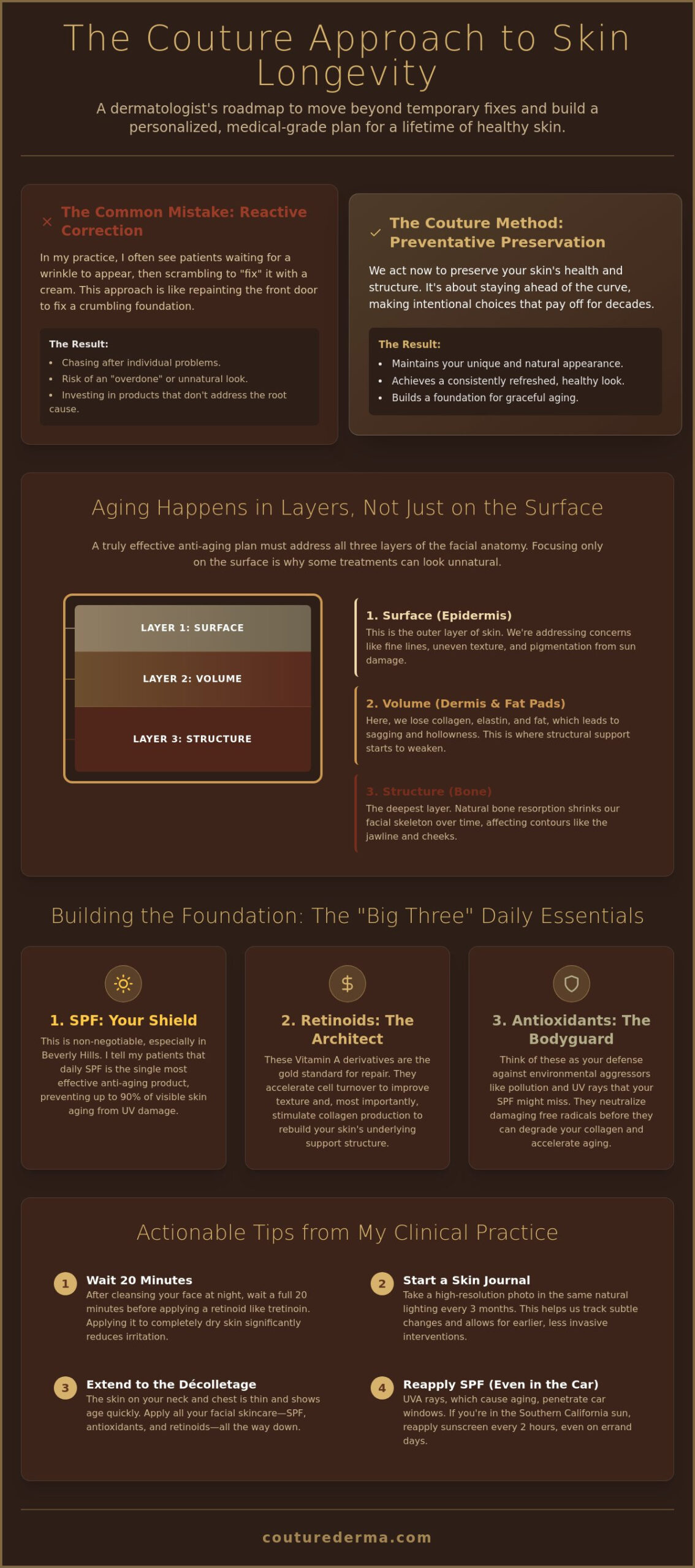
Most people are stuck in a cycle of reactive correction. They wait for a wrinkle to appear, then they try to “fix” it with a cream. Here’s the thing; that is like trying to repair a house’s foundation by repainting the front door. We want to move toward preventative maintenance. This means we act now to preserve what you have so you don’t have to scramble later. It is about staying ahead of the curve and making intentional choices that pay off over time.
This philosophy of proactive care should extend to all areas of your wellness. For men who want to stay ahead of the curve regarding their physical health and performance, you can check out FullMast for science-based vitality tips.
To better understand this concept, watch this helpful video:
The Difference Between Surface Care and Structural Support
Aging does not just happen on the surface. It happens in layers. First, there is bone resorption (the natural loss of bone density as we age). Then, we see fat loss and collagen depletion. If your plan only addresses the outer layer of skin, you will eventually look “done” because the underlying structure isn’t there to support it. This is why I often discuss jawline contouring with patients who want to maintain a natural silhouette. We need to address all three layers to ensure you look like yourself, just refreshed and balanced.
Actionable Tip: Start a skin journal today. Take a high-resolution photo of your face in natural light every three months. It helps us track subtle changes that you might miss in the daily mirror check, allowing for earlier, less invasive interventions.
The Role of Genetics and Lifestyle in Your Timeline
Your DNA provides the blueprint, but your environment builds the house. In my practice, I look at your family history as much as your current skin state. We also use the Fitzpatrick skin type (a scale of skin color and how it reacts to the sun) to determine which treatments are safe for you. If you have a deeper skin tone, some aggressive lasers might cause hyperpigmentation (dark spots). And we have to be meticulous about that. Creating a long-term anti-aging plan must account for these risks from day one.
Actionable Tip: Apply your facial skincare all the way down to your chest (décolletage). This area has thinner skin and fewer oil glands, meaning it often shows age faster than the face if neglected.
Living in Beverly Hills adds another layer of complexity. Our year-round sun means we are constantly battling understanding photoaging, which is the premature aging caused by UV exposure. You need more aggressive antioxidant support here than someone living in a cloudy climate. It is not just about SPF; it is about neutralizing environmental damage before it settles in. Let’s be honest, your lifestyle dictates your skin’s future as much as your products do.
Actionable Tip: When you’re out in the Southern California sun, don’t just rely on your morning SPF. Reapply every two hours, even if you’re just running errands in your car, because UV rays penetrate side windows easily.
Building the Foundation: Daily Habits and Medical-Grade Topicals
Think of your daily routine as the high-quality fabric of your skin’s future. If the material is thin or frayed, even the most expert tailoring won’t make the final garment look right. In my practice, I find that creating a long-term anti-aging plan starts with what I call the “Big Three”: SPF, Retinoids, and Antioxidants. These aren’t just optional additions; they are the medical-grade pillars that support every other treatment we do at Couture Dermatology & Laser.
I see patients who have a bathroom cabinet full of “clean beauty” products but still struggle with fine lines and uneven texture. The issue often comes down to potency. For example, over-the-counter retinol must be converted by your skin into retinoic acid before it can work. Tretinoin (a prescription-strength Vitamin A derivative) is already in its active form. It goes straight to work increasing cell turnover and building collagen. But with that power comes a responsibility to protect your skin barrier (the outer layer that keeps moisture in and irritants out). If you rush the process, you’ll end up with peeling and redness instead of a glow.
Actionable Tip: Apply your antioxidant serum (like Vitamin C) to completely dry skin in the morning. Damp skin can sometimes increase the acidity of certain serums, which often leads to unnecessary stinging or irritation.
Why Medical-Grade Topicals Outperform the Drugstore
The main difference lies in bioavailability (how much of a product actually enters the skin). Many drugstore products have the right ingredients on the label but the wrong delivery system. If the pH balance (the acidity level) of a Vitamin C serum isn’t exactly right, it will just sit on the surface without penetrating. This is why understanding medical-grade anti-aging strategies is vital. We want to ensure that every drop of product you apply is actually doing the work it’s supposed to do.
Actionable Tip: Wait 20 minutes after washing your face before applying Tretinoin. This simple pause ensures your skin is fully dry, which significantly lowers the risk of the medication absorbing too quickly and causing a “retinol burn.”
The Beverly Hills Factor: Managing Photodamage Year-Round
Living in Los Angeles means we deal with “incidental sun” every single day. Whether you’re driving on Wilshire or walking to lunch, that UV exposure adds up. I often tell my patients that a single day at the beach without protection can undo a month of laser work. This is why creating a long-term anti-aging plan in a sunny climate requires DNA repair enzymes in your morning routine. These enzymes help fix the cellular damage from the sun before it turns into a permanent dark spot or wrinkle. If you’re tired of guessing which bottles are worth the shelf space, it might be time for a professional skin analysis to streamline your routine for real results.
The Decadal Roadmap: When to Introduce Professional Interventions
In my practice, the 40s are often the decade of the “great awakening” for skin care. Patients who were previously relaxed about their routine suddenly notice their reflection looks different in the morning light. But here is the secret; the best time to start is simply when you notice changes that bother you. Creating a long-term anti-aging plan is a dynamic process that shifts as your biology does. For a broader look at how we approach these transitions, you can read more about The Art of Skin Rejuvenation.
In Your 30s: Preservation and Prevention
This is the decade of maintenance. We want to stop wrinkles before they become permanent etchings in the skin. I often recommend “Baby Botox,” which involves micro-dosing neurotoxins to soften expression lines while keeping natural movement. We also introduce light chemical peels to maintain cell turnover (the process of shedding old skin). Understanding essential skincare for aging at this stage sets the foundation for everything that follows.
Actionable Tip: Focus on the “necklace lines” on your neck right now. This skin is thinner and has fewer oil glands, making these horizontal lines much harder to treat once they deepen in your 50s.
In Your 40s: Restoration and Refinement
I see many patients in their 40s who feel their face looks “tired” despite getting enough sleep. This is usually due to volume loss in the mid-face and temples. We address this with strategic fillers or jawline contouring to restore a youthful silhouette. We also begin using non-ablative lasers to boost collagen (the protein that keeps skin firm) without significant downtime.
Actionable Tip: If you’re in your 40s, switch to a cream-based cleanser. Your skin begins to produce less sebum (natural oil) during this decade, and foaming cleansers can be too aggressive for the maturing barrier.
In Your 50s and Beyond: Renewal and Maintenance
Now we move into the phase of deeper renewal. For texture issues and sun damage that has accumulated over decades, we may use ablative lasers like CO2. These treatments remove thin layers of skin to reveal the smoother tissue beneath. We also have to manage hormonal changes that lead to increased dryness and sensitivity. Renewal is the final pillar of creating a long-term anti-aging plan that stands the test of time.
Actionable Tip: Switch to a lipid-rich moisturizer containing ceramides and fatty acids. These ingredients help “glue” your skin cells back together, providing the structural support that thinning skin desperately needs.
The Role of Lasers and Injectables in Structural Preservation
The real magic happens through synergy. I often see patients who want Botox for their forehead but ignore the volume loss in their cheeks. Using neurotoxins (Botox/Dysport) alone is like fixing the shingles on a roof when the support beams are sagging. But when we combine these with fillers or biostimulators (fillers that trigger your body to make its own collagen), we achieve a result that is both natural and enduring. It is about creating a refreshed look that doesn’t scream “procedure.”
Lasers: The Gold Standard for Skin Quality
Lasers like the Fotona or CO2 act as “exercise” for your collagen. They create controlled micro-injuries that force your skin to repair itself, resulting in a thicker and more resilient outer layer. In our practice, we differentiate between treating pigment (brown spots) and texture (lines/scars). For most patients, fractional lasers (lasers that treat a fraction of the skin at a time) are the perfect choice for a long-term plan because they offer significant results with manageable downtime. For a deeper dive into the technology, you can explore The Couture Guide to Laser Skin Resurfacing.
Actionable Tip: Schedule your aggressive laser treatments in the winter months. Even in Beverly Hills, the UV index is lower during this time, which significantly reduces the risk of post-treatment hyperpigmentation (dark spots) while your skin is in its vulnerable healing phase.
Injectables: Maintaining the Scaffolding
Neurotoxins stop the “wear and tear” on your skin’s surface by relaxing the muscles that cause repetitive folding. Think of it as preventing a piece of silk from being creased over and over in the same spot. To support the deeper layers, we use biostimulators to replace the structural proteins we naturally lose. This is especially effective for under-eye brightening, where the skin is thinnest and shows fatigue first. Statistics from 2025 show that aesthetic procedures have seen a 41.3% increase recently, largely because patients are moving away from dramatic changes toward this type of subtle, structural support. If you are ready to stop reacting to new wrinkles and start a proactive strategy, book your structural assessment today.
Starting Your Journey: The Couture Consultation Process
Let’s be honest; a plan is only as good as the expert who helps you navigate it. In our Beverly Hills practice, we don’t start with a needle or a laser. We start with a comprehensive diagnostic exam. Creating a long-term anti-aging plan requires a meticulous look at your medical history, your lifestyle, and your specific aesthetic goals. I see patients who have spent years chasing “the next big thing” in skincare without ever having a professional assessment of their skin’s actual needs. This is why a Couture Consultation is the most critical step in your transformation journey.
In my practice, I build a roadmap that accounts for the “maintenance phases” of your life. There are times when we will be aggressive with treatments like the Fotona laser, and there are times when we focus solely on healing and protection. It is about the rhythm of care. We want to ensure your skin barrier is always resilient enough to handle the next step in your plan. This collaborative approach ensures that your results are not just temporary improvements but a permanent elevation of your skin’s health.
What should you bring to your first visit?
Bring your actual product bag. It is far more helpful than a “wish list” of procedures you saw on social media. I need to know exactly what you are putting on your face every morning and night. This allows me to see where your routine is working and where it might be sabotaging your results. We will also discuss realistic expectations. We aren’t trying to make you look like someone else; we are refining your natural features to look refreshed and healthy at every age.
Actionable Tip: Take high-resolution photos of your skin in natural light for three consecutive days before your appointment. Show these to your doctor so they can see how your skin behaves in your normal environment, which is often different from how it looks under office lights.
Why a long-term partnership matters
Your skin is a living organ that changes with the seasons, your stress levels, and your hormones. This is why you should see your dermatologist at least twice a year to adjust your plan. We also prioritize full-body skin exams to monitor for skin cancer alongside your aesthetic care. It is about holistic well-being. Creating a long-term anti-aging plan is not a transaction; it is a partnership that evolves as you do. If you are ready to move beyond quick fixes and start a medical-grade roadmap, book a consultation with Dr. Abisogun to begin your transformation journey today.
Invest in Your Skin’s Future Today
Your skin is the only garment you’ll wear for a lifetime. It deserves the same level of care and precision as a custom-fit piece of couture. Creating a long-term anti-aging plan is about more than just erasing a single wrinkle; it’s about building a foundation of health that carries you through every decade. We’ve discussed the power of medical-grade topicals and the structural support provided by advanced lasers and injectables. These tools work best when they’re part of a cohesive, professional roadmap. In my practice, I combine the Harvard-trained expertise of Dr. Chinonso Kagha Abisogun with a deep appreciation for the artistry of the human face. We specialize in treating all skin types and diverse tones, ensuring that every patient achieves a result that looks natural and refreshed. If you’re ready to stop guessing and start investing in yourself, begin your transformative journey with a personalized Couture consultation. Let’s build a future where you feel as confident in your skin as you do in your accomplishments.
Frequently Asked Questions
Is it ever too late to start a long-term anti-aging plan?
It is never too late to begin improving your skin’s health and appearance. In my practice, I see patients in their 60s and 70s who achieve remarkable transformations through regenerative treatments. While starting early is ideal for prevention, modern technologies like the CO2 laser can effectively address deep texture issues and sun damage at any age. The focus simply shifts from prevention to repair and restoration.
How much does a professional anti-aging plan typically cost per year?
The investment in a customized roadmap varies significantly based on the complexity of your needs and the frequency of professional treatments. A basic plan might focus on medical-grade topicals and periodic chemical peels, while a more comprehensive approach includes annual laser resurfacing and bi-annual injectables. In Beverly Hills, patients often view this as a tiered investment where the initial “correction” phase is higher, followed by a lower-cost maintenance phase.
Can I achieve results with just over-the-counter products?
You can maintain general skin health with store-bought products, but they rarely provide the structural changes needed for long-term anti-aging. Over-the-counter options lack the high concentrations of active ingredients found in medical-grade formulas. For example, drugstore retinol is often too weak to trigger significant collagen production. If you are serious about creating a long-term anti-aging plan, you’ll eventually need the potency that only a prescription or professional-grade product can offer.
What is the most important step in a long-term skin plan?
Consistency with high-level sun protection is the single most important factor in skin longevity. UV damage is responsible for the majority of visible aging, including dark spots and fine lines. Without a dedicated SPF routine, even the most expensive laser treatments will fail to provide lasting results. I tell my patients that their daily sunscreen is the insurance policy for every other aesthetic investment they make in our practice.
How do I know if I need Botox or filler?
We use Botox to treat “dynamic” wrinkles caused by muscle movement, while fillers address “static” lines and volume loss. If you notice lines only when you frown or squint, neurotoxins are usually the answer. If you see hollows under your eyes or sagging in your cheeks while your face is at rest, we likely need to restore volume with dermal fillers. Often, the best results come from using both in a synergistic way.
What happens if I stop my anti-aging plan suddenly?
Your skin will simply return to its natural aging process at its normal biological rate. You won’t suddenly look older than you would have otherwise; you just lose the “paused” state that treatments provide. For instance, the effects of Botox will wear off over three to four months, and your muscles will regain their full movement. The benefits you’ve accumulated from creating a long-term anti-aging plan, like improved collagen density, will gradually diminish over time without maintenance.
Can a plan address acne scars and aging at the same time?
Yes, many professional treatments are designed to improve both texture and tone simultaneously. I often use the Fotona laser or fractional CO2 to break up scar tissue while also stimulating the deep collagen needed to firm aging skin. We can tailor your roadmap to prioritize acne scar refinement during the same sessions where we address fine lines. This multi-tasking approach is a hallmark of bespoke dermatology.
How long does it take to see real results from a long-term plan?
You will typically see surface-level improvements in texture and glow within four to six weeks of starting a medical-grade routine. However, structural changes like collagen remodeling take much longer. It usually takes three to six months to see the full impact of a laser series or a new retinoid protocol. Patience is essential because we are rebuilding your skin from the inside out, not just painting over the surface.