

Last week, a patient sat in my office and admitted she had spent three years hiding her thinning hairline. She wanted hair restoration beverly hills but was terrified of looking artificial or “pluggy.” I see patients who feel this exact same frustration every day at my practice. You want your hair back, but you also want to avoid the scalp irritation and “doll hair” results that come from generic treatments.
It’s completely normal to feel overwhelmed by the choice between surgery and medical options. You deserve to understand the root cause of your thinning rather than just guessing with another bottle of store-bought serum. This article will guide you through our couture approach to regrowth. We treat the scalp like “soil” that needs specific medical care and artistic tailoring to thrive.
I’ll explain how a board-certified dermatologist uses medical science to reverse hair loss and restore your confidence. We will cover everything from identifying your specific hair loss type to building a long-term maintenance plan. You’ll learn how we create a thicker, natural-looking hairline that fits your face perfectly. Let’s look at how a bespoke medical strategy can transform your hair and your self-assurance.
Key Takeaways
- Learn why we treat your scalp as the “soil” of your hair journey, because you can’t grow a healthy garden if the foundation is blocked by inflammation or scarring.
- Explore how our bespoke approach to hair restoration beverly hills counters unique local factors like high UV damage and lifestyle stress to ensure your results look natural and last.
- Discover how regenerative options like PRP and exosomes use your own biological signals to wake up dormant follicles without the fear of “pluggy” or artificial outcomes.
- Understand the importance of the tailoring metaphor, where we adjust our medical protocols to respect the specific needs of different hair textures, including curly and coily types.
- Master the timeline of your transformation by learning how hair growth cycles dictate a patient, long term plan for achieving true aesthetic harmony.
Why Is Your Hair Thinning? Understanding Hair Restoration in Beverly Hills
In my practice, I often meet people who feel like their hair loss happened overnight. But in most cases, it’s a quiet, gradual process that has been happening for months or even years. When we talk about hair restoration beverly hills, we aren’t just talking about a one-time procedure. It’s a blend of medical therapy to stop the loss and aesthetic enhancement to bring back the volume you’ve lost. Understanding the causes of hair loss is the first step because you can’t fix what you haven’t diagnosed.
Beverly Hills presents its own challenges, from the constant UV damage of our sunny climate to the high-pressure lifestyles that keep our cortisol (stress hormone) levels spiked. I see patients who think they need a transplant when they actually need a medical protocol. We have to look at the whole picture. Are you actually thinning, or are you just shedding? Shedding is temporary, but thinning is a progressive miniaturization (the process where hair follicles shrink and produce finer, shorter hairs) that leads to visible scalp. To better understand the technology behind modern treatments, watch this helpful video:
Common Culprits: From Genetics to Lifestyle
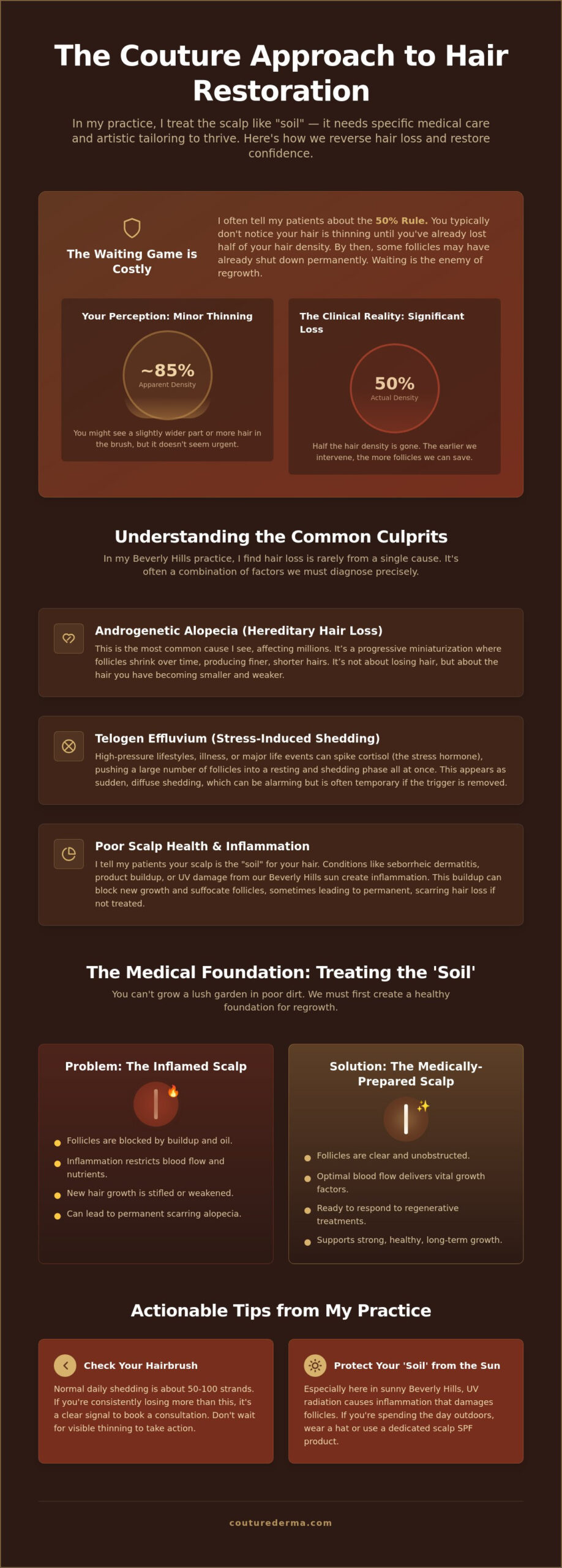
Let’s be honest, genetics usually play the biggest role. Androgenetic alopecia (hereditary hair loss) is the most common cause, affecting roughly 50 million men and 30 million women in the United States. But I also see a lot of telogen effluvium (temporary thinning caused by a shock to the system). This can be triggered by anything from a high fever to extreme work stress. In my practice, we treat each case like a custom suit. We don’t just look at the hair; we look at the person. Actionable Tip: Check your hairbrush. Losing more than 100 strands a day is the signal to book a consultation.
When to Seek Professional Intervention
Waiting is the enemy of regrowth. I often tell my patients about the 50% rule. You typically don’t notice your hair is thinning until you’ve already lost half of your hair density. By then, some follicles may have reached a state of irreversible follicle death. As a board-certified dermatologist, my job is to identify your specific alopecia (hair loss) type before we even discuss treatment. We need to know if we are fighting hormones, inflammation, or lifestyle factors first. Actionable Tip: If you’re spending the day outdoors, wear a hat or use a scalp SPF (sun protection factor) to prevent UV-induced inflammation that can damage hair follicles.
The Medical Foundation: Why Scalp Health Is the ‘Soil’ for Regrowth
I like to tell my patients that their scalp is the soil for their hair. You can’t grow a lush garden in poor, neglected dirt. In my practice, I see many people who jump straight into looking for hair restoration beverly hills without realizing their scalp is actually working against them. If you have chronic inflammation or scarring, those follicles are essentially suffocating. It’s not just about the hair strands; it’s about the living tissue that supports them. Scarring alopecia (a type of hair loss where follicles are replaced by scar tissue) is a clinical reality that requires immediate medical attention. If we don’t catch it early, the hair loss becomes permanent. That’s why I prioritize a medical-first approach. We aren’t just trying to cover up the problem. We’re trying to save the follicles you still have.
Clearing the Path: Treating Scalp Inflammation
Many people dismiss a flaky scalp as just “dandruff.” But it’s often more than that. I see patients with seborrheic dermatitis (a common inflammatory skin condition) that causes oil and dead skin to build up around the follicle. This buildup blocks new growth and can even lead to permanent damage if left untreated. Much like how we approach acne scar refinement by focusing on the health of the underlying tissue, we must ensure your scalp is a healthy environment for new hair. Actionable Tip: Switch to a sulfate-free, pH-balanced shampoo to maintain your scalp’s protective barrier and reduce irritation.
Prescription-Grade Protocols vs. Over-the-Counter
Let’s be honest about over-the-counter options. Generic Minoxidil often fails because the alcohol-based delivery system causes redness and itching. In my practice, I often prescribe a custom blend that includes anti-inflammatories to ensure the medication actually reaches the follicle without making you miserable. This is the difference between a one-size-fits-all approach and a couture medical protocol. We look at the latest medical treatments for hair loss to find what works for your specific biology. When people search for hair restoration beverly hills, they usually want results they can see, but those results depend on a medical foundation. If you’ve tried the drugstore route without success, it might be time to schedule a clinical scalp assessment.
Regenerative Medicine: Comparing PRP and Non-Surgical Regrowth Options
Regenerative medicine, once a futuristic concept, is now our most powerful tool. In my practice, I see patients who have spent years trying to “fix” their hair with superficial treatments that never reach the root of the problem. But here’s the thing; your follicles often just need a wake-up call at the cellular level. When we talk about hair restoration beverly hills, we’re talking about using your body’s own biology to signal growth. It’s about precision, timing, and a deep understanding of how your cells communicate. Think of it as the difference between a mass-produced garment and a custom-tailored suit; one is meant for everyone, but the other is designed specifically for your unique biology.
PRP: The Gold Standard for Natural Volume
PRP (Platelet-Rich Plasma) involves taking a small sample of your blood and spinning it in a centrifuge to concentrate the platelets. These platelets are essentially “liquid gold” because they contain growth factors that stimulate the hair follicle to stay in the growth phase longer. But let’s be honest; not all PRP is created equal. The Couture difference in our practice comes down to the concentration. I see patients who had PRP elsewhere and saw no results because the platelet count was too low. We also focus on the exact depth of the injection to ensure the growth factors hit the target. I often look to expert guidance on hair loss to keep our protocols at the highest clinical standard. Actionable Tip: Hydrate aggressively for 24 hours before your PRP session to improve the volume and quality of your plasma.
The Rise of Exosomes and Peptides
Exosomes are the next frontier in cellular signaling for hair. Think of them as the “messengers” that tell your cells exactly how to behave and repair themselves. Unlike PRP, they don’t require a blood draw, which is a huge plus for many of my patients. Are they worth the investment yet? In most cases, I find they provide a significant boost for patients with early-stage thinning or those who want to maximize their results from other treatments. It’s like applying a high-end skincare serum to the scalp, but it works from the inside out. We also frequently integrate Low-Level Laser Therapy (LLLT) to boost ATP (energy) production within the cells. It’s about giving the follicle the fuel it needs to actually produce hair. Actionable Tip: If you use an at-home LLLT device, consistency is the only way it works; use it for 20 minutes three times a week for at least six months to see a measurable change.
Tailoring the Journey: A Couture Approach to Different Hair Textures
I often tell my patients that a silk suit requires completely different care than a heavy wool one. The same is true for your hair. In my practice, I see patients who have been treated with a “one size fits all” approach that completely ignores their hair’s unique texture and their skin’s specific needs. When you look for hair restoration beverly hills, you need a plan that respects your biology. Skin tone is a critical factor that many practitioners overlook. It dictates how we adjust our laser settings to avoid unwanted pigment changes. We also have to be mindful of how deep we place our injections to ensure the medication reaches the follicle without causing unnecessary inflammation.
Regrowth Strategies for Curly and Coily Hair
Type 3 and 4 hair textures are beautiful but incredibly delicate. I see many women who struggle with traction alopecia (hair loss caused by constant pulling or tension from braids and extensions). In these cases, we aren’t just fighting genetics; we’re healing the scalp from physical stress. Protecting the fragile curl pattern during medical treatment is essential. We use specific injection techniques that minimize trauma to the follicle. Actionable Tip: If you have type 4 hair, avoid high-heat styling for 7 days after any scalp injection to let the tissue heal without added stress. We also recommend using a silk or satin pillowcase to reduce friction on the scalp during the regrowth phase. This small change helps protect the new, finer hairs as they emerge.
Aesthetic Harmony: Designing a Natural Hairline
Let’s be honest about the “celebrity wig” look. A perfectly straight hairline looks artificial because nature isn’t perfectly straight. In our practice, we focus on aesthetic harmony. We use “feathering” and irregular patterns to mimic how hair actually grows. This is where my artistic sensibility comes in. We look at your whole face. Just as jawline contouring frames the lower face, a well-designed hairline frames the upper face and balances your proportions. It’s a collaborative, transformative journey that requires a meticulous eye for detail. Actionable Tip: Gently massage your scalp for five minutes each night to improve blood flow, but avoid doing this for 48 hours after any professional injection treatment.
If you’re ready to see what a tailored approach to hair restoration beverly hills can do for your confidence, book your bespoke hair consultation today. We’ll work together to create a plan that respects your texture and delivers natural, lasting results.
Your Transformation: What to Expect from a Board-Certified Dermatologist
In my practice, I often tell patients that the first consultation is a dialogue, not a sales pitch. We aren’t just looking at your scalp; we’re looking at your history, your goals, and your lifestyle. When you pursue hair restoration beverly hills, you’re starting a collaborative journey that requires a meticulous eye and a lot of patience. I see patients who expect a miracle in three weeks, but hair simply doesn’t work that way. True transformation is a gradual progression. It’s about building a relationship with your hair and your doctor to ensure long term success. Knowing how to choose the best dermatologist in Los Angeles is the first step in ensuring your safety and your results.
The Timeline of Regrowth
Hair grows in cycles, and we have to respect that biological rhythm. During the first one to three months, you might actually notice more shedding. I call this the “dread shed,” and it’s actually a positive sign. It means the old, weak hairs are making room for stronger, healthier strands. From months four to nine, we start to see the emergence of fine “baby” hairs. By the twelve month mark, you finally see the full, robust density of our tailored protocol. Actionable Tip: Take a high-quality photo of your hairline in the same lighting every four weeks to track the subtle changes that are hard to see in the mirror daily.
Why Credentials Matter in Beverly Hills
I see patients who have had unfortunate experiences at “med spas” where there wasn’t a board-certified dermatologist on site. Hair restoration is a medical procedure, not just a beauty treatment. My Harvard training allows me to approach your care with scientific rigor while maintaining a keen aesthetic sensibility. This is especially important for treating diverse skin types and textures where the margin for error is slim. Actionable Tip: Always ask to see “before and after” photos specifically for your hair type and skin tone before committing to a plan.
Let’s be honest; hair restoration isn’t a one-off event. It’s a lifestyle. Think of it like a high-end fitness routine or a bespoke skincare regimen. You need a maintenance phase to protect the progress we’ve made. We’ll create a long term plan that fits into your life so you can keep that natural, natural-looking hairline for years to come. It’s about more than just hair; it’s about the self-assurance that comes with feeling like yourself again. Actionable Tip: When you start a new medical hair protocol, wait at least six months before judging the results, as this is the minimum time needed for a full growth cycle to show visible change.
Reclaiming Your Confidence and Your Hairline
We’ve explored why scalp health is the “soil” for growth and how tools like PRP wake up dormant follicles. But here’s the thing; your journey is unique. A one size fits all approach doesn’t work for something as personal as your hair. In my practice, I see patients who find success because we stopped guessing and started tailoring every protocol. It’s about matching the treatment to you, much like a master tailor fits a custom suit to your exact proportions.
My Harvard trained background ensures that your hair restoration beverly hills plan is built on a foundation of medical safety. We use bespoke medical protocols that respect every hair texture and skin tone, from straight to coily. You shouldn’t have to settle for artificial results or generic advice that ignores your unique biology. We prioritize aesthetic harmony so your new growth looks entirely natural and helps you feel like yourself again.
It’s time to stop hiding and start feeling a sense of calm confidence. If you’re ready to move away from over the counter guesswork and toward a professional, artistic solution, I’m ready to help. Begin your custom regrowth journey at Couture Dermatology today. There is always a path forward when you have the right medical expertise and a dedicated partner by your side.
Frequently Asked Questions
Is hair restoration in Beverly Hills permanent?
Most surgical hair restoration beverly hills procedures are considered permanent because the donor follicles are resistant to thinning. But medical treatments like topical protocols or regenerative therapies require ongoing care to maintain the results. In my practice, I see patients who forget that hair loss is a progressive condition. If you stop the maintenance, the surrounding non-transplanted hair will often continue to thin over time.
How much does a typical hair restoration protocol cost?
The investment for a bespoke protocol varies based on the specific cause of your hair loss and the complexity of the treatment plan. A patient needing simple medical management will have a different experience than someone requiring multiple regenerative sessions. We focus on creating a couture plan that prioritizes your long term goals rather than a one size fits all price tag. It is best to start with a clinical assessment to determine your exact needs.
Can I get a hair transplant if I have curly or coily hair?
You can certainly undergo a transplant with curly or coily hair, but the technique must be highly specialized. The follicles of Type 3 and Type 4 hair are curved beneath the skin, which makes extraction much more delicate than straight hair. I see patients with diverse hair textures who require a meticulous approach to avoid damaging the follicle during the process. It is about respecting the unique “architecture” of your hair.
What is the difference between a hair transplant and medical hair restoration?
A hair transplant is a surgical procedure that moves hair from one area to another; medical hair restoration focuses on stopping loss and thickening existing hair without surgery. Think of surgery as adding new “plants” to the garden, while medical restoration is about improving the soil and health of the plants already there. In many cases, I recommend a combination of both to achieve the most natural and robust aesthetic outcome for the patient.
Does PRP for hair growth actually work for everyone?
PRP is highly effective for many, but it typically works best for those in the early stages of thinning or androgenetic alopecia (hereditary hair loss). It is often less effective for areas where the scalp is completely smooth and the follicles have already scarred over. In my practice, I use a clinical scalp assessment to determine if your follicles are still active enough to respond to growth factors. If the follicle is gone, we have to look at other options.
How soon can I return to work after a non-surgical hair treatment?
Most patients return to their normal work schedule immediately after a non-surgical session like PRP or laser therapy. You might experience some mild redness or a “tight” feeling on the scalp, but this typically fades within a few hours. I usually suggest avoiding heavy exercise or intense sun exposure for the first 24 hours to let the scalp settle. It is a discreet way to manage your transformation without a long recovery period.
What should I look for in a Beverly Hills hair restoration expert?
You should prioritize a board-certified dermatologist who has extensive experience with your specific hair texture and skin tone. Look for someone who views hair restoration beverly hills as a medical-aesthetic journey rather than just a transaction. In my practice, I emphasize that credentials like Harvard training provide a foundation of safety, but artistic sensibility is what delivers the natural look. Always ask to see their specific protocols for long term maintenance.