
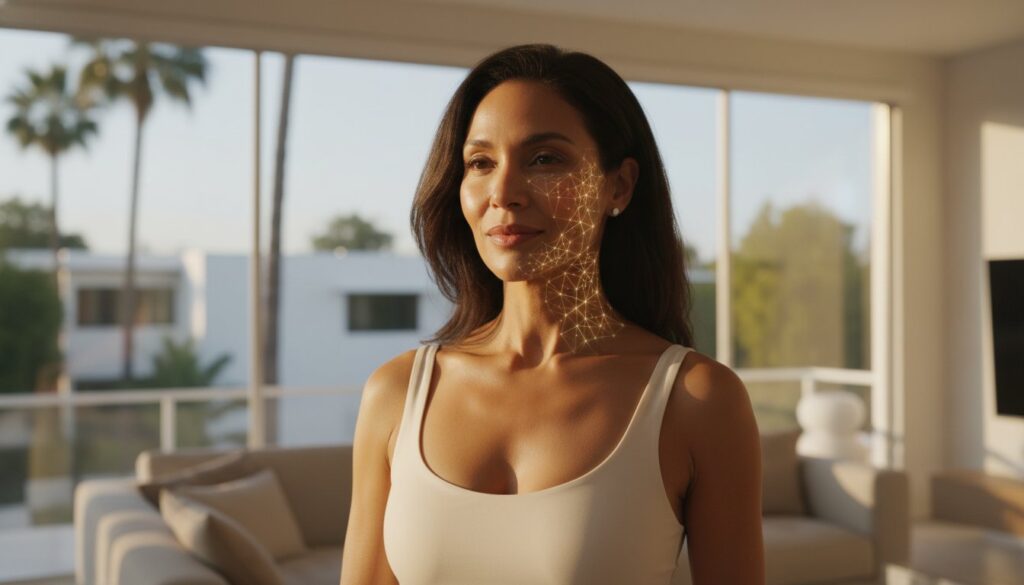
Last Tuesday, a patient named Elena sat in my chair, tracing the subtle hollows of her cheeks while asking a question I hear almost daily: how does sculptra work for collagen to provide a natural look? She wanted to restore her youthful volume but was deeply afraid of the overfilled “pillow face” she had seen online. Over 85% of the new patients I consult with share this exact concern, feeling frustrated by the cycle of short-lived results and the fear of looking “done.”
You likely want a solution that feels like a natural evolution rather than a drastic change. This article will walk you through the precise science of biostimulation, showing you how we use poly-L-lactic acid, a biocompatible synthetic material, to trigger your body’s own regenerative powers. It’s a sophisticated method of rebuilding your skin’s structural foundation from the inside out, rather than just filling a crease.
We’ll explore the clinical mechanism that allows Sculptra to create an enduring, natural-looking rejuvenation. We will look at the timeline for your results and why this approach is the gold standard for a refined, “couture” finish that typically lasts up to two years.
Key Takeaways
- Understand the science of Poly-L-Lactic Acid (PLLA), the biocompatible “blueprint” that serves as a sophisticated scaffold for your skin’s long-term renewal.
- Discover exactly how does sculptra work for collagen by initiating a controlled biological signal that prompts your body to rebuild its own structural foundation.
- Learn to navigate the “hidden phase” of the biostimulation timeline, where the most significant, natural-looking refinements happen beneath the surface over several weeks.
- Explore why we prioritize a “global” approach to rejuvenation, treating the entire face to improve skin texture and radiance rather than simply filling an isolated line.
- Gain insight into the “Couture Journey,” where we use specialized fanning and cross-hatching techniques to curate a result that honors your unique bone structure.
The Biological Blueprint: What is Sculptra and the Science of PLLA?
A patient recently came to my office concerned that her face felt like it was losing its structural integrity. She described it as a “deflating” sensation that made her look tired regardless of how much sleep she got. This is a common conversation in my practice, where we focus on refinement rather than just filling. For patients like her, I often recommend Sculptra, a sophisticated biostimulatory injectable that functions quite differently from the products you might see on social media. Understanding how does sculptra work for collagen requires looking at its primary ingredient: Poly-L-Lactic Acid (PLLA).
PLLA is a biocompatible, biodegradable synthetic polymer that medical professionals have utilized for over 30 years in dissolvable sutures. In this Sculptra overview, you can see how its long history in medical devices provides a foundation of clinical trust. In the world of Couture Dermatology, I view Sculptra as a structural investment. It is the “haute couture” of injectables because it is custom-built within your own skin over time, acting as a scaffold rather than a temporary accessory.
To better understand this concept, watch this helpful video:
PLLA vs. HA Fillers: A Tale of Two Mechanisms
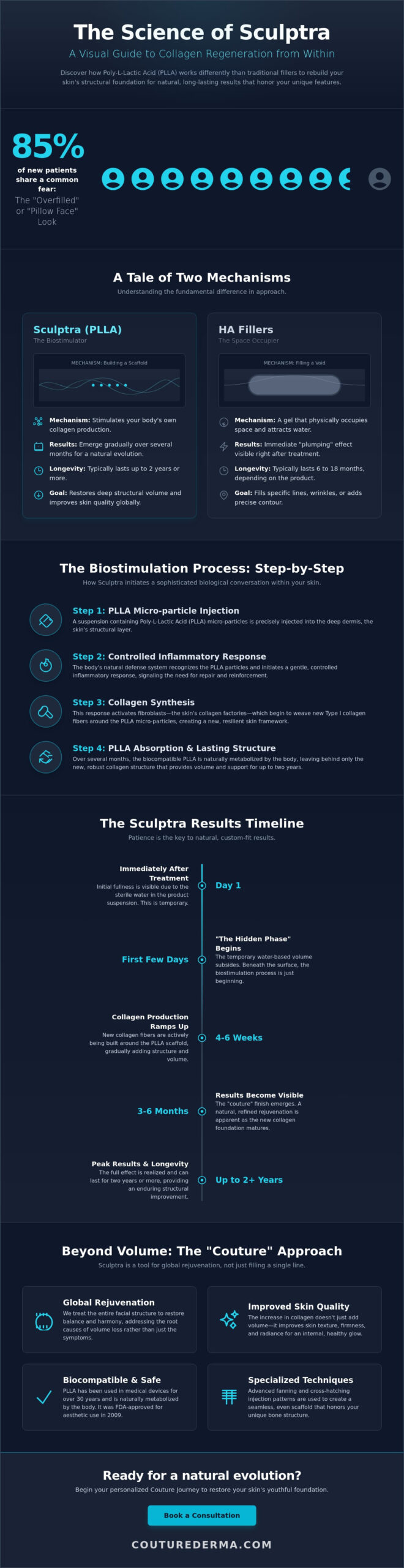
Most patients are familiar with Hyaluronic Acid (HA) fillers, which provide an immediate “plump” by physically occupying space and attracting water molecules. While HA is excellent for specific contouring, Sculptra plays a longer game. It doesn’t just sit there; it communicates with your body. When we discuss how does sculptra work for collagen, we are talking about biological synthesis. The PLLA micro-particles trigger a mild inflammatory response that signals your fibroblasts to produce new collagen fibers. This requires a “wait and see” approach, as the true results emerge over several months. I typically choose this biostimulation for global volume loss because it creates a soft, natural finish that looks like you, only more rested.
The Safety Profile of Poly-L-Lactic Acid
Safety is the cornerstone of my Beverly Hills practice, and the history of PLLA is incredibly reassuring. The FDA first approved PLLA for facial fat loss in 2004, followed by a broader aesthetic approval in 2009 for the correction of shallow to deep nasolabial fold contour deficiencies. Your body naturally metabolizes the PLLA micro-particles into lactic acid and eventually CO2, which you simply breathe out. This predictable metabolic pathway is why I feel confident using it to curate long-term results. We aren’t just masking the signs of aging; we are using advanced dermatologic science to restore the skin’s biological foundation from the inside out.
The Biostimulation Process: How Sculptra Triggers Natural Collagen Production
In my practice, I often see patients who desire a glow that feels internal rather than just topical. When we perform this treatment, the process begins the moment the Poly-L-lactic acid (PLLA) suspension enters the deep dermis. These microscopic particles act as a catalyst for change. They do not just fill space; they initiate a sophisticated biological conversation within your skin. This is the fundamental secret of how does sculptra work for collagen to create lasting refinement.
The body recognizes these PLLA particles as a subtle signal for repair. This triggers what we call a controlled inflammatory response. It is a gentle, intentional nudge to the immune system. According to the FDA Summary of Safety and Effectiveness, these micro-particles are gradually absorbed as they stimulate the body’s own natural processes. This response is exactly what we want; it is the body’s way of identifying where new structural support is needed most.
The Fibroblast Recruitment Phase
Fibroblasts are the essential cells responsible for producing the structural proteins that give your skin its bounce and thickness. Think of them as your skin’s internal architects. Biostimulation is the process of provoking a natural regenerative response in the skin. Through complex chemical signaling, the PLLA particles recruit these fibroblasts to the injection site. Once they arrive, they begin the meticulous work of rebuilding the skin’s foundation. This isn’t a temporary fix; it is a curated restoration of your skin’s health from the inside out.
Type I vs. Type III Collagen: Building Quality and Structure
The beauty of this treatment lies in the quality of the collagen produced. Initially, the body creates Type III collagen, which is often associated with the early stages of healing and flexibility. Over the following 24 weeks, this matrix transitions into Type I collagen. This is the strong, structural variety that defines a youthful, resilient complexion. This dual-action approach creates a dense collagen matrix that improves both visible volume and fine skin texture.
As the PLLA particles slowly dissolve, they leave behind a scaffolding of your own natural proteins. This creates a finish that is both elegant and enduring. If you are ready to start your own Couture Journey, understanding this microscopic timeline helps set realistic expectations for your results. We typically see the most refined outcomes appearing three to six months after the initial session, as the new collagen matrix fully matures and integrates into your tissue.
The Sculptra Timeline: Why Patience is the Key to Custom-Fit Results
I’ve treated hundreds of patients who initially feel a bit of “buyer’s remorse” just 72 hours after their first session. They leave my office with a beautifully hydrated, full look that seems to vanish by the third day. I call this the “water carrier effect.” The initial volume you see is simply the sterile water used to deliver the product; once your body absorbs that fluid, you’ll feel like you’ve reset to your baseline. Don’t be discouraged. This is a normal part of the Couture Journey.
During the hidden phase between weeks two and six, the poly-L-lactic acid (PLLA) particles are quietly recruiting your body’s fibroblasts. The Science of PLLA Biostimulation details how these particles act as a regenerative scaffold; they trigger a subtle biological response that leads to sustained neocollagenesis, or new collagen growth. Many patients ask me, “how does sculptra work for collagen if the volume disappears after two days?” The answer lies in this quiet, cellular work that occurs long before you see a change in the mirror.
The reveal phase typically begins around week eight. This is when you’ll notice a distinct “glow” and a gradual refinement of skin texture. Because we are growing living tissue, the results continue to improve and peak at the 6 to 9 month mark. It’s an unhurried process that rewards the patient who values elegance over instant, often obvious, gratification.
Managing Expectations: The Three-Treatment Protocol
In my practice, I rarely stop after a single session. To achieve a truly bespoke, couture-level result, we typically recommend a series of 2 to 3 sessions spaced about 6 weeks apart. Think of this as layering a fine garment. We aren’t just filling a hole; we are building a durable foundation of structural protein. During your follow-up appointments, I monitor how your specific tissue responds to the PLLA. This allows us to curate the volume precisely where your unique facial structure needs it most, ensuring the finish is always sophisticated and never overdone.
Longevity and Maintenance
While traditional hyaluronic acid fillers might last 6 to 12 months, Sculptra results frequently endure for 2 years or more. This impressive duration is because Sculptra longevity is a result of the body’s own tissue replacement, not the persistence of the product itself. You aren’t just carrying a gel in your skin; you’ve actually restored your biological architecture. To sustain this elevated look indefinitely, I suggest a “Maintenance Glow” appointment. A single annual vial is often enough to keep your collagen production active and maintain your results without ever needing a full “re-do” of the initial series.
Beyond Volume: Sculptra for Skin Quality and Global Rejuvenation
I often meet patients who point to a single fold around their mouth and ask for it to be “filled.” In my practice, we shift the focus from chasing individual lines to a global rejuvenation strategy. Sculptra acts as a foundational treatment that restores the entire facial framework. By treating the temples, cheeks, and jawline, we create a signature lifted look that appears entirely natural. This approach addresses the root cause of aging rather than just masking the symptoms.
When you understand how does sculptra work for collagen, you realize its benefits extend far beyond simple plumping. As the collagen matrix rebuilds, we see a visible improvement in skin quality. This includes a reduction in the appearance of large pores and the smoothing of crêpy skin texture. I’ve observed that patients who receive these biostimulatory treatments often require less traditional filler over time because their own skin is doing the heavy lifting.
- Jawline Definition: We use Sculptra to reinforce the mandibular border, providing a crisp, youthful contour.
- Temple Restoration: Filling hollow temples subtly lifts the tail of the brow and opens the eye area.
- Mid-face Support: Strengthening the cheek area provides the structural lift needed to soften nasolabial folds.
The Sculptra Glow: More Than Just Plumpness
The “Sculptra glow” is a phenomenon many of my patients describe around the twelve week mark. This radiance isn’t just a surface effect; it’s the result of increased dermal thickness. When your skin is denser and more structured, it reflects light more efficiently. This creates a healthy, luminous finish that topical creams simply cannot replicate. You’ll find your skin feels more resilient and hydrated as the new collagen fibers provide better internal support.
Inclusivity in Biostimulation: Treating Skin of Color
For my patients with higher melanin levels, safety and precision are non-negotiable. I use a meticulous clinical approach that prioritizes high dilution and deep placement to ensure seamless results. This prevents the formation of visible nodules or hyperpigmentation. Sculptra is a fantastic tool for diverse skin types because it addresses the specific way different ethnicities age. It allows us to restore volume and refine texture without the risk of looking over-done or unnatural. In my experience, it’s one of the most reliable ways to achieve a beautifully smooth finish for every skin tone.
Experience the art of refinement with a treatment plan tailored to your unique skin journey. Book your consultation at Couture Dermatology today.
The Couture Journey: Your Personalized Sculptra Protocol in Beverly Hills
In my Beverly Hills practice, I don’t believe in a one-size-fits-all approach to volume. When you sit down for a consultation, we look at far more than just surface lines. We examine your unique bone structure and the history of your skin’s elasticity to curate a plan that respects your natural architecture. This helps us determine exactly how does sculptra work for collagen within your specific tissue layers to achieve the most elegant result.
The delivery method is just as vital as the product itself. I utilize specialized techniques like fanning and cross-hatching to ensure the poly-L-lactic acid particles are distributed evenly. Fanning involves spreading the product in a radial pattern from a single entry point; cross-hatching creates a grid-like support system. This scaffolding ensures your new collagen grows in a smooth, uniform sheet rather than in isolated pockets.
Once you leave the office, the results are partly in your hands. I always emphasize the Rule of 5 to my patients as the most critical post-care step. You’ll need to massage the treated areas for 5 minutes, 5 times a day, for 5 days. This consistent movement keeps the particles dispersed. It prevents the formation of small nodules and ensures the biostimulation process remains seamless and natural.
The Art of the Injection
The injector’s eye is what separates a standard treatment from a luxury experience. In our practice, we prioritize the natural anatomy of your face to avoid that overdone or pillowy look that often concerns new patients. We want you to look like a refreshed version of yourself, not a different person entirely. Many patients ask me during their first visit, how does sculptra work for collagen over the long term? I explain that it isn’t a quick fix, but a gradual rebuilding of your skin’s structural integrity.
To ensure your visit is serene and comfortable, we mix lidocaine, a common numbing agent, directly into the Sculptra. We also use specialized micro-cannulas that glide through tissue with minimal disruption. This approach minimizes bruising and allows you to return to your lifestyle with bold confidence.
The Couture Signature: Combining Sculptra with Lasers
While Sculptra builds the foundation deep within the dermis, we often pair it with surface-level refinements for a total transformation. Laser resurfacing is the perfect partner because it addresses pigmentation and fine texture while Sculptra restores youthful volume from beneath. In my experience, timing is everything for these synergistic results.
We typically wait about 4 to 6 weeks after a biostimulator session before performing laser treatments. This allows the initial inflammatory response to settle so the laser can work effectively on the skin’s surface. You can learn more about these curated pairings in The Couture Guide to Laser Skin Resurfacing. This combination creates a signature rejuvenation that feels both elevated and enduring.
Cultivating Your Natural Radiance
In my practice, I often tell patients that understanding how does sculptra work for collagen is the first step toward a more enduring kind of rejuvenation. Unlike traditional fillers that provide instant gratification; this biostimulator acts as a seed for your own biological renewal. We’ve seen clinical data showing a 66 percent increase in type 1 collagen after just three months. It’s a gradual process that requires a bit of patience, but the payoff is a result that feels entirely yours because your body literally built it.
I’ve guided hundreds of patients through this couture journey in our Beverly Hills clinic, focusing on subtle refinement rather than an overfilled look. As a Harvard-trained, board-certified dermatologist, I pay special attention to the nuances of skin of color to ensure every treatment is both safe and effective. We typically schedule sessions six weeks apart to allow your skin’s natural architecture to rebuild itself properly. It’s about creating a foundation of health that lasts for two years or more.
Begin Your Couture Journey: Schedule a Sculptra Consultation with Dr. Abisogun
I look forward to helping you achieve a look that feels as timeless as it is authentic.
Frequently Asked Questions
How long does it take for Sculptra to start working?
You will typically begin to see the first visible signs of refinement about 6 to 8 weeks after your initial session. Because this is a biological process rather than a mechanical fill, your body needs time to build new structural proteins. In my clinical experience, the most elegant and noticeable results usually peak around the 12 week mark after your second or third treatment.
Is Sculptra safer than traditional dermal fillers?
Sculptra has maintained an excellent safety profile for over 20 years and is FDA-approved for the correction of shallow to deep nasolabial fold contour deficiencies. While traditional hyaluronic acid fillers offer the benefit of being reversible, Sculptra provides a different kind of security by using your own biology to create volume. This approach avoids the “puffy” or over-filled look that sometimes occurs with gel-based products.
Can Sculptra cause lumps or nodules under the skin?
Small lumps can occur in roughly 1 percent of patients, but these are largely preventable with modern injection techniques and proper post-care. In our practice, we use higher dilution ratios and precise placement to ensure the product integrates seamlessly into your tissue. Following the recommended massage protocol at home is the best way to ensure your results remain beautifully smooth and even.
How many vials of Sculptra will I need for a full face treatment?
A standard clinical guideline is to use one vial per decade of life, so a 50 year old patient may require 5 vials total. This volume is usually distributed over 2 or 3 separate appointments to allow for a gradual and natural-looking transformation. I curate every plan based on your unique bone structure and skin quality, so your specific Couture Journey might require more or less than the average.
What is the ‘Rule of 5’ massage for Sculptra and why is it important?
The Rule of 5 asks you to massage the treated areas for 5 minutes, 5 times a day, for 5 days after your injection. This repetitive motion is vital because it manually distributes the poly-L-lactic acid microparticles throughout the dermis. Proper massage prevents the particles from clustering in one spot, which ensures your new collagen grows in a uniform, natural-looking layer rather than in small clusters.
Can I get Sculptra if I have already had Botox or other fillers?
You can absolutely combine Sculptra with Botox or hyaluronic acid fillers to achieve a more comprehensive rejuvenation. Many of my patients use Botox for dynamic wrinkles and traditional fillers for immediate lip volume while using Sculptra for overall skin thickness. Understanding how does sculptra work for collagen helps us layer these treatments strategically to build a foundation that is both elevated and enduring.
Does Sculptra actually grow real collagen?
Sculptra is a true biostimulator that triggers the production of Type I collagen, which is the gold standard for firm, youthful skin. Clinical data shows that this treatment can increase collagen concentration by as much as 66 percent after three sessions. This is why the results feel so natural; you aren’t just seeing a product under the skin, you’re seeing a genuine improvement in your own skin’s density.
What happens if I stop getting Sculptra after one treatment?
If you decide to stop after a single treatment, you will still retain the new collagen your body produced during that initial cycle. You won’t experience any “sagging” or negative side effects from stopping; your skin will simply continue its natural aging process from a slightly improved baseline. While one vial won’t provide the full volume of a complete series, it still contributes to the long term health and thickness of your skin.