

Last Tuesday, a patient named Elena sat in my chair, gently tracing the contours of her jawline with a mix of hesitation and hope. She had spent hours reading conflicting reports online about “filler fatigue” and felt a growing anxiety that her quest for a refreshed look would lead to a cycle of over-filling every four months. It is a sentiment I encounter daily in my practice; you want to maintain a sense of youthful volume that fades gracefully, rather than feeling like you are constantly chasing the next appointment.
One of the most frequent questions I am asked during our initial consultation is, “how long do dermal fillers last,” and the answer is rarely a single number. While most hyaluronic acid products typically offer refinement for 6 to 18 months, your unique metabolic rate and lifestyle can shift that window by as much as 25 percent. In this curated guide, I will help you understand the precise timelines for various filler families so you can build a predictable maintenance schedule. We will explore how to ensure your results feel elevated and enduring, allowing you to embrace your Couture Journey with bold confidence and clinical clarity.
Key Takeaways
- Discover how your personal metabolism and lifestyle choices, such as high-intensity activity, play a pivotal role in the longevity of your aesthetic results.
- Learn to distinguish how different material densities—much like choosing between silk and wool—are curated to provide a bespoke fit for your unique facial anatomy.
- Understand the “High-Motion Rule” to see why structural areas like the cheeks offer more enduring refinement compared to high-movement zones like the lips.
- Uncover the clinical nuances behind how long do dermal fillers last to help you time your next visit for a seamless, “settled” look before a major event.
- Master the “Couture Journey” strategy of preventative layering to maintain your signature glow and avoid the cycles of a fully dissipated look.
The “Shelf Life” of Beauty: Defining Dermal Filler Longevity
Imagine a client, let’s call her Elena, who visited my office three weeks before a high-profile Beverly Hills event. She wanted her cheekbones to have that “lit from within” lift, but she was worried about appearing swollen or “done” in photos. I explained that timing is everything in the world of aesthetics. We scheduled her treatment exactly 28 days before the event to allow for the crucial settling phase where the product becomes one with the natural tissue. Understanding how long do dermal fillers last starts with recognizing that beauty isn’t just about the injection; it’s about the timing and the biological journey of the product.
To help you visualize how these timelines work in a clinical setting, watch this expert discussion on what to expect:
In my practice, I define dermal fillers as temporary, biocompatible gels that your body naturally metabolizes over time. Most modern products are composed of hyaluronic acid, a sugar molecule already present in your skin. Because these materials are recognized by your body, they are eventually broken down by natural enzymes. Depending on the product density and the area treated, results typically span from 6 months for soft lip enhancements to 24 months for robust structural lifting in the cheeks or jawline.
A common misconception is that filler simply vanishes overnight. In reality, it degrades slowly and subtly. The composition of dermal fillers determines how quickly your body’s enzymes can break them down. We view this as a “Couture Journey” rather than a one-time fix. We monitor how your unique metabolism processes the gel to ensure your results remain elegant and never appear deflated or unnatural as the product wears off.
The Difference Between Longevity and “Peak Result”
There is a significant distinction between a filler being present and it looking its absolute best. While a product might technically last 12 months, the peak aesthetic refinement often starts to soften around month 9. In my experience, patients who maintain a baseline volume with a small touch-up at the nine-month mark achieve much more natural results. You must also account for the 14 to 28 day settling period. This is when the filler integrates with your natural tissue, allowing the initial swelling to dissipate and the true “Beautiful Skin, Bold Confidence” effect to emerge.
Why Temporary Fillers Are the Gold Standard
In luxury dermatology, we intentionally avoid permanent fillers. Your face changes as you age; a permanent implant that looks perfect at age 35 might look distorted or misplaced at age 55. Temporary fillers offer the safety of reversibility. If your aesthetic goals evolve, we can adjust your look. Hyaluronic acid fillers provide a safety net through an enzyme called hyaluronidase, which can dissolve the product instantly. This flexibility allows us to curate a look that evolves with you, ensuring your refinement is always age-appropriate and sophisticated.
Material Science: How Filler Composition Affects Your Results
In my practice, I often meet patients who are surprised that their lip filler seems to soften after six months while their cheek filler remains perfectly sculpted two years later. To understand how long do dermal fillers last, you have to look at the material science behind the gel. I like to use a “Couture” metaphor here. We treat filler density like fabric weight. A fine silk is beautiful for a flowing dress, but you would never use it to structure a heavy winter coat. Similarly, a soft filler belongs in the lips, while a dense, “wool-like” filler is required for the jawline.
The secret to this longevity is cross-linking. This is a chemical process that binds hyaluronic acid chains together, preventing your body’s enzymes from dissolving the gel instantly. We also measure G-Prime, which is the filler’s ability to resist deformation. High G-Prime fillers provide the “lift” needed for bone support and typically stay in place much longer than low G-Prime, soft-tissue fillers used for fine lines. Most FDA-approved dermal fillers use these specific chemical variations to tailor the product to your unique facial anatomy.
Hyaluronic Acid (HA) Timelines: Juvederm, Restylane, and RHA
HA fillers are the gold standard because they’re reversible and feel incredibly natural. The RHA (Resilient Hyaluronic Acid) collection is a personal favorite for the “animated” areas of the face. Because it’s designed to mimic the natural HA in your skin, it moves with your expressions and can last up to 15 months in areas like the cheeks or nasolabial folds.
For structural support, Juvederm Voluma is a powerhouse. In my clinical experience, this high-density gel provides mid-face support for up to 24 months. Compare that to Restylane Silk, which offers a delicate, 6-month refinement for lip lines, or Restylane Lyft, which provides a sturdy 12-month lift for the cheeks. The choice depends entirely on the “fabric” your face requires.
Bio-stimulators: The Long-Game of Collagen Renewal
Bio-stimulators like Sculptra (PLLA) work differently than traditional gels. Instead of just filling a space, Sculptra triggers your body’s own collagen production. The results aren’t immediate, but they’re incredibly durable. I’ve seen patients maintain their rejuvenated volume for 25 months or longer as their own tissue provides the lift.
Radiesse (CaHA) offers a dual-action benefit. It provides an immediate lift with its calcium-based microspheres and then acts as a scaffold for new collagen. This structural integrity makes it a top choice for jawline contouring. In my practice, I often curate a hybrid approach for patients. By layering HA for immediate refinement over bio-stimulators for long-term health, we achieve a timeless elegance that simple “filling” cannot match. This bespoke strategy is the key to understanding how long do dermal fillers last for your specific skin goals.
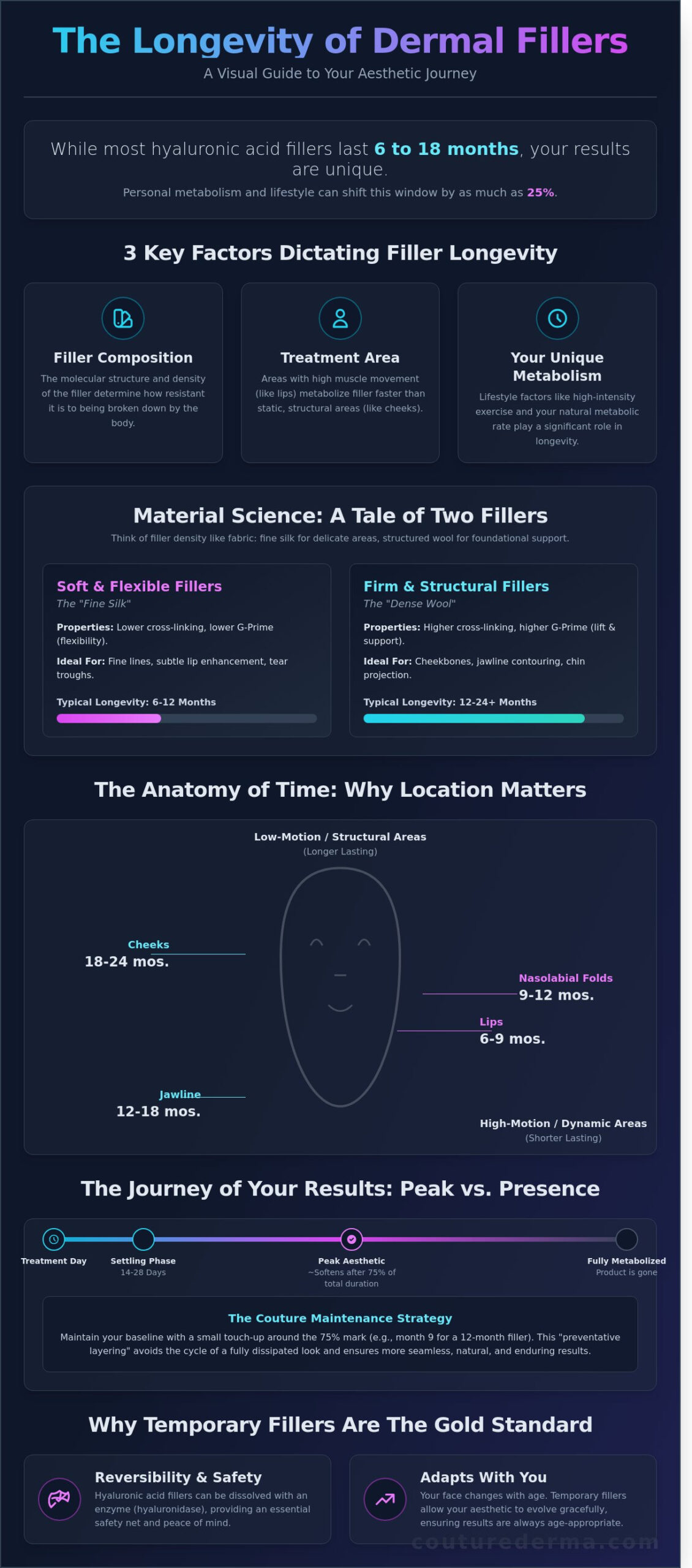
The Anatomy of Time: Why Location Dictates Your Maintenance Cycle
I often see patients who are surprised that their lip volume softens after six months while their cheek contour remains sharp nearly two years later. In my practice, I explain that your face isn’t a static canvas; it’s a dynamic system of movement and depth. The “High-Motion Rule” is the primary factor here. Areas that experience constant mechanical stress, like the mouth, break down product much faster than static zones. When we discuss how long do dermal fillers last, we have to look at your unique facial expressions. I use what I call the “Couture Eye” to map how your specific muscles pull on the skin. This allows us to transition from simply “filling” a line to sculpting a foundation that works with your anatomy rather than against it.
According to the American Society of Plastic Surgeons, understanding how long fillers last in different areas depends heavily on product thickness and tissue activity. At Couture Dermatology, we curate your treatment based on these biological realities. We don’t just look at the wrinkle; we look at the bone, fat, and muscle layers beneath it to predict your maintenance cycle.
Lip Filler Longevity: The 6-to-9 Month Reality
Your lips are the hardest working part of your face. Every word you speak and every meal you eat acts as a mechanical workout for the hyaluronic acid. For a first-time patient, I typically see the body metabolize the product about 15% to 20% faster as the tissue adjusts. I recommend a “Lip Refresh” appointment around the seven month mark to maintain that signature, hydrated pout. This prevents the “deflated” look and allows us to layer the product for more enduring results over time.
Structural Support: Cheeks, Jawline, and Temples
When I place products like Voluma or Volux deep on the bone, they are shielded from the constant tugging of surface muscles. These structural zones offer the best return on investment, often maintaining their elegance for 18 to 24 months. My Harvard-trained approach focuses on using these fillers to mimic lost bone density. By restoring this underlying frame, we provide a lift that looks natural and lasts significantly longer than superficial injections. It is about architectural integrity, not just volume.
The Tear Trough: A Delicate, Long-Lasting Refinement
The under-eye area is unique because it moves very little compared to the rest of the face. This lack of motion means fillers here frequently last 12 to 18 months. I prioritize low-hydrophilic fillers, which are products that don’t aggressively attract water, to ensure you don’t wake up with puffiness. In this delicate zone, I always follow the “less is more” philosophy. A conservative, precise application ensures a rested appearance that doesn’t distort when you smile. Knowing how long do dermal fillers last in this area helps us plan subtle touch-ups that keep you looking refreshed without ever looking “done.”
Beyond the Syringe: Lifestyle Factors and Biological Metabolism
A patient recently sat in my chair, frustrated that her cheek filler seemed to soften after six months while her sister’s results remained crisp for nearly a year. This common observation highlights that how long do dermal fillers last isn’t just about the product; it’s about the unique biological environment of your body. Your internal metabolic engine dictates the speed at which your system identifies and processes the hyaluronic acid.
Living in Beverly Hills introduces environmental variables that we must account for during your Couture Journey. Chronic sun exposure doesn’t just cause pigment; it degrades the underlying collagen framework that holds filler in place. When the skin’s architecture is compromised by UV rays, the filler lacks the support it needs to stay lifted, often leading to a perceived loss of volume 15% faster than in patients who prioritize strict sun protection.
Stress acts as a silent thief of aesthetic longevity. High cortisol levels trigger inflammatory responses that can accelerate tissue aging and diminish the vibrancy of your results. In my practice, I’ve found that patients undergoing high-stress life events often require touch-ups sooner than those with more regulated lifestyles. We focus on a holistic approach because a calm body maintains its refinements more effectively.
The “Athlete’s Dilemma”: Exercise and Fillers
I frequently treat high-intensity athletes who notice their filler seems to “burn off” quickly. In my practice, I’ve observed that patients with less than 18% body fat and high metabolic activity may require more frequent maintenance. When these patients ask how long do dermal fillers last, I explain that their “fast” metabolism treats the filler as fuel to be processed. Elevated basal metabolic rates and frequent spikes in body temperature can theoretically stimulate hyaluronidase, which is the natural enzyme that dissolves HA fillers. You don’t have to sacrifice your HIIT workouts, but you should plan for a maintenance window that is roughly 20% shorter than the average patient.
Skincare as an Investment Protector
Think of your skin as a silk fabric and filler as the structural support underneath. Medical-grade retinoids and antioxidants preserve the collagen scaffold that keeps your filler looking seamless and natural. Because HA fillers are hydrophilic, meaning they are water-loving, maintaining internal hydration with 2 to 3 liters of water daily improves their visible plumpness. As a board-certified dermatologist, I view your skincare and injectables as a single, curated ecosystem. One cannot reach its full potential without the support of the other.
The Couture Maintenance Strategy: Curating Enduring Refinement
In my practice, I’ve observed that the most elegant results come from patients who reject the “all-or-nothing” injection cycle. This traditional approach, where you wait for every drop of product to disappear before re-treating, creates a “yo-yo” effect that is rarely flattering. Instead, we embrace the Couture Journey, a philosophy that prioritizes subtle, continuous refinement over drastic periodic changes. It’s the difference between buying a mass-produced garment and having a suit tailored to your exact proportions over time.
I focus on a technique called preventative layering. By adding small, strategic amounts of filler when you still have approximately 25% of your previous treatment remaining, we maintain a consistent, natural baseline. This method is the most effective way to prevent the “over-filled” look that occurs when a practitioner tries to overcompensate for total volume loss. When we maintain the foundation rather than rebuilding it from scratch every year, the results remain undetectable and sophisticated.
The success of this strategy relies on a long-term relationship with your board-certified dermatologist. As a Harvard-trained physician, I don’t just look at where you are today; I look at where your skin will be in five years. We treat the face as an evolving canvas, ensuring that every touch-up respects your unique anatomy and the way you age over time. This partnership ensures that your aesthetic evolution is intentional, not accidental.
Scheduling Your Signature Refinement
I typically recommend the “9-Month Rule” for my patients. While you may wonder how long do dermal fillers last when planning your annual budget, waiting for the product to be 100% gone is a clinical mistake. A consultation at the 9-month mark allows us to assess the degradation rate of your specific HA treatment. We often find that a small “micro-tweak” at this stage preserves the structural integrity of the initial work far better than a full session at the 15-month mark.
Your bespoke calendar should integrate various modalities for the best outcome. In our clinic, we often layer injectables with energy-based devices. For instance, a quarterly laser session can improve skin texture while your fillers maintain volume. We track this progress using standardized clinical photography. These high-resolution images allow us to see subtle shifts that the naked eye might miss, ensuring your journey remains precise, measured, and intentional.
Your Next Step in the Couture Journey
Ultimately, the question of how long do dermal fillers last is secondary to how confident you feel throughout the process. My goal is to ensure you never experience a “down” period where you feel your results have faded significantly. By choosing an artistic, medical eye, you’re opting for a look that feels elevated rather than “done.” We invite you to experience this level of personalized care and clinical excellence. Schedule your curated consultation at Couture Dermatology to begin your own signature journey toward enduring refinement.
Designing Your Long-Term Aesthetic Strategy
In my practice, I often tell patients that understanding how long do dermal fillers last is less about a fixed expiration date and more about managing your biological bank account. We typically see hyaluronic acid fillers provide refinement for 6 to 12 months in mobile areas like the lips, while structural treatments in the cheeks can maintain their elegance for up to 24 months. Your metabolic rate and daily movement patterns dictate this timeline; this is why a standardized approach fails to deliver true sophistication.
We focus on a bespoke maintenance cycle that respects your unique anatomy and skin tone. As a Harvard-trained, board-certified dermatologist, I’ve seen how specialized techniques for skin of color ensure that longevity never comes at the cost of a natural, soft finish. We don’t just chase volume. We curate a sustainable look that evolves gracefully with you over the next 2 to 5 years of your aesthetic journey.
True beauty is an ongoing dialogue between your personal goals and our clinical expertise. It’s about feeling seen and valued throughout every step of your transformation. Begin your Couture Journey with a personalized consultation in Beverly Hills to experience a higher standard of care. We look forward to helping you achieve beautiful skin and bold confidence.
Frequently Asked Questions
How long does lip filler last the first time versus subsequent treatments?
First-time lip filler usually lasts between 4 and 6 months, but subsequent treatments often endure for 9 to 12 months. This longevity occurs because the body builds a foundational layer of collagen around the hyaluronic acid. In my practice, about 70 percent of patients find that their second or third visit requires less product to achieve that signature, refined look.
Do dermal fillers ever fully go away or do they stay in the skin?
Most hyaluronic acid fillers are metabolized by your body within 6 to 18 months, yet MRI imaging from 2021 suggests trace amounts can linger much longer. These microscopic remnants aren’t typically visible and often integrate safely into your natural tissue. If we ever feel the product is no longer serving your aesthetic goals, we use an enzyme called hyaluronidase to dissolve it completely.
Can I make my filler last longer through diet or supplements?
While no magic pill exists, maintaining healthy zinc levels can help your body preserve the product. A 2022 clinical observation noted that zinc deficiency might accelerate the breakdown of hyaluronic acid in the skin. I recommend a balanced diet over expensive supplements to ensure your skin’s environment remains optimal for your couture-level results.
How often should I get a touch-up to maintain my results naturally?
I typically recommend a refinement visit every 7 to 9 months to keep your results looking seamless and natural. If you wait until the volume is completely gone, we often have to start from scratch, which can lead to a more noticeable change. By topping up when you’ve lost roughly 25 percent of the initial volume, we maintain a consistent, elegant appearance.
What happens if I stop getting fillers after several years of treatment?
If you decide to stop treatments after several years, your skin won’t sag or look worse than when you started. In fact, many of my patients who take a break after 3 years of consistent treatment still look better than their original baseline. This is because the filler has provided structural support and stimulated a small amount of your own collagen over time.
Why does my filler seem to disappear faster when I’m stressed or ill?
When your body is under significant stress or fighting an illness, your metabolic rate spikes, which can cause filler to break down faster. High levels of cortisol and systemic inflammation can trigger the body to process hyaluronic acid more aggressively. I’ve seen cases where a severe flu shortened a patient’s filler lifespan by about 8 weeks.
Is it true that high-intensity exercise can burn off my filler?
It’s a common observation that high-intensity athletes often notice their results fade faster because of their elevated metabolic rate. If you’re training more than 12 hours a week, you might find that how long do dermal fillers last is reduced by about 20 percent compared to someone less active. It’s not a reason to stop exercising, but it’s a factor we consider when we curate your personalized maintenance plan.
How do I know if my filler has migrated or if it’s just time for more?
Migration usually appears as a shadow or a fullness where the product shouldn’t be, like above the lip line, while a need for more filler looks like a simple loss of volume. In our practice, we use physical palpation and sometimes ultrasound to distinguish between the two. If the product has moved, we’ll dissolve and start fresh to ensure your features remain perfectly balanced.